
Six Clashes (六冲)
六冲 · Earthly Branch dynamics in BaZi
In BaZi astrology, the Six Clashes (Liu Chong) (六冲) is one of the fundamental interactions between Earthly Branches (地支). Six pairs of directly opposing branches that create tension, conflict, and sudden change. The six clashes are Zi-Wu, Chou-Wei, Yin-Shen, Mao-You, Chen-Xu, Si-Hai.
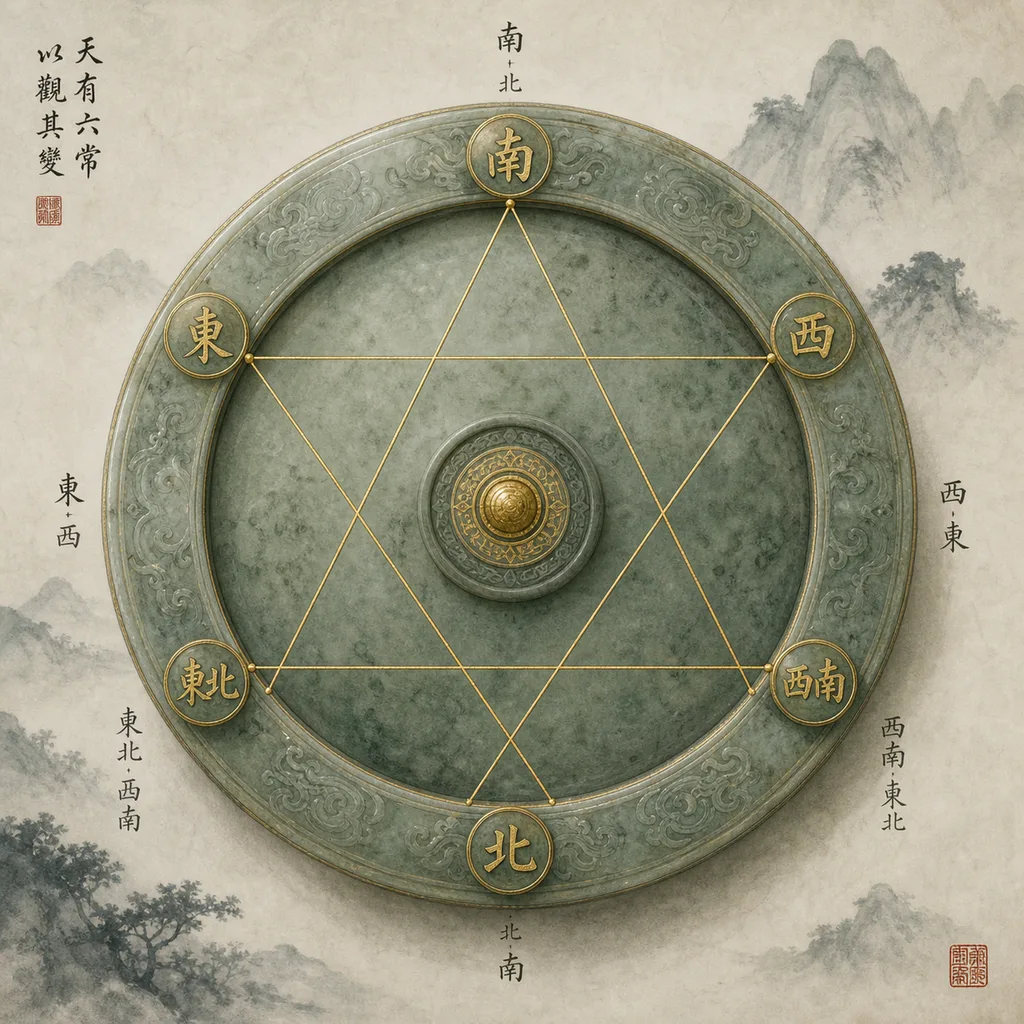
Six Clashes pairs branches directly opposite on the zodiac wheel. This opposition generates intense energy, often manifesting as confrontation, sudden change, or breakthrough, depending on context.
Each branch contains hidden heavenly stems. When branches clash, these stems also collide, adding layers of elemental and ten god conflict that reveal the true nature of the disruption.
While disruptive, clashes can break stagnation and initiate necessary change. In a favorable context, they may bring liberation, success in competition, or swift resolution of long-standing issues.
| Quick Facts | |
|---|---|
| Chinese Name | 六冲 (Liu Chong) |
| Category | Conflict |
| Interaction Type | Confrontation |
| Number of Interactions | 6 clash pairs |
| Core Mechanism | Opposing branches 180 degrees apart create energetic friction and sudden change. |
| Transformation Rule | No elemental transformation; generates disruption and force. |
| Hidden Stem Role | Hidden stems collide to amplify or modify the conflict’s expression. |
| Directional Pattern | Branches directly opposite on the zodiac wheel. |
| Classical Source | San Ming Tong Hui (三命通會), Discourse on Six Clashes |
| Practical Significance | Indicates upheaval, separations, and breakthroughs in life areas governed by the clashing branches. |
Opposites Attract and Repel
Six Clashes pairs branches directly opposite on the zodiac wheel. This opposition generates intense energy, often manifesting as confrontation, sudden change, or breakthrough, depending on context.
Hidden Stems Deepen Conflict
Each branch contains hidden heavenly stems. When branches clash, these stems also collide, adding layers of elemental and ten god conflict that reveal the true nature of the disruption.
Clashes Are Not Inherently Bad
While disruptive, clashes can break stagnation and initiate necessary change. In a favorable context, they may bring liberation, success in competition, or swift resolution of long-standing issues.
The Geometry of Opposition
Six Clashes arise from the precise arrangement of the twelve Earthly Branches on the zodiac wheel. Each branch sits exactly 180 degrees opposite its clashing partner: Zi (Rat) at north opposes Wu (Horse) at south; Chou (Ox) and Wei (Goat) oppose at 30° and 210°; Yin (Tiger) and Shen (Monkey) at 60° and 240°; Mao (Rabbit) and You (Rooster) at 90° and 270°; Chen (Dragon) and Xu (Dog) at 120° and 300°; Si (Snake) and Hai (Pig) at 150° and 330°. This direct opposition creates a channel of forceful energy exchange. Unlike harmonious combinations where branches merge, clashes maintain separation and generate friction. The physical distance on the wheel reflects a fundamental polarity: one branch represents the extreme of a quality, the other its antithesis. For example, Zi is pure Water (midnight, winter), Wu is pure Fire (noon, summer). Their clash is not merely elemental but temporal and directional. In a BaZi chart, when two clashing branches appear, they create a tension that demands resolution—either through external events or internal transformation. The clash can manifest as a sudden event (like a job change) or a chronic stress (like a strained relationship). Understanding which branches clash reveals the specific arenas of life affected: Zi-Wu affects career and self (Water vs. Fire), Chou-Wei affects partnerships and foundation (Earth vs. Earth), and so on.
Hidden Stems: The Deeper War
Each Earthly Branch contains hidden Heavenly Stems (Cang Gan) that represent the branch’s internal energy. When two branches clash, their hidden stems also engage, often creating more intricate conflicts than the surface elements suggest. For example, Zi (Rat) contains Gui (阴水, Yin Water). Wu (Horse) contains Ding (阴火, Yin Fire) and Ji (阴土, Yin Earth). The clash of Zi and Wu is thus not just Water vs. Fire, but Gui Water vs. Ding Fire and Ji Earth. If the Day Master is Water, the hidden Ding Fire may represent a resource (wealth) or authority (official) that is under attack. Similarly, Chou (Ox) contains Ji (阴土), Gui (阴水), and Xin (阴金). Wei (Goat) contains Ji (阴土), Ding (阴火), and Yi (阴木). The Earth-Earth clash of Chou-Wei involves hidden stems that bring in Water and Metal (Chou) versus Fire and Wood (Wei), creating a complex interplay of production and destruction. In practice, the hidden stems reveal the real stakes of the clash. For instance, if a person’s Wealth Star (Cai) is hidden in a branch that clashes, financial instability may occur. The clash of hidden stems can also activate certain Ten Gods: a clash between a hidden Officer (Guan) and a hidden Rob Wealth (Jie Cai) might indicate conflict with authority or colleagues. Practitioners analyze not only the branch clash but also the interaction of the hidden stems to predict the specific nature of the upheaval.
Transformation: Friction Over Fusion
Unlike the Three Harmonies (San He) or Six Combinations (Liu He), Six Clashes do not transform elements. There is no alchemical merging; instead, the energy is one of repulsion and disruption. Classical texts state that when two branches clash, they ‘destroy each other’ (相沖). However, transformation can occur if the clash is resolved by a third element. For example, if Zi and Wu clash, the presence of Chen (Dragon) or Yin (Tiger) might form a Combination that mitigates the clash. But the clash itself never produces a new element. The lack of transformation means the conflict remains raw and unresolved unless external factors intervene. In a BaZi chart, a clash between two pillars (e.g., Year and Month) indicates a fundamental tension in that period of life. If the clash involves the Day Pillar (self and spouse), it often points to marital discord or personal identity crisis. The absence of transformation also means that the clash’s effects are immediate and forceful, not gradual. Practitioners often look for ‘rescue’ combinations—if a third branch appears that forms a Harmony with one of the clashing branches, the conflict may be subdued. For instance, if Zi clashes with Wu, but Xu (Dog) appears, Xu combines with Wu to form a Fire Bureau, potentially channeling the clash’s energy into productive action. Without such rescue, the clash stands as a stark opposition that must be navigated carefully.
Clashes in Daily Life: Signs and Seasons
In a BaZi reading, Six Clashes manifest in specific life areas depending on the pillars involved. A clash in the Year Pillar affects ancestry and early life; it may indicate a break from family traditions or relocation. A clash in the Month Pillar impacts career and siblings; it often signals job changes, competition, or conflicts with peers. A clash in the Day Pillar (especially with the Day Branch representing spouse) is a classic sign of marital tension, divorce, or a partner who is ‘opposite’ in nature. A clash in the Hour Pillar relates to children, projects, and late life; it can mean rebellious children or sudden endings. Timing is crucial: when a Luck Pillar or Annual Pillar clashes with a natal branch, events are triggered. For example, a Zi (Rat) year clashing with a Wu (Horse) in the natal chart may bring a major career shift or health issue related to the heart/circulation (Fire) or kidneys (Water). In relationships, a couple with clashing Day Branches often experiences intense attraction followed by conflict—the ‘opposites attract’ dynamic. However, if other chart factors are supportive (e.g., the clash is in a favorable element for the Day Master), the relationship can be dynamic and growth-oriented. Health-wise, clashes point to the organ pairs: Zi-Wu affects kidneys and heart; Mao-You affects liver and lungs; Si-Hai affects gallbladder and bladder. Practitioners advise caution during clash periods, especially for travel, surgery, or major decisions.
San Ming Tong Hui on Six Clashes
The classical text San Ming Tong Hui (三命通會) dedicates a discourse to the Six Clashes, explaining that they arise from the ‘mutual opposition of yin and yang energies.’ The text states: ‘When two branches face each other, their qi collides, causing sudden movements and changes.’ It emphasizes that clashes are not inherently unlucky; rather, they ‘break open stagnation and allow new qi to enter.’ The original teaching uses the metaphor of a locked door: the clash is the force that breaks the lock, for good or ill. In the classical view, the severity of a clash depends on the strength of the branches involved. A strong branch can ‘overcome’ its opponent, while a weak branch may be ‘destroyed.’ For example, if a chart has abundant Water (Zi strong) clashing with a solitary Fire (Wu weak), the Fire may be extinguished, leading to loss of reputation or vitality. Conversely, if Fire is strong, it may evaporate the Water, causing depletion of resources. Modern interpretation builds on this by considering the entire chart’s context. Today’s practitioners also assess whether the clash is ‘favorable’ or ‘unfavorable’ based on the Day Master’s needs. If the Day Master is weak and needs support, a clash that destroys a supportive element is harmful. If the Day Master is strong and needs control, a clash that restrains excess can be beneficial. The classical wisdom remains relevant: clashes are catalysts, and their outcome depends on the resilience of the involved branches and the presence of remedial combinations.
Frequently Asked Questions
What does Six Clashes mean in BaZi?
Six Clashes (六冲) refers to the opposition between six pairs of Earthly Branches that are directly opposite each other on the zodiac wheel. This creates energetic friction, sudden changes, and confrontations in the areas of life represented by the clashing branches. In a BaZi chart, clashes indicate dynamic tension that can lead to breakthroughs or disruptions, depending on context.
Is Six Clashes good or bad?
Six Clashes is neither inherently good nor bad. It is a force of change. If the clash breaks a negative pattern or stagnation, it can be beneficial. If it disrupts stability, it can be harmful. The outcome depends on the Day Master’s elemental needs, the strength of the clashing branches, and whether rescue combinations exist. Practitioners assess the overall chart to determine if the clash is favorable or unfavorable.
How does Six Clashes affect relationships/marriage?
When the Day Branch (spouse palace) clashes with another pillar, especially the Year or Month Branch, it often indicates marital tension, arguments, or separation. Couples with clashing Day Branches may experience intense attraction but struggle with fundamental differences. However, if the clash is well-managed and other chart factors are supportive, the relationship can be dynamic and growth-oriented. A clash in the Year Pillar may affect family harmony.
How does Six Clashes affect career and wealth?
A clash in the Month Pillar (career palace) often signals job changes, competition, or conflicts with superiors. It can bring sudden opportunities or disruptions. For wealth, a clash involving the Wealth Star (hidden in a branch) may indicate financial instability or unexpected gains/losses. The element of the clash matters: Water-Fire clashes (Zi-Wu) may affect cash flow, while Earth-Earth clashes (Chou-Wei) affect assets and savings.
What is the difference between Six Clashes and other similar relations?
Six Clashes (六冲) is direct opposition, causing conflict and change. Six Harms (六害) involve hidden animosity and subtle sabotage. Six Combinations (六合) create harmony and merging. Three Harmonies (三合) form powerful alliances. While clashes are confrontational, harms are more insidious. Combinations are constructive, clashes are destructive but can clear the way for new beginnings.
How do practitioners resolve or work with Six Clashes in a reading?
Practitioners first identify which branches clash and assess the impact on the Day Master. They look for ‘rescue’ combinations—a third branch that forms a Harmony with one of the clashing branches to diffuse the conflict. They also advise timing: avoid major decisions during clash periods (e.g., when the Annual Pillar triggers a clash). Feng shui adjustments or wearing colors/elements that strengthen the weaker branch can help balance the energy.