The Ten Gods — Complete Guide
Ten archetypal energies derived from your Day Master's relationship with every other element in your chart.
The Ten Gods (十神, Shishen) in BaZi are ten archetypes that classify a person’s relationships, personality, and life themes based on how each of the eight characters interacts with the Day Master (the self). Derived from the five elemental relationships—same element, producing, being produced, controlling, and being controlled—they split into five positive and five negative aspects, such as Direct Wealth, Indirect Wealth, Officer, Seven Killings, and Resource stars. These categories reveal career, wealth, authority, and support dynamics in a chart.
The Ten Gods, or Shishen (十神), form the backbone of BaZi (Eight Characters) analysis. They are the ten distinct relationship archetypes that emerge from the interaction between your Day Master — the element representing you — and the other seven characters in your birth chart. These archetypes describe how you express yourself, handle money, relate to authority, process knowledge, and compete with others. Classical texts like the Yuan Hai Zi Ping (渊海子平) and San Ming Tong Hui (三命通会) treat these ten spirits as essential keys for reading a person's character and destiny. This guide introduces each of the Ten Gods, explains how they operate in pairs, and links to detailed pages for deeper exploration.
How It Works
The Ten Gods are not arbitrary labels. They derive directly from the Five Elements and their generating and controlling cycles. Your Day Master (日主) is the element of your birth day stem. Every other element in your chart — the remaining stems and all branches — relates to that Day Master in one of ten specific ways.
The system organizes these ten relationships into five pairs. Each pair shares a fundamental life domain, but the two members express that domain differently based on polarity. Polarity refers to whether the interacting element is of the same polarity (yin/yang) as your Day Master or the opposite polarity.
Here is the structure:
- Companion Stars (比劫) — Same element as you. These represent yourself, your peers, and competition. The Direct variant (比肩) is your equal; the Indirect variant (劫财) is the one who takes from you.
- Output Stars (食伤) — The element you generate. These represent your expression, creativity, and speech. The Direct variant (食神) is calm and artistic; the Indirect variant (伤官) is sharp and rebellious.
- Wealth Stars (财星) — The element you control. These represent money, resources, and what you manage. The Direct variant (正财) is steady income; the Indirect variant (偏财) is windfall and speculative gain.
- Power Stars (官杀) — The element that controls you. These represent authority, pressure, and rules. The Direct variant (正官) is legitimate authority; the Indirect variant (七杀) is forceful pressure and challenge.
- Resource Stars (印星) — The element that generates you. These represent knowledge, support, and protection. The Direct variant (正印) is traditional learning; the Indirect variant (偏印) is unconventional intuition.
This paired structure matters because the two members of each pair often have a dynamic relationship. For instance, a chart with both Direct Wealth and Indirect Wealth shows someone who handles both steady income and speculative opportunities. The strength and placement of each God in your chart — which stems and branches they appear in, and whether they are favorable or unfavorable to your Day Master — determines how strongly that archetype manifests in your personality.
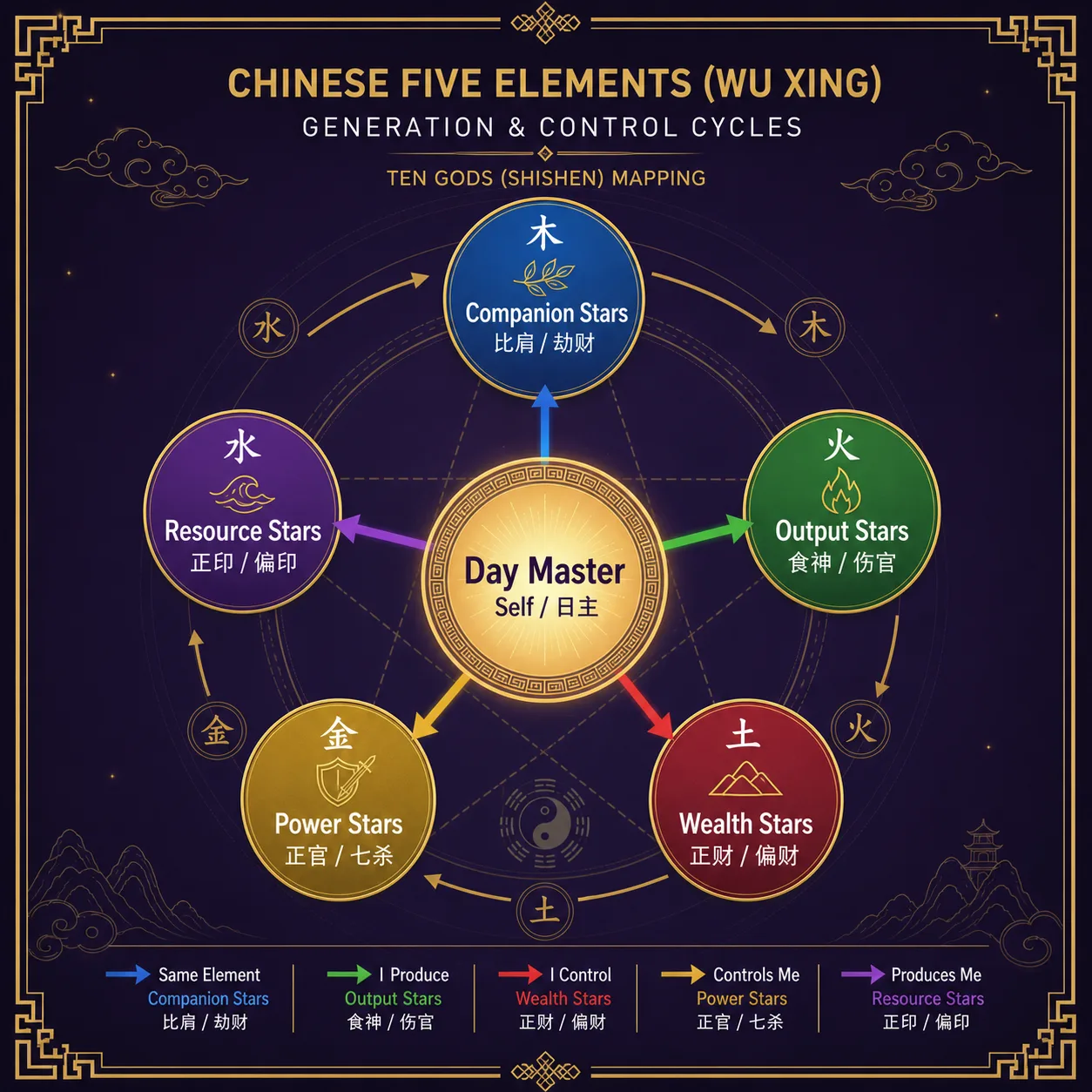
The Day Master (your self) relates to every other element through five natural cycles. Each cycle produces a pair of Ten Gods.
The Ten Gods Reference Table
Every Ten God is determined by exactly two factors: the element relationship to your Day Master, and the Yin-Yang polarity. This matrix shows all ten at a glance.
| Relationship to Day Master | Same Polarity (Direct / 正) | Opposite Polarity (Indirect / 偏) |
|---|---|---|
| Same Element (比劫) Self, peers, competition | Companion (比肩) Independence, self-reliance | Rob Wealth (劫财) Competition, risk-taking |
| I Produce (食伤) Expression, creativity, output | Eating God (食神) Artistic talent, gentle expression | Hurting Officer (伤官) Rebellion, innovation, sharp wit |
| I Control (财星) Wealth, resources, management | Direct Wealth (正财) Stable income, diligence | Indirect Wealth (偏财) Windfall, investment, generosity |
| Controls Me (官杀) Authority, pressure, discipline | Direct Officer (正官) Legitimate authority, duty | Seven Killings (七杀) Pressure, courage, transformation |
| Produces Me (印星) Knowledge, support, nourishment | Direct Resource (正印) Traditional wisdom, mentorship | Indirect Resource (偏印) Unconventional thinking, intuition |
The Complete List
Self-identity, independence, and how you stand among equals. Asserts individuality and resists being overshadowed.
Competition, social networking, and risk-taking. The rival who challenges your resources — yet drives ambition.
Creative expression, artistic talent, and quiet enjoyment. Calm, steady output — polished, refined, generous.
Rebellion, innovation, and challenging authority. Sharp, restless output — the engine of disruptors.
Stable income, diligence, and practical management. The honest earner — values hard work and reliability.
Windfall opportunities, investment vision, and generosity. The gambler's instinct — spotting what others miss.
Legitimate authority, responsibility, and discipline. The law, the boss, the institution — trustworthy and upright.
Intense pressure, courage, and transformative power. The harsh taskmaster — breaks you or forges you stronger.
Traditional knowledge, maternal care, and wisdom. The scholar, the mentor — quiet confidence from support.
Unconventional thinking, intuition, and metaphysical talent. The eccentric scholar drawn to the esoteric.
Deep Dive: Understanding Each Pair
The card grid above gives you a quick overview. But the Ten Gods reveal their true depth when you examine how each pair operates — what happens when a god is balanced, excessive, or missing, and how the two members of each pair interact when they appear in the same chart.
The Companion Stars
The Companion Stars — 比肩 (Bǐ Jiān) and 劫财 (Jié Cái) — form the same element as the Day Master in the BaZi natal chart. In the Five Element cycle, this is the "same qi" that reinforces the self. Where the Resource Stars (印) nourish you from within and the Output Stars (食伤) express your talent outward, the Companion Stars represent your horizontal relationships: the people who stand beside you, not above or below. They are the axis of social identity, peer competition, and the raw instinct to claim your share of the world. Classical texts like Yuan Hai Zi Ping (渊海子平) treat this pair as the "brothers and sisters" of the chart — the forces that either support your ambitions or consume your resources depending on their strength and placement.
Companion (比肩 · Bǐ Jiān)
The self-reliant, quietly enduring companion.
Their engine is an internal code of honor—a private benchmark of what it means to be true to oneself. Every choice is filtered through this lens, making them fiercely principled and unwilling to compromise their core values for external approval. This inner compass, not circumstance, dictates their pace.
Balanced, they are loyal and equal partners. When excessive, they become emotionally unavailable, treating intimacy as a threat to independence.
“When the self is too strong, the officer star is wounded”
— Di Tian Sui (滴天髓)
Rob Wealth (劫财 · Jié Cái)
The bold sibling who seizes opportunity.
Driven by a competitive, social instinct to read crowds and broker deals. When balanced, this person exudes charisma, market savvy, and a generous, protective energy that fiercely defends allies.
Passionate but volatile — the lover who sweeps you off your feet, then spends your savings on a speculative venture.
“sees wealth as a battlefield”
— San Ming Tong Hui (三命通会)
The Output Stars
The Output Stars—Eating God (食神 · Shi Shen) and Hurting Officer (伤官 · Shang Guan)—represent the Day Master’s self-expression: the element I produce. In the Five Element cycle, this is the “I control” output, where my Day Master’s intrinsic energy flows outward into tangible creation, speech, and craft. Classical texts like Yuan Hai Zi Ping (渊海子平) treat this pair as the “voice of the self”—not merely what I do, but how I reveal my essence to the world. While both share the same elemental root, their polarity splits dramatically: Eating God expresses through calm, generous refinement; Hurting Officer through sharp, restless brilliance. Together, they define whether your output is a song or a manifesto, a painting or a protest.
Eating God (食神 · Shi Shen)
The gentle producer of unhurried creativity.
They move through life savoring each moment, guided by an inner sense of abundance rather than ambition. Their mind filters the world through taste, texture, and feeling, seeking experiences that nourish the soul. This sensory depth makes them natural connoisseurs of life’s quiet pleasures.
In partnership, they radiate warmth and playful charm, making others feel effortlessly at ease. When excessive, they drift from obligation to obligation, savoring the sweetness of connection while dodging the deeper work of commitment.
“When the output star is too heavy, the self becomes a servant to its own appetite.”
— Di Tian Sui (滴天髓)
Hurting Officer (伤官 · Shang Guan)
The rebel genius who shatters authority.
Driven by a sharp-edged intellect, this person expresses creativity through disruption, wit, and iconoclasm. When balanced, they possess precise thinking and a satirical, avant-garde energy that challenges the status quo.
Magnetic but volatile, demanding intellectual equality and mocking a partner's complacency.
“shatters the mirror of authority”
— San Ming Tong Hui (三命通会)
When Eating God and Hurting Officer Appear Together
When both Output Stars coexist in a chart, the Day Master commands a dual voice: one that soothes and one that provokes. This is a rare and potent configuration—the person can write a tender sonnet at dawn and a scathing editorial by noon. Classical theory from Yuan Hai Zi Ping suggests that the Eating God tempers the Hurting Officer’s edge, while the Hurting Officer prevents the Eating God from lapsing into complacency. Yet the interplay demands balance: if both are overabundant, the chart suffers from “output leakage,” where the person’s energy is scattered across too many projects, leaving no single masterpiece complete. The key is their relative strength—when Eating God dominates, the rebel learns diplomacy; when Hurting Officerdominates, the diplomat finds the courage to rebel against injustice. This dynamic creates a self-correcting loop: the chart’s most productive expression emerges when each star’s intensity is modulated by the other’s presence. Ultimately, the ideal configuration is not the absence of conflict, but a rhythmic oscillation between creative spontaneity and disciplined refinement—allowing the native to channel brilliance into lasting achievement rather than fleeting brilliance.
The Wealth Stars
In BaZi, the Wealth Stars are the element that the Day Master controls — the resource I subdue, manage, and convert into tangible value. This is the Five Element relationship of "I control" (我克者), meaning Wealth represents everything the self must actively engage with: money, possessions, ambition, and the fruits of one's labor. The polarity of that controlling element — Yin or Yang — splits this pair into two distinct archetypes. As the classical San Ming Tong Hui (三命通会) states, Wealth is the "servant of the self," but the nature of that servant differs radically depending on whether it is Direct or Indirect. Where Direct Wealth is the steady yield of a cultivated field, Indirect Wealth is the unpredictable bounty of a foreign market.
Direct Wealth (正财 · Zheng Cai)
The steady accumulator of predictable wealth.
This person is methodical and risk-averse, valuing routine, punctuality, and measurable progress. They build wealth slowly but irreversibly, driven by a need for control and stability.
Direct Wealth governs the primary marriage bond, producing a loyal spouse. When excessive, it can smother a partner with over-protectiveness or treat marriage as a ledger of obligations.
Indirect Wealth (偏财 · Pian Cai)
The opportunistic deal-maker with magnetic charm.
Driven by the thrill of spotting and seizing opportunities, this person possesses sharp social intelligence and a gambler's instinct. When balanced, they exude charisma and generosity, reading rooms and closing deals with intuitive ease.
In romance, they treat love like a high-stakes game—thrilling, spontaneous, and full of surprise gifts. But their eye for the next best opportunity can leave partners feeling like a temporary hand they're always ready to fold.
“unexpected windfall”
— Yuan Hai Zi Ping (渊海子平)
When Direct Wealth and Indirect Wealth Appear Together
When both Wealth Stars occupy the same chart, the native possesses a dual financial brain: one hemisphere for disciplined accumulation, the other for opportunistic expansion. This pairing is common in successful serial entrepreneurs who build a core business (Direct Wealth) while reinvesting profits into speculative ventures (Indirect Wealth). Classical theory, however, cautions that too much Wealth of any kind can "overpower the Day Master" — as Di Tian Sui (滴天髓) puts it, "When Wealth is abundant, the body must be strong to bear it." Without a robust Day Master, the person becomes a servant to their own money, juggling two contradictory impulses until both collapse into anxietyand burnout. The key, therefore, lies in balance: either strengthen the Day Master through favorable elements (Resource or Companion stars) or consciously limit the scope of speculative ventures. A well-managed dual Wealth structure rewards versatility, allowing the native to pivot fluidly between security and opportunity—but only when the self remains the master, not the servant, of its own ambition.
The Power Stars
The Power Stars—Direct Officer (正官 · Zheng Guan) and Seven Killings (七杀 · Qi Sha)—are the two governing forces of structure and pressure in a BaZi chart. Both are produced by the controlling element relative to the Day Master: the element that restrains you. If your Day Master is Wood, these stars are Metal; if Fire, they are Water; and so forth. This Five Element dynamic is critical: the Day Master is the "self," and these stars represent the external forces that shape, test, and refine that self. The Yin-Yang polarity determines which star manifests—the same element with the same polarity as the Day Master yields Direct Officer (a gentle, legitimate restraint), while the opposite polarity yields Seven Killings (a harsh, aggressive confrontation). Classical texts like San Ming Tong Hui (三命通会) emphasize that these two stars govern a person's relationship with authority, law, and discipline—both external (society, employers) and internal (self-control, conscience).
Direct Officer (正官 · Zheng Guan)
The disciplined guardian of duty and order.
Driven by integrity and a deep respect for rules, this person finds purpose in responsibility and structure. They are methodical, reliable, and thrive on clear hierarchy, earning trust through steady consistency.
Loyal and responsible, valuing stability over passion, but may struggle with spontaneity and emotional warmth.
“a person who is respected by others and who respects the law”
— Yuan Hai Zi Ping (渊海子平)
Seven Killings (七杀 · Qi Sha)
The fierce tiger of decisive action.
Driven by raw courage and a need to overcome obstacles, this person thrives under pressure. When balanced, they are a charismatic leader who inspires loyalty through sheer willpower, embodying decisiveness and the drive to seize opportunities.
Intense, passionate devotion but also jealousy and possessiveness; the same person who would die for you may also try to control you.
“tiger—beautiful if tamed, deadly if not”
— Di Tian Sui (滴天髓)
When Direct Officer and Seven Killings Appear Together
A chart containing both Power Stars is inherently dynamic—it represents the classic tension between legitimacy and ambition, between the mandate of heaven and the raw drive of the individual. This duality often manifests in a personality that can oscillate between disciplined service and rebellious impulse, depending on which star is activated by the current luck pillar. The key to harmonizing this tension lies in the presence of a transforming element—such as a favorable Output star—which can channel the Seven Killings’ aggression into productive creativity. Ultimately, such charts are not inherently unlucky; they simply demand greater self-awareness and conscious management of one’s power.
The Resource Stars
The Resource Stars are the output of the Element that Produces the Day Master — in classical terms, this is the "mother" of the self. If your Day Master is Wood, Water is your Resource; if Fire, Wood is your Resource; if Earth, Fire; if Metal, Earth; if Water, Metal. This pair governs how you absorb, process, and transmit knowledge, memory, and inherited wisdom. In Yuan Hai Zi Ping (渊海子平), the Resource is likened to the canopy of a tree — it shelters, nourishes, and gives form to the trunk. Unlike the Wealth Stars (which you control) or Officer Stars (which control you), the Resource is the one relationship in the chart where you are the passive receiver. Its polarity — Direct or Indirect — determines whether that reception is orthodox and nurturing, or eccentric and transformative.
Direct Resource (正印 · Zheng Yin)
The orthodox scholar of tradition and method.
Their inner world is sustained by the quiet absorption of patterns—a photographic recall of details that lets them reconstruct entire systems from fragments. They are nourished by the act of understanding itself, finding safety in the depth of their own comprehension. This fosters a protective, maternal instinct to preserve and pass on what they have mastered.
Favors long-term commitment and domestic stability, but must be tempered by Officer or Wealth Star to avoid stagnation and self-righteousness.
Indirect Resource (偏印 · Pian Yin)
The maverick scholar of unconventional mastery.
Driven by intuition and a thirst for esoteric knowledge, this person is a fiercely independent thinker who solves problems laterally and reads hidden motives, seeing patterns others miss.
They bond by sharing obscure theories and unconventional ideas, but may dissect a partner's casual remark until its warmth evaporates. Without mental sparring, the connection flatlines into polite cohabitation.
“lonely star”
— Di Tian Sui (滴天髓)
When Direct Resource and Indirect Resource Appear Together
When both Resource Stars appear in the same chart, the Day Master receives two types of nourishment simultaneously: one from the orthodox path and one from the shadow path. This creates a dynamic tension — the person is both a traditionalist and a heretic, constantly oscillating between wanting institutional approval and wanting to break free from it. Classical theory, as stated in San Ming Tong Hui (三命通会), warns that when both are present without a controlling Wealth Star, the energies can "choke" the Day Master—manifesting as mental indigestion, indecision, or a chronic inability to commit to one life path. The remedy lies not in eliminating either star, but in cultivating a clear hierarchy: letting the Direct Resource anchor ethics and structure, while allowing the Indirect Resource to fuel creativity and unconventional insight. When properly balanced, this pairing produces a rare individual who can innovate within tradition, rather than being torn apart by it.
Ten Gods and Career Direction
Your dominant Ten Gods reveal natural career inclinations — but remember, no single god determines your path. Read this table alongside your full chart structure for the most accurate guidance.
| Dominant Ten God | Natural Career Strengths | Watch Out For |
|---|---|---|
| Companion (比肩) | Freelancing, independent business, technical expertise, endurance sports | Stubbornness, difficulty delegating, lone-wolf tendencies |
| Rob Wealth (劫财) | Sales, trading, public relations, competitive industries, entrepreneurship | Impulsive spending, over-competitiveness, burnout |
| Eating God (食神) | Arts, culinary, teaching, writing, healing professions, performance | Complacency, avoidance of conflict, lack of ambition |
| Hurting Officer (伤官) | Innovation, technology, law, design, criticism/review, freelance consulting | Arrogance, friction with authority, bridge-burning |
| Direct Wealth (正财) | Finance, accounting, administration, operations, real estate | Over-conservatism, missed opportunities, rigidity |
| Indirect Wealth (偏财) | Investment, trading, business development, hospitality, entertainment | Speculation, scattered focus, financial volatility |
| Direct Officer (正官) | Government, management, law enforcement, corporate leadership | Rigidity, risk aversion, excessive conformity |
| Seven Killings (七杀) | Military, emergency services, crisis management, high-pressure startups | Aggression, making enemies, stress-related health issues |
| Direct Resource (正印) | Education, academia, healthcare, counseling, religious institutions | Over-dependence, lack of initiative, enabling behavior |
| Indirect Resource (偏印) | Research, metaphysics, alternative medicine, technology, niche specializations | Isolation, eccentricity, difficulty with mainstream acceptance |
Key Ten God Combinations
In BaZi analysis, the Ten Gods (十神, Shí Shén) derive their true power not in isolation, but through their dynamic interactions. A single star reveals a trait, but a combination reveals a destiny—a coherent narrative of how ambition, pressure, and support weave together to produce tangible life outcomes. The classical texts, from Yuan Hai Zi Ping to Di Tian Sui, consistently emphasize that reading these structural relationships is the difference between a novice and a master.
1. Eating God Produces Wealth (食神生财, Shí Shén Shēng Cái)
This is the most auspicious and stable wealth pattern, representing the flow of creative output into tangible assets. The Eating God (output, talent) generates the Wealth star (resources), meaning your skills and expressive abilities naturally convert into financial gain. In real life, this manifests as an artisan who sells their crafts, a consultant whose insights generate retainers, or a writer whose books earn royalties—wealth that comes from doing what you are genuinely good at, without destructive competition.
2. Hurting Officer Meets Direct Officer (伤官见官, Shāng Guān Jiàn Guān)
This is the classic clash of titans: the brilliant, rebellious Hurting Officer collides with the legitimate, structured Direct Officer. The San Ming Tong Hui warns that this combination often indicates a person who is exceptionally intelligent but inherently resistant to authority, rules, and conventional hierarchy. Practitioners consider this challenging because it creates a life of internal friction—one where a sharp tongue or a non-conformist attitude can derail a career just as it is peaking. The key lesson here is learning to temper brilliance with diplomacy.
3. Seven Killings Transformed by Resource (杀印相生, Shā Yìn Xiāng Shēng)
Here, the terrifying pressure of Seven Killings (competition, authority, danger) is refined and neutralized by the Resource star (knowledge, education, support). This is the "warrior-scholar" archetype—a person who thrives under extreme pressure because they use wisdom and study as a shield. Instead of being crushed by a demanding boss or a hostile market, they channel that aggression into strategic mastery. This pattern often produces high-ranking military officers, crisis managers, and surgeons who remain calm and decisive in life-or-death situations.
4. Direct Officer Protected by Resource (官印相生, Guān Yìn Xiāng Shēng)
This combination represents authority legitimized by knowledge—the trusted leader. The Direct Officer (position, status) is nourished by the Resource (credential, mentorship), creating a cycle where power is sustained by competence and moral backing. Unlike the aggressive Seven Killings pattern, this is a gentler, more stable path to leadership. In practice, this is the career civil servant, the respected judge, or the corporate executive who rose through merit and institutional support rather than cutthroat tactics. The Di Tian Sui notes that this pattern signifies a person who governs others because they are first governed by principle.
5. Rob Wealth Competes for Direct Wealth (比劫夺财, Bǐ Jié Duó Cái)
This is the pattern of financial pressure from competition. The Rob Wealth and Friend stars represent peers, siblings, and rivals who actively compete for your Direct Wealth (your hard-earned resources). In a chart, this often indicates a person who earns money but constantly faces expenses, loan requests from friends, or market competitors slashing their prices. Itcreates a cycle where income arrives only to be siphoned away, leaving little lasting accumulation. To mitigate this, the practitioner is advised to strengthen the Day Master through favorable elements, or to embrace the Rob Wealth as a form of proactive sharing—such as investing in partnerships or charitable giving—thereby converting destructive competition into controlled collaboration. Ultimately, the key lies in recognizing that this clash is not a curse, but a lesson in resource management and boundary-setting.
Common Misconceptions About the Ten Gods
The Ten Gods are the most misunderstood component of BaZi, largely because of their misleading English translations and dramatic nomenclature. Here are the most persistent myths—and the classical reality.
Myth 1: "Ten Gods" Means Ten Deities
The word "God" (神, shen) is a mistranslation that has persisted for convenience. In classical texts like Yuan Hai Zi Ping, shen simply means "spirit" or "influence"—these are relationship labels, technical terms for how elements interact with your Day Master. Think of them as role names in a chart, not supernatural beings. No one is worshipping your Resource Star; it is a structural descriptor of how Qi flows through your destiny.
Myth 2: Direct is Always Good, Indirect is Always Bad
This is the most damaging oversimplification. In Di Tian Sui, the quality of any god is determined solely by whether it balances or aggravates the chart. A weak Day Master may desperately need an "indirect" god like Eating God (伤官) to generate output and vitality, while a "direct" god like Direct Officer (正官) could crush an already fragile frame. Usefulness depends on the Five Elements' seasonal strength, not on the label.
Myth 3: Names Like "Seven Killings" Predict Violence
The term 七杀 (Seven Killings) terrifies beginners, but it refers to transformative pressure and competitive intensity—not literal killing. These dramatic names are metaphorical, drawn from ancient military terminology where "killing" meant "overcoming an obstacle." In practice, Seven Killings often manifests as discipline, surgical precision, or a fierce work ethic. A surgeon, a special forces officer, or a competitive athlete all carry this star productively.
Myth 4: You Can Read Your Career From a Single God
No single god dictates your profession. San Ming Tong Hui emphasizes that the same god means different things depending on chart structure, season, and pillar position. A Wealth Star in the Year Pillar speaks to ancestry and early environment; in the Hour Pillar, it governs late-life legacy. The god's element, its strength relative to the Day Master, and its combination with other stars all shift its expression. Context is everything—isolating one god is like judging a novel by a single word.
Classical Sources & References
The Ten Gods system is codified in three foundational texts of Chinese metaphysics, all available through the Chinese Text Project (CText):
- Yuan Hai Zi Ping (渊海子平, c. 14th century) — The earliest systematic BaZi manual, attributed to Xu Zi Ping. Defines the Ten Gods framework and their basic interpretations. Read on CText →
- San Ming Tong Hui (三命通会, 1573) — Compiled by Wan Min Ying during the Ming Dynasty. The most comprehensive classical BaZi encyclopedia, with extensive Ten Gods case studies. Considered the "bible" of traditional practitioners.
- Di Tian Sui (滴天髓, c. 11th century) — Attributed to Jing Fang, with commentaries by Ren Tie Qiao (1827). Known for its poetic precision in describing elemental dynamics and Ten God interactions.
Note: The Ten Gods are a traditional interpretive framework rooted in Five Element theory, not a scientifically validated personality system. Modern practitioners use them as a symbolic language for self-reflection, not as deterministic predictions.
Further Reading & External Resources
- BaZi (Four Pillars) — Wikipedia — Overview of the Four Pillars of Destiny system, its history, and its relationship to the Ten Gods framework.
- Sexagenary Cycle — Wikipedia — The 60-cycle of stems and branches from which the Ten Gods derive their elemental relationships.
- Wuxing (Five Elements) — Wikipedia — The five-phase theory that generates the Ten Gods through production and control cycles.
Ready to explore your Ten Gods?
Get your complete BaZi chart with Day Master, element balance, and all Ten Gods in seconds.
Cast Your BaZi Chart Free →How do I find my Ten Gods?
You first need your BaZi chart, which requires your birth date, time, and location. Once you have your four pillars, identify your Day Master (the stem of your day pillar). Then compare every other stem and branch element to that Day Master using the Five Elements generating and controlling cycles. Each relationship maps to one of the Ten Gods.
What is the difference between Direct and Indirect Gods?
Direct Gods (正) have the opposite polarity (yin/yang) to your Day Master, while Indirect Gods (偏) share the same polarity. Direct Gods tend to express their domain in a controlled, conventional manner — like steady income or legitimate authority. Indirect Gods express the same domain with more intensity, creativity, or unconventionality — like speculative wealth or forceful pressure.
Can I have more than one of the same God in my chart?
Yes. Each of the eight characters in your BaZi chart produces a God relationship, so you can see the same God multiple times. When a God appears repeatedly, its influence strengthens significantly. For example, two or three Direct Wealth stars suggest a very strong focus on stable earnings and practical management.
Which Ten Gods are considered most favorable?
There is no universal answer. A God that is favorable for one person may be unfavorable for another, depending on the strength of the Day Master and the overall chart structure. Classical texts emphasize balancing the five elements. A weak Day Master often benefits from Resource and Companion stars, while a strong Day Master may need Output, Wealth, or Power stars to channel excess energy productively.
What do the Ten Gods mean in BaZi?
The Ten Gods (十神) in BaZi represent different archetypes that reflect the relationship between the Day Master (the Heavenly Stem of the Day) and the other elements in the chart. Each God embodies specific qualities and influences, shaping aspects of personality, behavior, and life experiences.
How do I use a Ten Gods calculator?
To use a Ten Gods calculator, input your birth date and time to generate your BaZi chart. The calculator will analyze the interactions between the Day Master and the other elements, identifying the Ten Gods present in your chart and their respective influences.
What are the characteristics of each Ten God?
Each Ten God has unique characteristics: Companion (朋友) symbolizes support and friendship; Rob Wealth (劫财) represents competition; Direct Resource (正印) signifies nurturing; Indirect Resource (偏印) indicates creativity; Eating God (食神) embodies talent; Hurting Officer (伤官) reflects assertiveness; Seven Killings (七杀) denotes power; Direct Officer (正官) symbolizes authority; Indirect Wealth (偏财) represents unexpected gains; and Direct Wealth (正财) signifies stable income.
What is the Direct Officer star and what does it mean?
The Direct Officer (正官) star represents authority, structure, and discipline in a BaZi chart. It signifies a person's ability to take on leadership roles and responsibilities, often associated with career advancement and respect in society.
What is the Seven Killings star and how does it affect my chart?
The Seven Killings (七杀) star is associated with power, assertiveness, and sometimes aggression. In a BaZi chart, it can indicate a strong drive for success and ambition, but may also bring challenges related to conflict and stress if not balanced properly.
How do Ten Gods affect career and wealth?
The Ten Gods influence career and wealth by shaping an individual's strengths and opportunities. For example, Direct Wealth (正财) and Indirect Wealth (偏财) are directly linked to financial success, while the Direct Officer (正官) can indicate career advancement, and the Eating God (食神) may enhance creativity in professional pursuits.