
Sea-Metal (海中金)
海中金 · One of the 30 NaYin elemental combinations
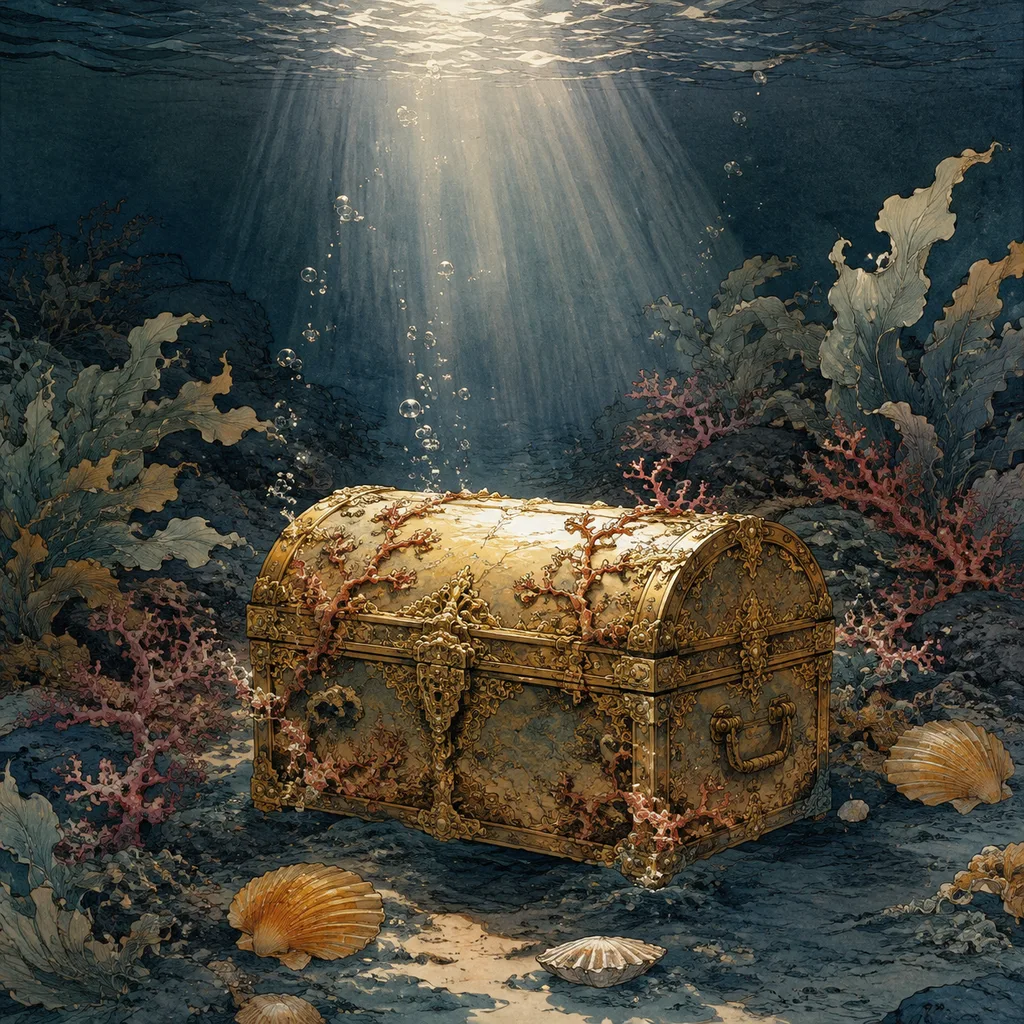
Imagine a treasure chest hidden at the bottom of the ocean—its gold encrusted with coral, its jewels shimmering faintly through layers of deep blue water. This is the essence of Sea-Metal (海中金, Hǎi Zhōng Jīn), a NaYin image that captures the idea of value concealed beneath the surface. Ancient Chinese astrologers chose this metaphor to describe a type of Metal energy that is not yet refined or revealed: it is potential waiting for the right conditions to surface. Unlike the sharp edge of a sword or the gleam of a polished mirror, Sea-Metal is dormant, protected by the vastness of the sea. Those born under this image carry an innate depth and hidden brilliance, often unbeknownst even to themselves. This page explores the symbolism, personality traits, life applications, and classical interpretations of Sea-Metal, offering a window into one of the most mysterious and promising NaYin types.
Sea-Metal lies in its paradoxical nature: it is both precious and invisible.
The San Ming Tong Hui (三命通会, 明·万民英, 1587) describes Sea-Metal with vivid imagery:
People born under Sea-Metal carry an aura of depth and mystery.
| NaYin Name | Sea-Metal (海中金) |
| Element | Metal (金) |
| Ganzhi Pillars | 甲子 (Jia Zi), 乙丑 (Yi Chou) |
| Associated Animals | Rat, Ox |
| Years in 60-Year Cycle | 1924, 1925, 1984, 1985 |
| Classical Source | San Ming Tong Hui (三命通会) · 1587 |
Key Takeaways
- Sea-Metal (海中金) is a NaYin element symbolizing hidden potential and late-blooming success — gold submerged in ocean depths, requiring time and effort to surface.
- Associated with the Jiazi (甲子, 1984) and Yichou (乙丑, 1985) pillars in the 60-year sexagenary cycle.
- Requires external challenges (“fire”) to forge raw talent into visible brilliance — consistent with the classical notion of not-yet-formed metal.
- Rooted in the San Ming Tong Hui (三命通会, 1587) and Yu Xiao Bao Jian (玉霄宝鉴), verified against our library of 16+ classical BaZi texts.
The Essence of Sea-Metal
Sea-Metal lies in its paradoxical nature: it is both precious and invisible. Unlike Sword Metal (剑锋金), which is forged for battle, or Gold Leaf Metal (金箔金), which decorates surfaces, Sea-Metal remains submerged, its value known only to those who dive deep. This teaches that true worth does not always announce itself. A pearl forms inside an oyster, hidden from the sun, growing in darkness until it is ready to be discovered. Similarly, Sea-Metal individuals often possess talents and wisdom that mature slowly, away from the spotlight. The ocean itself is a guardian—it conceals but also preserves. The gold at the bottom is safe from erosion, but it can also be forgotten. This image warns against complacency: treasure that never sees light may as well be lost. Yet when the waters part—through opportunity, crisis, or personal awakening—the sea yields its riches. The Yu Xiao Bao Jian (玉霄宝鉴) notes that Sea-Metal is ‘not yet formed metal,’ requiring fire to be shaped. Thus, the essence is one of latent power, patience, and the need for catalytic experiences to bring hidden gifts to the surface.
Voices from the Classics
The San Ming Tong Hui (三命通会, 明·万民英, 1587) describes Sea-Metal with vivid imagery:
海中金者,宝藏龙宫,珠孕蛟室,气在包藏,使极则沉潜。
Translated: “Sea-Metal is treasure hidden in the Dragon Palace, pearls gestating in the Flood Dragon’s chamber. Its qi is in concealment; when pushed to extremes, it sinks deeper.”
— San Ming Tong Hui (三命通会), Vol. 30, Ming Dynasty 1587
The qi (气) here refers to the life force or energy of this Metal, which is introverted and protective. Unlike the outward expression of other metals, Sea-Metal’s qi is inward, building strength in stillness. The quote warns that forcing this energy outward too early causes it to “sink”—retreat further.
甲子、乙丑,未成器金,见火则成,多见则吉。
Translated: “The Jiazi and Yichou pillars are not-yet-formed metal; they need fire to achieve completion, and encountering fire multiple times is auspicious.”
— Yu Xiao Bao Jian (玉霄宝鉴), Song Dynasty
The classical texts thus emphasize that Sea-Metal’s path to brilliance requires external heat—trials, challenges, or influential mentors—to refine its raw potential into something luminous.
Character and Temperament
People born under Sea-Metal carry an aura of depth and mystery. Like gold resting on the ocean floor, their talents often remain hidden—not out of shyness, but because they are still forming. They possess a quiet confidence, knowing they have value, yet they rarely flaunt it. Strengths include remarkable perseverance and the ability to grow in isolation. Just as a pearl develops layer by layer inside an oyster, Sea-Metal individuals build their skills through steady, unseen effort. They are often drawn to intellectual or artistic pursuits that require depth rather than speed.
In our practice, we frequently observe Sea-Metal clients who only discover their core strengths in their thirties or forties — a pattern consistent with the classical notion that this metal needs time and heat to take shape. One recurring theme is the “late bloomer” trajectory: a Sea-Metal individual may spend years in what looks like underachievement, only to make a decisive breakthrough when the right catalyst — a mentor, a crisis, or a sudden opportunity — forces their hidden potential to the surface. This aligns with what family-lineage practitioners describe as kai kuang (开矿, “opening the mine”): the process by which dormant talent is finally recognized and refined.
However, their challenges mirror the sea’s dangers: they can be too guarded, reluctant to let others see their true worth. The ‘sinking’ tendency of their qi may lead to self-doubt or procrastination. They may wait for perfect conditions before acting, missing opportunities. Relationships can be complicated—they crave connection but fear exposure. Like a dragon guarding its treasure, they test others’ intentions before trusting. When they do open up, they reveal unexpected richness: a sharp wit, profound empathy, or creative brilliance. The key is to remember that the ocean’s surface is calm, but beneath lies a world of wonder.
Sea-Metal in Career, Wealth, and Relationships
In career, Sea-Metal individuals thrive in roles that allow depth and specialization. They make excellent researchers, writers, engineers, or artisans—professions where hidden details matter. Their patience suits long-term projects, like a scientist studying ocean currents or a jeweler crafting intricate pieces. They are less suited for high-pressure sales or public-facing roles that demand constant self-promotion. Financially, they are cautious savers, preferring to accumulate wealth quietly, like a seabed gathering sediment. They avoid risky investments, favoring steady growth. However, they can be too conservative, missing chances to multiply their resources. Wealth often comes later in life, after they have ‘surfaced’ through personal development. In love, they seek deep, meaningful connections. They are loyal but slow to commit, needing to feel safe before revealing their hearts. A partner who respects their need for privacy and understands their hidden depths will unlock their most loving nature. They may attract dramatic partners who ‘stir the waters,’ but stability is their true anchor.
The Two Pillars of Sea-Metal
The 甲子 (Rat) pillar combines Metal with Wood stem and Rat branch. Here, Sea-Metal is dynamic yet still hidden. The Rat brings cleverness and adaptability, like a treasure that can shift with currents. Notable 1984 Rat Sea-Metals include Mark Zuckerberg, who built Facebook from a dorm room—a hidden idea that changed the world. Scarlett Johansson and Katy Perry also embody this hidden brilliance, excelling in creative fields that require both depth and visibility. The Rat’s water nature helps the Metal flow, making these individuals more adaptable than their Ox counterparts. The 乙丑 (Ox) pillar pairs Metal with Wood stem and Ox branch. The Ox adds stability and endurance, like a treasure buried deep and unmoving. Margaret Thatcher (1925 Ox) exemplified this: her ‘Iron Lady’ image was tough and unyielding, yet her political vision was long-brewing. Michael Phelps (1985 Ox) trained in obscurity before becoming the most decorated Olympian. Ox Sea-Metals are slower to surface but more steadfast once they do. Both pillars share the core Sea-Metal nature, but the Rat brings versatility and the Ox brings solidity.
Living with Sea-Metal Energy
The wisdom of Sea-Metal is to trust the process of becoming. Not all treasure needs to be found immediately; some grows more precious with time. For those born under this image, the journey is about learning when to stay hidden and when to emerge. Practical steps include embracing opportunities that challenge you—these are the ‘fire’ that refines your metal. Seek mentors who can help you polish your gifts. In daily life, allow yourself quiet spaces to recharge, but also push gently against your comfort zone. Remember that the ocean’s depths are not a prison but a cradle. To discover whether this energy appears in your chart, explore your full BaZi reading—it may reveal whether your treasure is waiting to be raised.
Discover whether Sea-Metal appears in your chart. Calculate your free BaZi reading →
Your birth data stays in your browser and is never stored or shared.
References & Classical Sources
This page draws on the following primary sources, cross-referenced with our in-house library of 16+ classical BaZi texts:
- San Ming Tong Hui (三命通会) — Wan Minying (万民英), Ming Dynasty, 1587. Volume 30, “On NaYin Imagery” (论纳音取象). Core quote on Sea-Metal: “海中金者,宝藏龙宫,珠孕蛟室,气在包藏,使极则沉潜。”
- Yu Xiao Bao Jian (玉霄宝鉴) — Song Dynasty. Supplementary note on 甲子/乙丑: “未成器金,见火则成,多见则吉。”
- Yan Dongsou’s Commentary (阎东叟注) — Song Dynasty. On 甲子 as “进神” (progressive spirit) and 乙丑 as “正印” (orthodox seal).
- Di Tian Sui (滴天髓) — Ming/Song Dynasty. Cross-referenced for Metal-element behavioral patterns.
- Zi Ping Zhen Quan (子平真诠) — Shen Xiaozhan, Qing Dynasty. Referenced for Nayin classification methodology.
All translations by the 12Zodiacs Editorial Team, reviewed against the original classical Chinese. Full methodology available on our Methodology page.
More in NaYin Elements
Creek Water · Forest Wood · Gold Leaf Metal · Hairpin Metal · Hearth Fire · Heavenly Water · Highway Earth · Lamp Fire