
Mountain-Base-Fire (山下火)
山下火 · One of the 30 NaYin elemental combinations
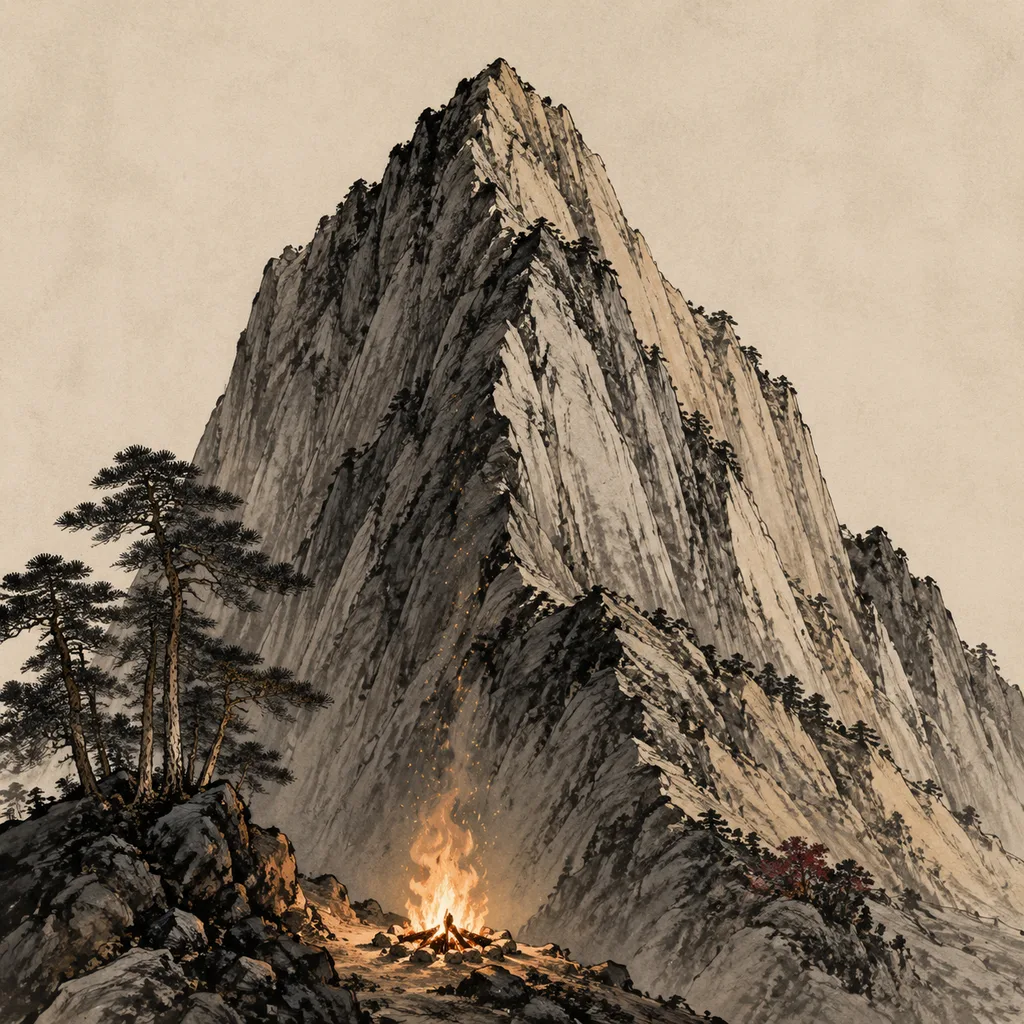
Mountain-Base-Fire (山下火) literally translates to 'fire at the foot of the mountain.' This image evokes a campfire flickering at a trailhead, or the warm glow of a forge nestled in a valley town. Unlike the blazing summit beacon of Mountain-Fire or the contained hearth of Hearth-Fire, Mountain-Base-Fire is humble, grounded warmth—a small flame that yet holds the potential to ignite an entire landscape. Ancient astrologers chose this metaphor to describe a fire that is not immediately impressive but carries latent power, waiting for the right conditions to spread. This page explores the essence, classical roots, personality traits, life applications, and the two pillar expressions of this unique nayin, offering a comprehensive guide to understanding its subtle yet profound influence.
What Mountain-Base-Fire truly represents is the quiet, persistent warmth that fuels growth from the shadows.
The San Ming Tong Hui (三命通会) describes Mountain-Base-Fire with poetic imagery: '山下火者,草间熠耀,花裹荧煌,寒林缀叶之光,隔幔点衣之彩。方朔以...
My teacher often emphasized that Mountain-Base-Fire is the most misunderstood of all NaYin types because people expec...
| NaYin Name | Mountain-Base-Fire (山下火) |
| Element | Fire (火) |
| Ganzhi Pillars | 丙申, 丁酉 (Yang Fire, Yin Fire) Stems |
| Associated Animals | Monkey, Rooster |
| Years in 60-Year Cycle | 1956, 2016, 1957, 2017 |
| Classical Source | 《三命通会》明·万民英,1587 · 卷三十「论纳音取象」/ 阎东叟注 / 《五行要论》 |
Key Takeaways
- Mountain-Base-Fire represents latent potential — a modest flame capable of moving mountains when the time comes.
- This NaYin describes people who start quietly but build toward explosive impact.
- The foothill metaphor teaches: don’t despise small beginnings. Every wildfire started with a single spark.
- Classical texts describe fire hiding its light at the mountain’s base, retreating into stillness.
What Mountain-Base-Fire Truly Represents
What Mountain-Base-Fire truly represents is the quiet, persistent warmth that fuels growth from the shadows. Picture a campfire at the base of a mountain: it does not command the peak, but it provides the light and heat needed to prepare for the ascent. This is not a summit beacon (Mountain-Fire) that signals from afar, nor a contained forge (Hearth-Fire) that shapes metal within walls. Mountain-Base-Fire is grounded warmth—modest now, but capable of igniting something much larger. The image teaches character: steadfastness in humility, patience in obscurity, and the understanding that true power often begins small. Just as a forge-glow in a valley town sustains the blacksmith's work, those with this nayin often find their strength in supporting roles, nurturing others, and building foundations. They are the warm contained light that does not seek attention but is deeply felt by those who draw near.
The Classical Record
The San Ming Tong Hui (三命通会) describes Mountain-Base-Fire with poetic imagery: '山下火者,草间熠耀,花裹荧煌,寒林缀叶之光,隔幔点衣之彩。方朔以萤火名之,故妙选有萤火照水格。' This translates to: 'Mountain-Base-Fire is the shimmer among grass, the brilliance within flowers, the light of leaves adorning cold forests, the color of dots on garments through a curtain. Fang Shuo named it firefly fire, hence the classic pattern of firefly shining over water.' The text emphasizes that this fire's qi (vital energy) is small and subtle, like a firefly's glow, yet it can illuminate dark places. Yan Dongsou notes that the fire is 'self-sick' (丙申) or 'self-dead' (丁酉), meaning its qi is weak and requires the support of wood to flourish. The Yu Xiao Bao Jian does not contain a specific entry for this nayin, but the classical sources highlight the importance of environment and timing for this modest flame to fulfill its potential.
山下火者,草间熠耀,花裹荧煌,寒林缀叶之光,隔幔点衣之彩。方朔以萤火名之,故妙选有萤火照水格。
— 《三命通会》明·万民英,1587 · 卷三十「论纳音取象」/ 阎东叟注 / 《五行要论》
丙申: 丙申,自病之火,丁酉自死之火,其气极微,假木相助,其气方生。
Yan Dongsou: “丙申病火,以木为文明之德,以水为旷达之性,以土为福慧之基,惟金为暴虐,纵有吉辰,革为不和之气。”
丁酉: 丁酉,自死之火,其气极微,假木相助,其气方生。
The Inner Landscape
My teacher often emphasized that Mountain-Base-Fire is the most misunderstood of all NaYin types because people expect fire to be bold and assertive, but this fire is quiet and unassuming. The inner landscape of a Mountain-Base-Fire individual is like a campfire at a trailhead—steady, warm, and inviting, but not flashy. Strengths include profound loyalty, a nurturing spirit, and the ability to thrive in modest circumstances. They are the ones who listen deeply, who support others without fanfare, and who find joy in simple pleasures. Challenges arise when they internalize the world's expectation to be more 'fiery'—they may feel overlooked or undervalued. Yet, like the forge-glow that transforms raw ore into steel, their patience and perseverance yield remarkable results over time. They need to trust that their contained warmth is enough, that their light, though small, is essential. The key is to embrace their foundational role, knowing that the mountain's base holds the entire structure aloft.
Work, Money, and Love under Mountain-Base-Fire
In career paths, Mountain-Base-Fire resonates with roles that involve nurturing, teaching, healing, or building from the ground up. These individuals excel as educators, counselors, artisans, or small business owners—any field where consistent, grounded effort yields lasting results. They are not drawn to the spotlight but to meaningful contribution. Financially, they tend to be cautious and conservative, preferring steady accumulation over risky ventures. They value security and often build wealth slowly, like a campfire that burns long and steady. In love and partnerships, they are loyal and devoted, seeking deep emotional connection rather than superficial excitement. They may appear reserved at first, but once committed, their warmth becomes a sanctuary for their partner. The imagery of warm contained light manifests as a protective, comforting presence. They are the ones who remember anniversaries, make tea for a sick partner, and create a home that feels like a refuge. Their challenge is to avoid settling for less than they deserve, as their humility can sometimes lead them to undervalue their own needs.
Two Doorways into Mountain-Base-Fire
Mountain-Base-Fire expresses uniquely through its two pillar combinations. The 丙申 (Monkey) pillar, with fire stem and metal branch, represents a fire that is 'self-sick'—its qi is weak and needs external support. Notable figures born in 1956 include Tom Hanks (American actor) and Leslie Cheung (Hong Kong singer-actor). Both exemplify the grounded warmth and versatile talent of this pillar: Hanks with his everyman appeal and consistent excellence, Cheung with his luminous yet understated charisma. The 丁酉 (Rooster) pillar, with fire stem and metal branch, is 'self-dead' fire, even more subdued. Daniel Day-Lewis, born in 1957, embodies this—a meticulous, transformative actor who shuns publicity yet leaves an indelible mark. The Monkey brings agility and sociability, while the Rooster adds precision and introspection. Both share the Mountain-Base-Fire core: modest beginnings, immense potential, and the need for the right environment to shine.
Embracing Your Mountain-Base-Fire Nature
Embracing your Mountain-Base-Fire nature means honoring the quiet, patient flame within. This nayin teaches that true strength is not always loud—it can be the steady warmth that nurtures growth over time. Practical wisdom: invest in relationships, build slowly, and trust that your light, though small, is enough. You are the foundation upon which great things are built. To discover whether this energy appears in your chart, explore your full BaZi reading.
Discover whether Mountain-Base-Fire appears in your chart. Calculate your free BaZi reading →
Your birth data stays in your browser and is never stored or shared.
References & Classical Sources
This page draws on the following primary sources, cross-referenced with our in-house library of 16+ classical BaZi texts:
- San Ming Tong Hui (三命通会) — Wan Minying (万民英), Ming Dynasty, 1587. Volume 30, “On NaYin Imagery”. Core quote: “山下火者,草间熠耀,花裹荧煌,寒林缀叶之光,隔幔点衣之彩。方朔以萤火名之,故妙选有萤火照水格。”
- Yu Xiao Bao Jian (玉霄宝鉴) — Song Dynasty. Supplementary notes on 山下火 pillars.
- Yan Dongsou’s Commentary (阎东叟注) — Song Dynasty.
- Di Tian Sui (滴天髓) — Ming/Song Dynasty. Cross-referenced for Fire-element behavioral patterns.
- Zi Ping Zhen Quan (子平真诠) — Shen Xiaozhan, Qing Dynasty. Referenced for Nayin classification methodology.
All translations by the 12Zodiacs Editorial Team, reviewed against the original classical Chinese. Full methodology available on our Methodology page.
More in NaYin Elements
Creek Water · Forest Wood · Gold Leaf Metal · Hairpin Metal · Hearth Fire · Heavenly Water · Highway Earth · Lamp Fire