
Earthly Branch Relations
Harmonies, clashes, punishments — the hidden forces connecting twelve animals.
The 12 Earthly Branches (地支) are not static; they interact through harmonies (合), clashes (冲), punishments (刑), and harms (害). These hidden dynamics—such as a supportive combination or a disruptive clash—reveal relationship patterns, career timing, and life challenges. As the San Ming Tong Hui states, “Branches govern the hidden stems, and their movements shape destiny.” Understanding these relations is key to reading how external events and personal connections unfold.
In BaZi (Four Pillars of Destiny), the twelve Earthly Branches are far more than static markers of time. They form a living network of relationships—some supportive, others adversarial, and many quietly corrosive. These interactions between the branches shape how the energies in your chart combine, collide, and transform. Understanding Earthly Branch Relations is essential for anyone serious about reading a Chinese astrology chart with accuracy. A clash can signal sudden upheaval; a harmony can reveal hidden support. Classical texts like the San Ming Tong Hui (三命通会) devote entire chapters to these dynamics, treating them as the connective tissue of fate analysis. This guide explains the full system of branch interactions—from the intimate Six Harmonies to the punishing Three Punishments—so you can interpret your own chart with confidence.
How It Works
The Earthly Branches (地支, dìzhī) are the twelve animal signs that pair with the Ten Heavenly Stems to form the pillars of a BaZi chart. Each branch carries its own element, polarity, and hidden stems—the internal energies that dwell within. The relationships between branches operate on multiple layers simultaneously.
Some interactions are straightforward. The Six Clashes (六冲, liù chōng) pair branches that sit directly opposite each other on the zodiac wheel, creating a head-on collision of opposing elements. The Six Harmonies (六合, liù hé), by contrast, pair branches that form a complementary bond, often merging their energies into a new element entirely. For example, when Zi (Rat, water) meets Chou (Ox, earth), they combine into a powerful earth energy—a transformation that changes the entire landscape of a chart.
Other relations are more subtle. The Six Harms (六害, liù hài) describe branches that damage each other slowly, like water eroding stone. The Three Harmonies (三合, sān hé) form triangular alliances of three branches that together create a complete element—think of them as a support network that activates only when all three members are present. The Three Punishments (三刑, sān xíng) are patterns of mutual injury, where three branches lock into a cycle of blame and retribution.
To complicate matters further, these relations operate at different scales. A branch may be in harmony with one neighbor while clashing with another in the same chart. The timing pillar—whether a branch appears in your year, month, day, or hour pillar—also affects how strongly the interaction manifests. A clash in the hour pillar might affect your children or late-life projects; the same clash in the day pillar strikes at your core identity and marriage.
Finally, the stems themselves participate in this dance. Stem Combinations (天干五合, tiāngān wǔhé) and Stem Clashes (天干相冲, tiāngān xiāngchōng) add another layer of interaction. When a stem combines with another, they can transform into a new element, altering the flavor of the entire pillar. The Yuan Hai Zi Ping (渊海子平) treats these stem-level relations as complementary to the branch dynamics—stems represent the visible, outer expression of fate, while branches carry the hidden, internal currents.
In practice, a BaZi master looks at all these interactions together. A chart with many harmonies may indicate a smooth, supported life; a chart riddled with clashes suggests recurring turbulence. But nothing is purely good or bad—a clash can break a stagnant pattern, and a harmony can dilute a strong element. Context is everything.
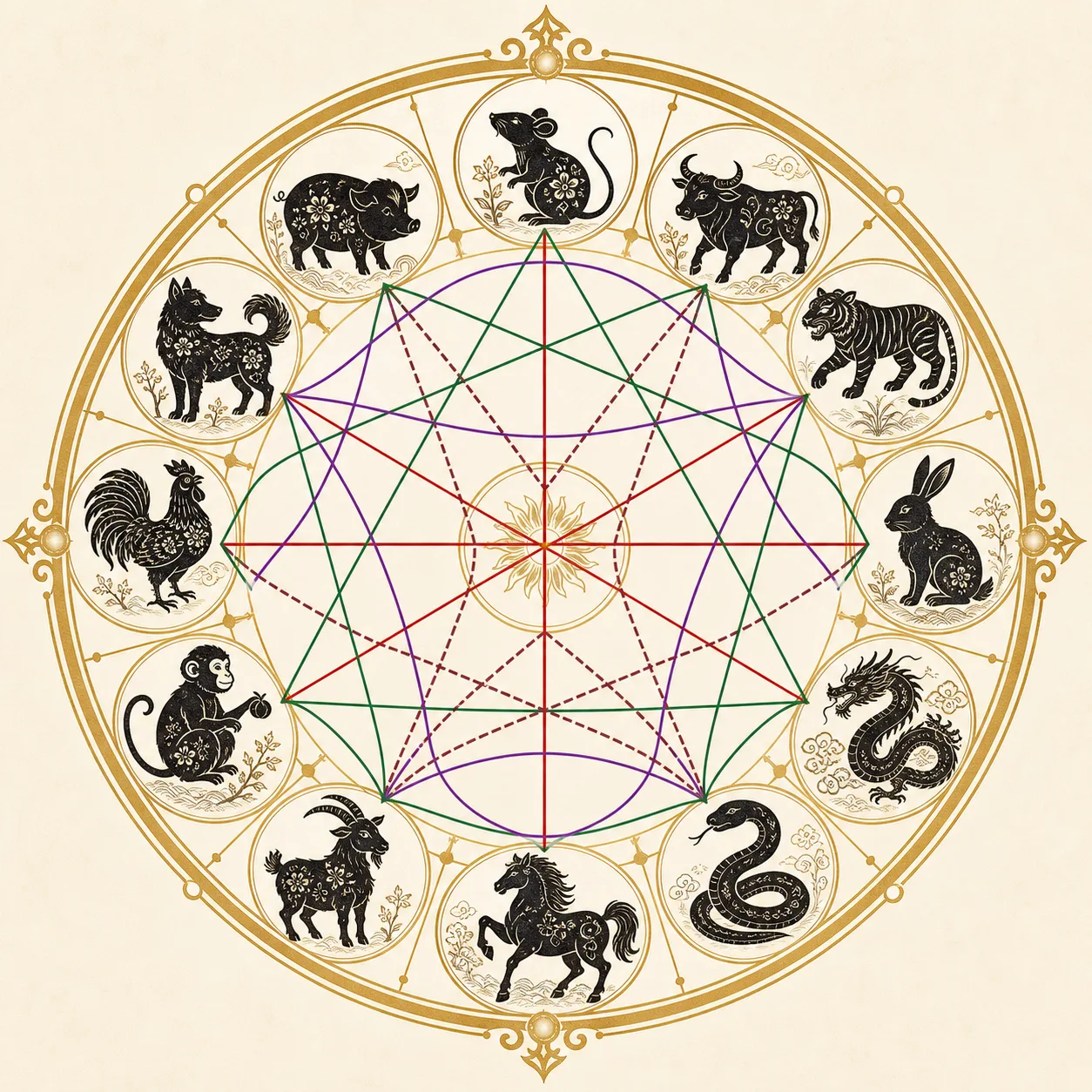
The 12 Earthly Branches form a relationship web through harmonies (green), clashes (red), harms (dark red), and punishments (purple). Each line type reveals a different kind of dynamic.
Branch Relations Reference Table
The twelve Earthly Branches interact through six types of relationships. Each type has a distinct effect on chart dynamics.
| Relation Type | Chinese | Count | Effect |
|---|---|---|---|
| Six Harmonies | 六合 (Liu He) | 6 pairs | Secret alliances that merge into new elements |
| Three Harmonies | 三合 (San He) | 4 triads | Complete elemental triangles (e.g., Tiger-Horse-Dog = Fire) |
| Six Clashes | 六冲 (Liu Chong) | 6 pairs | Opposition across the zodiac wheel — sudden change |
| Six Harms | 六害 (Liu Hai) | 6 pairs | Subtle damage — erodes from within |
| Three Punishments | 三刑 (San Xing) | 3 patterns | Cyclical conflict — self-sabotage and legal trouble |
| Stem Combinations | 天干五合 | 5 pairs | Stems that merge and transform |
Six pairs of branches forming secret alliances, merging into new elements. Quiet supporters that stabilize and transform.
Three triangular alliances creating a complete element. Power networks that activate when all three are present.
Partial alliances — only two of three members present. Incomplete bonds waiting for the third branch.
Six opposing pairs across the zodiac wheel. Friction, sudden change, displacement — the most dramatic relations.
Six pairs that damage each other subtly. Operate below the surface, slowly eroding relationships and fortune.
Four opposing stem pairs that clash. More superficial than branch clashes, but still signal friction.
Three patterns of cyclical conflict. Reveals self-sabotage, legal trouble, and interpersonal friction.
Reciprocal punishment cycles — each side inflicts harm on the other. Surfaces in workplace and legal disputes.
Internal conflict — a branch punishes itself. Anxiety, self-doubt, destructive habits from within.
Deep Dive: Each Relation Type Explained
The card grid gives a quick overview. Here we examine each relation type in depth — the specific branch pairs involved, what they mean in practice, and how classical texts interpret them.
Harmonies: The Supportive Bonds (六合, Liù Hé)
The most intimate of the supportive bonds, creating a near-merger of two branches' energies into a new transformed element.
Intimate mergerThe Six Harmony pairs are: Rat (子) and Ox (丑), which transform into Earth; Tiger (寅) and Pig (亥), transforming into Wood; Rabbit (卯) and Dog (戌), transforming into Fire; Dragon (辰) and Rooster (酉), transforming into Metal; Snake (巳) and Monkey (申), transforming into Water; and Horse (午) and Goat (未), transforming into either Fire or Earth depending on the seasonal context. The San Ming Tong Hui (三命通会) emphasizes that these combinations are only fully realized when both branches are present in the chart and not weakened by other destructive forces. For example, a Rat and Ox in the same chart can indicate a strong, earthy pragmatism, but if a Horse (which clashes with Rat) is also present, the harmony is broken.
Beyond the Six Harmonies, there are the Three Harmonies (三合, Sān Hé), which form a triangle of support over the four seasons. These are: Water Bureau (申子辰, Shen-Zi-Chen) — Monkey, Rat, Dragon; Wood Bureau (亥卯未, Hai-Mao-Wei) — Pig, Rabbit, Goat; Fire Bureau (寅午戌, Yin-Wu-Xu) — Tiger, Horse, Dog; and Metal Bureau (巳酉丑, Si-You-Chou) — Snake, Rooster, Ox. These groups represent the full cycle of a season's growth, maturity, and storage. A complete Three Harmony in a chart is a powerful indicator of focused, unwavering energy in that element's domain—often signifying a person with exceptional talent or a singular life path.
Detailed Analysis of Each Harmony Pair
1. Rat and Ox (子丑合 — Earth)
The Rat (Water) and Ox (Earth) seem incompatible — earth dams water. Yet in the harmony framework, Ox's earthiness channels Rat's flow rather than blocking it, creating fertile, irrigated ground. This is the harmony of disciplined emotion — intuition (Rat) given structure and purpose by pragmatism (Ox). When this pair appears in the Day Pillar, it suggests a person whose emotional intelligence is grounded and practical. They don't just feel — they build with their feelings. In relationships, this harmony brings loyalty and slow-burning commitment. The Yuan Hai Zi Ping notes that Rat-Ox in the spouse palace indicates a marriage that deepens over decades rather than sparking dramatically.
2. Tiger and Pig (寅亥合 — Wood)
The Tiger (Wood) and Pig (Water) combine to form Wood because Water nourishes Wood. This is the harmony of creative growth — raw potential (Pig) given fierce direction (Tiger). A person with this harmony tends to be both visionary and courageous, capable of turning ambitious ideas into reality. The Pig's generosity feeds the Tiger's ambition without depleting it. However, classical texts warn that if Fire is strong elsewhere in the chart, this Wood can be consumed, turning the harmony into a source of burnout. In career readings, Tiger-Pig suggests someone who thrives in entrepreneurial or pioneering roles.
3. Rabbit and Dog (卯戌合 — Fire)
The Rabbit (Wood) and Dog (Earth) combine to form Fire because Wood feeds Fire through Earth's mediation. This is the harmony of quiet passion — diplomatic grace (Rabbit) combined with steadfast loyalty (Dog) produces warmth that endures. The Di Tian Sui describes this pair as "the lamp that never goes out." People with this harmony excel in roles requiring patience and sustained effort: teaching, counseling, long-term research. In romance, this combination suggests devotion that survives distance and hardship.
4. Dragon and Rooster (辰酉合 — Metal)
The Dragon (Earth) and Rooster (Metal) combine to form Metal because Earth generates Metal. This is the harmony of refined power — raw ambition (Dragon) disciplined into precision (Rooster). A person with this combination has the drive to achieve greatness and the exactitude to execute flawlessly. They are often found in fields requiring both vision and technical mastery: architecture, surgery, law. The San Ming Tong Hui notes that this harmony in the Month Pillar indicates a person who transforms their family's legacy into something more polished and enduring.
5. Snake and Monkey (巳申合 — Water)
The Snake (Fire) and Monkey (Metal) combine to form Water because Fire melts Metal, and the molten result flows. This is the most volatile and transformative harmony — intelligence forged through friction. A person with this pair tends to be deeply insightful, strategically brilliant, and occasionally deceptive. They excel in diplomacy, research, or any field where information is power. However, the Yuan Hai Zi Ping warns that this combination can create a person who manipulates others "for their own good," leading to karmic backlash.
6. Horse and Goat (午未合 — Fire/Earth)
The Horse (Fire) and Goat (Earth) combine ambiguously — the resulting element depends on seasonal context. In summer, Fire dominates; in late seasons, Earth prevails. This is the harmony of adaptive warmth — radiant energy (Horse) grounded by nurturing patience (Goat). People with this pair are often charismatic and well-liked, with a natural talent for bringing others together. They excel in hospitality, community organizing, and creative arts. The seasonal dependency means their life path may shift dramatically depending on timing.
Three Harmony Bureaus: Seasonal Power Triangles
The Three Harmonies (San He) differ fundamentally from the Six Harmonies. While the latter are binary mergers, Three Harmonies are structural — they represent the complete arc of a season's energy from birth through peak to storage. Each bureau spans three branches that correspond to the beginning, middle, and end of a seasonal cycle:
Water Bureau (Shen-Zi-Chen, 申子辰): Begins with Monkey (Metal producing Water), peaks at Rat (pure Water), and consolidates at Dragon (Water's graveyard/storage). This bureau indicates a person whose power comes from depth — accumulated knowledge, patient strategy, and the ability to store resources for the right moment. When complete, it produces exceptional analysts, researchers, and investors.
Wood Bureau (Hai-Mao-Wei, 亥卯未): Begins with Pig (Water producing Wood), peaks at Rabbit (pure Wood), and consolidates at Goat (Wood's storage). This bureau signals creative growth — the ability to initiate, expand, and harvest. People with this bureau are natural builders: entrepreneurs, artists, and community leaders who turn ideas into thriving enterprises.
Fire Bureau (Yin-Wu-Xu, 寅午戌): Begins with Tiger (Wood producing Fire), peaks at Horse (pure Fire), and consolidates at Dog (Fire's storage). This bureau radiates charisma and visibility. People with this configuration are often performers, leaders, or innovators whose ideas catch fire and spread. The Di Tian Sui notes that a complete Fire bureau creates "a light that cannot be hidden."
Metal Bureau (Si-You-Chou, 巳酉丑): Begins with Snake (Fire producing Earth producing Metal), peaks at Rooster (pure Metal), and consolidates at Ox (Metal's storage). This bureau produces precision, discipline, and decisiveness. People with this configuration excel in law, medicine, military strategy, and any field requiring cutting clarity. They are the ones who make difficult decisions that others avoid.
A half-harmony (two of three branches) still has power but remains incomplete, waiting for the third branch to arrive via a luck pillar or annual cycle. This incompleteness creates a sense of anticipation — a talent or opportunity that is "almost there" but needs one more piece to fully activate. Practitioners pay close attention to which branch is missing, as its arrival often marks a pivotal life event.
Clashes: The Forces of Change (六冲, Liù Chōng)
The Rat and Horse sit directly opposite on the zodiac wheel, representing fundamental opposition between water and fire.
Opposing elementsThe Ox and Goat clash as earth branches, creating friction between stability and flexibility.
Stability vs. flexibilityThe Tiger and Monkey oppose each other, symbolizing conflict between bold action and clever adaptability.
Boldness vs. cunningThe Rabbit and Rooster clash, representing tension between gentleness and sharpness.
Gentle vs. sharpThe Dragon and Dog oppose each other, creating conflict between ambition and loyalty.
Ambition vs. loyaltyThe Snake and Pig clash, symbolizing opposition between mystery and openness.
Mystery vs. opennessThe manifestation of a clash depends on the elements and the palaces involved. A Rat-Horse clash (Water vs. Fire) is explosive and emotional—it often manifests as sudden upheaval in career or home life, or as a volatile romantic relationship. The Ox-Goat clash (both Earth) is a slower, grinding conflict, often manifesting as persistent health issues or stubborn interpersonal stalemates. The Tiger-Monkey clash (Wood vs. Metal) is a battle of authority; it frequently appears as conflict with superiors or the law. The Rabbit-Rooster clash is about precision and rules being broken, leading to legal disputes or surgical interventions. The Dragon-Dog clash is a clash of foundations, often causing instability in one's home or a sense of being uprooted. Finally, the Snake-Pig clash is a hidden, deceptive conflict, often manifesting as betrayal or undermining from a trusted colleague. The San Ming Tong Hui warns that a clash in the Year Pillar affects the ancestors and early life, while a clash in the Hour Pillar affects children and late-life legacy.
Clash Mechanics: Why Opposition Creates Change
A clash (冲, Chong) occurs when two branches sit directly opposite each other on the zodiac wheel — separated by exactly six positions. This 180-degree opposition is not merely symbolic; it reflects a fundamental elemental antagonism. Water extinguishes Fire, Fire melts Metal, Metal chops Wood, and so on. The clash forces one element to dominate or destroy the other, creating irreversible change.
However, the Di Tian Sui offers a crucial nuance: a clash's outcome depends entirely on which element is stronger. If the stronger element clashes the weaker, the weaker is destroyed — this is destructive change. But if the weaker element clashes the stronger, it provokes the stronger into action — this is catalytic change. A weak Rat clashing a powerful Horse doesn't extinguish the Horse; it enrages it, producing explosive creative energy or sudden career breakthroughs. This principle is why some charts with multiple clashes produce extraordinarily dynamic individuals rather than broken ones.
Palace-Specific Clash Interpretations
The location of a clash within the Four Pillars determines which life domain it affects:
Year-Month Clash: Affects the relationship with parents, early upbringing, and educational foundations. Often indicates leaving home early, a turbulent childhood, or a fundamental disagreement with family values. The person may build their identity in opposition to their roots.
Month-Day Clash: The most consequential for career and self-identity. The Month Pillar governs one's professional environment and social position; the Day Pillar governs the self. When these clash, the person frequently changes careers, challenges authority, or feels a persistent tension between who they are and what society expects of them. This clash is common in self-made entrepreneurs and revolutionaries.
Day-Hour Clash: Affects marriage and children. The Day Branch is the "spouse palace"; the Hour Branch governs descendants. A clash here may indicate marital friction, difficulty with conception, or a child whose temperament radically differs from the parent's. It can also mean the person's creative legacy diverges sharply from their personal life.
Year-Hour Clash: The widest span — ancestry versus descendants. This clash suggests a person who breaks generational patterns, for better or worse. They may completely reject their family's path and build something unprecedented, or they may repeat ancestral mistakes in a new form. The Yuan Hai Zi Ping treats this as a karmic indicator.
Harms: The Hidden Corrosion (六害, Liù Hài)
A corrosive tension arises when Rat intrudes upon the harmony of Goat, creating hidden friction.
Subtle erosionOx and Horse clash subtly, undermining each other's stability through persistent interference.
Quiet underminingTiger and Snake create a disruptive bond, where hidden aggression corrodes mutual trust.
Hidden aggressionRabbit and Dragon's harmony is disrupted, leading to insidious misunderstandings and slow decay.
Slow decayMonkey and Pig experience a corrosive pull, where playful energy turns into subtle conflict.
Playful conflictRooster and Dog's bond is tainted by persistent irritation, eroding their natural compatibility.
Persistent irritationWhile a clash is a public, loud argument, a Harm is the silent resentment that builds over years. It operates below the surface, corroding trust and goodwill. In a relationship pillar, a Harm often indicates a marriage that "works" on paper but suffers from emotional distance, passive-aggression, or a slow erosion of intimacy. In the career palace, it can manifest as a hidden enemy who subtly undermines your work without direct confrontation. The San Ming Tong Hui describes Harms as "a thief in the night," noting that their damage is often only fully realized in hindsight. For example, a Rabbit-Dragon Harm in the Year Pillar might indicate a family legacy of unspoken secrets or a quiet, ongoing feud with a sibling that never fully erupts but never truly heals.
The Psychology of Harms: Why Slow Corrosion Is Worse Than Open Conflict
While clashes are dramatic and visible — divorces, firings, public disputes — harms operate in silence. The distinction matters because humans are wired to respond to acute threats but are poor at recognizing chronic ones. A person with a prominent harm in their chart may spend years in a situation that looks functional from the outside but is slowly draining their vitality.
The San Ming Tong Hui categorizes the six harms by their underlying mechanism. Some arise from broken harmonies — when a third branch disrupts a natural pairing, creating resentment. Others stem from elemental irritation — when two branches' hidden stems are in a controlling cycle that neither can resolve. Understanding which mechanism is at play helps practitioners recommend remedies.
For example, the Rat-Goat Harm (子未害) occurs because Rat (Water) and Goat (Earth) should never directly interact — Earth should control Water from a distance, not touch it. When they are adjacent in a chart, the Goat's earthiness muddies the Rat's clarity, like dirt thrown into clean water. This manifests as clouded judgment, difficulty seeing situations clearly, or a tendency to attract people who drain one's energy without obvious malice.
The Tiger-Snake Harm (寅巳害) is more dangerous because both branches carry hidden Fire and Metal, creating a smoldering tension. The Tiger's boldness provokes the Snake's stealth, and vice versa. In practice, this harm often appears in charts of people who attract frenemies — those who smile to their face while plotting behind their back. The remedy is not confrontation (which the Snake thrives on) but strategic distance and documentation.
Unlike clashes, harms rarely resolve through direct action. Instead, they require what classical practitioners call "water to wash the wound" — introducing a third element that dilutes the irritation. For a Rat-Goat harm, Metal (which draws Earth's attention away from Water) can serve as a buffer. In life terms, this translates to finding a mediating interest, hobby, or person that redirects the harmful dynamic into a neutral channel.
Punishments: The Self-Sabotage Patterns (三刑, Sān Xíng)
The most psychologically complex branch relation, representing internal conflict, legal entanglements, and recurring self-sabotage patterns.
Internal conflictFirst is the Ungrateful Punishment (无恩之刑, Wú Ēn Zhī Xíng), involving Snake (巳), Monkey (申), and Tiger (寅). This pattern suggests a person who bites the hand that feeds them or who attracts ingratitude from others. It often manifests as disputes with mentors, or a tendency to burn bridges exactly when help is most needed. Second is the Rude Punishment (恃势之刑, Shì Shì Zhī Xíng), involving Goat (未), Ox (丑), and Dog (戌). This is about arrogance and bullying. A person with this configuration may be overly aggressive in negotiations, leading to legal vulnerabilities or professional censure. They may also be prone to accidents caused by reckless behavior.
Finally, the Self-Punishment (自刑, Zì Xíng) occurs when the branches Dragon (辰), Horse (午), Rooster (酉), or Pig (亥) appear twice in the chart (e.g., two Roosters). This is the most internal of the punishments, representing a person who is their own worst enemy. They may struggle with anxiety, obsessive overthinking, or a constant, self-imposed pressure that leads to burnout. Unlike clashes, which are external events, punishments are internal scripts that play out repeatedly, driving a person to make the same mistakes until the underlying psychological pattern is recognized and broken.
The Three Punishment Groups in Depth
Punishments (刑, Xing) are the most misunderstood branch interactions because they sound ominous but carry rich psychological meaning. Unlike clashes (which are external) or harms (which are interpersonal), punishments are fundamentally internal patterns — self-perpetuating cycles of behavior that a person inflicts upon themselves.
The Ungrateful Punishment (无恩之刑, Wu En Zhi Xing): Involving Snake, Monkey, and Tiger, this is a triangular pattern of reciprocal betrayal. The Snake produces the Monkey (Fire feeds Earth which feeds Metal), the Monkey controls the Tiger (Metal chops Wood), and the Tiger provokes the Snake (Wood feeds Fire). Each party gives something that ultimately harms another party in the triangle. In life, this manifests as a person who repeatedly encounters situations where their generosity is repaid with betrayal — or who themselves sabotage the very people who help them. The psychological root is a deep-seated belief that "receiving means owing," which makes genuine gratitude impossible. Breaking this pattern requires conscious practice of receiving without keeping score.
The Rude Punishment (恃势之刑, Shi Shi Zhi Xing): Involving Goat, Ox, and Dog — all Earth branches — this punishment arises not from elemental conflict but from stubbornness and power struggles among equals. When three Earth branches clash internally, it creates an immovable wall of pride. The person may be competent and hardworking but alienates allies through arrogance, rigidity, or an inability to compromise. The San Ming Tong Hui associates this punishment with legal disputes, property conflicts, and professional downfall caused by hubris rather than incompetence. The remedy is humility — specifically, seeking counsel from others before making high-stakes decisions.
The Self-Punishment (自刑, Zi Xing): Occurs when Dragon-Dragon, Horse-Horse, Rooster-Rooster, or Pig-Pig appear in the same chart. Unlike the other two punishments (which require three different branches), self-punishment is a single branch doubling up. It represents internal contradiction — a house divided against itself. Each doubled branch has a specific manifestation:
- Dragon-Dragon (辰自刑): Excess Earth creates stubbornness and obsessive accumulation. The person hoards resources, relationships, or responsibilities until the weight becomes unbearable. Physically, this may manifest as digestive issues or weight problems. The remedy is strategic release — decluttering, delegating, and learning to let go.
- Horse-Horse (午自刑): Excess Fire creates burnout and emotional volatility. The person runs hot — passionate, driven, but prone to sudden crashes. They may cycle between manic productivity and depressive withdrawal. Cardiovascular health is a concern. The remedy is pacing and regular rest.
- Rooster-Rooster (酉自刑): Excess Metal creates hypercriticism and perfectionism. The person may be exceptionally talented but sabotages relationships and projects through relentless fault-finding — both of others and themselves. Anxiety and respiratory issues are common. The remedy is cultivating acceptance and practicing self-compassion.
- Pig-Pig (亥自刑): Excess Water creates emotional flooding and indecision. The person feels everything deeply but struggles to act decisively. They may oscillate between over-generosity and sudden withdrawal, confusing those around them. Kidney and reproductive health may be affected. The remedy is grounding practices and structured decision-making frameworks.
Stem Combinations: When Heaven Merges (天干五合, Tiān Gān Wǔ Hé)
Jia (甲) and Ji (己) combine to form Earth. This pairing merges the strong Yang Wood with Yin Earth.
Grounded stabilityYi (乙) and Geng (庚) combine to form Metal. This union blends soft Yin Wood with hard Yang Metal.
Sharp decisivenessBing (丙) and Xin (辛) combine to form Water. This pairing fuses bright Yang Fire with refined Yin Metal.
Flowing adaptabilityDing (丁) and Ren (壬) combine to form Wood. This union joins gentle Yin Fire with vast Yang Water.
Hidden potentialWu (戊) and Gui (癸) combine to form Fire. This pairing merges solid Yang Earth with mysterious Yin Water.
Transformative sparkThese combinations represent a union of opposing forces—Yang and Yin—that create a new, transformed element. For instance, Jia (Yang Wood) and Ji (Yin Earth) are like a tree (Jia) growing into and enriching the soil (Ji); the result is a strong, stable Earth. The presence of a stem combination in the Four Pillars often indicates a focus on cooperation, partnership, and the blending of complementary skills. However, the San Ming Tong Hui cautions that a combination can be "bound" (合而不化, Hé Ér Bù Huà), meaning it fails to transform if the seasonal element or the Day Master is not supportive. For example, a Bing-Xin combination may fail to become Water in a hot, dry summer month, leaving the two stems in a state of tense attraction without resolution. This often manifests as a relationship that is intensely drawn together but cannot fully commit, or a business partnership that thrives on paper but fails to produce tangible results.
Conditions for Transformation: When Combinations Actually Change Elements
A common error among BaZi beginners is assuming that whenever two combining stems appear in a chart, the transformation automatically occurs. In reality, classical theory establishes strict criteria. The Qiong Tong Bao Jian (穷通宝鉴) specifies that a stem combination transforms only when at least one of the following conditions is met:
- Seasonal support: The month branch must contain the transforming element or an element that produces it. A Jia-Ji combination (transforming to Earth) requires a month branch in the Earth seasons (Ox, Dragon, Goat, or Dog) or Fire season (which produces Earth).
- Chart saturation: If the transforming element appears prominently elsewhere in the chart — especially in the month stem or day branch — it strengthens the combination's tendency to transform.
- Absence of interference: If a clashing or controlling element is strong enough to disrupt the combination, transformation fails. For example, a Bing-Xin combination (transforming to Water) will be blocked if Earth stems are powerful in the chart, as Earth dams Water.
When a combination fails to transform, it enters a state called "bound but not transformed" (合而不化). The two stems remain locked together, their original natures suppressed but not eliminated. This creates a fascinating dynamic: the person feels a persistent pull toward the transforming element's qualities but cannot fully embody them. A bound Jia-Ji combination, for instance, may create a person who yearns for stability and rootedness (Earth) but whose essential nature remains restless and growth-oriented (Wood).
The Five Combinations as Relational Archetypes
Beyond their elemental mechanics, the five stem combinations represent universal relational archetypes that appear in partnerships, friendships, and professional collaborations:
Jia-Ji (Tree and Soil → Earth): The Nurturing Bond. One partner provides structure and resources (Ji), while the other provides growth and vision (Jia). Together they create something more grounded than either could alone. This combination appears frequently in successful business partnerships where one founder is the visionary and the other is the operator.
Yi-Geng (Vine and Axe → Metal): The Transformative Bond. Soft adaptability meets hard decisiveness. The Yi partner brings flexibility and beauty; the Geng partner brings force and precision. Their union produces sharp, refined outcomes — but only if Yi doesn't get crushed by Geng's intensity. This combination is common in creative partnerships where one person designs and the other executes.
Bing-Xin (Sun and Jewel → Water): The Illuminating Bond. Radiant energy meets refined beauty. Bing brings visibility and warmth; Xin brings precision and value. Together they produce depth and insight (Water) — the ability to see clearly and communicate persuasively. This combination excels in media, diplomacy, and research.
Ding-Ren (Lamp and Ocean → Wood): The Quiet Growth Bond. Gentle warmth meets vast depth. Ding provides focused, steady light; Ren provides boundless, deep resources. Their combination produces organic, sustainable growth (Wood) — the kind of partnership that builds slowly but endures. This is the archetypal "slow and steady wins the race" combination.
Wu-Gui (Mountain and Mist → Fire): The Volcanic Bond. Solid mass meets mysterious fluidity. Wu provides stability and presence; Gui provides intuition and mystery. Their combination produces transformative energy (Fire) — a partnership that catalyzes change in others. This combination is found in spiritual teachers, therapists, and change-makers who combine grounded authority with intuitive insight.
Practical Applications
Knowing these relations changes how you read a BaZi chart. Start by mapping the branches in your four pillars and noting which harmonies, clashes, or harms appear. A single clash in your day pillar, for instance, might explain recurring marital friction or a restless sense of identity. A Three Harmony in your year pillar could reveal strong ancestral support or a protective network around your early years.
You can also use this knowledge for timing. When a passing year (the annual branch) forms a harmony or clash with a branch in your chart, that year will carry a distinct flavor. A year that completes a Half Harmony might bring the missing ally or opportunity. A year that triggers a punishment pattern might call for caution in legal and contractual matters. Classical practitioners used these interactions to select auspicious dates for weddings, business launches, and travel.
Finally, these relations help you understand relationships. Compare your chart with a partner's, family member's, or colleague's. If your day branches clash, you may have fundamentally different temperaments. If they harmonize, there is natural chemistry. The San Ming Tong Hui dedicates substantial sections to these pairings, treating them as a map of human compatibility.
Branch Relations in Compatibility Analysis
One of the most popular applications of branch relations is relationship compatibility (合婚, He Hun). When comparing two people's charts, practitioners examine the Day Branches of both partners. If the Day Branches form a Six Harmony (e.g., one person has Rabbit and the other has Dog), the partnership has a natural affinity — a magnetic pull that makes the relationship feel effortless, at least initially. If the Day Branches clash (e.g., Rat and Horse), the attraction is equally strong but far more volatile, producing a relationship that alternates between intense passion and explosive conflict.
However, compatibility is never binary. A clashing Day Branch can work brilliantly if both partners share a common Three Harmony bureau elsewhere in their charts. For example, if Person A has a Rat Day Branch and Person B has a Horse Day Branch (a clash), but both have Rooster branches that complete the Metal Bureau together, the shared Metal energy provides a stabilizing anchor. The clash becomes a source of dynamic tension rather than destruction — like two instruments playing in counterpoint.
The Yuan Hai Zi Ping also examines branch relations between the Spouse Star and the Day Branch. If a woman's Direct Officer star (representing her husband) sits on a branch that clashes with her Day Branch, it suggests that her partner's nature fundamentally conflicts with her own sense of self. This doesn't mean the marriage will fail, but it does mean the couple will need to navigate a persistent tension between intimacy and autonomy. Many long-lasting marriages with this configuration develop a "parallel play" dynamic — each partner maintains their own sphere while coming together for shared experiences.
Timing with Annual and Luck Pillars
Branch relations become most potent during luck pillar transitions. Every ten years, a new luck pillar (Da Yun) arrives with its own branch. When this branch interacts with your natal branches, it activates dormant patterns:
- Activating a harmony: If a Half Harmony in your chart receives the missing third branch from a luck pillar, the element transforms fully. This often marks a decade of focused achievement in that element's domain — a Wood bureau activation might bring a decade of creative breakthroughs and business expansion.
- Triggering a clash: When a luck pillar's branch clashes with your natal Day Branch, expect major life transitions. This is the classic indicator of marriage, divorce, career change, or relocation. The Di Tian Sui notes that a triggered Day Branch clash at ages 30-40 often produces the most defining decisions of a person's life.
- Completing a punishment: If two branches of a punishment triangle already exist in your chart, the arrival of the third via luck pillar can activate a decade-long pattern of legal issues, health crises, or psychological growth — depending on your awareness and response.
- Dissolving a harm: A luck pillar that brings the controlling element of a harmful pair can "wash away" the harm, bringing unexpected relief from a long-standing interpersonal difficulty.
Annual pillars (Liu Nian) provide shorter, more intense versions of these effects. A single year that triggers a clash can bring a concentrated crisis that resolves quickly, while a year that completes a harmony can deliver a windfall or fortuitous meeting. The interplay between the ten-year luck pillar (background climate) and the annual pillar (daily weather) creates a rich texture of timing that skilled practitioners use to advise on when to act and when to wait.
Reading Branch Relations in Your Chart
After assessing the Day Master's strength and mapping the Ten Gods (十神), the serious practitioner turns to the branches (地支). Why? Because branches reveal the environment—the hidden stems (藏干) and their interactions dictate whether your resources, relationships, and opportunities are stable or volatile. A chart is not a static snapshot; it is a web of dynamic relations that breathe life into the five elements.
Consider the location of a clash (冲). A clash in the spouse palace (日支)—e.g., 子午冲 in the Day Branch—directly impacts marriage and partnership. It suggests friction, sudden changes, or a partner who is independent to a fault. But a clash in the career sector (月支), such as 寅申冲, disrupts your professional path, authority, or relationship with parents/superiors. The same energy manifests differently: one shakes your bed, the other your office. Always read the palace first.
Yet, do not fall into the trap of binary thinking. Harmonies (合) are not always benevolent. A 子丑合 that binds your Wealth Star can freeze liquidity—harmony without movement is stagnation. Conversely, a clash is not always destructive. If your chart is dull or overly passive, a 冲 can break a deadlock, forcing action. The classic text 渊海子平 reminds us: "合而不化,如膠似漆;沖而有制,反成奇功" (A union that does not transform is like glue; a clash that is controlled becomes a rare success).
Finally, annual luck pillars (大运/流年) are the catalysts. A dormant relation—say, a 卯酉冲 hidden between two branches—may lie inert for decades. But when an annual pillar brings a third branch (e.g., 酉) that completes or triggers the clash, the event ignites. Similarly, a 合 that was blocked by a competing branch can suddenly bind when the blocker is removed by a year's arrival. Always check: what does the current year's branch do to your existing combinations? It is themissing piece that turns a static chart into a living, breathing map of timing. By tracking how each incoming branch interacts with your natal and luck pillars, you shift from reading a snapshot to predicting weather. This is why the same chart can produce very different life chapters—the branches are always in motion, and your job is to notice which doors they open or bolt shut.
Worked Examples: Branch Relations in Real Charts
To illustrate how these principles work together, consider three brief chart scenarios:
Example 1: The Entrepreneur with a Complete Fire Bureau
A person born in a Tiger year, Horse month, and Dog day has a complete Fire Bureau (Yin-Wu-Xu) spanning three pillars. This is an extraordinarily powerful configuration — Fire is the dominant force, radiating charisma, visibility, and drive. The person is likely a natural leader, performer, or innovator whose ideas capture public attention. However, the sheer intensity of Fire means they must guard against burnout, impulsivity, and a tendency to dominate others. If their Day Master is weak Fire or Wood (which feeds Fire), the bureau may overwhelm their constitution. The classical remedy is to strengthen the Day Master through Resource stars — cultivating knowledge, mentorship, and inner stability to balance the external brilliance.
Example 2: The Healer with Rat-Horse and Snake-Pig Clashes
A chart with both Rat-Horse and Snake-Pig clashes has two direct oppositions. On paper, this looks chaotic. But if the Day Master is strong Water (supported by the Rat), the clashes actually serve a catalytic function — the Horse and Pig provoke the person into action rather than harming them. This combination often appears in charts of people who work in crisis management, emergency medicine, or conflict resolution. Their life is defined by friction, but they've learned to channel it productively. The key insight is that clash is not the same as damage — it depends on which element is stronger and whether the clash is in a supportive palace.
Example 3: The Artist with a Self-Punishment Rooster
A person with two Roosters in their chart has a Metal self-punishment (酉自刑). The doubled Metal creates hypercriticism and perfectionism. This person may be exceptionally talented — Metal governs precision, craft, and refinement — but they sabotage themselves through relentless self-critique. Every creative project is scrutinized until the joy is drained from it. The classical remedy is to introduce Fire (which controls Metal) through activities that bring warmth and spontaneity: improvisation, play, and connection with Fire-type people. Over time, the person learns that perfection is not the goal — expression is. Many celebrated artists have this configuration, and their masterpieces often come from the moment they learn to work with their inner critic rather than being paralyzed by it.
These examples illustrate a core principle of BaZi reading: no single interaction defines a chart. The practitioner must always synthesize the full picture — Day Master strength, seasonal context, Ten Gods configuration, and the interplay of all branch relations — before drawing conclusions. A clash that destroys one chart may catalyze another; a harmony that stabilizes one person may stagnate another. The art lies in reading the relationships between relationships, not any single pattern in isolation.
Classical Sources & References
The Earthly Branch interaction system — harmonies, clashes, harms, and punishments — is codified in the foundational texts of Chinese metaphysics, available through the Chinese Text Project (CText):
- Yuan Hai Zi Ping (渊海子平, c. 14th century) — Contains the earliest systematic classification of Six Harmonies, Six Clashes, and Three Harmonies. Read on CText →
- San Ming Tong Hui (三命通会, 1599) — Provides the most exhaustive treatment of branch interactions, including harms, punishments, and self-punishments. Read on CText →
- Di Tian Sui (滴天髓, c. Ming Dynasty) — Offers philosophical commentary on when clashes produce opportunity versus destruction. Read on CText →
Further Reading & External Resources
- Earthly Branches — Wikipedia — The twelve zodiac animals and their seasonal, directional, and elemental associations.
- Sexagenary Cycle — Wikipedia — How the twelve Earthly Branches pair with ten Heavenly Stems to create the 60-cycle.
- Chinese Astrology — Wikipedia — The broader astrological framework in which branch relations play a central role.
Ready to decode your destiny?
Get your complete BaZi chart with all NaYin elements, branch relations, and compatibility analysis in seconds.
Cast Your BaZi Chart Free →What is the difference between Six Harmonies and Three Harmonies?
Six Harmonies are pairs of branches that merge into a new element—intimate, binary alliances. Three Harmonies require three branches to form a complete element, functioning more like a support network. Six Harmonies are immediate and transformative; Three Harmonies are structural and waiting for full activation.
Can a branch be in both a harmony and a clash at the same time?
Yes. A branch can harmonize with one neighbor while clashing with another in the same chart. The strength of each interaction depends on the surrounding pillars, seasonal influences, and the presence of other branches that may reinforce or dissolve the relationship.
Are clashes always bad in BaZi?
No. A clash can break stagnation, force necessary change, or clear away obstacles. Many successful people have prominent clashes in their charts—the friction creates drive. The key is whether the clash damages a vital element or simply agitates a robust one.
How do I know which branch relations matter most in my chart?
Focus first on the day pillar, which represents your core self and marriage. Then examine the month pillar for your career and family environment. Relations in the year and hour pillars are less personal but still influence your ancestry and descendants. The more a branch repeats across pillars, the stronger its impact.
What do Chinese zodiac clashes mean?
In BaZi, clashes (冲) refer to the dynamic interactions between Earthly Branches that create conflict or tension. These clashes can lead to challenges or disruptions in various aspects of life, such as relationships and career, but they can also catalyze change and growth.
Which Chinese zodiac signs clash with each other?
Each Chinese zodiac sign has specific clashes with others based on their positions in the 12 Earthly Branches. For example, Rat (Zi) clashes with Horse (Wu), Ox (Chou) clashes with Goat (Wei), and so forth, creating a cycle of conflict that can influence personal dynamics.
What is the difference between a clash and a harm in BaZi?
A clash (冲) involves two branches that directly oppose each other, leading to significant confrontation and change. In contrast, a harm (害) occurs when one branch negatively influences another, often resulting in subtle sabotage or emotional distress, but without the direct confrontation seen in clashes.
How do element clashes affect compatibility?
Element clashes in BaZi can significantly impact compatibility between individuals. When the elements associated with their respective branches clash, it may lead to misunderstandings and conflicts, while harmonious elements promote better understanding and cooperation.
What are branch combinations and how do they transform?
Branch combinations (合) occur when certain Earthly Branches unite to form a new entity, often resulting in a transformation of energies. For example, the combination of the Pig (Hai) and the Tiger (Yin) creates a harmonious relationship that can enhance creativity and collaboration.
How do clashes in the year pillar affect luck cycles?
Clashes in the year pillar can significantly influence an individual's luck cycles, as the year pillar represents external circumstances and social interactions. A clash in this position may indicate a year of upheaval or change, prompting the individual to adapt and reassess their life direction.