
Pine-Wood (松柏木)
松柏木 · One of the 30 NaYin elemental combinations
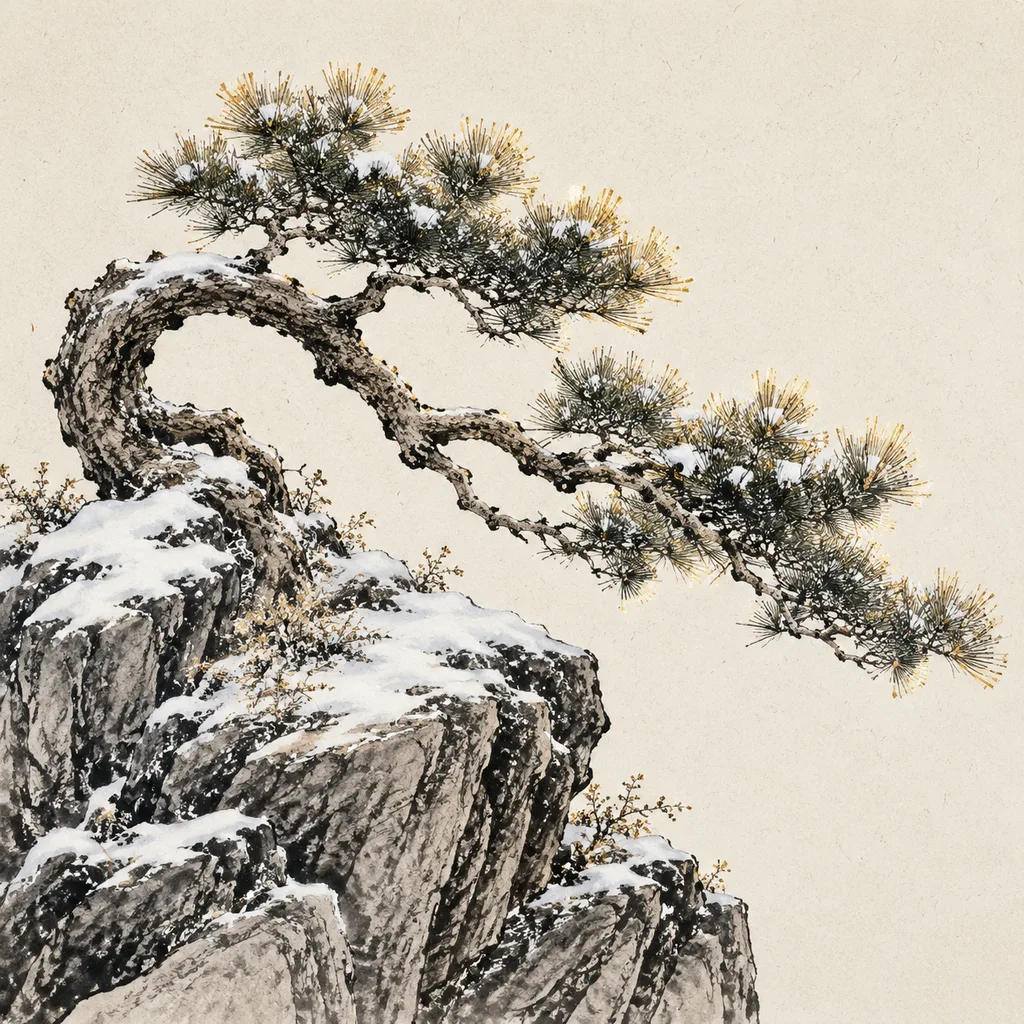
松柏木 (Sōng Bǎi Mù), or Pine-Wood, is the NaYin associated with the heavenly stems Geng Yin (1950, 2010) and Xin Mao (1951, 2011). The name evokes a lone pine tree rooted on a windswept cliff, its dark green needles holding fast through snow and ice while lesser trees shed their leaves. This image was chosen deliberately by ancient Chinese astrologers: Pine-Wood is not a forest—it is an individual standing against the elements. Its wood is dense and fragrant, its branches noble and unyielding. Where other woods bend or break, Pine-Wood endures, its color deepening in winter. This page explores the essence of this resilient NaYin, its classical foundations, personality traits, life applications, and the two distinct pillars that embody its energy.
Pine-Wood represents unshakable integrity in adversity.
The classical text 《三命通会》 (San Ming Tong Hui) by Ming dynasty scholar Wan Min Ying (1587) states: '松柏木者,泼雪凑霜,参天覆...
Those born under Pine-Wood carry a quiet, formidable presence.
| NaYin Name | Pine-Wood (松柏木) |
| Element | Wood (木) |
| Ganzhi Pillars | 庚寅, 辛卯 (Yang Metal, Yin Metal) Stems |
| Associated Animals | Tiger, Rabbit |
| Years in 60-Year Cycle | 1950, 2010, 1951, 2011 |
| Classical Source | 《三命通会》明·万民英,1587 · 卷一「纳音木」/ 卷一「释六十甲子性质吉凶」/ 阎东叟注 |
Key Takeaways
- Pine-Wood represents enduring character — evergreen strength that adversity reveals rather than destroys.
- This NaYin describes people who are most themselves when conditions are hardest.
- The pine metaphor carries a gentle reminder: even evergreens need water and soil.
- Classical texts describe trees that keep their color after winter comes, fragrant and unyielding.
What Pine-Wood Truly Represents
Pine-Wood represents unshakable integrity in adversity. The pine does not grow in fertile valleys alongside oaks and elms; it clings to rocky precipices, its roots cracking stone. When storms arrive, the pine does not bow—it sheds snow by flexing its branches, then snaps back upright. This is not the camaraderie of Forest-Wood, which thrives in community, nor the elastic adaptability of Willow-Wood, which bends with every breeze. Pine-Wood stands alone and endures. Winter does not defeat it—winter reveals it. As other trees go dormant and gray, the pine’s green becomes more vivid, more defiant. In human terms, this energy forges characters of profound loyalty and moral clarity. They do not seek approval or comfort; they seek purpose. Yet this solitude can become isolation, and their rigidity may crack before it bends. The pine’s lesson is that true strength is not about never yielding, but about knowing what must never be surrendered.
The Classical Record
The classical text 《三命通会》 (San Ming Tong Hui) by Ming dynasty scholar Wan Min Ying (1587) states: '松柏木者,泼雪凑霜,参天覆地,风撼笙篁之奏,雨余旌旆之张,此木藏居金下,位列正东,乃为极旺。' Translated: 'Pine-Wood splashes through snow and gathers frost, rising to canopy the sky and shelter the earth; wind shakes it like pipes in chorus, and after rain it spreads like banners unfurled. This wood hides beneath metal, stands at the due east, and is thus of utmost strength.' This passage emphasizes that Pine-Wood’s essence is immutable. The concept of qi here is one of unyielding vitality—a life force that persists regardless of external pressure. The text further notes that Geng Yin wood is 'enduring through winter,' and that metal's control does not destroy its nature. Yan Dongsou's commentary adds that Geng Yin is 'a solid wood that does not fear punishment or harm,' while Xin Mao is 'self-renewing wood that reaches for the clouds, unafraid of frost.' The Yu Xiao Bao Jian records no additional comment for this NaYin.
松柏木者,泼雪凑霜,参天覆地,风撼笙篁之奏,雨余旌旆之张,此木藏居金下,位列正东,乃为极旺。
— 《三命通会》明·万民英,1587 · 卷一「纳音木」/ 卷一「释六十甲子性质吉凶」/ 阎东叟注
庚寅: 庚寅,岁寒之木。雪霜无以改其操,况金能克之乎?上有庚辛,不假制治,自然成材。
Yan Dongsou: “庚寅地备奇,不避刑冲,宁辞衰败,乃五行坚实之木。若得和柔之气,德贵相符,必作显扬大用。”
辛卯: 辛卯,阎东叟云:辛卯木自旺,春夏则气节挺拔,建功立事;生于秋,则狂狷折挫,劲气不伸。
Yan Dongsou: “辛卯木自旺,春夏则气节挺拔,建功立事;生于秋则狂狷折挫,劲气不伸。”
The Inner Landscape
Those born under Pine-Wood carry a quiet, formidable presence. They are not flashy; their strength is felt rather than displayed. Consider the pattern we see in someone born under Pine-Wood: they typically grow up feeling different, often shouldering responsibilities early or holding principles that set them apart from peers. They may face a major setback in young adulthood—a financial collapse, a career failure, or a personal betrayal—that would break others. Before this turning point, they are perhaps overly rigid, expecting the world to match their standards. After, they learn that endurance is not about stubbornness but about selective yielding while preserving core values. They become the person others turn to in crisis, not because they offer easy comfort, but because they offer unwavering support. Their challenge is intimacy: like the pine, they stand alone, and their strength can feel intimidating or remote. They must learn that vulnerability is not weakness—that even the pine bends in the fiercest gale to avoid snapping. Strengths include integrity, perseverance, and a natural authority. Weaknesses include stubbornness, loneliness, and a tendency to judge those who bend too easily.
Work, Money, and Love under Pine-Wood
In career, Pine-Wood individuals gravitate toward roles that require backbone: judges, surgeons, military officers, engineers, or architects—professions that demand precision and moral clarity. They thrive in environments where they can stand firm against pressure, such as crisis management or long-term research. Financially, they are conservative and steady, building wealth slowly like rings in a tree. They distrust quick gains and prefer assets that endure—real estate, precious metals, or established businesses. However, they may hoard resources out of fear of scarcity, and need to learn that generosity does not deplete them. In love, Pine-Wood seeks a partner who respects their need for independence. They are slow to commit, but once bonded, fiercely loyal. Their ideal partner is someone who can weather storms beside them without trying to change their nature. Relationships that feel like a safe harbor work best; those that demand constant emotional expression may frustrate them. They express love through acts of protection and provision rather than words. A Pine-Wood partner will stand by you in your darkest hour, but may forget to say 'I love you' on a sunny day.
Two Doorways into Pine-Wood
Pine-Wood appears in two pillars: 庚寅 (Geng Yin, Tiger) and 辛卯 (Xin Mao, Rabbit). Geng Yin (years ending in 0, e.g., 1950, 2010) carries a robust, assertive energy. The stem Geng is Metal, which carves and shapes the Wood—this Pine-Wood is often hewn into something grand. Zhang Yimou, born 1950, exemplifies this: his films are meticulously structured, visually striking, and enduring in cultural impact. The Tiger adds courage and a pioneering spirit; these individuals may stand alone at the forefront of their field. Xin Mao (years ending in 1, e.g., 1951, 2011) has a more refined, resilient quality. Xin is also Metal, but delicate like jewelry, polishing the Wood rather than cutting it. This Pine-Wood is self-renewing, as Yan Dongsou notes: 'born in spring and summer, it rises with vigor; born in autumn, it is thwarted yet retains its spirit.' Notable figures include Robin Williams (1951), whose inner storms coexisted with brilliant creativity, and Jeff Bezos (1964), who built an empire on relentless endurance. The Rabbit lends diplomacy and subtlety; these individuals often withstand challenges through quiet persistence rather than frontal assault.
Embracing Your Pine-Wood Nature
Pine-Wood teaches that true nobility is not about never falling, but about standing up again, scarred but unchanged at the core. Its wisdom is for those who feel the weight of solitude in their convictions: endurance is its own reward. You do not need to be flexible for everyone; you need only know which winters are worth weathering. If you have felt this unyielding green within you, it may be the energy of Pine-Wood in your chart. To discover whether this energy appears in your chart, explore your full BaZi reading.
Discover whether Pine-Wood appears in your chart. Calculate your free BaZi reading →
Your birth data stays in your browser and is never stored or shared.
References & Classical Sources
This page draws on the following primary sources, cross-referenced with our in-house library of 16+ classical BaZi texts:
- San Ming Tong Hui (三命通会) — Wan Minying (万民英), Ming Dynasty, 1587. Volume 30, “On NaYin Imagery”. Core quote: “松柏木者,泼雪凑霜,参天覆地,风撼笙篁之奏,雨余旌旆之张,此木藏居金下,位列正东,乃为极旺。”
- Yu Xiao Bao Jian (玉霄宝鉴) — Song Dynasty. Supplementary notes on 松柏木 pillars.
- Yan Dongsou’s Commentary (阎东叟注) — Song Dynasty.
- Di Tian Sui (滴天髓) — Ming/Song Dynasty. Cross-referenced for Wood-element behavioral patterns.
- Zi Ping Zhen Quan (子平真诠) — Shen Xiaozhan, Qing Dynasty. Referenced for Nayin classification methodology.
All translations by the 12Zodiacs Editorial Team, reviewed against the original classical Chinese. Full methodology available on our Methodology page.
More in NaYin Elements
Creek Water · Forest Wood · Gold Leaf Metal · Hairpin Metal · Hearth Fire · Heavenly Water · Highway Earth · Lamp Fire