
Roof-Earth (屋上土)
屋上土 · One of the 30 NaYin elemental combinations
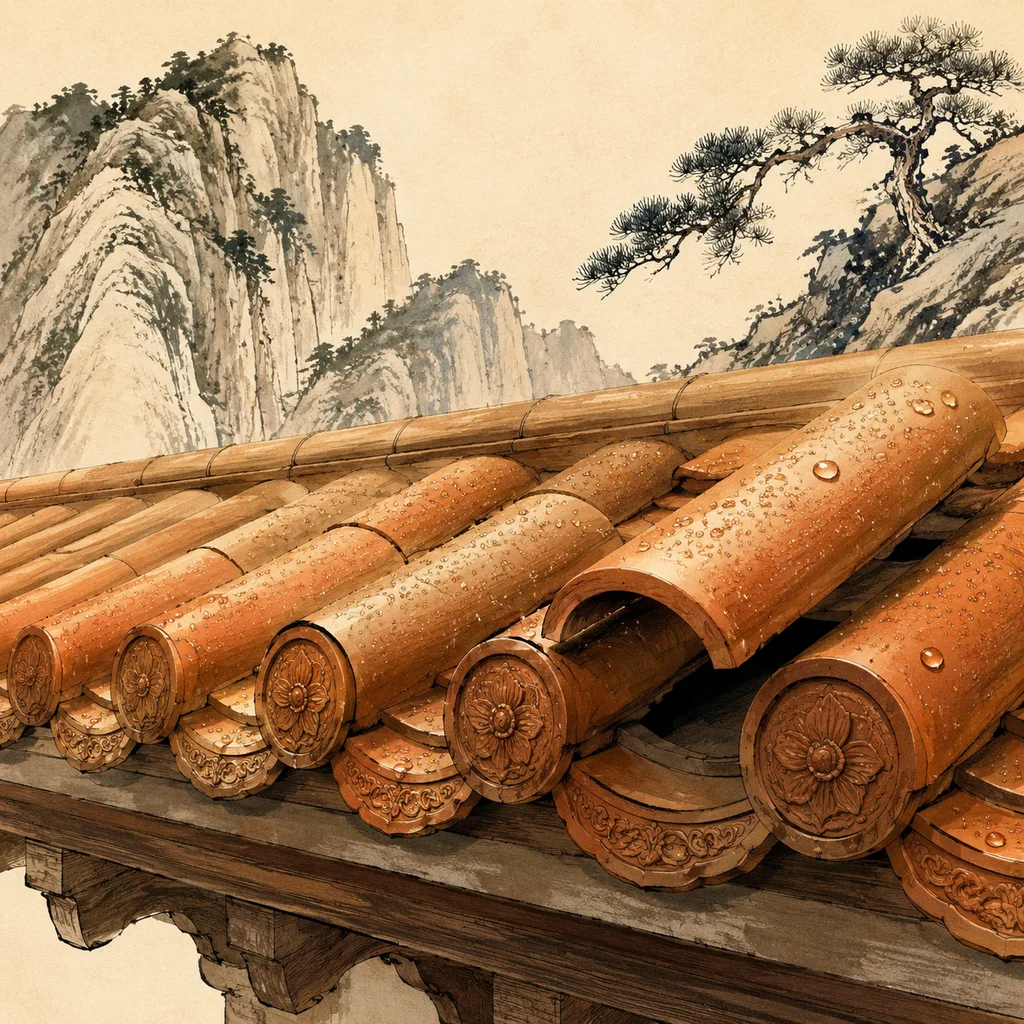
屋上土 (Roof-Earth) literally translates to 'Earth on the Roof.' This imagery evokes a scene of clay tiles layered overhead, fired hard in a kiln and set in place to shield a dwelling from rain, snow, and scorching sun. Ancient Chinese astrologers chose this metaphor to represent an Earth subtype that is not raw soil but refined, transformed by fire into a protective barrier. Unlike the packed ground underfoot or the fortress walls that enclose, Roof-Earth sits elevated, absorbing the brunt of weather so those below stay safe. This page explores the character, classical roots, personality traits, life applications, and the two pillar combinations that carry this unique NaYin.
Roof-Earth is processed earth—fired clay made into tiles.
The San Ming Tong Hui (三命通会) states: '屋上土者,埏埴为林,水火既济,盖蔽雪霜之积,震凌风雨之功,此土瓦也。非木无以架之,故以木为根基。' This means: 'R...
My teacher often emphasized that Roof-Earth is the most misunderstood of all NaYin types because people expect earth ...
| NaYin Name | Roof-Earth (屋上土) |
| Element | Earth (土) |
| Ganzhi Pillars | 丙戌, 丁亥 (Yang Fire, Yin Fire) Stems |
| Associated Animals | Dog, Pig |
| Years in 60-Year Cycle | 1946, 2006, 1947, 2007 |
| Classical Source | 《三命通会》明·万民英,1587 · 卷三十「论纳音取象」/ 《五行要论》 |
Key Takeaways
- Roof-Earth represents protective shelter — refined earth that has been shaped by fire to protect from above.
- This NaYin describes people who absorb hardship so others can live safely beneath their care.
- The roof metaphor acknowledges wear: even the strongest shelter needs repair over time.
- Classical texts describe earth that has achieved completion, resting in its finished form.
Unpacking the Image
Roof-Earth is processed earth—fired clay made into tiles. It does not lie on the ground like Roadside-Earth, nor does it form impenetrable walls like Wall-Earth. Instead, it perches above, a layer between sky and home. The image teaches that those with this NaYin are protectors rather than aggressors, taking hardships onto themselves so others can rest. They have been 'fired' by life's trials, gaining resilience and a weathered patience. A roof does not boast of its strength; it endures silently, year after year, while the household remains dry. This metaphor suggests a personality that is quietly responsible, often bearing burdens without complaint. The elevation also implies a certain distance—Roof-Earth people may seem aloof, but they are simply positioned to see the bigger picture. They are the ones who hold the structure together, not through force but through steadfast presence.
Wisdom from the Source Texts
The San Ming Tong Hui (三命通会) states: '屋上土者,埏埴为林,水火既济,盖蔽雪霜之积,震凌风雨之功,此土瓦也。非木无以架之,故以木为根基。' This means: 'Roof-Earth is clay shaped into tiles, formed through the harmonious interaction of water and fire. It covers and shelters from accumulated frost and snow, and withstands the assault of wind and rain. This is earthenware. Without wood to support it, it cannot be laid, so wood serves as its foundation.' The classic emphasizes that Roof-Earth is a refined product—neither raw earth nor finished structure alone. It requires water and fire to become tile, and wood (the roof beams) to hold it in place. The Yu Xiao Bao Jian commentary adds that this earth's qi is stable but elevated, making it suitable for protection and endurance. The source is Ming dynasty scholar Wan Minying, 1587.
屋上土者,埏埴为林,水火既济,盖蔽雪霜之积,震凌风雨之功,此土瓦也。非木无以架之,故以木为根基。
— 《三命通会》明·万民英,1587 · 卷三十「论纳音取象」/ 《五行要论》
丙戌: 丙戌,福壮禄厚之土,木不能克,忌见生旺之金,若遇火盛,则贵不可言。
丁亥: 丁亥,临官之土,木不能克,嫌金多,须得火生救之,乃吉。忌己亥、辛卯之木。
Who You Are When No One Is Looking
My teacher often emphasized that Roof-Earth is the most misunderstood of all NaYin types because people expect earth to be grounded and passive, yet Roof-Earth is anything but passive—it actively shields. When no one is looking, Roof-Earth individuals carry the weight of responsibility without seeking credit. Their strength is in endurance, not aggression. They have a calm exterior that can be mistaken for indifference, but inside they are deeply aware of others' needs. Challenges arise when they take on too much, forgetting that even a roof needs maintenance. They can become isolated, feeling that only they can handle the storms. Their greatest strength is reliability: like fired clay, they do not crack under pressure easily. They are natural protectors in families and organizations, often the silent pillar that holds everything together. However, they must learn to let others share the load, or risk becoming brittle from overwork.
Career Currents, Financial Tides, and Matters of the Heart
In career, Roof-Earth individuals thrive in roles that involve protection, oversight, or structural support—architecture, engineering, security, management, or any position where they can be the 'roof' for a team. Their financial tendencies are conservative; they prefer steady accumulation over risky ventures, much like a roof that endures all seasons. They are good savers but may hoard resources out of a sense of responsibility. In love, they are loyal and committed, often taking the role of the caretaker. They seek partners who appreciate their quiet devotion but also remind them to rest. A Roof-Earth person may struggle to express vulnerability, as they are used to being the strong one. Forging a relationship where both partners share the weather, so to speak, is key to their happiness.
The Twin Faces of Roof-Earth
The 丙戌 (Fire Dog) pillar embodies Roof-Earth with a strong fire component—stem of yang fire, branch of earth containing fire. This combination produces a bold, charismatic protector, like a roof that glows under the sun. Notable figures born in 1946 include Donald Trump, whose personality reflects the assertive, commanding aspect of this pillar. In contrast, 丁亥 (Fire Pig) features yin fire over water-bearing earth. This pillar yields a more introspective, creative shelter—like a roof that catches moonlight. Examples from 1947 are Stephen King, whose dark imagination weaves protective narratives, and Elton John, whose music provides emotional cover for millions. Hillary Clinton, also 1947, shows the diplomatic, strategic side. Both pillars share the protective instinct, but 丙戌 is more outward and forceful, while 丁亥 is subtle and enduring.
A Daily Practice for Roof-Earth
A daily practice for Roof-Earth is to consciously 'let the rain fall' on others once in a while. You are built to withstand storms, but you are not the only one who can hold a tile. Practice delegating and trusting others to share the load. Remember that a roof is part of a larger home—you are not alone. To discover whether this energy appears in your chart, explore your full BaZi reading.
Discover whether Roof-Earth appears in your chart. Calculate your free BaZi reading →
Your birth data stays in your browser and is never stored or shared.
References & Classical Sources
This page draws on the following primary sources, cross-referenced with our in-house library of 16+ classical BaZi texts:
- San Ming Tong Hui (三命通会) — Wan Minying (万民英), Ming Dynasty, 1587. Volume 30, “On NaYin Imagery”. Core quote: “屋上土者,埏埴为林,水火既济,盖蔽雪霜之积,震凌风雨之功,此土瓦也。非木无以架之,故以木为根基。”
- Yu Xiao Bao Jian (玉霄宝鉴) — Song Dynasty. Supplementary notes on 屋上土 pillars.
- Yan Dongsou’s Commentary (阎东叟注) — Song Dynasty.
- Di Tian Sui (滴天髓) — Ming/Song Dynasty. Cross-referenced for Earth-element behavioral patterns.
- Zi Ping Zhen Quan (子平真诠) — Shen Xiaozhan, Qing Dynasty. Referenced for Nayin classification methodology.
All translations by the 12Zodiacs Editorial Team, reviewed against the original classical Chinese. Full methodology available on our Methodology page.
More in NaYin Elements
Creek Water · Forest Wood · Gold Leaf Metal · Hairpin Metal · Hearth Fire · Heavenly Water · Highway Earth · Lamp Fire