
Heavenly-Water (天河水)
天河水 · One of the 30 NaYin elemental combinations
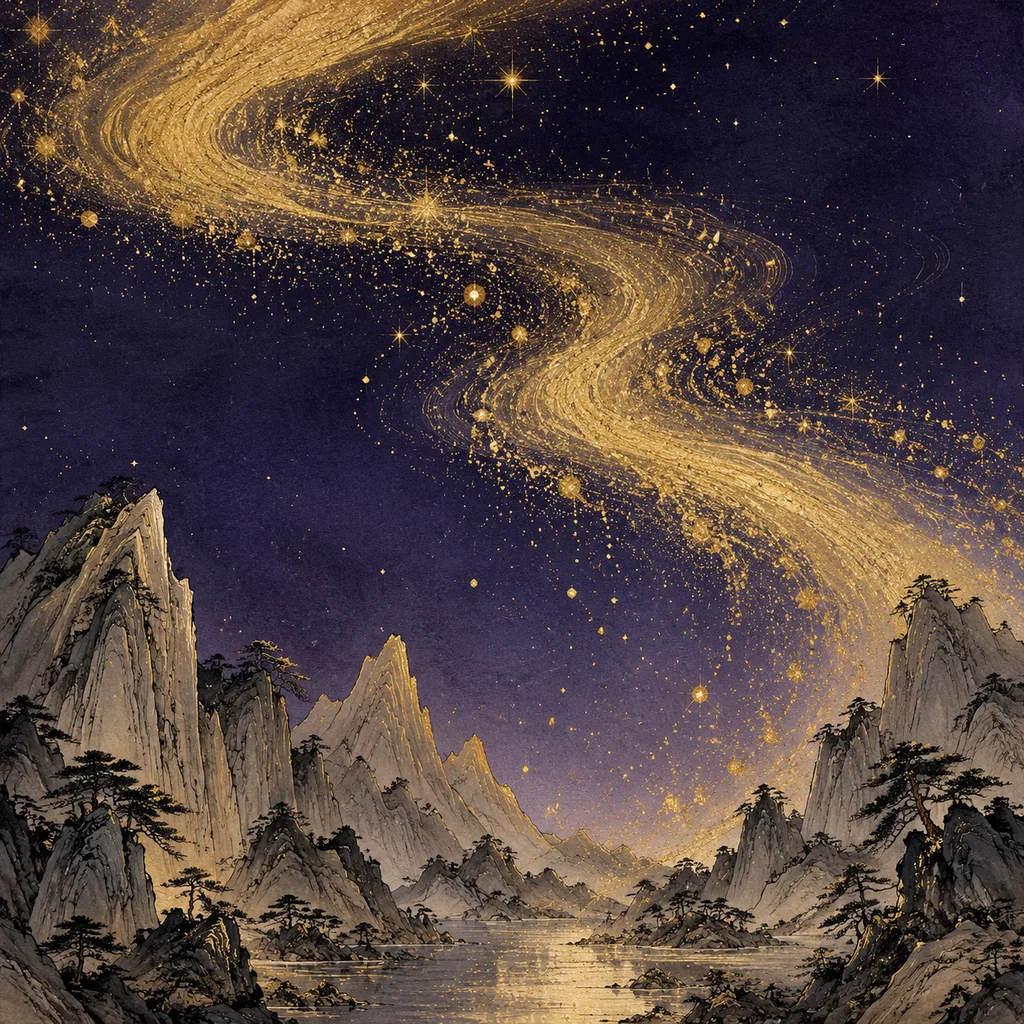
The term 'Heavenly-Water' (天河水) literally translates to 'River of Heaven' — the ancient Chinese name for the Milky Way. Imagine rain falling from the highest clouds, a celestial cascade that nourishes the earth without warning or demand. This is not a river you can trace to a source or a spring you can tap. It appears when the heavens decree, a timely blessing that arrives as a gentle shower or a life-giving storm. For those born under this NaYin, life mirrors this pattern: blessings come unexpectedly, and their presence is felt as a grace that cannot be forced. This page explores the essence, classical roots, personality traits, life applications, and the two pillar combinations of Heavenly-Water, revealing how this celestial energy shapes destiny.
Heavenly-Water embodies the paradox of being both visible and unreachable.
The San Ming Tong Hui (三命通会) by Ming scholar Wan Minying (1587) states: '天河水者,乱洒六野,密沛千郊,淋淋泻下银河,细细飞来碧落。' Thi...
Those graced with Heavenly-Water energy often possess an ethereal quality — they seem touched by something beyond the...
| NaYin Name | Heavenly-Water (天河水) |
| Element | Water (水) |
| Ganzhi Pillars | 丙午, 丁未 (Yang Fire, Yin Fire) Stems |
| Associated Animals | Horse, Goat |
| Years in 60-Year Cycle | 1906, 1966, 2026, 1907, 1967, 2027 |
| Classical Source | 《三命通会》明·万民英,1587 · 卷三十「论纳音取象」 |
Key Takeaways
- Heavenly-Water represents timely grace — nourishment that arrives from above at exactly the right moment.
- This NaYin describes people who show up in others’ lives precisely when they’re needed most.
- The celestial metaphor teaches: you don’t control the rain. Trust that your timing is divinely guided.
- Classical texts describe water from the highest fire position — rain that falls as blessing, existing only in heaven.
The Essence of Heavenly-Water
Heavenly-Water embodies the paradox of being both visible and unreachable. Unlike the Spring-Water (泉中水) that burbles from underground springs or the River-Water (大溪水) that flows in predictable channels, Heavenly-Water exists only in the sky, manifesting as rain, mist, or the starry river across the night. Its essence is that of a benefactor who gives without being asked — a sudden downpour that ends a drought, a cool drizzle on a scorching day. In character, this translates to a person who brings relief and inspiration to others, often arriving just when needed. Yet the water cannot be hoarded or channeled; attempts to control it lead only to frustration. Those with this energy must learn to trust in timing and accept that their gifts are meant to flow freely, not to be stored. The image teaches that true value lies in appearing at the right moment, not in constant presence.
Voices from the Classics
The San Ming Tong Hui (三命通会) by Ming scholar Wan Minying (1587) states: '天河水者,乱洒六野,密沛千郊,淋淋泻下银河,细细飞来碧落。' This translates to: 'Heavenly-Water scatters freely across the six wilds, pouring densely upon a thousand suburbs—streaming down from the Silver River, drifting fine as azure mist.' The passage highlights the principle of celestial giving: this water does not rise from earthly springs; it descends from the sky, nourishing all beneath it at heaven's own timing. This shows how Heavenly-Water appears as grace from above—arriving when the season calls, never when hoarded. The Yu Xiao Bao Jian adds that this water is pure and cannot be corrupted by earthly elements. The classical source thus frames Heavenly-Water as a celestial phenomenon born of natural cycles, not human effort.
天河水者,乱洒六野,密沛千郊,淋淋泻下银河,细细飞来碧落。
— 《三命通会》明·万民英,1587 · 卷三十「论纳音取象」
丙午: 丙午,天上之水,银汉有之,即十二辰之天后也,得之者高明豁达,颖异不凡。
丁未: 丁未,银汉之水,土不能克,天上之水,地金不能生也。
Character and Temperament
Those graced with Heavenly-Water energy often possess an ethereal quality — they seem touched by something beyond the mundane. Unlike the River-Water (大溪水) personality, which is steady, persistent, and carves its own path over time, the Heavenly-Water person is more intermittent and dramatic. They appear in others' lives as a sudden inspiration or timely help, then recede just as quickly. Their presence is felt as a blessing, but they resist being tied down to routine. Strengths include a natural ability to uplift and purify situations, a keen intuition for when to act, and a generosity that expects no return. However, challenges arise from their unpredictability: they may struggle with commitment, feel misunderstood when they withdraw, or become frustrated when others try to pin them down. Like rain, they can be refreshing but also overwhelming if they pour too much at once. Learning to modulate their flow — to know when to pour and when to pause — is their key growth edge.
Heavenly-Water in Career, Wealth, and Relationships
In career, Heavenly-Water individuals thrive in roles that involve timely intervention or inspiration: crisis management, teaching, mentoring, creative arts, or any field where they can offer sudden insights or solutions. They are often drawn to work that feels like a calling rather than a job. Financially, money comes and goes in waves — windfalls are common, but so are periods of scarcity. They are not natural savers; their wealth tends to flow through them to others. Investing in causes or projects that align with their values feels natural. In love, they attract partners who admire their luminous quality but may struggle with their elusiveness. Relationships need space for mystery and spontaneity; too much structure suffocates the connection. Partnership with someone who understands the value of absence and return — like a gardener who welcomes rain but doesn't demand it — creates lasting harmony. The key is to find a balance between being a gift and being present.
The Two Pillars of Heavenly-Water
Heavenly-Water manifests in two distinct pillar combinations, each colored by its earthly branch. The 丙午 (Bing-Wu, Horse) pillar, associated with years 1906, 1966, 2026, combines Fire stem and Fire branch, making the water especially pure and radiant. This water is 'the clearest of Heavenly-Water' — it cannot be extinguished by ordinary forces and shines like a star. Notable figures include Adam Sandler and Halle Berry, both born in 1966, whose careers reflect a blend of brilliance and unpredictability. The 丁未 (Ding-Wei, Goat) pillar, covering 1907, 1967, 2027, has a Fire stem and Earth branch, where the water is stored in a reservoir (庫). This water is more contained, like a deep well of celestial dew. Notable individuals include Julia Roberts, Nicole Kidman, and Frida Kahlo — all artists whose work draws from inner depths. The Horse pillar expresses outward radiance; the Goat pillar holds latent power that emerges in bursts.
Living with Heavenly-Water Energy
Living with Heavenly-Water energy means embracing the rhythm of arrival and retreat. The practical wisdom is to trust that your presence has impact even when you are not constantly visible. Like rain that nourishes and then evaporates, your gifts are no less real for being intermittent. Cultivate patience with your own cycles and allow others the same grace. To discover whether this energy appears in your chart, explore your full BaZi reading.
Discover whether Heavenly-Water appears in your chart. Calculate your free BaZi reading →
Your birth data stays in your browser and is never stored or shared.
References & Classical Sources
This page draws on the following primary sources, cross-referenced with our in-house library of 16+ classical BaZi texts:
- San Ming Tong Hui (三命通会) — Wan Minying (万民英), Ming Dynasty, 1587. Volume 30, “On NaYin Imagery”. Core quote: “天河水者,乱洒六野,密沛千郊,淋淋泻下银河,细细飞来碧落。”
- Yu Xiao Bao Jian (玉霄宝鉴) — Song Dynasty. Supplementary notes on 天河水 pillars.
- Yan Dongsou’s Commentary (阎东叟注) — Song Dynasty.
- Di Tian Sui (滴天髓) — Ming/Song Dynasty. Cross-referenced for Water-element behavioral patterns.
- Zi Ping Zhen Quan (子平真诠) — Shen Xiaozhan, Qing Dynasty. Referenced for Nayin classification methodology.
All translations by the 12Zodiacs Editorial Team, reviewed against the original classical Chinese. Full methodology available on our Methodology page.
More in NaYin Elements
Creek Water · Forest Wood · Gold Leaf Metal · Hairpin Metal · Hearth Fire · Highway Earth · Lamp Fire · Lightning Fire