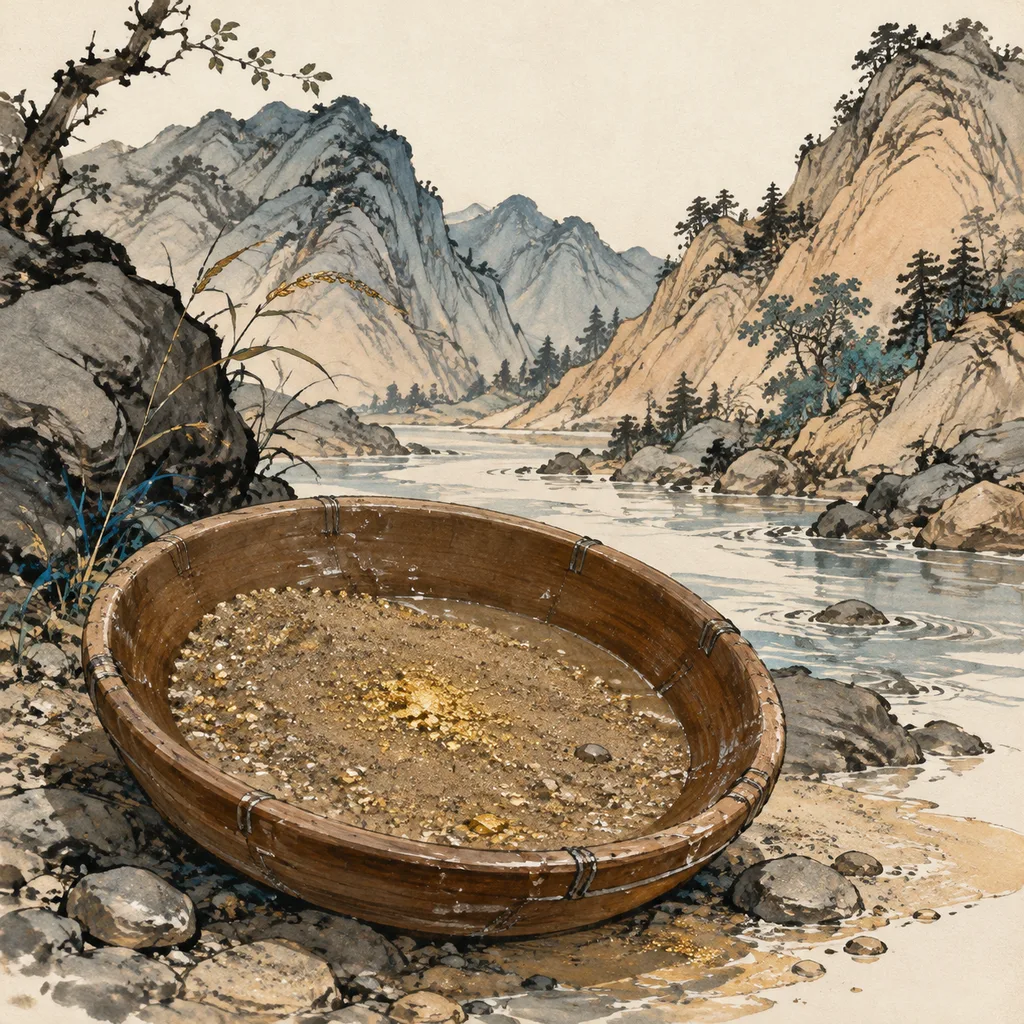
Sand-Metal, or 沙中金, translates literally to 'gold amidst sand.' The image evokes a riverbank where fine grains of gold lie hidden among silt and gravel—real treasure, but requiring patient washing to reveal its luster. Ancient astrologers chose this metaphor for a Metal subtype that is not hidden deep underground like Sea-Metal, nor already forged into a blade like Sword-Metal. Instead, Sand-Metal is accessible yet mixed with impurity. The gold is genuine, but one must separate it from the sand. This page explores the character, classical roots, personality traits, life applications, and pillar manifestations of this unique nayin, guiding you to recognize the value that emerges through careful refinement.
1
Unpacking the ImagenThe image of Sand-Metal teaches that worth is often obscured by outer layers. Like gold panned from river silt, individuals with this nayin possess authentic value that may not be immediately obvious. The sand represents distractions, superficiality, or challenges that must be sifted through. A second metaphor: treasure hidden in alluvial deposits—the gold is scattered, requiring diligence to gather. This is not ocean-submerged metal, which is deep and inaccessible; nor is it fully forged metal, which is already shaped. Sand-Metal is available but demands patient separation. The character is one of latent brilliance: the metal is real, but it coexists with grit. Patience and discernment are key; rushing leads to missing the gold entirely. In life, these individuals must learn to wash away the unnecessary, focusing on what is genuine.nnWisdom from the Source TextsnThe core meaning from the classic San Ming Tong Hui states: '砂中金者,刚形布地,宝质藏砂,直教淘洗为珍,必须因人始贵。' This translates to: 'Sand-Metal has its hard form spread across the earth, its precious essence hidden in the sands; only washing makes it a treasure, and only the right patron makes it honored.' The quote emphasizes that Sand-Metal's purity is achieved through effort—the gold is not naturally exposed but requires active refinement. The qi here is one of hidden potential that manifests through process. Yu Xiao Bao Jian adds that Sand-Metal 'is like gold in the river, waiting for the panner's hand.' This reinforces the idea that external circumstances and personal diligence are needed to unlock inherent value. The 'washing' represents life experiences that polish the individual. Thus, the classical wisdom sees Sand-Metal as a symbol of gradual self-realization.nnWho You Are When No One Is LookingnThose with Sand-Metal energy often possess a quiet, unassuming demeanor that belies a core of deep resilience. They may appear ordinary or even rough-edged on the surface, but those who take time to know them discover genuine loyalty and integrity. A key strength is their ability to persevere through difficulties; like gold that withstands the river's current, they endure hardship without losing their essence. However, a challenge is that they can become mired in self-doubt, mistaking the surrounding 'sand' for their own worth. In my years of reading charts, I've noticed that Sand-Metal-born individuals often have a pattern of downplaying their own achievements, as if they cannot fully accept that the gold is truly theirs. This humility is endearing but can hold them back. They need to learn to 'pan' their own experiences, recognizing the value they've accumulated.nnCareer Currents, Financial Tides, and Matters of the HeartnIn career, Sand-Metal individuals thrive in roles that involve refining, uncovering, or processing—such as gemology, archaeology, quality control, or any craft requiring meticulous attention. Their talent lies in seeing potential where others see waste. Financially, they may be cautious savers, but wealth tends to come gradually rather than through windfalls. They must guard against undervaluing their services, as their humble nature may lead to accepting less than they deserve. In love, they are loyal partners who build relationships slowly. The sand here represents initial misunderstandings or surface-level differences; once washed away, a deep, enduring bond emerges. They need patience from their partners and must learn to communicate their hidden depths. The imagery of treasure hidden in alluvial deposits applies: the relationship's true value reveals itself over time.nnThe Twin Faces of Sand-MetalnSand-Metal manifests differently depending on its pillar position. In the Year Pillar, it shapes one's early environment and family background—often a childhood where value was not immediately recognized but later proven. Celebrities born in such years often have humble beginnings that they later transcend. In the Month Pillar, Sand-Metal influences career and social standing; these individuals may work in industries that involve separation or refinement, and their professional life is a gradual process of earning respect. For example, those with Sand-Metal in the Month Pillar might be known for their steady rise rather than sudden fame. The image of gold in sand takes on nuances: in the Year Pillar, it suggests inherited potential waiting to be activated; in the Month Pillar, it emphasizes career as a process of extraction and polishing.nnnnnnRelated NaYin types:nSea-MetalWax-MetalMountain-Base-FireBaZi CalculatornnnA Daily Practice for Sand-MetalnThe practical wisdom of Sand-Metal is that your worth does not depend on immediate recognition. Like gold hidden in sand, your value is intrinsic but requires patient effort to reveal. Each day, practice sifting through your experiences: what is genuine? What is merely sand to be washed away? This mindset fosters resilience and self-trust. To discover whether this energy appears in your chart, explore your full BaZi reading.nnnDiscover whether Sand-Metal appears in your chart. Calculate your free BaZi reading →nYour birth data stays in your browser and is never stored or shared.nnnnReferences & Classical SourcesnnThis page draws on the following primary sources, cross-referenced with our in-house library of 16+ classical BaZi texts:nnSan Ming Tong Hui (三命通会) — Wan Minying (万民英), Ming Dynasty, 1587. Volume 30, “On NaYin Imagery”. Core quote: “砂中金者,刚形布地,宝质藏砂,直教淘洗为珍,必须因人始贵。”nYu Xiao Bao Jian (玉霄宝鉴) — Song Dynasty. Supplementary notes on 沙中金 pillars.nYan Dongsou’s Commentary (阎东叟注) — Song Dynasty.nDi Tian Sui (滴天髓) — Ming/Song Dynasty. Cross-referenced for Metal-element behavioral patterns.nZi Ping Zhen Quan (子平真诠) — Shen Xiaozhan, Qing Dynasty. Referenced for Nayin classification methodology.nnAll translations by the 12Zodiacs Editorial Team, reviewed against the original classical Chinese. Full methodology available on our Methodology page.nnnnnnnFrequently Asked QuestionsnCommon questions about Sand-Metal, answered by our BaZi research team.nnHow does Sand-Metal (沙中金) affect men specifically?Men born under the Sand-Metal (沙中金) nayin often display a reserved, even stoic exterior that masks a refined inner character. The sand-and-gold metaphor suggests they may initially seem unpolished or rough around the edges, but those who earn their trust discover deep integrity and loyalty. In traditional Chinese metaphysics, this nayin is considered more yin in nature, so such men may possess a gentle, patient demeanor rather than aggressive ambition. They often channel their energy into meticulous work or hobbies, finding satisfaction in uncovering hidden value—whether in antiques, minerals, or neglected projects. Their perseverance through hardship is a hallmark, but they must guard against being overlooked due to their unassuming presence. Relationships benefit when they learn to communicate their worth without waiting for others to discover it. Remember, nayin is one layer; a full BaZi analysis (including the four pillars) is needed for a complete picture.What character strengths and weaknesses come with Sand-Metal (沙中金)?Individuals with Sand-Metal (沙中金) destiny typically exhibit a quiet, unassuming nature that conceals a core of resilience and genuine worth. Like gold hidden in river silt, they may not seek the spotlight but possess authentic value that becomes evident over time. Key traits include patience, meticulousness, and a talent for seeing potential in overlooked places. They endure adversity without losing their essential integrity, much like gold withstands the river’s current. However, the ‘sand’ around them can manifest as external distractions or self-doubt, leading them to underestimate their own abilities. They are often loyal friends and partners, but their reserved communication style may be mistaken for aloofness. Creativity flows when they engage in refining or uncovering hidden treasures—whether in art, science, or people. While these tendencies are suggestive, a BaZi chart provides a more nuanced understanding.Why is Sand-Metal (沙中金) classified as a distinct NaYin category?Sand-Metal (沙中金) is unique because it represents metal that is not raw ore (like Sea-Metal) nor finished product (like Sword-Metal), but scattered nuggets awaiting collection and refinement. The image of gold in alluvial deposits emphasizes that value is present but requires active sifting—a process that mirrors the life path of those with this nayin. Unlike the hidden depth of Sea-Metal or the sharp clarity of Sword-Metal, Sand-Metal suggests a gradual revelation of worth through persistent effort. It is the only nayin that explicitly combines the themes of obscurity and scattered distribution. This makes it particularly suited to roles involving discovery, quality control, or restoration. The metaphor also imparts a life lesson: true treasure often lies beneath surface appearances, and patience in ‘washing away the sand’ reveals lasting brilliance. As with all nayin, this is one facet; the full BaZi chart gives the complete picture.Which professional paths align with Sand-Metal (沙中金) energy?Careers that involve refinement, discovery, or meticulous processing align well with Sand-Metal (沙中金) energy. Examples include gemology, archaeology, metallurgy, quality control, restoration of antiques or artworks, and forensic science—fields where hidden value is uncovered through careful technique. Their patience and eye for detail also suit roles in editing, data analysis, or auditing. They may excel as craftspeople, such as jewelers or watchmakers, who transform raw materials into something precious. The ‘sand’ aspect suggests they thrive in environments that require sifting through information or materials to find what matters. Financially, they are prudent savers rather than risk-takers, making them suited for roles in accounting or investment analysis. However, they should avoid careers that demand aggressive self-promotion. As with any nayin, career guidance is best integrated with the full BaZi chart for personalized advice.What should partners know about someone with Sand-Metal (沙中金)?In relationships, those with Sand-Metal (沙中金) energy often appear reserved initially, but once trust is established, they become deeply loyal and supportive partners. The ‘sand’ metaphor highlights that their true qualities may not be immediately visible, so potential partners need patience to appreciate their depth. They value stability and gradual growth over flashy romance. Compatibility in Chinese metaphysics considers the interaction of the five elements: Metal can be supported by Earth (which produces Metal) and challenged by Fire (which melts Metal). Thus, people with Earth nayin (e.g., Wall-Earth, Roadside-Earth) may harmonize well, while those with strong Fire nayin (e.g., Fire on the Mountain) could create tension. Water nayin can also help ‘wash the sand’ to reveal the gold. However, nayin is just one aspect; a full BaZi compatibility analysis examines the four pillars to assess relationship dynamics accurately.If I was born in these years, is Sand-Metal (沙中金) my NaYin?Sand-Metal (沙中金) corresponds to the Heavenly Stem and Earthly Branch combinations 甲午 (Jia Wu) and 乙未 (Yi Wei). In the Chinese sexagenary cycle, these occur every 60 years. The most recent 甲午 year was 2014, and the next will be 2074. The most recent 乙未 year was 2015, with the next in 2075. Therefore, individuals born in 1954 (甲午), 1955 (乙未), 2014 (甲午), and 2015 (乙未) fall under this nayin. It is important to note that the Chinese year begins around February 4–5 (Lichun), so anyone born in January or early February of those years should verify their exact lunar date. Also, nayin is just one component of a person’s destiny; the full BaZi chart, which includes year, month, day, and hour pillars, provides a comprehensive analysis.n
Related NaYin Pillars
The Sand-Metal (沙中金) resonance covers two pillars of the 60-year cycle:
2
NaYin Element
Sand-Metal (沙中金) carries the energy of metal.
3
Core Quality
Metal governs precision, discipline, and righteous judgment.
nnn
nn
nn
nn
n
NaYin Name
n
Sand-Metal (沙中金)
n
n
n
Element
n
Metal (金)
n
n
n
Ganzhi Pillars
n
()
n
n
n
Associated Animals
n
n
n
n
Years in 60-Year Cycle
n
See BaZi Calculator
n
n
n
Classical Source
n
《三命通会》明·万民英,1587
n
nn
nn
n
n🔑n
Key Takeaways
n
n
n
Sand-Metal represents inherent value discovered through patient refinement — gold mixed with gravel, real but requiring work to reveal.
n
This NaYin describes people who may feel overlooked early in life but whose worth is confirmed through testing.
n
The panning metaphor is hopeful: the sand eventually washes away. What remains is pure gold.
n
Classical texts describe metal formed and solid, mixed with sand, distinguishable but requiring separation.
n
n
nnnn
Unpacking the Image
n
The image of Sand-Metal teaches that worth is often obscured by outer layers. Like gold panned from river silt, individuals with this nayin possess authentic value that may not be immediately obvious. The sand represents distractions, superficiality, or challenges that must be sifted through. A second metaphor: treasure hidden in alluvial deposits—the gold is scattered, requiring diligence to gather. This is not ocean-submerged metal, which is deep and inaccessible; nor is it fully forged metal, which is already shaped. Sand-Metal is available but demands patient separation. The character is one of latent brilliance: the metal is real, but it coexists with grit. Patience and discernment are key; rushing leads to missing the gold entirely. In life, these individuals must learn to wash away the unnecessary, focusing on what is genuine.
nn
Wisdom from the Source Texts
n
The core meaning from the classic San Ming Tong Hui states: '砂中金者,刚形布地,宝质藏砂,直教淘洗为珍,必须因人始贵。' This translates to: 'Sand-Metal has its hard form spread across the earth, its precious essence hidden in the sands; only washing makes it a treasure, and only the right patron makes it honored.' The quote emphasizes that Sand-Metal's purity is achieved through effort—the gold is not naturally exposed but requires active refinement. The qi here is one of hidden potential that manifests through process. Yu Xiao Bao Jian adds that Sand-Metal 'is like gold in the river, waiting for the panner's hand.' This reinforces the idea that external circumstances and personal diligence are needed to unlock inherent value. The 'washing' represents life experiences that polish the individual. Thus, the classical wisdom sees Sand-Metal as a symbol of gradual self-realization.
nn
Who You Are When No One Is Looking
n
Those with Sand-Metal energy often possess a quiet, unassuming demeanor that belies a core of deep resilience. They may appear ordinary or even rough-edged on the surface, but those who take time to know them discover genuine loyalty and integrity. A key strength is their ability to persevere through difficulties; like gold that withstands the river's current, they endure hardship without losing their essence. However, a challenge is that they can become mired in self-doubt, mistaking the surrounding 'sand' for their own worth. In my years of reading charts, I've noticed that Sand-Metal-born individuals often have a pattern of downplaying their own achievements, as if they cannot fully accept that the gold is truly theirs. This humility is endearing but can hold them back. They need to learn to 'pan' their own experiences, recognizing the value they've accumulated.
nn
Career Currents, Financial Tides, and Matters of the Heart
n
In career, Sand-Metal individuals thrive in roles that involve refining, uncovering, or processing—such as gemology, archaeology, quality control, or any craft requiring meticulous attention. Their talent lies in seeing potential where others see waste. Financially, they may be cautious savers, but wealth tends to come gradually rather than through windfalls. They must guard against undervaluing their services, as their humble nature may lead to accepting less than they deserve. In love, they are loyal partners who build relationships slowly. The sand here represents initial misunderstandings or surface-level differences; once washed away, a deep, enduring bond emerges. They need patience from their partners and must learn to communicate their hidden depths. The imagery of treasure hidden in alluvial deposits applies: the relationship's true value reveals itself over time.
nn
The Twin Faces of Sand-Metal
n
Sand-Metal manifests differently depending on its pillar position. In the Year Pillar, it shapes one's early environment and family background—often a childhood where value was not immediately recognized but later proven. Celebrities born in such years often have humble beginnings that they later transcend. In the Month Pillar, Sand-Metal influences career and social standing; these individuals may work in industries that involve separation or refinement, and their professional life is a gradual process of earning respect. For example, those with Sand-Metal in the Month Pillar might be known for their steady rise rather than sudden fame. The image of gold in sand takes on nuances: in the Year Pillar, it suggests inherited potential waiting to be activated; in the Month Pillar, it emphasizes career as a process of extraction and polishing.
The practical wisdom of Sand-Metal is that your worth does not depend on immediate recognition. Like gold hidden in sand, your value is intrinsic but requires patient effort to reveal. Each day, practice sifting through your experiences: what is genuine? What is merely sand to be washed away? This mindset fosters resilience and self-trust. To discover whether this energy appears in your chart, explore your full BaZi reading.
Your birth data stays in your browser and is never stored or shared.
n
nnnReferences & Classical Sourcesn
n
This page draws on the following primary sources, cross-referenced with our in-house library of 16+ classical BaZi texts:
n
n
San Ming Tong Hui (三命通会) — Wan Minying (万民英), Ming Dynasty, 1587. Volume 30, “On NaYin Imagery”. Core quote: “砂中金者,刚形布地,宝质藏砂,直教淘洗为珍,必须因人始贵。”
n
Yu Xiao Bao Jian (玉霄宝鉴) — Song Dynasty. Supplementary notes on 沙中金 pillars.
n
Yan Dongsou’s Commentary (阎东叟注) — Song Dynasty.
n
Di Tian Sui (滴天髓) — Ming/Song Dynasty. Cross-referenced for Metal-element behavioral patterns.
n
Zi Ping Zhen Quan (子平真诠) — Shen Xiaozhan, Qing Dynasty. Referenced for Nayin classification methodology.
n
n
All translations by the 12Zodiacs Editorial Team, reviewed against the original classical Chinese. Full methodology available on our Methodology page.
n
nnn
nn
n
Frequently Asked Questions
n
Common questions about Sand-Metal, answered by our BaZi research team.
nn
How does Sand-Metal (沙中金) affect men specifically?
Men born under the Sand-Metal (沙中金) nayin often display a reserved, even stoic exterior that masks a refined inner character. The sand-and-gold metaphor suggests they may initially seem unpolished or rough around the edges, but those who earn their trust discover deep integrity and loyalty. In traditional Chinese metaphysics, this nayin is considered more yin in nature, so such men may possess a gentle, patient demeanor rather than aggressive ambition. They often channel their energy into meticulous work or hobbies, finding satisfaction in uncovering hidden value—whether in antiques, minerals, or neglected projects. Their perseverance through hardship is a hallmark, but they must guard against being overlooked due to their unassuming presence. Relationships benefit when they learn to communicate their worth without waiting for others to discover it. Remember, nayin is one layer; a full BaZi analysis (including the four pillars) is needed for a complete picture.
What character strengths and weaknesses come with Sand-Metal (沙中金)?
Individuals with Sand-Metal (沙中金) destiny typically exhibit a quiet, unassuming nature that conceals a core of resilience and genuine worth. Like gold hidden in river silt, they may not seek the spotlight but possess authentic value that becomes evident over time. Key traits include patience, meticulousness, and a talent for seeing potential in overlooked places. They endure adversity without losing their essential integrity, much like gold withstands the river’s current. However, the ‘sand’ around them can manifest as external distractions or self-doubt, leading them to underestimate their own abilities. They are often loyal friends and partners, but their reserved communication style may be mistaken for aloofness. Creativity flows when they engage in refining or uncovering hidden treasures—whether in art, science, or people. While these tendencies are suggestive, a BaZi chart provides a more nuanced understanding.
Why is Sand-Metal (沙中金) classified as a distinct NaYin category?
Sand-Metal (沙中金) is unique because it represents metal that is not raw ore (like Sea-Metal) nor finished product (like Sword-Metal), but scattered nuggets awaiting collection and refinement. The image of gold in alluvial deposits emphasizes that value is present but requires active sifting—a process that mirrors the life path of those with this nayin. Unlike the hidden depth of Sea-Metal or the sharp clarity of Sword-Metal, Sand-Metal suggests a gradual revelation of worth through persistent effort. It is the only nayin that explicitly combines the themes of obscurity and scattered distribution. This makes it particularly suited to roles involving discovery, quality control, or restoration. The metaphor also imparts a life lesson: true treasure often lies beneath surface appearances, and patience in ‘washing away the sand’ reveals lasting brilliance. As with all nayin, this is one facet; the full BaZi chart gives the complete picture.
Which professional paths align with Sand-Metal (沙中金) energy?
Careers that involve refinement, discovery, or meticulous processing align well with Sand-Metal (沙中金) energy. Examples include gemology, archaeology, metallurgy, quality control, restoration of antiques or artworks, and forensic science—fields where hidden value is uncovered through careful technique. Their patience and eye for detail also suit roles in editing, data analysis, or auditing. They may excel as craftspeople, such as jewelers or watchmakers, who transform raw materials into something precious. The ‘sand’ aspect suggests they thrive in environments that require sifting through information or materials to find what matters. Financially, they are prudent savers rather than risk-takers, making them suited for roles in accounting or investment analysis. However, they should avoid careers that demand aggressive self-promotion. As with any nayin, career guidance is best integrated with the full BaZi chart for personalized advice.
What should partners know about someone with Sand-Metal (沙中金)?
In relationships, those with Sand-Metal (沙中金) energy often appear reserved initially, but once trust is established, they become deeply loyal and supportive partners. The ‘sand’ metaphor highlights that their true qualities may not be immediately visible, so potential partners need patience to appreciate their depth. They value stability and gradual growth over flashy romance. Compatibility in Chinese metaphysics considers the interaction of the five elements: Metal can be supported by Earth (which produces Metal) and challenged by Fire (which melts Metal). Thus, people with Earth nayin (e.g., Wall-Earth, Roadside-Earth) may harmonize well, while those with strong Fire nayin (e.g., Fire on the Mountain) could create tension. Water nayin can also help ‘wash the sand’ to reveal the gold. However, nayin is just one aspect; a full BaZi compatibility analysis examines the four pillars to assess relationship dynamics accurately.
If I was born in these years, is Sand-Metal (沙中金) my NaYin?
Sand-Metal (沙中金) corresponds to the Heavenly Stem and Earthly Branch combinations 甲午 (Jia Wu) and 乙未 (Yi Wei). In the Chinese sexagenary cycle, these occur every 60 years. The most recent 甲午 year was 2014, and the next will be 2074. The most recent 乙未 year was 2015, with the next in 2075. Therefore, individuals born in 1954 (甲午), 1955 (乙未), 2014 (甲午), and 2015 (乙未) fall under this nayin. It is important to note that the Chinese year begins around February 4–5 (Lichun), so anyone born in January or early February of those years should verify their exact lunar date. Also, nayin is just one component of a person’s destiny; the full BaZi chart, which includes year, month, day, and hour pillars, provides a comprehensive analysis.
n
Related NaYin Pillars
The Sand-Metal (沙中金) resonance covers two pillars of the 60-year cycle:
Reviewed byMei Lin Chen, Editorial Lead & Cultural Translator
Last reviewed:
Our editorial team sources content from 16+ classical texts —
including San Ming Tong Hui, Yuan Hai Zi Ping, and
Di Tian Sui. Mei Lin Chen — Sun Yat-sen University history graduate with 15+ years of
family-lineage BaZi study — reviews every interpretation on this page.
Learn about our team →

 n
n