
Plain-Wood (平地木)
平地木 · One of the 30 NaYin elemental combinations
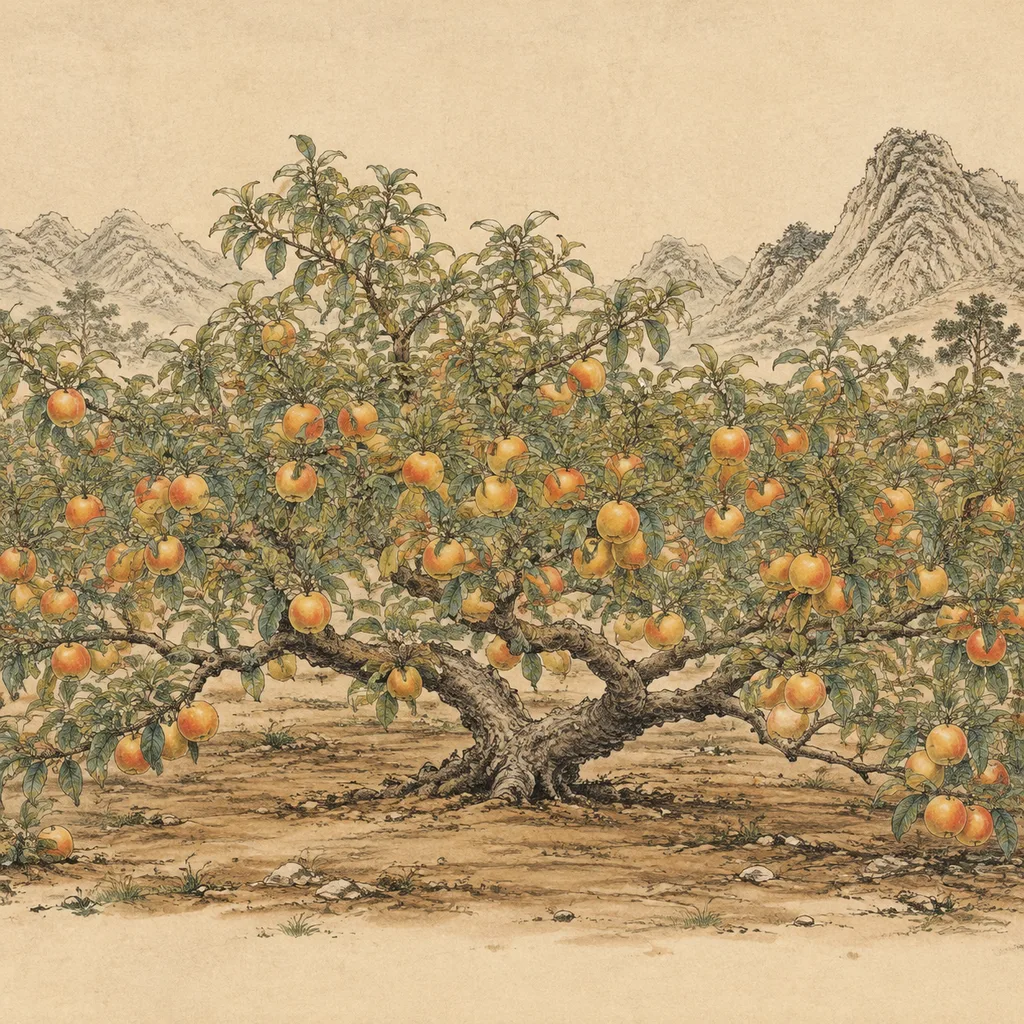
Plain-Wood (平地木, Píng Dì Mù) translates to 'level-ground wood'—a quiet orchard stretching across flat land, trees with branches low enough to touch, roots drinking from shallow soil. Unlike pine clinging to cliffs or forests towering overhead, Plain-Wood stays grounded. Ancient astrologers chose this image to describe a kind of Wood that serves the world not by rising above it, but by spreading wide, bearing fruit, and providing shelter. This page explores what it means to carry this energy: a personality rooted in practicality, a life built on steady contribution, and a spirit that finds greatness in the ordinary.
The image of an orchard on flat ground teaches humility and service.
The San Ming Tong Hui (三命通会) describes Plain-Wood as '初生萌蘖,始发枝条,唯资雨露之功,不喜雪霜之积,乃地上之茂材,人间之屋木。戊戌为栋,己亥为梁,最宜互换见之。...
Plain-Wood personalities are the quiet pillars of any group.
| NaYin Name | Plain-Wood (平地木) |
| Element | Wood (木) |
| Ganzhi Pillars | 戊戌, 己亥 (Yang Earth, Yin Earth) Stems |
| Associated Animals | Dog, Pig |
| Years in 60-Year Cycle | 1958, 2018, 1959, 2019 |
| Classical Source | 《三命通会》明·万民英,1587 · 卷三十「论纳音取象」/ 阎东叟注 |
Key Takeaways
- Plain-Wood represents grounded contentment — growth that finds satisfaction without striving for heights.
- This NaYin describes people whose quiet, practical contributions are no less valuable than dramatic peaks.
- The plains metaphor reframes: being ‘plain’ isn’t being less. Plains feed nations.
- Classical texts describe wood returning to roots, energy sealed in earth, growing in stillness.
Unpacking the Image
The image of an orchard on flat ground teaches humility and service. These trees do not compete for height; they grow broad, their branches forming canopies that shade travelers and offer fruit to passersby. Their roots spread horizontally, binding the soil and preventing erosion—a metaphor for the Plain-Wood person who strengthens communities by being dependable and nourishing. Unlike Forest-Wood, which rises in dense competition for sunlight, Plain-Wood grows in open, accessible spaces. And unlike Pine-Wood, which clings to rocky heights and endures storms alone, Plain-Wood thrives in the company of others, its value measured in yield, not altitude. To be Plain-Wood is to understand that true strength lies in what you provide, not what you conquer. The tree that feeds a village stands taller in legacy than any solitary peak.
Wisdom from the Source Texts
The San Ming Tong Hui (三命通会) describes Plain-Wood as '初生萌蘖,始发枝条,唯资雨露之功,不喜雪霜之积,乃地上之茂材,人间之屋木。戊戌为栋,己亥为梁,最宜互换见之。' This translates: 'Plain-Wood is a sprouting shoot, beginning to branch, relying solely on rain and dew, disliking accumulated frost and snow. It is lush timber on the ground, the house wood of the human world. WuXu is the ridgepole, JiHai is the beam; it is best if they exchange and see each other.' The passage highlights Plain-Wood's dependence on gentle nurturing (rain and dew) and its aversion to harsh conditions (frost and snow). As 'house wood,' it symbolizes the structural support of civilization—beams and pillars that hold up roofs. The qi of Plain-Wood is about foundational strength, not explosive growth. The Yu Xiao Bao Jian adds that Plain-Wood flourishes when supported by water elements and wilted by excessive fire. Properly understood, this Nayin teaches that true durability comes from rootedness and mutual support.
平地木者,初生萌蘖,始发枝条,唯资雨露之功,不喜雪霜之积,乃地上之茂材,人间之屋木。戊戌为栋,己亥为梁,最宜互换见之。
— 《三命通会》明·万民英,1587 · 卷三十「论纳音取象」/ 阎东叟注
戊戌: 戊戌,土中之木,忌重见土,若纳音土多,一生屯蹇,金不能克,盖金气至戌而散,遇金乃能致福。
Yan Dongsou: “戊戌之木,孤根独立,和之以水火旺气,则有英明秀实之德,入格则文章进达,福禄始终,然乘天将之气,主备历艰险,节操不移,方见晚福。”
己亥: 己亥,自生之木,根本繁盛,不忌众金,惟嫌辛亥、辛巳、癸酉之金。
Who You Are When No One Is Looking
Plain-Wood personalities are the quiet pillars of any group. They possess a grounded reliability that others instinctively trust, much like the orchard tree that offers shade without asking for recognition. Unlike Pine-Wood, which thrives on solitude and self-reliance, Plain-Wood people draw energy from community and collaboration. They are natural caretakers, often putting others' needs before their own, and they find fulfillment in tangible contributions—building, teaching, healing, or feeding. Their challenge lies in being taken for granted. Because they do not demand attention, others may overlook their needs. The metaphor warns: roots that give too much to the soil may themselves become depleted. Plain-Wood individuals must learn to set boundaries, to recognize when they are being overburdened, and to accept nourishment from others. Their strength is their accessibility, but that same openness can leave them vulnerable. When balanced, they are the steady force that families and organizations lean on, and their quiet competence earns lasting respect.
Career Currents, Financial Tides, and Matters of the Heart
In career, Plain-Wood thrives in roles that offer tangible service and structural support. Agriculture, education, healthcare, construction, and community organizing all resonate with this energy. These individuals excel as project managers, counselors, or artisans—professions where their patience and attention to detail shine. Financially, Plain-Wood tends toward caution and thrift. Like a tree that stores nutrients for lean seasons, they build savings slowly and dislike risk. However, their generous nature can lead to overspending on loved ones; they must guard against depleting their own reserves. In love, Plain-Wood seeks partnership that feels like a shared orchard—mutual cultivation, steady growth, and peaceful coexistence. They are devoted and attentive partners, but may struggle with partners who crave drama or constant excitement. They need someone who appreciates their steady presence and does not mistake their calm for indifference. The relationship that flourishes is one where both parties tend the roots, ensuring the bond remains nourished over time.
The Twin Faces of Plain-Wood
Plain-Wood appears in two pillar combinations, each adding a distinct flavor. WuXu (戊戌, years 1958, 2018) carries the image of a ridgepole—the central beam of a roof. People born under this pillar, like Michael Jackson and Madonna, often bear enormous responsibility and are thrust into the spotlight. The Dog's earth stem gives them a stubborn, resilient quality, but the Yan Dongsou commentary warns of a 'lonely root' that requires fire and water harmony to bloom. They may face significant early struggles before achieving stability. JiHai (己亥, years 1959, 2019) is the beam, a horizontal support that connects. Individuals like Kevin Spacey, Magic Johnson, Ronald Reagan, Hillary Clinton, and Justin Trudeau share this pillar. The Pig's earth stem nourishes the Wood, making it 'self-born' with abundant roots. However, the text cautions against excessive fire, which can incinerate this Wood. These personalities tend to be more adaptable and public-facing, using their connections to build influence. Both pillars share Plain-Wood's core of service, but WuXu leans toward solitary endurance, while JiHai thrives through relationships.
A Daily Practice for Plain-Wood
Each day, ask yourself: Am I growing wide or just tall? Plain-Wood teaches that lasting impact comes from spreading roots, not reaching for the sky. Take time to nurture the people and projects around you, but remember to drink the rain yourself. Your strength is in your availability, but even the sturdiest orchard needs rest. To discover whether this energy appears in your chart, explore your full BaZi reading.
Discover whether Plain-Wood appears in your chart. Calculate your free BaZi reading →
Your birth data stays in your browser and is never stored or shared.
References & Classical Sources
This page draws on the following primary sources, cross-referenced with our in-house library of 16+ classical BaZi texts:
- San Ming Tong Hui (三命通会) — Wan Minying (万民英), Ming Dynasty, 1587. Volume 30, “On NaYin Imagery”. Core quote: “平地木者,初生萌蘖,始发枝条,唯资雨露之功,不喜雪霜之积,乃地上之茂材,人间之屋木。戊戌为栋,己亥为梁,最宜互换见之。”
- Yu Xiao Bao Jian (玉霄宝鉴) — Song Dynasty. Supplementary notes on 平地木 pillars.
- Yan Dongsou’s Commentary (阎东叟注) — Song Dynasty.
- Di Tian Sui (滴天髓) — Ming/Song Dynasty. Cross-referenced for Wood-element behavioral patterns.
- Zi Ping Zhen Quan (子平真诠) — Shen Xiaozhan, Qing Dynasty. Referenced for Nayin classification methodology.
All translations by the 12Zodiacs Editorial Team, reviewed against the original classical Chinese. Full methodology available on our Methodology page.
More in NaYin Elements
Creek Water · Forest Wood · Gold Leaf Metal · Hairpin Metal · Hearth Fire · Heavenly Water · Highway Earth · Lamp Fire