
Ocean-Water (大海水)
大海水 · One of the 30 NaYin elemental combinations
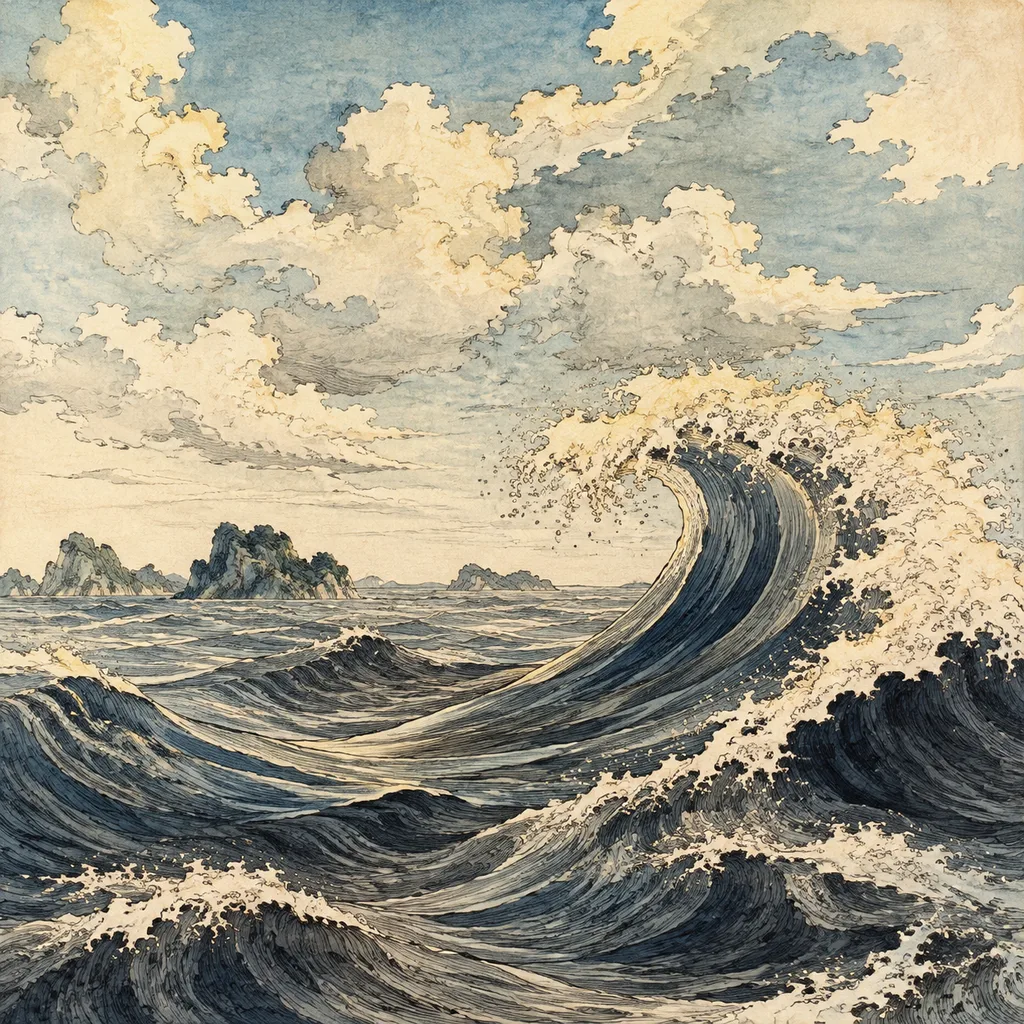
大海水, or Ocean-Water, is one of the thirty NaYin classifications in Chinese metaphysics. The name alone evokes a boundless, deep blue expanse—a scene of waves crashing against cliffs under a vast sky, water so deep it defies fathom. Ancient astrologers chose this metaphor to capture a specific type of Water energy: not the gentle stream or the lively creek, but the all-encompassing, still-yet-powerful ocean. This imagery hints at a personality that is vast in vision, accepting of all, yet immovable at its core. This page explores the symbolism, classical wisdom, personality traits, life applications, and the two pillar manifestations of Ocean-Water, revealing how this elemental subtype shapes those born under its influence.
The ocean accepts every river without discrimination—muddy, clear, raging, or gentle—yet remains itself, unchanged.
The San Ming Tong Hui (三命通会) describes Ocean-Water as '大海水者,总纳百川,汪洋无际,包括乾坤之大,升沉日月之光'—'Ocean-Water rece...
When no one is watching, an Ocean-Water person is like the sea at midnight—vast, reflective, and deeply introspective.
| NaYin Name | Ocean-Water (大海水) |
| Element | Water (水) |
| Ganzhi Pillars | 壬戌, 癸亥 (Yang Water, Yin Water) Stems |
| Associated Animals | Dog, Pig |
| Years in 60-Year Cycle | 1922, 1982, 1923, 1983 |
| Classical Source | 《三命通会》明·万民英,1587 · 卷三十「论纳音取象」 |
Key Takeaways
- Ocean-Water represents vast acceptance — boundless capacity to contain everything without being overwhelmed.
- This NaYin describes people with enormous patience and the ability to hold complexity others can’t.
- The ocean metaphor reminds: even oceans have shores and tides. You don’t need to contain everything forever.
- Classical texts describe water at heaven’s gate, energy sealed and still, inexhaustible in supply, impossible to overflow.
Unpacking the Image
The ocean accepts every river without discrimination—muddy, clear, raging, or gentle—yet remains itself, unchanged. This teaches that Ocean-Water individuals have a boundless capacity for acceptance. They can hold contradictions, absorb others' emotions, and still retain their own depth. Unlike a shallow stream that overflows with a little rain, the ocean's vastness means it takes a lot to disturb its peace. Another metaphor: the ocean's surface may be stormy, but deep down, it is utterly still. Ocean-Water people can appear turbulent on the outside while maintaining an unshakeable inner calm. They yield to nothing because, like the ocean, they are the final destination—everything flows to them. This gives them a quiet authority and a tendency to be all-embracing yet stubborn when pushed.
Wisdom from the Source Texts
The San Ming Tong Hui (三命通会) describes Ocean-Water as '大海水者,总纳百川,汪洋无际,包括乾坤之大,升沉日月之光'—'Ocean-Water receives all rivers within it, boundless and vast, embracing the magnitude of heaven and earth, bearing the rising and setting light of sun and moon.' This means Ocean-Water is the ultimate gathering force, a reservoir of all that flows. In classical thought, this NaYin embodies the qi of finality and containment. The Yu Xiao Bao Jian adds that such water is 'deep and calm, holding the essence of all streams.' The concept of qi here is about capacity: Ocean-Water holds the greatest potential for accumulation, but it also risks stagnation if not balanced by fire or earth. The per-pillar quotes further elaborate: 壬戌 is 'water at its coronation, incomparable, favoring fire and earth for support'; 癸亥 is 'water at its official position, where all waters converge, most fearing many earths.' This classical wisdom emphasizes the need for complementary elements to keep the ocean dynamic.
大海水者,总纳百川,汪洋无际,包括乾坤之大,升沉日月之光。
— 《三命通会》明·万民英,1587 · 卷三十「论纳音取象」
壬戌: 壬戌,癸亥水冠带戌,临官亥则力厚,兼亥为江,非他水比,故曰大海水。
癸亥: 癸亥,临官之水,名曰大海水,盖支干纳音皆水,忌见众水。
Who You Are When No One Is Looking
When no one is watching, an Ocean-Water person is like the sea at midnight—vast, reflective, and deeply introspective. They possess a quiet confidence that comes from knowing they hold immense depth. Unlike Stream-Water (涧下水), which is nimble and adaptive, constantly finding new paths, Ocean-Water stays still, letting the world come to it. Unlike Creek-Water (溪水), which babbles and sparkles in the sunlight, Ocean-Water is somber and serious, revealing its beauty only to those who dive deep. This makes them natural confidants and counselors; they absorb secrets without judgment. Their strength lies in their inclusivity and patience. However, their challenge is that they can become too passive, like a stagnant ocean—overwhelmed by what they take in, or too immovable to respond to change. They may also struggle with letting things go, holding onto emotions or grudges as the ocean holds its salt. Their depth can intimidate others, and they must learn to surface occasionally to connect.
Career Currents, Financial Tides, and Matters of the Heart
Career paths for Ocean-Water individuals naturally gravitate toward roles that involve containment, depth, and flow. They excel in psychology, counseling, research, maritime industries, or any field that requires holding complex information or managing large systems. Their financial tendencies mirror the tide: they can accumulate wealth steadily, like the ocean building sand, but they must guard against being too passive or generous, as the ocean gives freely. In love, they are like the deep current—loyal, protective, and all-accepting. They seek partners who appreciate their depth and do not fear their silence. However, they may struggle with expressing emotions overtly, preferring to show love through steadfast presence rather than words. Their partnerships thrive when both parties respect the need for personal space, just as the ocean has its own mysterious depths.
The Twin Faces of Ocean-Water
Ocean-Water manifests in two distinct pillar combinations: 壬戌 (Water-Yang, Earth branch Dog) and 癸亥 (Water-Yin, Earth branch Pig). 壬戌, associated with years like 1922 and 1982, is described as 'water at its coronation'—confident, incomparable, needing fire and earth for support. Notable figure Mao Anying (1922) exemplifies this pillar's noble yet vulnerable quality: born into vast influence but needing solid ground, his life ended tragically in war. 癸亥, for years 1923 and 1983, is 'water at its official position, where all waters converge, most fearing many earths.' This pillar is more receptive and fluid, as seen in Amy Winehouse (1983), whose immense artistic depth was both her glory and her undoing—drowning in the many earths (obstacles) of fame and personal struggles. While both share the oceanic vastness, 壬戌 is the open ocean with strong waves, while 癸亥 is the deep, still abyss that quietly absorbs everything.
A Daily Practice for Ocean-Water
To grow, Ocean-Water individuals need to honor both their depth and their need for motion. The ocean's health depends on currents, tides, and the occasional storm to churn nutrients from the depths. Similarly, you must invite movement into your life—new experiences, emotional releases, and occasional risks—to prevent stagnation. Your greatest gift is acceptance, but remember that the ocean also has boundaries: coasts and shores that define it. Learn to say no, to surface, and to let the sun evaporate some of what you hold. To discover whether this energy appears in your chart, explore your full BaZi reading.
Discover whether Ocean-Water appears in your chart. Calculate your free BaZi reading →
Your birth data stays in your browser and is never stored or shared.
References & Classical Sources
This page draws on the following primary sources, cross-referenced with our in-house library of 16+ classical BaZi texts:
- San Ming Tong Hui (三命通会) — Wan Minying (万民英), Ming Dynasty, 1587. Volume 30, “On NaYin Imagery”. Core quote: “大海水者,总纳百川,汪洋无际,包括乾坤之大,升沉日月之光。”
- Yu Xiao Bao Jian (玉霄宝鉴) — Song Dynasty. Supplementary notes on 大海水 pillars.
- Yan Dongsou’s Commentary (阎东叟注) — Song Dynasty.
- Di Tian Sui (滴天髓) — Ming/Song Dynasty. Cross-referenced for Water-element behavioral patterns.
- Zi Ping Zhen Quan (子平真诠) — Shen Xiaozhan, Qing Dynasty. Referenced for Nayin classification methodology.
All translations by the 12Zodiacs Editorial Team, reviewed against the original classical Chinese. Full methodology available on our Methodology page.
More in NaYin Elements
Creek Water · Forest Wood · Gold Leaf Metal · Hairpin Metal · Hearth Fire · Heavenly Water · Highway Earth · Lamp Fire