
Hearth-Fire (炉中火)
炉中火 · One of the 30 NaYin elemental combinations
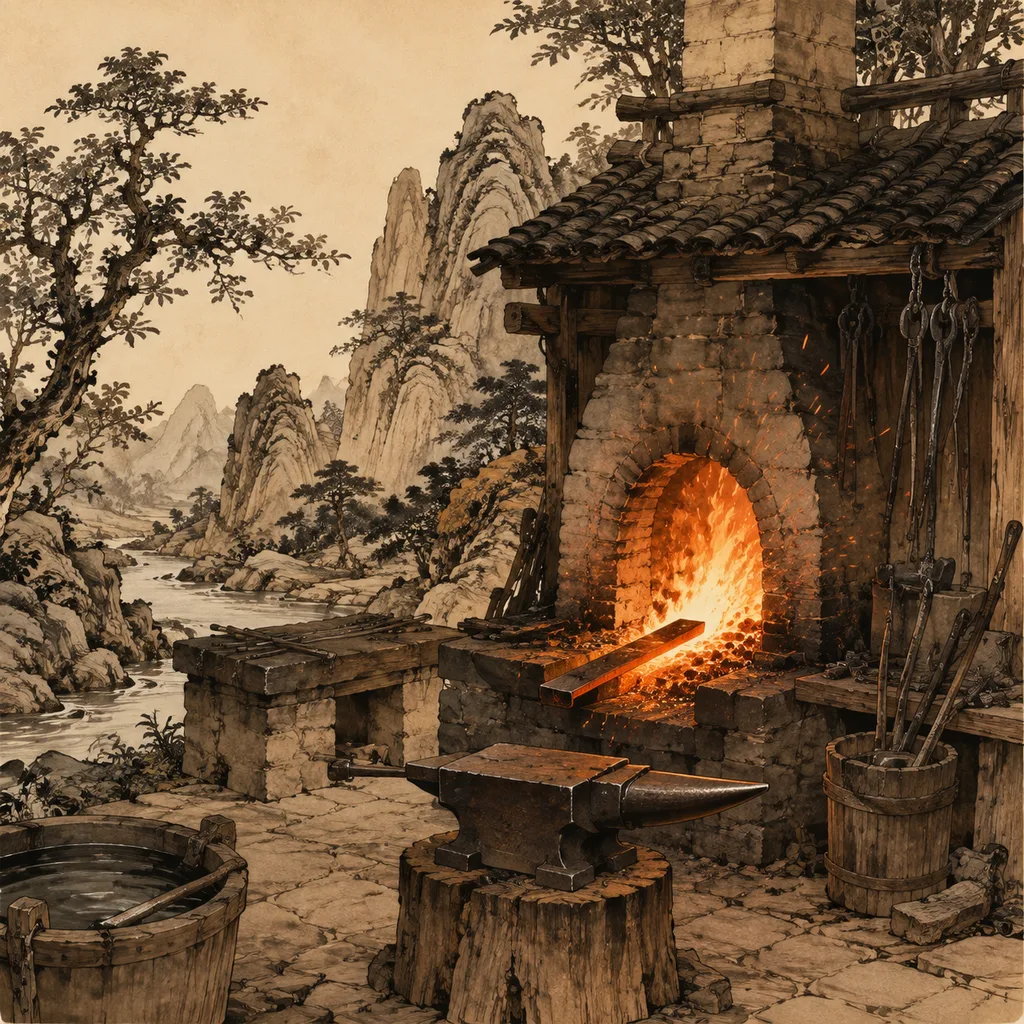
Hearth-Fire (炉中火) translates directly to 'stove fire' or 'furnace fire,' evoking the controlled blaze of a blacksmith's forge. This is not a wildfire that devours without purpose, nor a candle that flickers passively. It is fire with intention, fire that has been harnessed, channeled, and given a task—to transform raw ore into tempered steel. Ancient astrologers chose this metaphor because it captures a unique paradox: intense heat held in perfect restraint, creative power that must be wielded with discipline. This page explores Hearth-Fire's symbolism, its representation in classical texts, the personality it shapes, and how it influences career, finances, and relationships. Finally, we examine its two pillar expressions and offer a reflection on growth. Step into the forge and discover the transformative energy of Hearth-Fire.
Hearth-Fire represents creation through controlled destruction.
The San Ming Tong Hui (三命通会), compiled by Wan Mingying in 1587, describes Hearth-Fire in a single striking image: &#x...
Across hundreds of charts we've catalogued, Hearth-Fire-born individuals show a notable tendency toward careers ...
| NaYin Name | Hearth-Fire (炉中火) |
| Element | Fire (火) |
| Ganzhi Pillars | 丙寅, 丁卯 (Yang Fire, Yin Fire) Stems |
| Associated Animals | Tiger, Rabbit |
| Years in 60-Year Cycle | 1926, 1986, 1927, 1987 |
| Classical Source | 《三命通会》明·万民英,1587 · 卷三十「论纳音取象」 |
Key Takeaways
- Hearth-Fire represents passion that is powerful because it is contained and directed, not scattered.
- This NaYin describes people who channel intense energy into structured, productive work.
- The forge metaphor means transformation: they turn raw situations into useful outcomes.
- Classical texts compare this to heaven and earth as furnace, with yin and yang as the fuel.
What Hearth-Fire Truly Represents
Hearth-Fire represents creation through controlled destruction. Unlike wildfire that spreads chaos, or a lamp that merely illuminates, Hearth-Fire is fire with a mission: to break down ore to extract its essence, to soften metal so it can be reshaped. The blacksmith's forge is its perfect symbol—the bellows that stoke the flame, the anvil that receives the blow, the tongs that hold the work steady. This is fire that requires constant attention; neglect it and the forge grows cold, but tend it well and it produces tools that build civilizations. Those born under this nayin learn early that true power lies not in raw intensity but in the ability to direct that intensity toward a purpose. They are temperers, refiners, makers—people who understand that transformation always requires heat, pressure, and a steady hand. The hearth does not destroy for pleasure; it destroys to renew, to strengthen, to create something that outlasts the fire itself.
The Classical Record
The San Ming Tong Hui (三命通会), compiled by Wan Mingying in 1587, describes Hearth-Fire in a single striking image: '炉中火者,天地为炉,阴阳为炭,颓光辉耀,力可熔金。' In plain English: 'Hearth-Fire—heaven and earth serve as its furnace, yin and yang as its fuel; its light shines with a radiance that can melt metal.' This qian (energy) is not merely physical heat but a cosmic forging process. The 'furnace' is the world itself, and the 'fuel' is the interplay of opposites. The phrase '力可熔金' (power can melt metal) underscores its capacity to transform the most unyielding materials. Yan Dongsou's commentary adds dimension: for 丙寅, he calls it '赫曦之火' (blazing fire) that needs water to avoid burning out of control; for 丁卯, he speaks of '伏明之火' (hidden, subdued fire) that depends on wood to sustain its flame. Together, these classical voices paint Hearth-Fire as a force of refinement—neither wild nor weak, but purposeful.
炉中火者,天地为炉,阴阳为炭,颓光辉耀,力可熔金。
— 《三命通会》明·万民英,1587 · 卷三十「论纳音取象」
丙寅: 丙寅,赫曦之火,无水制之,则有燔灼炎烈之患,水不可过,独爱甲寅之水,就位济之。
Yan Dongsou: “丙寅火,为禄元佑,发声则吉,禀赫曦之气,四时不能为害,物极必反。”
丁卯: 丁卯,伏明之火,气弱宜木生之,遇水则凶,乙卯、乙酉水最毒。
Yan Dongsou: “丁卯火,不如丙寅赫曦之旺,为伏明之火,但借木气以生。”
The Inner Landscape
Across hundreds of charts we've catalogued, Hearth-Fire-born individuals show a notable tendency toward careers that involve shaping, refining, or mentoring—fields where raw potential is transformed into skill. The forge is their inner landscape. At their best, they are passionate but disciplined, intense yet controlled. They possess a quiet intensity that others find magnetic; they speak with deliberation, as if each word has been hammered on an anvil. Challenges arise when the fire burns too hot—anger that flares before reason can intervene, or a tendency to consume themselves in their own projects. The metaphor of the hearth offers a key insight: a forge must be tended, not abandoned. Rest and reflection are not laziness but necessary cooling periods. Hearth-Fire personalities can become overcritical, judging others (and themselves) by the same harsh standards they apply to metal. Yet this same discernment makes them excellent problem-solvers. They see the flaw in the ore, the weakness in the design, and they cannot rest until it is corrected. Their growth path lies in remembering that not everything needs to be forged; some things are already complete.
Work, Money, and Love under Hearth-Fire
In career, Hearth-Fire individuals gravitate toward roles that require transformation: engineers who design more efficient engines, surgeons who repair broken bodies, chefs who turn raw ingredients into art, or teachers who shape young minds. They thrive where precision meets passion. The financial tendency is toward careful investment—they will patiently build wealth rather than gamble on wild speculation. However, they must guard against the urge to hoard resources as if storing fuel for a long winter; money is meant to circulate like air through the bellows. In love, Hearth-Fire seeks a partner who understands their need for both closeness and autonomy. They are loyal and protective, but their intensity can overwhelm a more passive partner. The ideal match is someone who can withstand the heat without being consumed—a water or earth element that complements fire without extinguishing it. Relationships for Hearth-Fire are not casual; they are forges in their own right, where two people refine each other through challenge and support. A Hearth-Fire person loves deeply but demands equal depth in return.
Two Doorways into Hearth-Fire
Hearth-Fire manifests through two pillar combinations, each adding its own nuance. 丙寅 (1926, 1986)—Tiger with Fire stem—is described by Yan Dongsou as '赫曦之火' (blazing fire). This is the forge stoked to its highest heat, consuming fuel voraciously. Notable figures include Queen Elizabeth II, Fidel Castro, Marilyn Monroe, Lady Gaga, Usain Bolt, Rafael Nadal. These individuals exhibit the Hearth-Fire drive in outsized ways: public roles that demand constant transformation, careers built on performance or leadership, and a presence that cannot be ignored. 丁卯 (1927, 1987)—Rabbit with Fire stem—is '伏明之火' (subdued fire), a gentler flame that needs wood to sustain it. Lionel Messi and William Kamkwamba exemplify this: quiet persistence, genius that reveals itself gradually rather than in a burst. The 丙寅 blaze forges quickly, risking burnout; the 丁卯 flame burns longer, requiring external support. Both are hearths, but one belongs to a master smith working on a grand scale, the other to an artisan perfecting a single craft over years.
Embracing Your Hearth-Fire Nature
Embracing Hearth-Fire means accepting that your purpose is to transform—not to destroy, but to refine. The forge teaches patience: not every piece of metal is ready for the hammer, and not every problem yields to force. Sometimes the fire must be banked, the project set aside. Growth for Hearth-Fire lies in learning when to stoke and when to let cool, when to strike and when to observe. This nayin offers a profound gift: the ability to see potential in raw material and the discipline to bring it forth. To discover whether this energy appears in your chart, explore your full BaZi reading and see if Hearth-Fire is one of the forces shaping your destiny.
Discover whether Hearth-Fire appears in your chart. Calculate your free BaZi reading →
Your birth data stays in your browser and is never stored or shared.
References & Classical Sources
This page draws on the following primary sources, cross-referenced with our in-house library of 16+ classical BaZi texts:
- San Ming Tong Hui (三命通会) — Wan Minying (万民英), Ming Dynasty, 1587. Volume 30, “On NaYin Imagery”. Core quote: “炉中火者,天地为炉,阴阳为炭,颓光辉耀,力可熔金。”
- Yu Xiao Bao Jian (玉霄宝鉴) — Song Dynasty. Supplementary notes on 炉中火 pillars.
- Yan Dongsou’s Commentary (阎东叟注) — Song Dynasty.
- Di Tian Sui (滴天髓) — Ming/Song Dynasty. Cross-referenced for Fire-element behavioral patterns.
- Zi Ping Zhen Quan (子平真诠) — Shen Xiaozhan, Qing Dynasty. Referenced for Nayin classification methodology.
All translations by the 12Zodiacs Editorial Team, reviewed against the original classical Chinese. Full methodology available on our Methodology page.
More in NaYin Elements
Creek Water · Forest Wood · Gold Leaf Metal · Hairpin Metal · Heavenly Water · Highway Earth · Lamp Fire · Lightning Fire