
Willow-Wood (杨柳木)
杨柳木 · One of the 30 NaYin elemental combinations
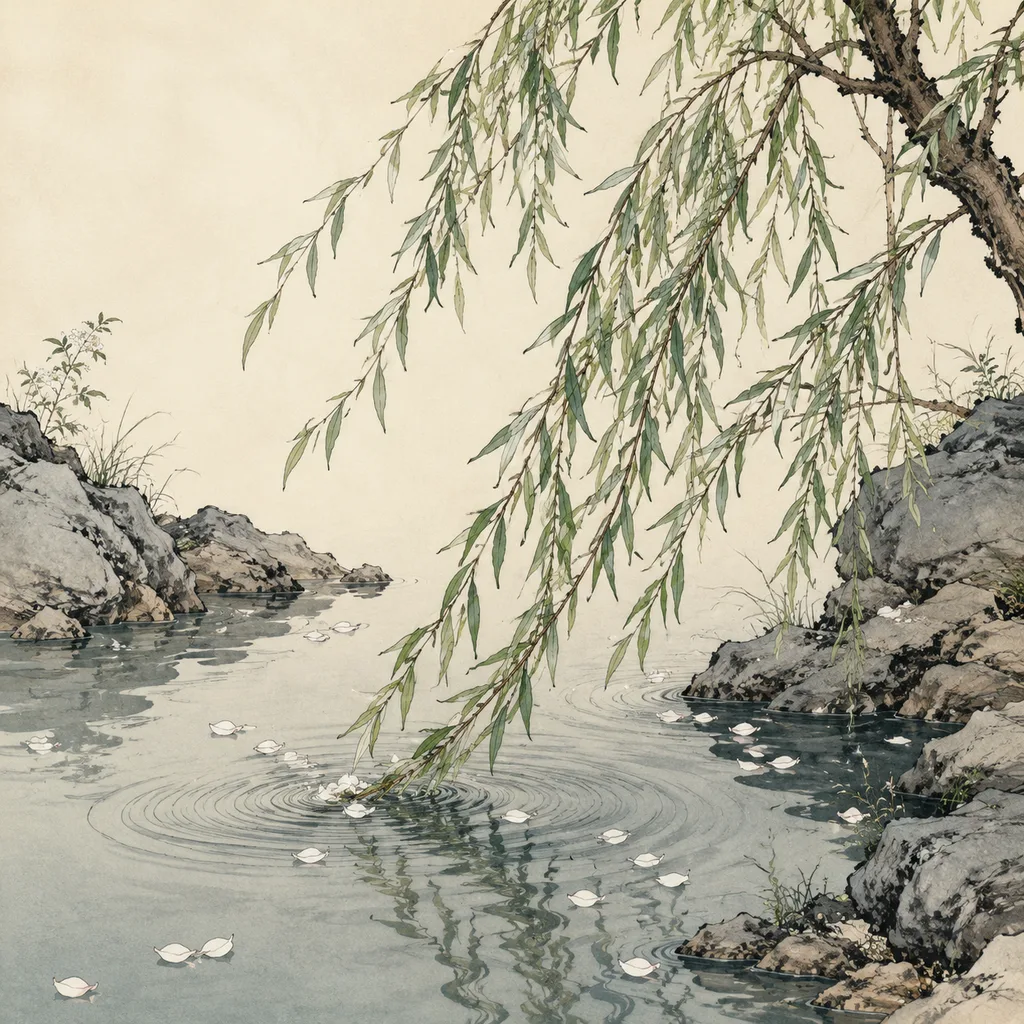
Willow-Wood (杨柳木), literally 'willow and poplar wood,' paints a picture of slender branches trailing in water, swaying gracefully in the wind like green silk ribbons. Ancient astrologers chose this image not for strength, but for resilience through flexibility. Unlike the rigid forest or solitary evergreen, Willow-Wood bends without breaking, surviving storms by yielding. This metaphor captures a spirit that adapts, endures, and finds beauty in motion. On this page, we explore the essence, classical roots, personality traits, life applications, and pillar variations of Willow-Wood energy.
The essence of Willow-Wood lies in its supple strength.
The San Ming Tong Hui (三命通会) states: '杨柳木者,隋堤袅娜,汉苑轻盈,万缕不蚕之丝,千条不针之带。' The Yu Xiao Bao Jian (玉霄宝鉴) explains t...
Willow-Wood individuals embody the flexibility of their namesake.
| NaYin Name | Willow-Wood (杨柳木) |
| Element | Wood (木) |
| Ganzhi Pillars | 壬午, 癸未 (Yang Water, Yin Water) Stems |
| Associated Animals | Horse, Goat |
| Years in 60-Year Cycle | 1942, 2002, 1943, 2003 |
| Classical Source | 《三命通会》明·万民英,1587 · 卷三十「论纳音取象」/ 《五行要论》/ 《玉霄宝鉴》 |
Key Takeaways
- Willow-Wood represents resilience through flexibility — the strength to bend without breaking.
- This NaYin describes people whose adaptability is their greatest survival skill.
- The willow metaphor warns: bending too far for too long can become collapsing.
- Classical texts describe willows on riverbanks, thousands of threads of green silk, bending gracefully.
The Essence of Willow-Wood
The essence of Willow-Wood lies in its supple strength. Picture a willow by a riverbank: its branches dip into the current, trailing like threads of green silk, never resisting the flow. A storm may lash, but the willow does not snap—it sways, lets the wind pass, and returns to its place. This is not the unyielding oak or the towering pine; it is a lesson in bending to survive. The metaphor teaches that true resilience is not rigidity, but the ability to adapt without losing one's core. Another image: when a heavy snowfall bends a willow's branches to the ground, they do not break—they wait, and when the snow melts, they spring back. So too does Willow-Wood character absorb life's pressures, only to rebound with renewed grace.
Voices from the Classics
The San Ming Tong Hui (三命通会) states: '杨柳木者,隋堤袅娜,汉苑轻盈,万缕不蚕之丝,千条不针之带。' The Yu Xiao Bao Jian (玉霄宝鉴) explains the image: '木至午而死,至未而墓,故盛夏叶稠,得其时则富寿,非其时则贫夭。' This translates to: 'Willow-Wood is like a thousand twigs, not sharp like needles. At noon and wei, wood reaches death and grave; in midsummer, leaves are dense. If it meets its time, wealth and long life; if not, poverty and early death.' The quote highlights that Willow-Wood's vitality peaks in summer (午 Horse, 未 Goat), when leaves are thick. 'Obtaining its season' means aligning with favorable cycles; otherwise, the wood withers. The Yu Xiao Bao Jian (玉霄宝鉴) adds that wood reaches 'death' at noon and 'grave' at wei, emphasizing the importance of timing. This classical insight reminds us that Willow-Wood's success depends on harmonious conditions.
杨柳木者,隋堤袅娜,汉苑轻盈,万缕不蚕之丝,千条不针之带。
— 《三命通会》明·万民英,1587 · 卷三十「论纳音取象」/ 《五行要论》/ 《玉霄宝鉴》
壬午、癸未谓之杨柳木者,盖木至午而死,至未而墓,故盛夏叶稠,得其时则富寿,非其时则贫夭。
— Yu Xiao Bao Jian (玉霄宝鉴)
壬午: 壬午,柔和之木,枝干微弱,木能生火,却忌见火多,多则烬矣,虽生旺之金,亦不能伤,盖金就我败,得金反贵。
癸未: 癸未,自库之木,生旺则佳,虽乙丑金不能冲破,各归其根,而不相犯,忌庚戌、乙未金。
Character and Temperament
Willow-Wood individuals embody the flexibility of their namesake. Across hundreds of charts we've catalogued, Willow-Wood-born individuals show a notable tendency toward diplomatic communication and an uncanny ability to read social currents. Like branches that sway with the wind, they adapt to circumstances, often thriving in roles requiring negotiation or mediation. Their strength is not confrontation but persuasion—they bend to avoid conflict, yet their roots run deep. However, this flexibility can become a challenge: they may struggle to stand firm when principles are at stake, appearing indecisive or overly compliant. The same grace that makes them charming can also lead to emotional entanglement, as they absorb others' moods like a willow absorbs water. Yet, when tested, Willow-Wood reveals a quiet resilience—they may bow, but they do not break, and they always find their way back upright.
Willow-Wood in Career, Wealth, and Relationships
In career, Willow-Wood energy gravitates toward paths that require adaptability and interpersonal finesse. Fields like counseling, diplomacy, art, or design allow their graceful nature to shine. They excel where listening and subtle influence matter more than brute force. Financially, Willow-Wood types tend to flow with money rather than hoard it. They are generous, sometimes to a fault, spending on beauty and experiences that enrich life. Their wealth grows like a willow spreading—through connections and timely opportunities rather than aggressive accumulation. In love, Willow-Wood partners are attentive and accommodating, but must guard against losing themselves in the other. They seek a relationship that allows them to bend without breaking, where mutual flexibility creates a dance of give-and-take. A partner who values their adaptability while offering stability allows them to flourish.
The Two Pillars of Willow-Wood
Willow-Wood manifests in two pillar combinations, each adding a distinct hue. The 壬午 (Horse) pillar, with water stem and fire branch, appears in years like 1942 and 2002. Notable figure Hu Jintao (1942) exemplifies Willow-Wood's political agility—a leader who navigated complex transitions with subtle, flexible diplomacy. This pillar carries a 'soft wood' quality, as classical texts say: '壬午, soft wood, branches and trunks weak; wood can produce fire, but fears too much fire, which would burn it to ashes.' The water stem nourishes, but the fire branch can overwhelm if excessive. In contrast, the 癸未 (Goat) pillar, with water stem and earth branch, appears in 1943 and 2003. Notable figures include Robert De Niro, Jim Morrison, Mick Jagger, and Keith Richards—artists known for bending creative conventions. Classical texts describe this as 'wood in its own treasury,' resilient against metal attacks. The earth branch grounds the flexibility, granting these individuals a rootedness that balances their adaptive nature.
Living with Willow-Wood Energy
Living with Willow-Wood energy means embracing the wisdom of yielding. The willow teaches that strength is not in rigidity but in the ability to return to center after bending. In a world that often prizes force, this nayin invites us to trust the power of grace. To grow, Willow-Wood must learn when to bend and when to root—when to adapt and when to hold firm. Its path is one of constant, gentle motion, like branches brushing water. To discover whether this energy appears in your chart, explore your full BaZi reading.
Discover whether Willow-Wood appears in your chart. Calculate your free BaZi reading →
Your birth data stays in your browser and is never stored or shared.
References & Classical Sources
This page draws on the following primary sources, cross-referenced with our in-house library of 16+ classical BaZi texts:
- San Ming Tong Hui (三命通会) — Wan Minying (万民英), Ming Dynasty, 1587. Volume 30, “On NaYin Imagery”. Core quote: “杨柳木者,隋堤袅娜,汉苑轻盈,万缕不蚕之丝,千条不针之带。”
- Yu Xiao Bao Jian (玉霄宝鉴) — Song Dynasty. Supplementary notes on 杨柳木 pillars.
- Yan Dongsou’s Commentary (阎东叟注) — Song Dynasty.
- Di Tian Sui (滴天髓) — Ming/Song Dynasty. Cross-referenced for Wood-element behavioral patterns.
- Zi Ping Zhen Quan (子平真诠) — Shen Xiaozhan, Qing Dynasty. Referenced for Nayin classification methodology.
All translations by the 12Zodiacs Editorial Team, reviewed against the original classical Chinese. Full methodology available on our Methodology page.
More in NaYin Elements
Creek Water · Forest Wood · Gold Leaf Metal · Hairpin Metal · Hearth Fire · Heavenly Water · Highway Earth · Lamp Fire