
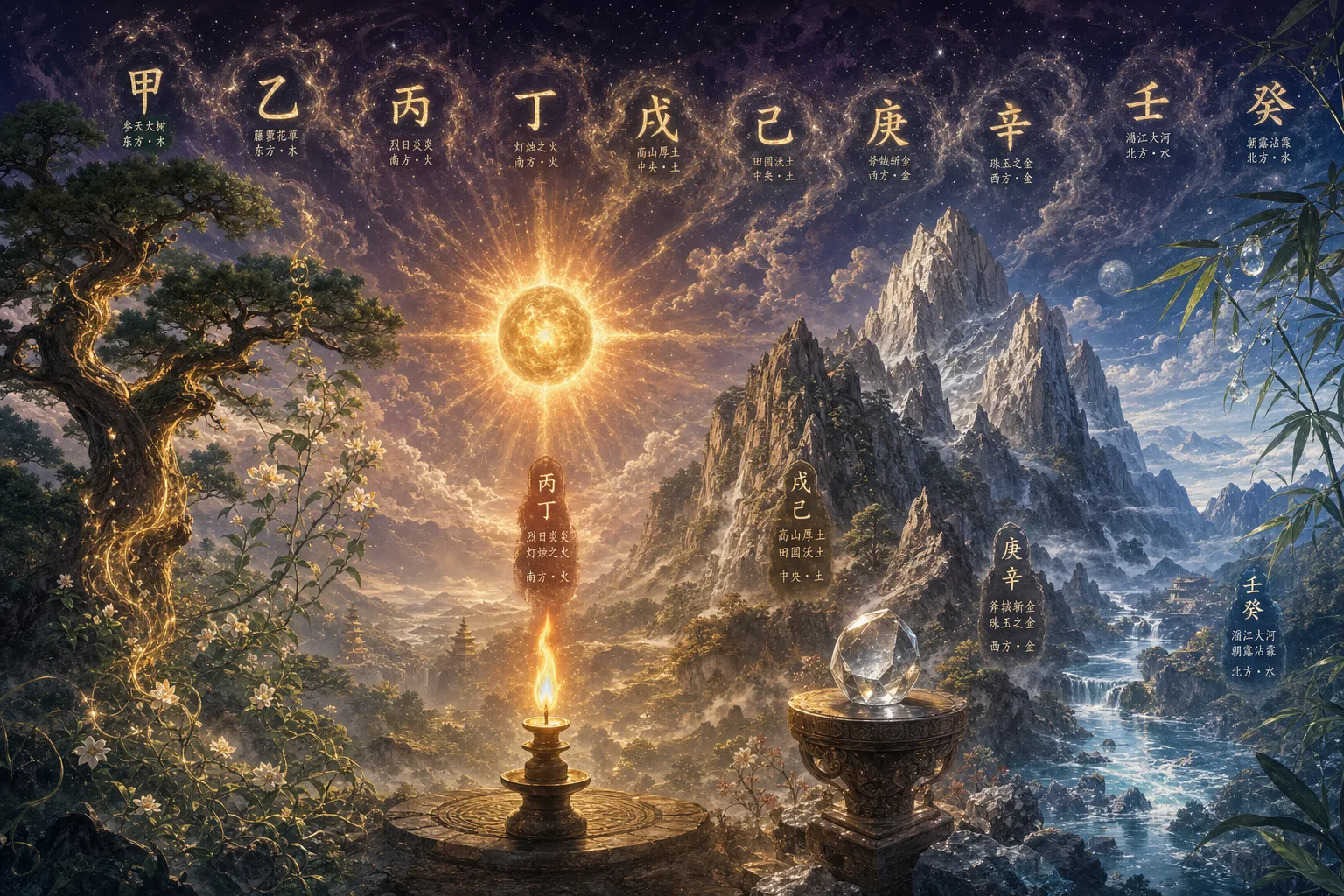
The Ten Heavenly Stems
Five elements in Yang and Yin expressions — your Day Master is the anchor of your entire chart.
The Ten Heavenly Stems (天干, Tian Gan) are ten cyclical symbols used in BaZi to represent time and the five elements—Wood, Fire, Earth, Metal, and Water—each split into Yin and Yang pairs. They are: Jia (甲), Yi (乙), Bing (丙), Ding (丁), Wu (戊), Ji (己), Geng (庚), Xin (辛), Ren (壬), and Gui (癸). The Day Master (日主), the stem of your birth day, is the most important, revealing your core character and destiny.
In BaZi (Four Pillars of Destiny), the Ten Heavenly Stems form the backbone of your entire chart. These ten symbols—five elements expressed in both Yang and Yin forms—represent the energetic quality of each pillar, with the Day Master (the stem governing your birth day) serving as the anchor for all interpretation. Classical texts like the Yuan Hai Zi Ping (渊海子平) treat the Day Master as the self, the reference point against which every other element in your chart is weighed. Understanding the Ten Heavenly Stems is the first step toward reading your own destiny map, because every strength, weakness, relationship pattern, and career inclination flows from this single character. This guide introduces the system, explains how polarity shapes each element's expression, and links to dedicated pages for each of the ten stems.
How It Works
The Ten Heavenly Stems are not arbitrary labels. They are the five Chinese elements—Wood, Fire, Earth, Metal, and Water—each split into a Yang and a Yin counterpart. This split creates a nuanced vocabulary for describing personality and fate. Yang stems are expansive, outward-moving, and assertive; Yin stems are receptive, inward-turning, and adaptive. Together, they cover the full spectrum of human expression.
The stems follow a fixed sequence that mirrors the cycle of the seasons. Yang Wood (甲) begins the year in early spring, followed by Yin Wood (乙) as spring deepens. Yang Fire (丙) arrives with summer's intensity, and Yin Fire (丁) represents the lingering warmth of late summer. Yang Earth (戊) marks the transition into autumn, while Yin Earth (己) governs the harvest period. Yang Metal (庚) cuts through early autumn, Yin Metal (辛) refines it, Yang Water (壬) surges with winter, and Yin Water (癸) brings the cycle to a close. Each stem also carries an associated element, direction, season, and set of physical correspondences—organs, colors, and body parts—that inform medical and psychological readings.
Why does polarity matter? Take Wood as an example. Yang Wood is the towering tree—upright, principled, and difficult to bend. Yin Wood is the vine or flowering plant—graceful, resourceful, and able to weave around obstacles. Both share Wood's core drive for growth, but they express it completely differently. A Yang Wood Day Master might confront a problem head-on; a Yin Wood Day Master might find a creative detour. Classical commentators from the San Ming Tong Hui (三命通会) emphasized that the same element in different polarities can produce leaders versus diplomats, warriors versus strategists. Knowing your Day Master's polarity tells you not just what element you are, but how that element behaves in the world.
The Complete List
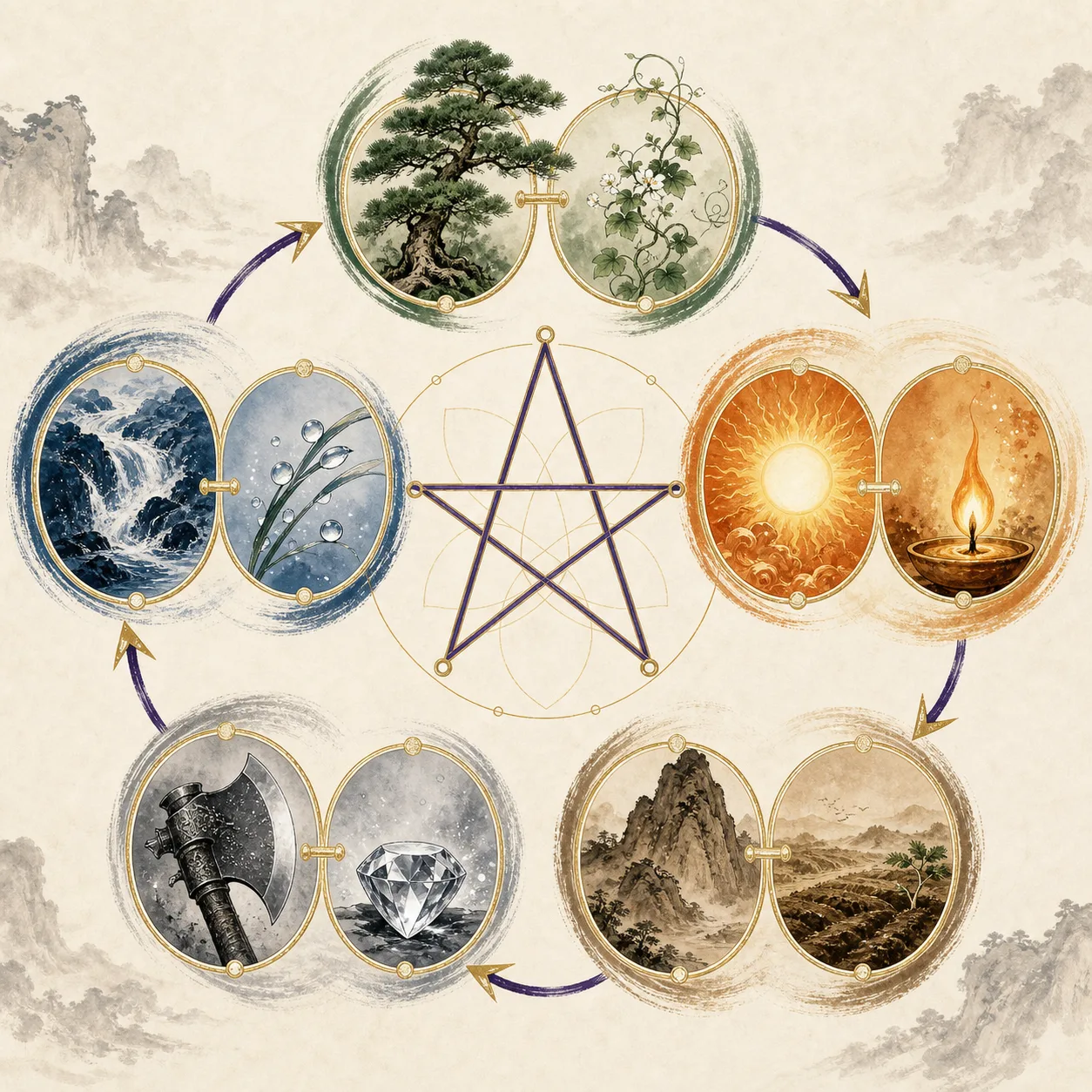
Each of the Five Elements splits into a Yang (active) and Yin (receptive) expression, creating the Ten Heavenly Stems. They follow the natural generating cycle.
The Ten Stems Reference Table
Each element expresses itself through two stems — one Yang (active, outward) and one Yin (receptive, inward). This table is your quick reference for all ten.
| Element | Yang Stem (阳) | Yin Stem (阴) | Symbolic Image |
|---|---|---|---|
| Wood (木) | Jia (甲) — The Great Tree | Yi (乙) — The Flowering Vine | Growth, expansion, benevolence |
| Fire (火) | Bing (丙) — The Sun | Ding (丁) — The Candle Flame | Passion, visibility, transformation |
| Earth (土) | Wu (戊) — The Mountain | Ji (己) — The Cultivated Soil | Stability, trust, nourishment |
| Metal (金) | Geng (庚) — The Axe Blade | Xin (辛) — The Jewelry | Justice, precision, refinement |
| Water (水) | Ren (壬) — The Great River | Gui (癸) — The Morning Dew | Wisdom, depth, adaptability |
The great tree — upright, principled, impossible to ignore. Leads with conviction and moral force.
The flowering plant — supple, observant, endlessly adaptable. Bends without breaking.
The sun — radiant, generous, impossible to hide. Illuminates every room with warmth.
The candle flame — steady, sensitive, quietly illuminating. Guides others through darkness.
The mountain — solid, trustworthy, immovable. Provides the foundation others build upon.
The cultivated soil — nurturing, fertile, endlessly productive. Grows careers and communities.
The axe blade — sharp, just, built for reform. Cuts through confusion with decisive force.
The jewelry — refined, precise, inherently beautiful. Brings polish and elegance to everything.
The great river — powerful, intelligent, always moving. Carves new channels with unstoppable momentum.
The morning dew — wise, intuitive, gentle. Perceives what others miss through quiet insight.
Deep Dive: The Ten Stems Explained
Each stem carries a distinct archetype rooted in elemental imagery. Understanding your Day Master's stem — and the stems in your other pillars — reveals the texture of your personality beyond the basic element.
In BaZi (八字) or Four Pillars astrology, the Ten Heavenly Stems (天干, Tiān Gān) are the foundational energies that shape a person's innate character, destiny, and interactions with the world. Rooted in the cyclical movement of Yin and Yang, these ten stems—five pairs of elemental expressions—offer a profound map of human psychology and potential. The classical text 滴天髓 (Dī Tiān Suǐ, "Dropping Heaven's Essence") describes them as the "gateway to understanding the Way of Heaven," each stem representing a distinct mode of being, a unique strategy for navigating life's challenges and opportunities. This analysis delves into each of the Ten Heavenly Stems, contrasting their Yang and Yin manifestations and drawing upon classical imagery to illuminate their essence.
Wood Stems (木, Mù) — The Impulse to Grow
Wood is the energy of expansion, growth, and forward momentum. It is associated with spring, the dawn, and the direction of the East. In the Dī Tiān Suǐ, Wood is described as the "seed of life that must break through the soil," symbolizing initiative, ambition, and a moral compass. The quality of this growth, however, differs dramatically between its Yang and Yin forms.
Jia Wood (甲) — The Great Tree
The towering pine, unyielding and principled.
Like a tree that grows toward light, their inner force is a quiet ambition to stand tall and provide shelter. They are driven by a need for integrity and purpose, seeking to become a pillar others can rely on.
They offer steadfast loyalty and a protective presence, yet may struggle to bend with another's needs, preferring to stand firm rather than sway in the winds of compromise.
Yi Wood (乙) — The Flowering Vine
The bending vine that never breaks.
Climbing ever upward, Yi Wood seeks growth through adaptability, weaving around life's hurdles with quiet persistence. This inner force thrives on connection and organic expansion, finding purpose in nurturing others while reaching for personal illumination.
Yi Wood partners offer gentle, intuitive support, bending to fit the emotional landscape of those they love. They flourish when given space to grow alongside, not over, their companions, valuing mutual flourishing over control.
“the wisdom of the soft overcoming the hard”
— Di Tian Sui (滴天髓)
Fire Stems (火, Huǒ) — The Power of Radiance
Fire is the element of transformation, passion, and illumination. It corresponds to summer, the South, and the peak of the day. Fire brings warmth, charisma, and the power to inspire, but it can also burn out or cause destruction if uncontained. The Dī Tiān Suǐ associates Fire with the "spirit of the sun," which brings clarity and life to all it touches.
Bing Fire (丙) — The Blazing Sun
The Blazing Sun at High Noon
Radiance itself, they are propelled by an innate need to illuminate and uplift, channeling warmth and clarity into every endeavor with a natural, generous authority.
They shine brightest when given space to share their glow, yet they must learn to let partners bask without being consumed by their perpetual brightness.
Ding Fire (丁) — The Midnight Lamp
The Midnight Lamp — focused, penetrating, gentle light
A steady flame that never flickers, Ding Fire's inner drive is to illuminate what others overlook. They possess a quiet, persistent intensity that transforms darkness into clarity, powered by an unyielding will to sustain warmth and insight in any environment.
In partnership, Ding Fire offers a constant, comforting glow that makes others feel seen and safe. They thrive when their light is acknowledged, but may dim if they sense their warmth is taken for granted.
“the most refined and civilized of all the stems”
— Di Tian Sui (滴天髓)
Earth Stems (土, Tǔ) — The Principle of Stability
Earth is the element of grounding, nourishment, and reliability. It is associated with the late summer, the center, and the transition between all seasons. Earth holds everything together, providing a foundation for growth and a repository for wisdom. The Dī Tiān Suǐ calls Earth the "mother of all things," emphasizing its role as the great equalizer and stabilizer.
Wu Earth (戊) — The Great Mountain
The Immovable Mountain of Solidity
Relentlessly cultivating stability through patient, incremental effort, they anchor themselves in enduring principles and seek to build legacies that outlast fleeting trends.
They offer unwavering loyalty and protective shelter, yet may become so fixed in their ways that partners feel unheard. Their steadfastness is a fortress, but one that needs occasional gates.
Ji Earth (己) — The Nourishing Field
The Nourishing Field, quiet nurturer of growth.
Unlike the blazing fire that seeks to consume, Ji Earth is drawn to absorb and transform. Their inner drive is a quiet, persistent urge to receive the raw materials of life and turn them into something enduring, enriching everything they touch with patient, unseen labor.
A natural safe harbor, they anchor partnerships through practical devotion rather than grand gestures — remembering the small things that make a house a home, and standing firm when storms threaten the roof.
“soft earth that can grow a thousand things”
— Di Tian Sui (滴天髓)
Metal Stems (金, Jīn) — The Art of Refinement
Metal is the element of precision, discernment, and justice. It is associated with autumn, the West, and the harvest, a time of cutting away the old to make way for the new. Metal represents the ability to define, to structure, and to judge. The Dī Tiān Suǐ describes Metal as the "instrument of transformation," which can both create and destroy.
Geng Metal (庚) — The Forged Blade
The Forged Blade — decisive, direct, unapologetically powerful.
An unrelenting urge to cut through complexity and impose order. This is the will to shape raw reality into something precise, driven by an inner mandate for clarity and decisive action.
They value honesty and directness, expecting partners to match their forthrightness. Loyalty is paramount, but they may struggle with emotional nuance, preferring straightforward exchanges over subtle cues.
“steel that can cut through the world”
— Di Tian Sui (滴天髓)
Xin Metal (辛) — The Polished Jewel
The Polished Jewel: refined, perceptive, and precise.
Like a gemstone's internal fire, their drive is to distill complexity into flawless clarity—each facet of life examined until it shines with singular truth. They are moved by the pursuit of exactness, where every detail aligns into a harmonious whole.
Attuned to every subtle shift in a partner's mood, they notice what others miss — the unspoken hurt, the half-formed wish. Yet this same perceptiveness can become a magnifying glass, turning small frictions into fractures that linger long after the moment passes.
“beauty and delicacy”
— Di Tian Sui (滴天髓)
Water Stems (水, Shuǐ) — The Depths of Wisdom
Water is the element of wisdom, flow, and mystery. It is associated with winter, the North, and the deep silence of the night. Water adapts to any container, yet it can erode the hardest stone. It represents the subconscious, the flow of life, and the power of intuition. The Dī Tiān Suǐ states that Water is the "source of all intelligence," emphasizing its connection to the unseen realms of thought and spirit.
Ren Water (壬) — The Raging River
The Raging River, unstoppable and all-encompassing.
Propelling forward with relentless momentum, they seek to carve new paths through every obstacle, driven by an innate urge to expand, explore, and absorb all that life offers into their vast depths.
They flow around partners, adapting to any contour, yet their powerful presence can overwhelm. They seek a companion who can navigate their depths without being swept away, offering both freedom and grounding.
Gui Water (癸) — The Morning Dew
The Morning Dew — silent, perceptive, all-pervading.
A quiet receptivity defines their essence—an intuitive attunement to subtle currents that others overlook. They navigate life by absorbing, reflecting, and gently influencing, finding power in stillness and precision.
They offer a mirror-like presence, reflecting partners' emotions with uncanny clarity. Yet, they may hold back their own needs, preferring to adapt and flow around others rather than assert their own direction.
“Gui Water is the intelligence that flows into every crevice, seeing what the sun cannot reach.”
— Di Tian Sui (滴天髓)
Heavenly Stem Combinations (天干五合)
In BaZi, the Heavenly Stems are not static labels—they interact, merge, and transform. The Five Combinations (天干五合) represent the most intimate bond between two stems, drawing from the He Luo Li Shu principle of "close union yields transformation." When a combination occurs in a chart, it alters the elemental landscape, often "tying up" one stem so it cannot act independently. This is critical: a combined stem loses its original aggressive nature and instead expresses the new transformed element, provided the transformation is supported by the season and earthly branches.
1. Jia + Ji → Earth (甲己合化土)
Jia (Yang Wood) and Ji (Yin Earth) combine to form Earth. This is the "union of respect" because Jia, the tall tree, bends to nourish Ji, the fertile field. In practice, this combination often neutralizes a destructive Wood-over-Earth clash. If the chart is Earth-dominant (e.g., born in Wei or Chou months), the transformation succeeds, turning Jia from a threat into a stabilizing force—good for careers requiring patience, agriculture, or real estate.
2. Yi + Geng → Metal (乙庚合化金)
Yi (Yin Wood) and Geng (Yang Metal) merge into Metal. This is the "righteous union," as Geng's axe carves Yi's vine, and in return, Yi softens Geng's harshness. When transformation occurs (strong Metal season, Shen or You branches), the result is sharp discernment and decisive action. In reading, this pair often signals a partnership where one person's flexibility (Yi) meets another's authority (Geng)—successful in law, surgery, or finance.
3. Bing + Xin → Water (丙辛合化水)
Bing (Yang Fire) and Xin (Yin Metal) combine to form Water. Known as the "union of honor," Fire melts Metal, and the liquid result is Water—intelligence and strategy. This transformation is hardest to achieve, requiring deep Water season (Zi or Hai months) and no Earth to block. When it works, the person gains profound insight and persuasive power, often excelling in diplomacy, research, or esoteric studies. If it fails, the stems remain enemies, causing internal conflict between ambition (Bing) and refinement (Xin).
4. Ding + Ren → Wood (丁壬合化木)
Ding (Yin Fire) and Ren (Yang Water) combine to form Wood. This is the "union of seduction"—Water and Fire are natural opposites, yet their byproduct is growth(wood), symbolizing transformation through mutual attraction. In practical terms, this combination often appears in charts where passion and creativity intertwine, yet it demands careful balance—too much Ding can scorch the Wood, while excessive Ren may drown it. Astrologers read this union as a call for emotional maturity, where the fire of desire and the depth of intuition must harmonize to yield lasting, organic results. When successfully transformed, it grants visionary insight and artistic flair, but it remains one of the more volatile combinations, requiring strong roots elsewhere in the chart to stabilize its yielding nature.
Practical Applications
Knowing your Day Master gives you more than a label—it gives you a lens. In career planning, a Yang Wood person might thrive in leadership or law, while a Yin Wood person excels in diplomacy, design, or counseling. In relationships, understanding your own stem's needs and your partner's reveals why certain dynamics feel effortless and others require constant negotiation. A Yang Fire person needs recognition and space to shine; a Yin Water person needs depth and quiet trust. These aren't superficial preferences—they're structural tendencies rooted in your chart's elemental composition.
You can also use the stems to understand recurring life patterns. If you're a Yang Metal person who keeps clashing with authority, the issue may not be your behavior but your element's inherent drive to cut through what it sees as corruption or inefficiency. Recognizing that tendency allows you to channel it constructively. The stems also illuminate health: each element governs specific organs, so a weak Yin Wood stem might manifest as liver or eye issues, prompting preventive care. Finally, the stems help you pick auspicious timing. When the year's stem aligns with or supports your Day Master, opportunities tend to open; when it clashes, patience pays off.
Common Misconceptions About the Heavenly Stems
Myth 1: “Your Day Master Determines Your Entire Personality”
While the Day Master (日主, rì zhǔ)—the Heavenly Stem of your day pillar—is the anchor of your BaZi chart, it is not the whole story. In classical texts like the Qiong Tong Bao Jian (《窮通寶鑑》), the Day Master is read in context with the other three stems and four branches. For example, a Jia Wood (甲木) Day Master with a strong Geng Metal (庚金) stem in the month pillar may manifest as disciplined and sharp, not the gentle, flexible tree often described in isolation. The Year, Month, and Hour stems act as “advisors,” modifying the Day Master’s expression. A person’s personality is a synthesis of all four stems, their elemental interactions, and the Earthly Branches’ hidden stems (藏干, cáng gān). Reducing a chart to the Day Master alone is like judging a novel by its title.
Myth 2: “Yang Is Always Stronger or Better Than Yin”
This misconception stems from a superficial reading of Yang (陽) as active and Yin (陰) as passive. In practice, Yin stems have distinct strategic advantages. Yang Wood (甲木) grows tall but breaks in storms; Yin Wood (乙木) bends and survives, thriving as vines that climb and adapt. Similarly, Yin Metal (辛金) is refined, precise, and sharp—often more effective in jewelry, tools, and diplomacy than the raw, unyielding Yang Metal (庚金). Classical masters note that Yin stems excel in environments requiring finesse, negotiation, and endurance. The Di Tian Sui (《滴天髓》) states: “Yin and Yang are not superior or inferior; they are different modes of expression.” A Yin Day Master with strong resources (印, yìn) can outlast and outperform a Yang stem in long-term endeavors.
Myth 3: “Stem Combinations Always Produce Transformation”
Heavenly Stem combinations (合, hé)—such as Jia-Ji combining to Earth (甲己合土) or Bing-Xin combining toWater (丙辛合水)—are often misunderstood as automatic transformations. In classical BaZi theory, a combination only transforms if specific conditions are met: the transforming element must be supported by the season, the month branch, or a strong presence in the chart. Otherwise, the combination merely binds or restrains the two stems, altering their behavior without changing their elemental nature. Thus, a Jia-Wui combination may simply indicate a close bond or a hidden conflict, not a literal shift to Earth. Context—not the combination itself—decides the outcome.
Classical Sources & References
The Heavenly Stems system is codified in foundational texts of Chinese metaphysics, accessible through the Chinese Text Project (CText):
- Di Tian Sui (滴天髓, c. Ming Dynasty) — The most revered commentary on Heavenly Stem nature, attributed to Liu Ji (Liu Bowen). Defines the core character of each stem through poetic analogy. Read on CText →
- Qiong Tong Bao Jian (穷通宝鉴, c. Qing Dynasty) — The definitive guide to stem-season relationships, explaining how each Heavenly Stem behaves under different monthly and seasonal conditions. Read on CText →
- Yuan Hai Zi Ping (渊海子平, c. 14th century) — The earliest systematic BaZi manual by Xu Zi Ping, establishing the Ten Heavenly Stems as the foundation of Four Pillars analysis. Read on CText →
Further Reading & External Resources
- Heavenly Stems — Wikipedia — Overview of the ten celestial stems and their role in the Chinese calendar, astrology, and numerology.
- Sexagenary Cycle — Wikipedia — The 60-year cycle formed by pairing Heavenly Stems with Earthly Branches, the structural backbone of BaZi.
- Wuxing (Five Elements) — Wikipedia — The five-phase theory that underpins all stem interactions: production, control, and reduction cycles.
How do I find my Day Master?
Your Day Master is the Heavenly Stem of your birth day in the Chinese solar calendar. Use a BaZi calculator or consult a practitioner to convert your Western birth date into the Four Pillars. The stem in the day pillar (second position) is your Day Master.
What if I don't relate to my Day Master description?
Your Day Master is only one of four pillars. The other three stems, plus the Earthly Branches, modify how your Day Master expresses itself. A Yang Wood person with heavy Metal in the chart may appear more decisive and cutting than a typical Yang Wood. Full chart analysis is always more accurate than Day Master alone.
Is the Day Master the same as my zodiac sign?
No. The Chinese zodiac sign comes from your birth year's Earthly Branch, while the Day Master comes from your birth day's Heavenly Stem. Two people born in the same year share a zodiac animal but may have entirely different Day Masters—and therefore different personalities and destinies.
Can my Day Master change over time?
No. Your Day Master is fixed at birth. However, the Ten-Year Luck Cycles (Da Yun) and annual pillars bring different elements into your chart, temporarily strengthening or weakening your Day Master. These cycles explain why certain periods of life feel empowering while others feel draining.
What does my Day Master mean in BaZi?
In BaZi, your Day Master (日主) represents your core self and personal identity. It is derived from the Heavenly Stem associated with your birth date and reflects your innate characteristics, strengths, and challenges in life.
How do I read my Day Master on a BaZi chart?
To read your Day Master on a BaZi chart, locate the Heavenly Stem that corresponds to your birth date in the Day column. This stem will provide insights into your personality traits, life path, and how you interact with the world around you.
What is the difference between a strong and weak Day Master?
A strong Day Master has ample supportive elements in their BaZi chart, indicating resilience and capability, while a weak Day Master lacks support and may face more challenges. The strength of the Day Master is assessed by the balance of elements present in the chart, influencing one's overall fortune and well-being.
How do the 10 Heavenly Stems relate to the Chinese zodiac?
The 10 Heavenly Stems are part of the larger sexagenary cycle that includes the 12 Earthly Branches (生肖), which correspond to the Chinese zodiac. Each Stem pairs with a Branch to form a unique combination that influences personality traits and life events, creating a comprehensive system of astrological interpretation.
Which Day Master is compatible with mine?
Compatibility among Day Masters is determined by the interactions of the Five Elements (五行) associated with each Stem. Generally, Day Masters of the same element or those that produce or support each other are considered compatible, fostering harmonious relationships.
What are the 10 Heavenly Stems in Chinese astrology?
The 10 Heavenly Stems (天干) in Chinese astrology are Jia (甲), Yi (乙), Bing (丙), Ding (丁), Wu (戊), Ji (己), Geng (庚), Xin (辛), Ren (壬), and Gui (癸). Each Stem has unique attributes, elemental associations, and Yin/Yang characteristics that influence individual destinies and interactions in BaZi.
Ready to explore your Heavenly Stems?
Get your complete BaZi chart with Day Master, element balance, and all Ten Gods in seconds.
Cast Your BaZi Chart Free →