
Half Harmonies (半合)
半合 · Earthly Branch dynamics in BaZi
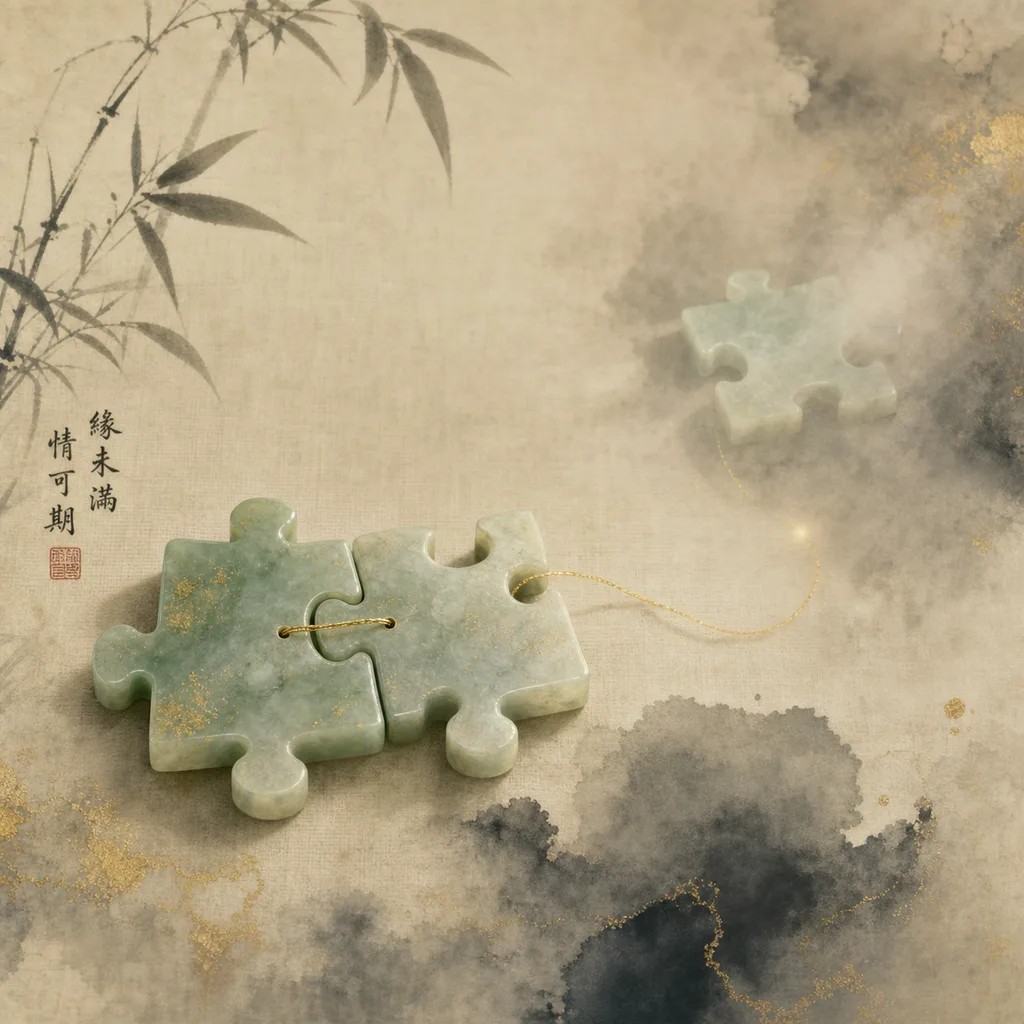
In BaZi astrology, the Half Harmonies (半合) is one of the fundamental interactions between Earthly Branches (地支). When only two of the three harmony branches are present, creating a partial harmony that is weaker but still significant.
Half Harmonies represent an unfinished three-harmony frame, storing energetic potential that awaits the missing branch to fully activate. This creates a dynamic of anticipation and opportunity.
Birth-Bloom halves (e.g., Shen-Zi) connect origin and peak, producing flowing energy. Bloom-Grave halves (e.g., Zi-Chen) connect peak and storage, yielding accumulation. Birth-Bloom is stronger.
The missing branch can appear in luck pillars, completing the harmony. Alternatively, a clash to either existing branch can break the half-harmony, dispersing its potential.
| Quick Facts | |
|---|---|
| Chinese Name | 半合 (Ban He) |
| Category | Combination |
| Interaction Type | Partial synthesis |
| Number of Interactions | 8 half-harmony pairs |
| Core Mechanism | Two of three branches in a three-harmony frame form a partial elemental fusion, awaiting the third to complete. |
| Transformation Rule | Does not fully transform; generates ~50-60% elemental influence, stronger in Birth-Bloom halves. |
| Hidden Stem Role | Hidden stems reveal the internal elemental dynamics; e.g., Shen-Zi’s hidden stems reinforce Water. |
| Directional Pattern | Adjacent or separated by one position on the zodiac wheel, forming a triangle edge. |
| Classical Source | Yuan Hai Zi Ping (淵海子平), Chapter on Half Combinations |
| Practical Significance | Indicates potential energy, incomplete cycles, and opportunities that require external activation. |
Incomplete Harmony, Latent Power
Half Harmonies represent an unfinished three-harmony frame, storing energetic potential that awaits the missing branch to fully activate. This creates a dynamic of anticipation and opportunity.
Birth-Bloom vs Bloom-Grave Strength
Birth-Bloom halves (e.g., Shen-Zi) connect origin and peak, producing flowing energy. Bloom-Grave halves (e.g., Zi-Chen) connect peak and storage, yielding accumulation. Birth-Bloom is stronger.
External Completion or Disruption
The missing branch can appear in luck pillars, completing the harmony. Alternatively, a clash to either existing branch can break the half-harmony, dispersing its potential.
The Structural Mechanics of Half Harmonies
Half Harmonies (半合) arise when two of the three branches in a three-harmony frame appear in the chart. Each three-harmony frame forms a triangle on the zodiac wheel, with branches spaced 120° apart. For example, the Water frame consists of Shen (Monkey, 1st), Zi (Rat, 2nd), and Chen (Dragon, 3rd). When only Shen and Zi are present, we have a Birth-Bloom half-harmony; when only Zi and Chen, a Bloom-Grave half. The missing branch creates an incomplete circuit, like a triangle missing one vertex. The positional logic is precise: the two branches must be exactly as in the frame—no other pair. This incompleteness means the elemental transformation is partial, not full. The half-harmony generates a directional pull toward the missing branch, which can appear in the luck pillars (大运) or annual pillars, completing the synthesis. If the missing branch never arrives, the half-harmony remains as potential, influencing the chart subtly. The strength of the half-harmony depends on whether it is Birth-Bloom (生旺半合) or Bloom-Grave (旺墓半合), with the former being more dynamic and the latter more stabilizing.
Hidden Stem Dynamics in Half Harmonies
Hidden stems (藏干) within each earthly branch reveal the internal composition of a half-harmony, modifying its surface-level behavior. For instance, in the Shen-Zi half-harmony, Shen contains Geng (Metal), Ren (Water), and Wu (Earth); Zi contains Gui (Water). The dominant hidden stem in Shen is Geng Metal, which generates Gui Water in Zi, reinforcing the Water transformation. This internal flow makes Shen-Zi a strong Water-producing half-harmony. In contrast, Zi-Chen: Zi has Gui Water, Chen has Wu (Earth), Yi (Wood), and Gui (Water). The Earth hidden stem in Chen (Wu) resists Water, but the presence of Gui Water in both creates a conflicting yet stable accumulation. The hidden stems also determine the ten gods involved: for example, if the Day Master is Fire, the Water half-harmony becomes an Official or Resource, affecting career and authority. Practitioners analyze hidden stems to assess whether the half-harmony is internally harmonious or conflicted. A half-harmony with aligned hidden stems (e.g., Shen-Zi with Geng generating Gui) is more potent than one with clashing stems (e.g., Zi-Chen with Earth vs Water). This internal dynamic often dictates whether the half-harmony manifests as supportive or obstructive in a reading.
Transformation Conditions and Elemental Effects
A half-harmony does not fully transform the elements of the participating branches. Instead, it generates a partial elemental influence—roughly 50-60% of a full three-harmony transformation. The transformation is conditional: it requires that the elements involved are not severely weakened by clashes or counter-harmonies in the chart. For example, a Shen-Zi half-harmony produces Water, but if the chart has strong Earth (which controls Water) or a clash on Shen (e.g., Yin-Shen clash), the half-harmony may be disrupted. Birth-Bloom halves transform more readily because they connect the generative source (e.g., Shen Metal gives birth to Water) with the peak (Zi Water). Bloom-Grave halves, like Zi-Chen, are more resistant to transformation because they connect the peak (Zi) with the grave (Chen, where Water is stored), resulting in accumulation rather than flow. If the missing branch appears in a luck pillar or annual pillar, the half-harmony can become a full three-harmony, completing the transformation. However, if the missing branch is clashed or harmed, the half-harmony remains partial. The elemental effect also depends on the season: a half-harmony in its native season (e.g., Shen-Zi in winter) is stronger than one in a counter-season.
Real-World Manifestations in BaZi Readings
In practice, Half Harmonies indicate latent opportunities or unfinished business. In career readings, a half-harmony in the wealth or resource pillar suggests potential for financial gain or learning that requires external activation—like a job offer pending a final interview. For example, a Wood half-harmony (Hai-Mao) in the output pillar may indicate creative projects that need a final push (the missing Wei) to launch. In relationships, the half-harmony often represents a partnership that is strong but incomplete; the missing branch can symbolize a third party or a missing element (e.g., commitment) that, when it appears in a luck pillar, could lead to marriage. Health-wise, a half-harmony in the day pillar can indicate a chronic condition that flares up when the missing branch arrives. For instance, a Fire half-harmony (Yin-Wu) might relate to heart issues that intensify in Xu years. Timing is crucial: practitioners look for the missing branch in the luck pillars or annual pillars to predict when the half-harmony activates. If the half-harmony is disrupted by a clash, it can indicate sudden changes or setbacks. The ten gods involved further refine the interpretation—e.g., a half-harmony forming the Wealth element can signal financial windfall when completed.
Classical Wisdom and Modern Interpretation
The classical source, Yuan Hai Zi Ping (淵海子平), dedicates a chapter to half combinations, stating that ‘when two branches combine, they await the third to complete the transformation; without the third, the energy is half-formed.’ The text emphasizes that half-harmonies are not as powerful as full three-harmonies but still exert influence. In classical practice, half-harmonies were often seen as auspicious if the missing branch appeared in the luck pillars, indicating timely support. Modern practitioners interpret half-harmonies as indicators of potential rather than fixed outcomes. For example, a half-harmony in the natal chart suggests a talent or opportunity that requires cultivation. The distinction between Birth-Bloom and Bloom-Grave halves is a key classical teaching: Birth-Bloom halves are ‘alive’ and active, while Bloom-Grave halves are ‘storing’ and passive. In contemporary readings, this translates to: Birth-Bloom halves suggest dynamic growth areas, while Bloom-Grave halves indicate areas of accumulation or stagnation that need release. The classical advice is to never force a half-harmony; instead, wait for the natural arrival of the missing branch in the luck cycle. This patience-oriented approach remains relevant today, reminding practitioners that not all potential needs immediate activation.
Frequently Asked Questions
What does Half Harmonies mean in BaZi?
Half Harmonies (半合) occur when two of the three branches in a three-harmony frame are present, creating a partial elemental fusion. They represent incomplete cycles, latent energy, and potential that awaits the third branch to fully activate. This interaction is common in natal charts and luck pillars, indicating areas of life where opportunities are pending or relationships are developing.
Is Half Harmonies good or bad?
Half Harmonies are neutral; their quality depends on the context. They can be auspicious if the missing branch appears in luck pillars, completing a beneficial harmony (e.g., forming the Wealth element). They can be challenging if the half-harmony is disrupted by clashes or if the partial element conflicts with the Day Master. Generally, they indicate potential that needs proper timing to manifest.
How does Half Harmonies affect relationships/marriage?
In relationships, a half-harmony in the spouse or palace pillar can indicate a strong bond that feels incomplete—perhaps awaiting a commitment or a child (the missing branch). When the missing branch arrives in a luck pillar, marriage or deepening of the relationship may occur. If the half-harmony is clashed, it may signal separations or delays.
How does Half Harmonies affect career and wealth?
A half-harmony in the wealth or career pillar suggests financial or professional potential that is not yet fully realized. For example, a Metal half-harmony in the wealth pillar may indicate a business deal that needs one more partner or resource (the missing branch) to close. Timing is key: the missing branch’s arrival in a luck pillar can trigger success.
What is the difference between Half Harmonies and other similar relations?
Unlike full three-harmonies, which completely transform the elements, half-harmonies only partially transform and require a third branch. Compared to clashes (六冲), which are confrontational, half-harmonies are cooperative but incomplete. Compared to harms (六害), which are subtle obstructions, half-harmonies are supportive but conditional. Directional frames (三会) involve three consecutive branches and are stronger, while half-harmonies are weaker but more focused.
How do practitioners resolve or work with Half Harmonies in a reading?
Practitioners first identify the missing branch and check if it appears in the luck pillars or annual pillars to predict activation. If the half-harmony is beneficial, they advise patience and preparation for when the missing branch arrives. If it is disruptive, they may recommend feng shui or timing adjustments to mitigate negative effects. The half-harmony’s hidden stems are also analyzed to understand internal dynamics.