The Five Elements (Wu Xing) in Chinese Zodiac: The Complete Guide
Wood, Fire, Earth, Metal, and Water — the five forces that shape every zodiac sign’s personality, destiny, and relationships. Discover your element, understand the generating and controlling cycles, and learn how Five Elements theory applies to your career, health, and daily life.
What Are the Five Elements (Wu Xing)?
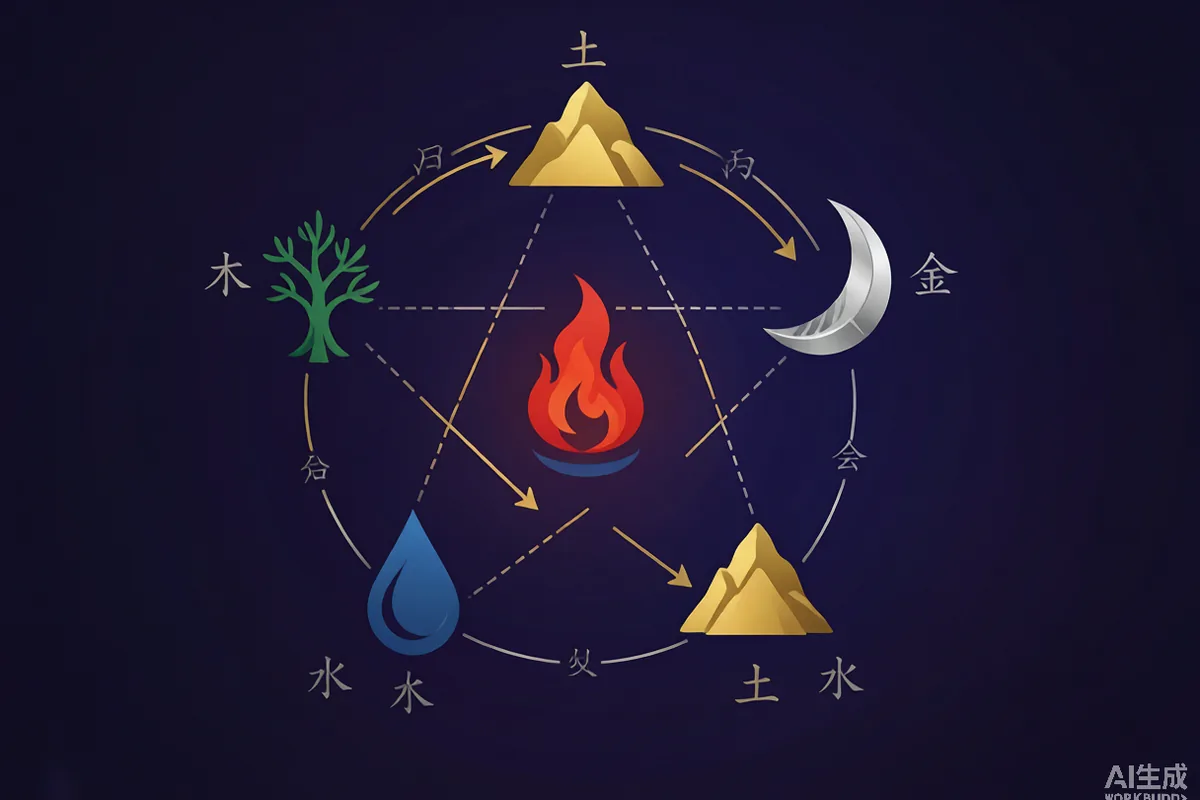
The Five Elements theory — known in Chinese as Wu Xing (五行, literally “five movements” or “five phases”) — is the foundational framework of Chinese philosophy, medicine, astrology, and feng shui. Unlike the Western four elements (earth, air, fire, water), which describe static substances, the Chinese Five Elements describe dynamic processes and relationships. Wood is not a piece of timber; it is the energy of growth and expansion. Fire is not a flame; it is the energy of transformation and peak intensity.
In the Chinese zodiac, each of the 12 animal signs carries a fixed element that never changes. Additionally, each birth year cycles through all five elements via the Heavenly Stems (天干), creating a 60-year grand cycle of unique animal-element combinations. This means a Wood Dragon (born 2024) and a Fire Dragon (born 2036) share the same animal archetype but express it through entirely different elemental lenses — the Wood Dragon is creative and growth-oriented, while the Fire Dragon is passionate and transformative.
Understanding your element is essential because it modifies how your animal sign manifests. Two people born under the Tiger sign — one a Metal Tiger, the other a Fire Tiger — will have recognizably different personalities, career strengths, and relationship dynamics. Your element adds color, texture, and depth to your zodiac identity.
Quick fact: The Wu Xing system predates the zodiac animals by centuries. The earliest written references to the Five Elements appear in the Shang Shu (Book of Documents), dated to roughly 1,000 BCE, while the 12 zodiac animals were formally codified later during the Han Dynasty (206 BCE – 220 CE).
Wood (木 Mù)
Wood is the energy of springtime, dawn, and new beginnings — the irrepressible force of a seedling pushing through stone. Wood types are visionaries who see potential where others see emptiness. They are driven by growth, creativity, and a deep desire to nurture others toward their full potential.
- Signs: Tiger, Rabbit
- Direction: East
- Season: Spring
- Planet: Jupiter
- Color: Green
- Yin/Yang: Both (Yang Wood = towering tree; Yin Wood = flowering vine)
- Traits: Creative, compassionate, growth-oriented, generous, idealistic, flexible
- Strengths: Vision, mentoring, long-range planning, resilience, generosity
- Challenges: Overextension, stubborn idealism, workaholic tendencies, frustration when blocked
- Best careers: Teaching, counseling, environmental science, urban planning, creative arts, nonprofit leadership
- Health focus: Liver, gallbladder, tendons, eyes. Prone to stress headaches and tension when frustrated.
Fire (火 Huǒ)
Fire is the energy of midsummer and high noon — the peak of Yang intensity. Fire types move through life like a flame: impossible to ignore, magnetic, and transformative. They inspire through sheer enthusiasm, illuminate dark corners, and catalyze change wherever they go.
- Signs: Snake, Horse
- Direction: South
- Season: Summer
- Planet: Mars
- Color: Red
- Yin/Yang: Both (Yang Fire = blazing sun; Yin Fire = candle flame)
- Traits: Passionate, charismatic, bold, inspirational, expressive, spontaneous
- Strengths: Leadership, motivation, quick thinking, emotional warmth, dramatic flair
- Challenges: Burnout, impatience, impulsiveness, attention-seeking, volatility when unchecked
- Best careers: Public speaking, entertainment, marketing, entrepreneurship, emergency services, athletics
- Health focus: Heart, small intestine, blood, tongue. Vulnerable to anxiety and sleep disruption when overstimulated.
Earth (土 Tǔ)
Earth is the energy of stability, nourishment, and transition — the fertile ground that all other elements depend on. Earth types are the anchors of their communities: dependable, patient, and deeply practical. They build things that last and provide the foundation others build upon.
- Signs: Ox, Dragon, Goat, Dog
- Direction: Center
- Season: Late Summer (transitional periods between seasons)
- Planet: Saturn
- Color: Yellow / Brown
- Yin/Yang: Both (Yang Earth = mountain; Yin Earth = garden soil)
- Traits: Stable, reliable, grounded, nurturing, practical, harmonious
- Strengths: Consistency, trustworthiness, mediation, long-term planning, resource management
- Challenges: Stubbornness, resistance to change, over-worrying, possessiveness, stagnation
- Best careers: Real estate, agriculture, banking, human resources, healthcare, insurance, civil service
- Health focus: Spleen, stomach, mouth, muscles. Digestive issues when worried or anxious.
Water (水 Shuǐ)
Water is the energy of winter and the deep unknown — the most Yin of all elements. Water types navigate life like a river: patient, persistent, and impossible to stop. They possess an intelligence that runs deeper than logic, reading situations and people with quiet precision.
- Signs: Rat, Pig
- Direction: North
- Season: Winter
- Planet: Mercury
- Color: Black / Dark Blue
- Yin/Yang: Both (Yang Water = ocean and great river; Yin Water = stream and morning dew)
- Traits: Adaptable, intuitive, philosophical, diplomatic, perceptive, resourceful
- Strengths: Strategic thinking, empathy, communication, adaptability, depth of understanding
- Challenges: Indecisiveness, over-sensitivity, evasiveness, emotional absorption, tendency to flow around problems rather than confront them
- Best careers: Diplomacy, research, psychology, writing, maritime industries, philosophy, intelligence, communication
- Health focus: Kidneys, bladder, bones, ears. Lower back pain and fatigue when depleted or fearful.
Find Your Element
Enter your birth year to discover your Chinese zodiac element, animal sign, and key traits.
The Generating Cycle (相生 Shēng)
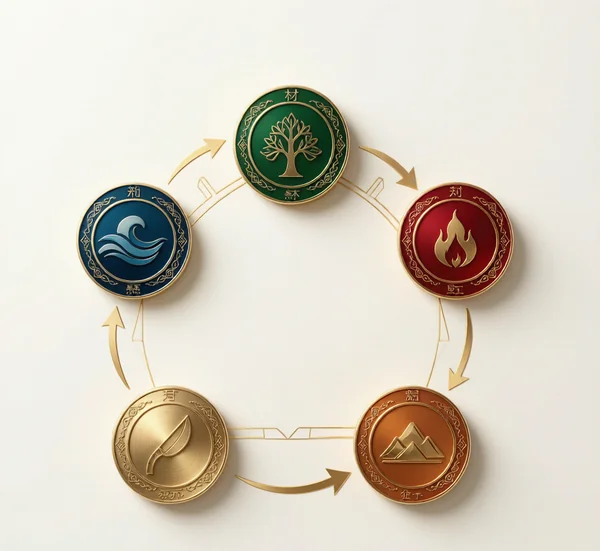
In the Generating Cycle — also called the Creative or Productive Cycle — each element nourishes and creates the next in a continuous, self-sustaining loop. This is the cycle of growth, support, and harmony. When two people’s elements follow this pattern (e.g., Water feeds Wood), the relationship tends to feel natural and mutually enriching.
Generating Cycle (相生)
How Each Element Generates
- Wood → Fire: Fuel ignites into flame. Wood provides the material that Fire needs to burn.
- Fire → Earth: Ash settles into soil. Fire transforms matter into fertile ground.
- Earth → Metal: Ore forms within rock. Earth compresses and concentrates minerals over time.
- Metal → Water: Condensation gathers on cold metal surfaces. Metal facilitates the collection of water.
- Water → Wood: Rain nourishes roots. Water is the essential ingredient for all plant growth.
In relationships, a person whose element generates their partner’s element tends to be the natural supporter — the one who nourishes, encourages, and brings out the best in the other.
The Controlling Cycle (相克 Kè)
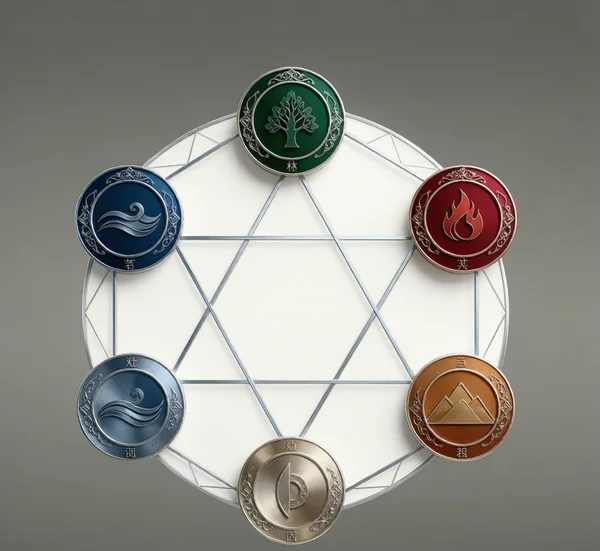
In the Controlling Cycle — also called the Destructive or Overcoming Cycle — each element restrains or controls another, preventing any single force from becoming dominant. This is not a negative cycle; it is the ancient equivalent of a system of checks and balances. Without control, growth becomes chaos. Without growth, control becomes stagnation. Both cycles are essential for harmony.
Controlling Cycle (相克)
How Each Element Controls
- Wood → Earth: Roots split soil apart, breaking through any containment.
- Earth → Water: Dams and levees contain rivers, directing their flow.
- Water → Fire: Water extinguishes flame, preventing destruction from spreading.
- Fire → Metal: Heat melts and reshapes metal, bending it to new purpose.
- Metal → Wood: An axe fells a tree, pruning uncontrolled growth.
In relationships, a controlling element pair requires more conscious effort. The tension is not destructive by nature — it creates growth through challenge, like a personal trainer who pushes you beyond your comfort zone.
Five Elements Compatibility Matrix
Use this 5×5 matrix to quickly check how any two elements interact. For detailed sign-by-sign analysis, see our full compatibility guide. Generating pairs (green) are naturally harmonious — one nourishes the other. Controlling pairs (red) create tension that requires conscious work. Same-element pairs (gray) amplify each other, which can be either intensifying or overwhelming.
| 木 Wood | 火 Fire | 土 Earth | 金 Metal | 水 Water | |
|---|---|---|---|---|---|
| 木 Wood | Same — Amplified | Generates ↑ | Controls ↓ | Controlled ↓ | Generated ↑ |
| 火 Fire | Generated ↑ | Same — Amplified | Generates ↑ | Controls ↓ | Controlled ↓ |
| 土 Earth | Controlled ↓ | Generated ↑ | Same — Amplified | Generates ↑ | Controls ↓ |
| 金 Metal | Controls ↓ | Controlled ↓ | Generated ↑ | Same — Amplified | Generates ↑ |
| 水 Water | Generates ↑ | Controlled ↓ | Controls ↓ | Generated ↑ | Same — Amplified |
Row element reads across; column element reads down. Generates ↑ = the row element nourishes the column element. Controls ↓ = the row element restrains the column element. Generated ↑ = the column element nourishes the row element.
The Ten Heavenly Stems (天干)
The Heavenly Stems are the backbone of the Chinese calendrical system. There are ten stems — five pairs of Yin and Yang for each element. Each year is assigned one stem, and because there are ten stems cycling alongside twelve animal signs, it takes 60 years for every possible combination to appear exactly once.
Why does a 60th birthday matter? In Chinese culture, a 60th birthday is called huá jiǎ (花甲, “flowering stem-cycle”) and is celebrated as one of life’s most important milestones. It marks the completion of one full cosmic cycle — you have lived through every possible Heavenly Stem and Earthly Branch combination. The celebration honors not just longevity, but the wisdom gained from experiencing the full spectrum of elemental energies.
| Last Digit of Birth Year | Heavenly Stem | Element | Polarity | Symbol |
|---|---|---|---|---|
| 0 | 庚 Gēng | Metal | Yang | Axe, sword, raw ore |
| 1 | 辛 Xīn | Metal | Yin | Jewelry, needle, fine tool |
| 2 | 壬 Rén | Water | Yang | Ocean, great river, flood |
| 3 | 癸 Guǐ | Water | Yin | Stream, mist, morning dew |
| 4 | 甲 Jiǎ | Wood | Yang | Oak tree, pine, timber |
| 5 | 乙 Yǐ | Wood | Yin | Willow, vine, flower |
| 6 | 丙 Bǐng | Fire | Yang | Sun, forge, bonfire |
| 7 | 丁 Dīng | Fire | Yin | Candle, lantern, ember |
| 8 | 戊 Wù | Earth | Yang | Mountain, cliff, boulder |
| 9 | 己 Jǐ | Earth | Yin | Farmland, clay, dust |
The 60-Year Grand Cycle (六十花甲)
When the 12 animal signs combine with the 10 Heavenly Stems, they produce 60 unique year-types — a complete cycle known as the Sexagenary Cycle or Liùshí Huā Jiǎ (六十花甲). This cycle has been used continuously in China for over 2,000 years to mark time, record history, and calculate destiny.
Here is the complete 60-year cycle organized by element. Each element governs 12 consecutive years before the next element takes over:
| Element | Years (recent cycle) | Animal Sequence |
|---|---|---|
| Wood | 2024, 2025, 2014, 2015, 2004, 2005, 1994, 1995, 1984, 1985, 1974, 1975 | Dragon, Snake, Horse, Goat, Monkey, Rooster, Dog, Pig, Rat, Ox, Tiger, Rabbit |
| Fire | 2026, 2027, 2016, 2017, 2006, 2007, 1996, 1997, 1986, 1987, 1976, 1977 | Horse, Goat, Monkey, Rooster, Dog, Pig, Rat, Ox, Tiger, Rabbit, Dragon, Snake |
| Earth | 2028, 2029, 2018, 2019, 2008, 2009, 1998, 1999, 1988, 1989, 1978, 1979 | Monkey, Rooster, Dog, Pig, Rat, Ox, Tiger, Rabbit, Dragon, Snake, Horse, Goat |
| Metal | 2030, 2031, 2020, 2021, 2010, 2011, 2000, 2001, 1990, 1991, 1980, 1981 | Dog, Pig, Rat, Ox, Tiger, Rabbit, Dragon, Snake, Horse, Goat, Monkey, Rooster |
| Water | 2032, 2033, 2022, 2023, 2012, 2013, 2002, 2003, 1992, 1993, 1982, 1983 | Rat, Ox, Tiger, Rabbit, Dragon, Snake, Horse, Goat, Monkey, Rooster, Dog, Pig |
Each element pair spans two years (one Yang, one Yin). For example, 2024 = Yang Wood Dragon (甲辰), 2025 = Yin Wood Snake (乙巳). The pattern repeats every 60 years — so someone born in 2024 shares the same stem-branch combination as someone born in 1964.
Nayin (納音): The 30 Element Sub-Types
Beyond the basic five elements, Chinese astrology also uses a system called Nayin (納音) — sometimes translated as “melodic elements.” Each of the 60 stem-branch combinations is assigned a poetic, nature-based sub-element that adds a layer of nuance. For example, a Wood Dragon (2024) is not just “Wood” — in the Nayin system, it is “Fire from the Lamp” (覆灯火), suggesting a warm, contained, illuminating energy rather than a forest fire.
How to use Nayin: Your Nayin element adds a poetic dimension to your basic element profile. For example, a person with “Metal from the Sword” (born in years like 1992, 1932) has a sharper, more decisive Metal energy than someone with “Metal from the Hairpin” (born 1948, 2008), whose Metal energy is more decorative and refined. Knowing your Nayin element can help you understand the quality of your element — not just what it is, but how it expresses itself.
Feng Shui by Zodiac Element
Each element responds to specific feng shui adjustments. The goal is always balance — strengthening a weak element and moderating an excessive one. Here are practical feng shui tips for each animal sign based on their fixed element:
Elements in Career and Health
Five Elements theory extends far beyond personality — it maps directly onto career guidance and traditional Chinese medicine (TCM). Understanding these connections can help you choose work environments that suit your nature and identify health patterns to watch.
Wood: Career & Health
- Education & teaching
- Counseling & therapy
- Environmental science
- Urban planning & architecture
- Creative arts & writing
- Nonprofit & social work
- Agriculture & botany
- Organs: Liver, gallbladder
- Tissues: Tendons, ligaments
- Sense: Eyes (vision)
- Emotion: Anger when frustrated
- Risk: Stress headaches, tension, eye strain
- Tip: Stretch regularly, manage anger through movement
Fire: Career & Health
- Public speaking & leadership
- Entertainment & media
- Marketing & branding
- Entrepreneurship
- Emergency services
- Athletics & fitness
- Hospitality & events
- Organs: Heart, small intestine
- Tissues: Blood vessels
- Sense: Tongue (taste)
- Emotion: Joy (excess = mania)
- Risk: Anxiety, insomnia, palpitations
- Tip: Prioritize sleep, avoid overstimulation
Earth: Career & Health
- Real estate & property
- Agriculture & food industry
- Banking & finance
- Human resources
- Healthcare & nursing
- Civil service & government
- Insurance & risk management
- Organs: Spleen, stomach
- Tissues: Muscles, flesh
- Sense: Mouth (taste)
- Emotion: Worry, pensiveness
- Risk: Digestive issues, weight fluctuation
- Tip: Eat regularly, practice grounding exercises
Water: Career & Health
- Diplomacy & international relations
- Research & academia
- Psychology & counseling
- Writing & journalism
- Maritime & shipping
- Philosophy & spirituality
- Intelligence & analysis
- Organs: Kidneys, bladder
- Tissues: Bones, marrow
- Sense: Ears (hearing)
- Emotion: Fear, fright
- Risk: Lower back pain, fatigue, urinary issues
- Tip: Stay warm, manage fear, protect kidneys
Elements and the Five Seasons
In the Chinese calendar, there are not four seasons but five — the fifth being “Late Summer” or “Transition,” the Earth season that sits between each of the other four. This is why Earth is the central element: it mediates every transition.
| Element | Season | Climate | Direction | Emotion | Virtue | Life Phase |
|---|---|---|---|---|---|---|
| Wood | Spring | Windy | East | Anger | Benevolence (仁) | Birth & Growth |
| Fire | Summer | Hot | South | Joy | Propriety (礼) | Maturation & Peak |
| Earth | Late Summer | Damp | Center | Worry | Trust (信) | Transition & Stability |
| Metal | Autumn | Dry | West | Grief | Justice (义) | Harvest & Decline |
| Water | Winter | Cold | North | Fear | Wisdom (智) | Rest & Storage |
The five Confucian virtues — Benevolence, Propriety, Trust, Justice, and Wisdom — each map to one element. In traditional thought, cultivating your element’s virtue strengthens your energy, while neglecting it creates imbalance.
Explore related: Compatibility Guide · Career Guide · Personality Guide · Benmingnian Guide · Year Chart · BaZi Calculator · Element Generation · Element Control · Six Harmonies · Six Clashes
Practical tip: You don’t need to limit yourself to your birth element. The Five Elements philosophy encourages balance across all five. If your chart is dominated by Fire, consciously cultivate Water qualities (stillness, reflection) to temper the blaze. If you have too much Earth, add Wood energy (movement, creativity, growth) to break up stagnation. The goal is not to become a pure expression of one element, but to achieve dynamic harmony among all five.
Frequently Asked Questions
How do I find my Chinese zodiac element?
u003cpu003eYour element is determined by the last digit of your birth year: 0 or 1 = Metal, 2 or 3 = Water, 4 or 5 = Wood, 6 or 7 = Fire, 8 or 9 = Earth. Note that the Chinese year starts at the Lunar New Year (late January to mid-February), so if you were born in January or early February, you may belong to the previous year’s element. You can also use the Element Calculator above for an instant result.u003c/pu003e
What is the difference between a fixed element and a year element?
u003cpu003eEach of the 12 animal signs has a u003cstrongu003efixed elementu003c/strongu003e that never changes — for example, the Tiger is always Wood, the Horse is always Fire. The u003cstrongu003eyear elementu003c/strongu003e cycles through all five elements based on the Heavenly Stems, creating a unique combination every year. A Wood Dragon (2024) and a Fire Dragon (2036) share the same fixed Earth element from the Dragon, but their year elements differ, producing distinct personality flavors.u003c/pu003e
Which Chinese zodiac elements are compatible?
u003cpu003eElements in a u003cstrongu003egenerating relationshipu003c/strongu003e are naturally harmonious: Wood feeds Fire, Fire creates Earth, Earth bears Metal, Metal collects Water, and Water nourishes Wood. For example, a Water-sign person and a Wood-sign person tend to support and enrich each other. Pairs linked by the controlling cycle — such as Water and Fire, or Metal and Wood — are traditionally seen as needing more effort and balance.u003c/pu003e
What is the most powerful Chinese zodiac element?
u003cpu003eNo single element is more powerful than the others. The Five Elements theory emphasizes balance and harmony. True power comes from understanding and balancing all five elements within yourself and your environment. Each element has unique strengths: Wood brings creativity, Fire brings passion, Earth brings stability, Metal brings precision, and Water brings wisdom.u003c/pu003e
Do Chinese zodiac elements change every year?
u003cpu003eYes, but slowly. The year element changes every two years — one Yang year and one Yin year per element — while the animal changes every year. Rolling the five elements across the 12 animals produces the full 60-year cycle. This is why 2024 was a Wood Dragon year, 2025 a Wood Snake year, and 2026 a Fire Horse year.u003c/pu003e
What is Nayin and do I need to know mine?
u003cpu003eu003cstrongu003eNayinu003c/strongu003e (納音) is a refinement system that assigns a poetic sub-element to each of the 60 stem-branch combinations. For example, a Wood Dragon year (2024) is classified as u0022Fire from the Lampu0022 in Nayin, suggesting warm, contained, illuminating energy. Knowing your Nayin element adds nuance to your profile — it describes the quality of your element, not just its category.u003c/pu003e
Are Chinese zodiac elements the same as Western astrology elements?
u003cpu003eNo. Western astrology uses four elements — fire, earth, air, and water — assigned permanently to each of the 12 monthly signs. The Chinese system uses five elements, replaces air with Wood and Metal, and rotates them across years rather than fixing them to signs. The Chinese Five Elements (Wu Xing) describe dynamic processes — growth, transformation, stabilization, refinement, and flow — not static substances.u003c/pu003e
How do the Five Elements relate to health?
u003cpu003eIn Traditional Chinese Medicine (TCM), each element corresponds to specific organs, tissues, senses, and emotions. Wood governs the liver and gallbladder; Fire governs the heart and small intestine; Earth governs the spleen and stomach; Metal governs the lungs and large intestine; Water governs the kidneys and bladder. An elemental imbalance may manifest as physical symptoms in the associated organs.u003c/pu003e