
Mulberry-Wood (桑柘木)
桑柘木 · One of the 30 NaYin elemental combinations
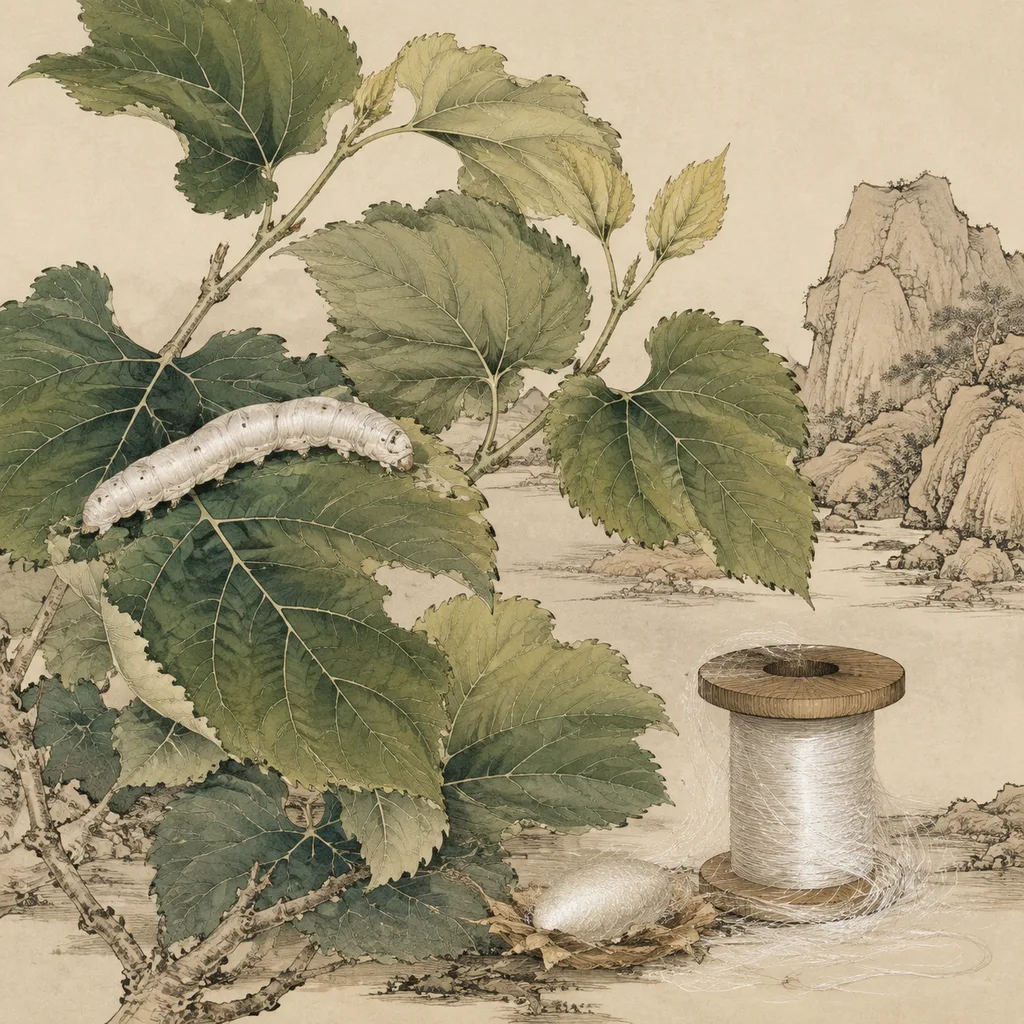
The mulberry tree (桑柘木) does not stand tall like a pine or bear fruit like an apple tree. Its leaves are food for silkworms, silently sustaining the entire silk industry through quiet sacrifice. This NaYin evokes a scene of cultivation, not conquest: a grove where every leaf is a gift, and the wood itself is shaped into looms and spinning wheels. Ancient astrologers chose this metaphor to represent a person whose life force is channeled into service, production, and the creation of beauty for others. Unlike a wild forest, the mulberry grove is orderly, domesticated, and purposeful. Its energy is not about personal ambition but about enabling the ambitions of the many. This page explores the symbolism, classical wisdom, personality traits, and life applications of those born under the Mulberry-Wood NaYin, revealing how giving of oneself can be the most powerful form of growth.
The essence of Mulberry-Wood lies in generative sacrifice.
The *San Ming Tong Hui* (三命通会) by Wan Minying (1587) describes Mulberry-Wood as: “桑柘木者,缯彩镒基,绮罗根本,士民飘飘之袂,圣贤楚楚之衣,此木供蚕为弧...
Mulberry-Wood personalities are defined by their willingness to be used for the benefit of others.
| NaYin Name | Mulberry-Wood (桑柘木) |
| Element | Wood (木) |
| Ganzhi Pillars | 壬子, 癸丑 (Yang Water, Yin Water) Stems |
| Associated Animals | Rat, Ox |
| Years in 60-Year Cycle | 1912, 1972, 2032, 1913, 1973 |
| Classical Source | 《三命通会》明·万民英,1587 · 卷三十「论纳音取象」/ 《五行要论》/ 《烛神经》 |
Key Takeaways
- Mulberry-Wood represents generative sacrifice — wood that feeds entire industries by giving of itself.
- This NaYin describes people who nurture others with their very substance and still somehow keep growing.
- The mulberry metaphor carries a necessary boundary: even feeding trees need rest. Giving is beautiful but not infinite.
- Classical texts describe curled, unextended wood in waterlogged ground, feeding silkworms in their season.
The Essence of Mulberry-Wood
The essence of Mulberry-Wood lies in generative sacrifice. Its wood is not harvested for timber but shaped into looms; its leaves are not for shade but for silkworms. This is a tree that gives itself away so that others can create. Unlike towering Forest-Wood, which stands independent and self-sufficient, Mulberry-Wood finds its purpose in relationship to an industry—the silk trade that clothed emperors and commoners alike. Unlike Plain-Wood, content to grow in orchards, Mulberry-Wood is cultivated in neat rows, pruned for maximum leaf yield. Its character is that of a provider who asks nothing in return, a nurturer whose wealth comes from seeing others thrive. The mulberry tree teaches that true strength is not in standing tall but in bending low to feed the hungry. Its roots hold the soil, but its leaves are currency of generosity. Every silkworm that spins its cocoon is a testament to the mulberry's quiet, indispensable role. Those who embody this energy often find themselves in roles where their efforts are the foundation for others' success—teachers, healers, craftsmen, and leaders who serve.
Voices from the Classics
The *San Ming Tong Hui* (三命通会) by Wan Minying (1587) describes Mulberry-Wood as: “桑柘木者,缯彩镒基,绮罗根本,士民飘飘之袂,圣贤楚楚之衣,此木供蚕为弧,其用甚大。” This translates to: “Mulberry-Wood is the foundation of silks and brocades, the root of fine fabrics. It provides the flowing sleeves of commoners and the elegant robes of sages. This wood feeds silkworms to make bows (for looms), and its uses are vast.” The text emphasizes that Mulberry-Wood is not valued for its own timber but for what it enables. The concept of *qi* here is one of yielding and transformation—the tree gives its leaves, which become silk, which becomes garments of status and beauty. The *Yu Xiao Bao Jian* (玉霄宝鉴) adds that Mulberry-Wood people are naturally industrious and find fulfillment in serving a larger purpose. The passage highlights that this NaYin's power is in its utility: “其用甚大” (its uses are very great). Unlike other woods that are admired for their height or fruit, Mulberry-Wood is praised for its capacity to be consumed in the creation of something exquisite.
桑柘木者,缯彩镒基,绮罗根本,士民飘飘之袂,圣贤楚楚之衣,此木供蚕为弧,其用甚大。
— 《三命通会》明·万民英,1587 · 卷三十「论纳音取象」/ 《五行要论》/ 《烛神经》
壬子: 壬子,专位之木,癸丑偏库之木,遇死绝则富贵,生旺则贫贱,水多则夭折,金多土盛为佳。
癸丑: 癸丑,偏库之木,遇死绝则富贵,生旺则贫贱,水多则夭折,金多土盛为佳。
Character and Temperament
Mulberry-Wood personalities are defined by their willingness to be used for the benefit of others. Unlike Forest-Wood, which grows independently and resists interference, Mulberry-Wood thrives under cultivation—it accepts pruning, shaping, and even sacrifice of its leaves without complaint. This makes them natural supporters, often working behind the scenes to ensure the success of a team or family. They are patient, detail-oriented, and find deep satisfaction in seeing their efforts bear fruit through others. Their strength is their generosity; they give freely of their time, knowledge, and resources. However, this selflessness can become a challenge: they may neglect their own needs, feeling that their worth is only in what they provide. They can be taken for granted, or they may struggle to say no, leading to burnout. The mulberry tree's low stature reminds them to stay grounded and not lose sight of their own growth. In relationships, they are devoted partners who seek to nurture and support, but must learn to receive as well as give. Their temperament is calm and steady, but when pushed too far, they can become resentful—like a tree that has been over-pruned. Balancing sacrifice with self-care is their lifelong lesson.
Mulberry-Wood in Career, Wealth, and Relationships
In career, Mulberry-Wood individuals excel in roles that involve service, production, or enabling others. They make excellent teachers, nurses, social workers, artisans, and managers who build up their teams. Their ability to see the big picture through small, consistent efforts suits them for industries like textiles, agriculture, education, and healthcare. Financially, they are cautious and generous—they prefer steady income over risky ventures, and they often share their wealth with family or community. They may struggle with financial self-assertion, undervaluing their own contributions. In love, they are devoted and nurturing, often putting their partner's needs first. They seek relationships where they can be the stable foundation, but they must learn to ask for reciprocation. Their partnership style is one of quiet devotion, like the mulberry that supports the silkworm. They may attract partners who are more ambitious or charismatic, and they find joy in being the wind beneath their partner's wings. The key for Mulberry-Wood is to ensure that their giving does not become a one-way street, and that they also allow themselves to be nourished.
The Two Pillars of Mulberry-Wood
Mulberry-Wood appears in two pillar combinations: 壬子 (Yang Water Rat) and 癸丑 (Yin Water Ox). The Rat pillar (壬子) embodies a more dynamic, flowing energy—water feeds the wood, making it lush but also prone to being uprooted. Those born in 壬子 years (1912, 1972, 2032) like Sundar Pichai and Gene Kelly often display a blend of creativity and practicality, using their gifts to innovate within established systems. The Ox pillar (癸丑) adds earthy stability—the water is yin, the soil is rich, making the wood more rooted and enduring. Notable 癸丑 individuals (1913, 1973) include Larry Page, Sergey Brin, and Albert Camus. These figures combine intellectual depth with a drive to build lasting structures. While both share the sacrificial giving of Mulberry-Wood, the Rat year tends toward more visible, pioneering leadership, while the Ox year leans toward behind-the-scenes cultivation and resilience. The difference is subtle: 壬子 is the mulberry by a stream, quick to grow; 癸丑 is the mulberry in deep soil, slow but steadfast.
Living with Mulberry-Wood Energy
Living with Mulberry-Wood energy means embracing the paradox that true strength lies in service. The mulberry tree does not compete for the sun; it grows low, offering its leaves to the silkworm, and in doing so, becomes part of something magnificent. This NaYin teaches that your worth is not diminished by what you give away—it is amplified. The challenge is to give without losing yourself, to serve without becoming a doormat. Growth for Mulberry-Wood comes from learning to receive as well as give, to prune your own branches before they break. Whether you are a master weaver or a quiet supporter, your role is essential. To discover whether this energy appears in your chart, explore your full BaZi reading.
Discover whether Mulberry-Wood appears in your chart. Calculate your free BaZi reading →
Your birth data stays in your browser and is never stored or shared.
References & Classical Sources
This page draws on the following primary sources, cross-referenced with our in-house library of 16+ classical BaZi texts:
- San Ming Tong Hui (三命通会) — Wan Minying (万民英), Ming Dynasty, 1587. Volume 30, “On NaYin Imagery”. Core quote: “桑柘木者,缯彩镒基,绮罗根本,士民飘飘之袂,圣贤楚楚之衣,此木供蚕为弧,其用甚大。”
- Yu Xiao Bao Jian (玉霄宝鉴) — Song Dynasty. Supplementary notes on 桑柘木 pillars.
- Yan Dongsou’s Commentary (阎东叟注) — Song Dynasty.
- Di Tian Sui (滴天髓) — Ming/Song Dynasty. Cross-referenced for Wood-element behavioral patterns.
- Zi Ping Zhen Quan (子平真诠) — Shen Xiaozhan, Qing Dynasty. Referenced for Nayin classification methodology.
All translations by the 12Zodiacs Editorial Team, reviewed against the original classical Chinese. Full methodology available on our Methodology page.
More in NaYin Elements
Creek Water · Forest Wood · Gold Leaf Metal · Hairpin Metal · Hearth Fire · Heavenly Water · Highway Earth · Lamp Fire