
Wood Element (木 / Mù)
Of the five elements in Chinese metaphysics, Wood (木 / Mù) is the force of expansion. It is the sapling that cracks concrete, the vine that climbs toward sunlight, and the forest that reshapes entire landscapes over centuries. Wood energy is directional, purposeful, and relentlessly upward. In the Four Pillars system, Wood governs how we initiate, how we plan, and how we treat others while we climb. Its virtue is benevolence (仁 / rén) — not softness, but the principled conviction that growth should lift everyone, not just the individual. When Wood is balanced in a chart, a person acts with vision and fairness. When it is excessive or depleted, that same drive turns rigid, judgmental, or explosive. Understanding Wood means understanding the difference between healthy ambition and the stubbornness that comes when a tree refuses to bend.
Wood (木 / Mù) is one of the Five Elements (五行) in Chinese metaphysics, representing growth, creativity, benevolence, and new beginnings. Associated with spring, the color green, the direction east, and the planet Jupiter, Wood governs how we initiate, plan, and expand. In BaZi (Four Pillars), Wood appears as the Day Master for those born under Heavenly Stems Jia (甲, Yang Wood) and Yi (乙, Yin Wood), and is carried by the zodiac animals Tiger, Rabbit, and Dragon. Wood years occur every 12 years in the cycle, most recently 2010–2011 and 2022–2023.
Wood in the Generating Cycle
The generating cycle (生 / shēng) describes how each element feeds the next. Wood sits at the very foundation of this cycle because it transforms water into fire — the spark of life itself.
Water nourishes Wood. Just as rain feeds a forest, Water element in a chart provides Wood with the emotional depth, intuition, and adaptability it needs to grow. A Wood Day Master with strong Water support is like a well-rooted tree: resilient, resourceful, and hard to topple. Without Water, Wood dries out — creativity becomes frantic, and growth becomes forced.
Wood feeds Fire. When wood burns, it releases stored energy as light and heat. In a BaZi chart, this relationship shows up as ambition turned into visible achievement. Wood types who connect with Fire energy become charismatic, expressive, and influential. They don’t just have ideas — they ignite movements. The classical text Di Tian Sui describes this as “the tree that rises to meet the sun,” a metaphor for how Wood’s quiet persistence eventually produces radiant results.
Wood in the Controlling Cycle
The controlling cycle (克 / kè) keeps the elements in check, preventing any one force from becoming tyrannical. Wood’s role here is both conqueror and conquered.
Wood controls Earth. Roots break through soil, rocks, and even foundations. In personality terms, this is Wood’s ability to challenge stagnation. Wood types naturally question the status quo, disrupt outdated systems, and push through bureaucratic resistance. This makes them excellent reformers — but it also means they can be insensitive to established structures that others hold dear. A Wood person who over-controls Earth becomes a bulldozer, flattening traditions without a second thought.
Metal controls Wood. The axe, the saw, the blade — Metal represents boundaries, rules, and refinement. When Metal energy is present in a chart, it prunes Wood’s excess. This is not destruction for its own sake; it is the necessary trimming that makes a tree stronger. Wood types who accept Metal’s discipline become precise, skilled, and polished. Those who resist it become wild, overgrown, and eventually break under their own weight. The classic analogy in Yuan Hai Zi Ping compares this to a forest that needs periodic thinning to prevent disease and wildfire.
Wood Element Compatibility
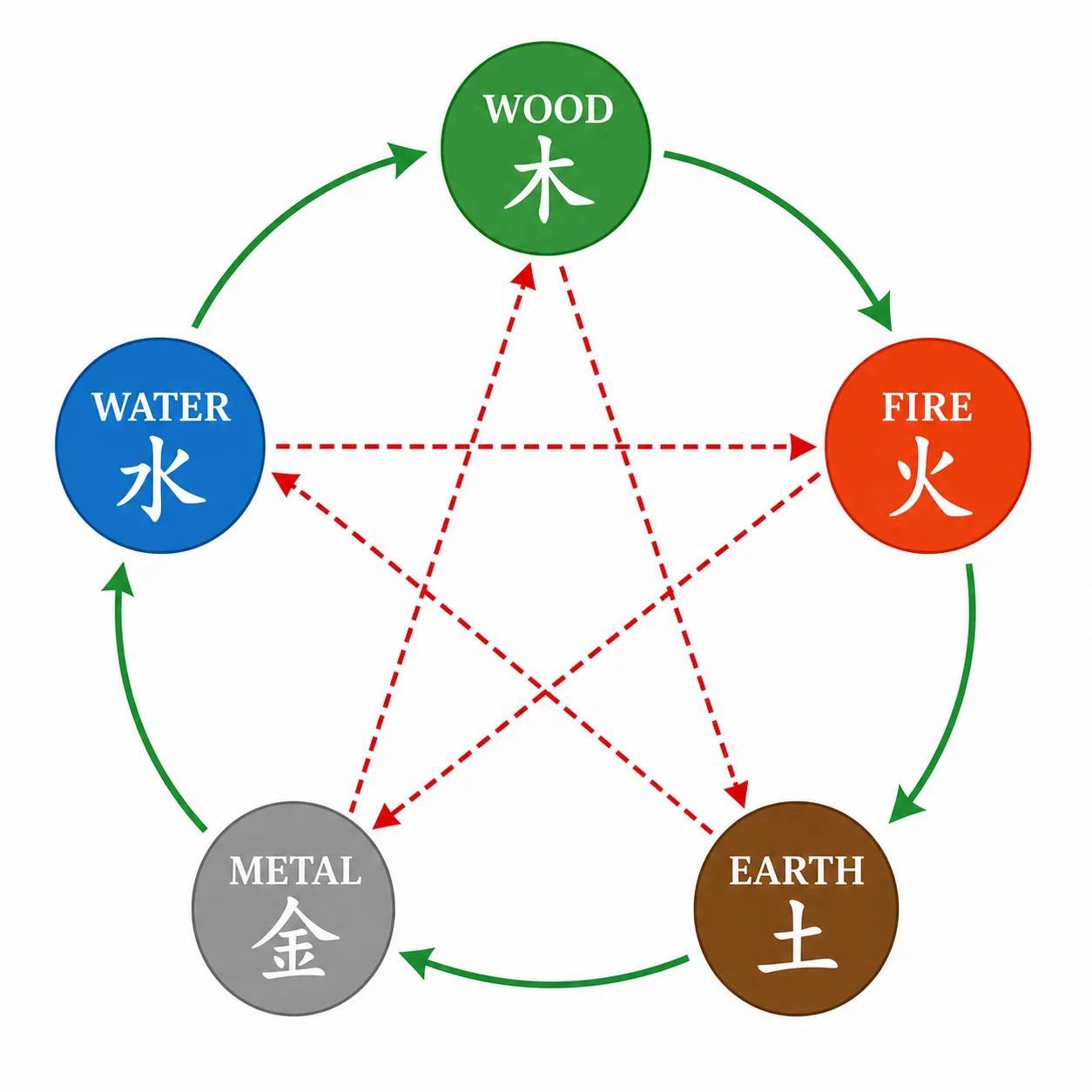
In the Five Element cycle, Wood interacts with other elements through two mechanisms: the generating (producing) cycle (相生) and the controlling (overcoming) cycle (相克). These interactions determine which elements are naturally compatible with Wood and which create friction.
Water → Wood (Best Match)
Water nourishes Wood. Water element people (Rat, Pig) provide the emotional depth, intuition, and resources that Wood needs to grow. This is the most supportive pairing — Water partners feel purposeful around Wood’s vision, and Wood types feel understood and sustained. In romance, this is a nurturing, growth-oriented bond.
Wood → Fire (Productive)
Wood feeds Fire. Fire element people (Horse, Snake) energize Wood’s ideas into visible action. Wood provides fuel; Fire provides light. Together they create warmth and visibility. However, if Wood is weak, Fire can consume it — leading to burnout.
Wood vs. Metal (Challenging)
Metal controls Wood — the axe cuts the tree. Metal people (Monkey, Rooster) bring discipline and precision that can either refine Wood or crush it. In relationships, this pairing requires mutual respect: Wood must accept pruning, Metal must not over-cut. When balanced, this pairing produces sharp, accomplished outcomes.
Wood vs. Earth (Contentious)
Wood controls Earth — roots break through soil. Wood people naturally challenge Earth’s stability, which can be either constructive (breaking stagnation) or destructive (uprooting foundations). Earth partners (Ox, Goat, Dog, Dragon) may feel overwhelmed by Wood’s constant drive for change.
Wood + Wood (Amplifying)
Same-element pairings amplify each other. Two Wood people share values of growth and vision, creating an instant understanding. But without Water to nourish or Fire to channel the excess, double Wood can become competitive, rigid, or exhausting — a forest too dense to thrive.
Wood Compatibility with Each Zodiac Animal
For relationship readings, practitioners compare the Day Branches of both partners. But the year-branch element also matters for general compatibility:
- Wood + Rat (Water): Excellent — Water nourishes Wood. The Rat’s intelligence feeds Wood’s vision.
- Wood + Ox (Earth): Challenging — Wood roots disrupt Ox’s stability. Requires patience.
- Wood + Tiger (Wood): Amplifying — Two pioneers. Great for shared ambition, risk of competition.
- Wood + Rabbit (Wood): Harmonious — Yang + Yin Wood. The tree and the vine, naturally complementary.
- Wood + Dragon (Earth/Wood): Complex — Dragon’s Earth is controlled by Wood, but Dragon’s hidden Water nourishes it. Depends on chart balance.
- Wood + Snake (Fire): Productive — Wood feeds Snake’s Fire. Creative and passionate, but Wood must pace itself.
- Wood + Horse (Fire): Productive — Wood fuels Horse’s radiance. Visible, charismatic pairing.
- Wood + Goat (Earth): Neutral-Challenging — Wood controls Goat’s Earth. Goat’s nurturing nature may feel stifled.
- Wood + Monkey (Metal): Challenging — Metal chops Wood. Requires mutual respect and clearly defined roles.
- Wood + Rooster (Metal): Challenging — Sharp Metal prunes Wood. Can refine Wood’s raw talent, or wound it.
- Wood + Dog (Earth): Neutral — Wood controls Earth, but Dog’s loyalty provides a stable base. Workable with effort.
- Wood + Pig (Water): Excellent — Pig’s Water deeply nourishes Wood. Warm, supportive, growth-oriented.
Personality of Wood Types
Wood-dominant people are builders. They see a plot of empty land and imagine a garden. They see a stalled project and envision the path forward. This forward-thinking nature makes them natural initiators — the ones who raise their hands first, who pitch the idea, who volunteer for the hard task before anyone else has fully understood the assignment.
Their strengths are considerable. Wood types are creative in a practical way; their imagination is always tethered to implementation. They are also deeply principled. The virtue of benevolence (仁 / rén) manifests as genuine concern for others’ welfare. A Wood person will fight for a colleague’s promotion, defend an underdog, and insist on fair process even when cutting corners would be easier. They lead by inspiration rather than coercion, and people naturally want to follow someone with such clear direction.
But every strength has a shadow. Wood’s growth orientation becomes stubbornness when challenged. A Wood type who feels threatened will not bend — they will snap or dig in. This rigidity often masks a deeper fear: that yielding means losing identity. Wood types can also be judgmental, measuring everyone against their own internal standard of “right growth.” They may struggle to appreciate different paths to success, dismissing others as lazy or unfocused when those people simply move at a different pace.
When balanced, Wood is the most inspiring of the five elements. When imbalanced, it is the most exhausting — both for the Wood person and for everyone around them.
Wood Element Personality: Male vs. Female Expressions
While the core traits of Wood — vision, growth, benevolence — apply regardless of gender, cultural conditioning often shapes how these traits are expressed:
Wood Element Male Personality: Wood men tend to be the “builders” — they express their growth energy through tangible projects, career advancement, and protecting their family’s future. They are often the ones who start businesses, lead community initiatives, or champion causes. Their challenge is vulnerability: Wood men may equate growth with constant achievement, making it hard to rest or ask for help. In relationships, they show love through provision and planning rather than words. The benevolence (仁) virtue manifests as protective care — they want to shield and elevate those they love.
Wood Element Female Personality: Wood women channel growth into both achievement and nurturing. They tend to be multi-capable — managing careers, families, and creative projects simultaneously. Their challenge is over-functioning: taking on too much because “if I don’t grow it, nobody will.” Wood women often have strong ethical convictions and will advocate fiercely for fairness. In relationships, they need a partner who respects their autonomy and doesn’t feel threatened by their ambition. The benevolence virtue manifests as mentoring — they naturally lift other women and create opportunities for those around them.
Wood Element Career & Professions
Wood’s growth-oriented energy makes it naturally suited to careers involving initiation, education, healing, and systems-building. Wood types excel in roles where they can plant seeds — literal or metaphorical — and watch them grow over time. They are the visionaries who see potential before others do.
Best Career Fields for Wood Element People
Yang Wood (甲) types thrive in large-scale, structural roles — CEOs, founders, professors, judges, and urban planners. They think in decades and build institutions. Yin Wood (乙) types excel in adaptive, creative roles — designers, writers, counselors, and negotiators. They succeed through flexibility and subtle influence rather than force.
Wood Element Career Weaknesses: Wood types can struggle with roles that require constant crisis management (Fire-dominated work) or rigid rule-following (Metal-dominated work). They prefer organic growth over imposed structure. When stuck in bureaucratic environments, Wood types become frustrated and may “break out” to start their own ventures.
Wood Element Chinese Zodiac Years
In the 60-year sexagenary cycle, each zodiac animal appears five times — once for each element. Wood years come when the year’s Heavenly Stem carries Wood energy. Here are all Wood years from 1940 to 2040:
| Year | Stem-Branch | Zodiac Animal | Polarity | NaYin Element |
|---|---|---|---|---|
| 1944 | Jia-Shen | Monkey | Yang Wood | Spring Water (泉中水) |
| 1945 | Yi-You | Rooster | Yin Wood | Spring Water (泉中水) |
| 1954 | Jia-Wu | Horse | Yang Wood | Sand Metal (砂石金) |
| 1955 | Yi-Wei | Goat | Yin Wood | Sand Metal (砂石金) |
| 1964 | Jia-Chen | Dragon | Yang Wood | Lamp Fire (覆灯火) |
| 1965 | Yi-Si | Snake | Yin Wood | Lamp Fire (覆灯火) |
| 1974 | Jia-Yin | Tiger | Yang Wood | Creek Water (大溪水) |
| 1975 | Yi-Mao | Rabbit | Yin Wood | Creek Water (大溪水) |
| 1984 | Jia-Zi | Rat | Yang Wood | Creek Water (大溪水) |
| 1985 | Yi-Chou | Ox | Yin Wood | Creek Water (大溪水) |
| 1994 | Jia-Xu | Dog | Yang Wood | Mountain Fire (山头火) |
| 1995 | Yi-Hai | Pig | Yin Wood | Mountain Fire (山头火) |
| 2004 | Jia-Shen | Monkey | Yang Wood | Spring Water (泉中水) |
| 2005 | Yi-You | Rooster | Yin Wood | Spring Water (泉中水) |
| 2014 | Jia-Wu | Horse | Yang Wood | Sand Metal (砂石金) |
| 2015 | Yi-Wei | Goat | Yin Wood | Sand Metal (砂石金) |
| 2024 | Jia-Chen | Dragon | Yang Wood | Lamp Fire (覆灯火) |
| 2025 | Yi-Si | Snake | Yin Wood | Lamp Fire (覆灯火) |
| 2034 | Jia-Yin | Tiger | Yang Wood | Creek Water (大溪水) |
| 2035 | Yi-Mao | Rabbit | Yin Wood | Creek Water (大溪水) |
How to use this table: Find your birth year. If it appears here, you were born in a Wood year. The NaYin column shows your year’s poetic element — a secondary refinement that adds texture to your reading. It is normal for a Wood year to carry a NaYin of a different element — the stem element and the year NaYin are two independent systems, which is why many Wood years in this table show Water or Fire NaYin instead. Note that even if your birth year doesn’t appear here, you may still have Wood energy in your Day Master (the stem of your day pillar, not year pillar). Use our BaZi calculator to find your complete element profile.
Wood in the Zodiac
Three of the twelve Chinese zodiac animals carry Wood’s energy: the Tiger (虎 / hǔ), the Rabbit (兔 / tù), and the Dragon (龙 / lóng). Each expresses Wood differently.
The Tiger is Yang Wood in its most assertive form. This is the great tree (甲 / jiǎ) — tall, commanding, impossible to ignore. Tigers lead through sheer presence. They are pioneers who thrive in new territory, but their intensity can overwhelm those who prefer collaboration over conquest.
The Rabbit is Yin Wood (乙 / yǐ) — the flowering vine. Rabbits grow sideways as much as upward. They are diplomats, negotiators, and artists who achieve through charm rather than force. Where the Tiger pushes, the Rabbit persuades. This makes the Rabbit the most socially graceful of the Wood signs, but also the most prone to avoiding direct confrontation.
The Dragon is Wood in its most transformative state. Dragons combine Wood’s vision with an almost mythical sense of purpose. They are the architects of grand schemes, the ones who think in decades while others think in days. Dragon Wood can be magnificent — or megalomaniacal — depending on the rest of the chart. When balanced, they inspire nations. When imbalanced, they exhaust everyone trying to keep up with their ambitions.
Wood in BaZi Charts
In a BaZi chart, Wood appears as a Day Master (日主 / rì zhǔ), representing your core self. The distinction between Yang and Yin Wood is fundamental.
Yang Wood (甲 / jiǎ) is the great tree. People with this Day Master are built for scale. They think in systems, structures, and long timelines. They are the CEOs, the architects, the founders. Their challenge is learning to bend without breaking — to accept that not every obstacle requires a frontal assault.
Yin Wood (乙 / yǐ) is the flowering vine. These people are adaptable, resourceful, and quietly persistent. They succeed by weaving through obstacles rather than confronting them. The vine’s genius is finding support in unlikely places — a skill that makes Yin Wood types exceptional in negotiation, design, and any field requiring subtle influence.
The NaYin (纳音 / nà yīn) system further refines Wood into six distinct types. Forest Wood (大林木) is collective strength — the power of many trees together. Pine Wood (松柏木) endures winter; these people are resilient under pressure. Willow Wood (杨柳木) is flexible and graceful, bending without breaking. Plain Wood (平地木) grows on open ground — practical and unpretentious. Pomegranate Wood (石榴木) bears fruit; these people are productive and generative. Mulberry Wood (桑柘木) feeds silkworms — nurturing and service-oriented. Each NaYin adds a layer of nuance to how Wood expresses itself in a chart.
Cultural & Medical Associations
Wood’s correspondences extend far beyond personality. In Chinese medicine, Wood rules the liver (肝 / gān) and gallbladder (胆 / dǎn). The liver is the organ of planning and decision-making; the gallbladder governs courage and judgment. When Wood is balanced, decisions come easily and courage flows. When stagnant, frustration builds — the emotion of Wood is anger (怒 / nù), which in Chinese medicine is understood as blocked upward energy seeking release.
Wood’s direction is East (东 / dōng), where the sun rises. Its season is Spring (春 / chūn), the time of planting and new beginnings. Its color is green (绿 / lǜ), the color of living vegetation. Its planet is Jupiter (木星 / mù xīng) — the classical “Year Star” that governs expansion and good fortune. The virtue of benevolence (仁 / rén) ties all of this together: Wood’s growth is never purely selfish. Like a forest that shelters countless creatures, Wood’s purpose is to create conditions where life can flourish.
Wood Element in Chinese Medicine (TCM)
In Traditional Chinese Medicine, Wood rules the liver (肝, Gān) and gallbladder (胆, Dǎn). The liver is responsible for the smooth flow of Qi throughout the body — it plans and regulates, just as Wood plans and grows. The gallbladder governs decision-making and courage.
When Wood is balanced: Energy flows smoothly, decisions come easily, vision is clear, and the body feels flexible and resilient. The person wakes with purpose and sustains energy throughout the day.
When Wood is imbalanced (stagnant): Liver Qi stagnation manifests as anger, frustration, irritability, and physical tension — especially tight shoulders, jaw clenching, and tension headaches. Digestive issues (the Wood-Earth controlling relationship) are common. In TCM, the emotion of Wood is anger (怒, Nù), understood not as a character flaw but as blocked upward energy seeking release.
When Wood is deficient: The person may feel directionless, lack motivation, or experience vision problems (Wood governs the eyes in TCM). Muscle cramps, brittle nails, and hair loss can also indicate Wood deficiency.
TCM recommendations for Wood types:
- Diet: Sour foods (lemon, vinegar, pickles) support liver function. Green leafy vegetables nourish Wood energy. Avoid excessive alcohol, which overtaxes the liver.
- Exercise: Stretching (especially side bends and twists) releases liver Qi stagnation. Walking in nature is particularly restorative for Wood types.
- Emotional health: Express anger constructively — through exercise, creative work, or honest communication. Suppressed anger is the primary cause of Wood-related illness in TCM.
- Sleep: The liver’s peak repair time is 1:00–3:00 AM. Wood types benefit from sleeping before 11:00 PM to allow the gallbladder (11 PM–1 AM) and liver to detoxify.
Wood Element NaYin Variations
The NaYin (纳音) system refines Wood into 6 poetic sub-elements, each with a distinct personality and life implication. Explore your specific NaYin Wood type:
Wood Heavenly Stems
In BaZi, your Day Master is the Heavenly Stem of your day pillar. Wood has two stems, each with a radically different expression:
- Yang Wood (甲, jiǎ) — The great tree — structural, commanding, built for scale
- Yin Wood (乙, yǐ) — The flowering vine — adaptable, persuasive, quietly persistent
Learn more: Five Element Generating Cycle · Five Element Controlling Cycle · All 30 NaYin Elements · Heavenly Stems Guide
Classical Sources & References
The Wood element’s properties are codified in foundational texts of Chinese metaphysics, available through the Chinese Text Project (CText):
- Huang Di Nei Jing (黄帝内经, c. 200 BCE) — The foundational medical text that maps Wood to the liver, spring, east, and anger. Establishes the five-element correspondence system. Read on CText →
- Di Tian Sui (滴天髓, c. Ming Dynasty) — Commentary on how Wood behaves in different chart conditions: “Jia Wood is the great tree, Yi Wood is the flowering vine.” Read on CText →
- Yuan Hai Zi Ping (渊海子平, c. 14th century) — The systematic BaZi manual defining Wood’s role as Day Master and its interactions with other elements. Read on CText →
Further Reading & External Resources
- Wuxing (Five Elements) — Wikipedia — The foundational five-phase system in which Wood represents spring, growth, and the virtue of benevolence.
- Heavenly Stems — Wikipedia — The ten celestial stems, including Jia (甲) and Yi (乙), the two Wood stems.
- Sexagenary Cycle — Wikipedia — The 60-year cycle that determines which years are Wood-element years.
What does the Wood element mean in Chinese astrology?
The Wood element (木, Mù) represents growth, creativity, expansion, and benevolence. It is associated with spring, the color green, the direction east, and the planet Jupiter. In BaZi, Wood governs how you initiate projects, plan for the future, and treat others while pursuing your goals. Wood is the force of life pushing upward — the tree that cracks concrete, the vine that reaches sunlight. Its virtue is benevolence (仁, rén), meaning growth should benefit everyone, not just the individual.
What are the Wood element Chinese zodiac years?
True Wood years (where the Heavenly Stem is Jia/甲 or Yi/乙) in the 60-year cycle include: 1942, 1943, 1954, 1955, 1974, 1975, 2034, and 2035. Additionally, the zodiac branches Tiger (寅) and Rabbit (卯) always carry Wood energy regardless of the year’s stem, so Tiger years (1962, 1974, 1986, 1998, 2010, 2022) and Rabbit years (1963, 1975, 1987, 1999, 2011, 2023) have Wood influence. To find your specific element, you need to know your full birth year’s Heavenly Stem, not just the zodiac animal.
What are Wood element personality traits?
Wood element people are visionary, creative, principled, and growth-oriented. Key strengths include natural leadership, the ability to see potential where others see emptiness, strong ethical convictions, and a drive to build systems that benefit many people. Weaknesses include stubbornness, rigidity when challenged, judgmental attitudes toward those who move at a different pace, and a tendency to overextend themselves. Wood types lead by inspiration rather than coercion and are natural initiators who volunteer first and figure it out later.
Who is the Wood element most compatible with?
Wood is most compatible with Water (Rat, Pig) because Water nourishes Wood in the generating cycle — this is the most supportive pairing. Wood is also productive with Fire (Horse, Snake) because Wood feeds Fire, creating warmth and visibility. Wood is most challenged by Metal (Monkey, Rooster), as Metal controls Wood — the axe cuts the tree. Wood also contends with Earth (Ox, Goat, Dog), as roots break through soil. Two Wood people amplify each other, sharing values but risking competition without moderating elements.
Which careers suit Wood element people?
Wood types excel in careers involving initiation, growth, education, and healing: entrepreneurship, education, healthcare, environmental science, agriculture, urban planning, writing and publishing, coaching, law and advocacy, social work, and non-profit leadership. Yang Wood (甲) types thrive in large-scale structural roles like CEO, founder, professor, or judge. Yin Wood (乙) types excel in adaptive creative roles like designer, writer, counselor, or negotiator. Wood types struggle in rigidly bureaucratic or crisis-management-heavy environments.
How does Wood affect health in Chinese medicine?
In Traditional Chinese Medicine (TCM), Wood rules the liver (肝) and gallbladder (胆). When balanced, energy flows smoothly, decisions come easily, and the body feels flexible. When stagnant, Wood manifests as anger, irritability, tension headaches, tight shoulders, and digestive issues. Wood’s emotion is anger (怒), understood as blocked upward energy. To support Wood health: eat sour and green foods, stretch regularly, walk in nature, express emotions constructively, and sleep before 11 PM to allow the liver and gallbladder their peak repair time (11 PM–3 AM).
Ready to discover how Wood shapes your destiny?
Reveal your Day Master, element balance, and hidden personality patterns in seconds.
Cast Your BaZi Chart Free →