

Enter Your Birth Details
Advanced: True Solar Time (optional)
Select your birth city to apply True Solar Time correction, which adjusts your birth time based on the sun's actual position. If unknown, leave collapsed — your chart will still be accurate to the hour.
100% Free · No Sign-up · No Data Stored — your birth details never leave your browser
Your Four Pillars
Day Master Analysis
Career & Life Path
Five Elements Balance
Branch Interactions
Heavenly Stem Combinations
Da Yun — Major Luck Periods
NaYin Five Elements
People Who Share Your Sign
Wellness & Health Tendencies
★ Pattern Analysis (格局)
★ Favorable Elements (用神)
★ Climate Adjustment (调候)
★ Divine Stars & Influences (神煞)
★ Conception & Life Palace
Deep Reading — Classical Sources & Modern Lens
Loading detailed interpretations...
Why trust this chart?
Table of Contents
How to Use This BaZi Calculator
Getting your personalized Four Pillars chart takes less than 30 seconds. Here's what each step reveals:
- Enter your birth date — Use the calendar picker to select the exact date. BaZi uses the solar calendar (not the lunar calendar), so your Gregorian birthday is correct as-is.
- Set your birth time — The hour you were born determines your Hour Pillar, which governs your dreams, investments, and later-life chapters. If you're unsure, leave it at 12:00 PM — you can still generate a three-pillar chart, but the Hour Pillar and hour-dependent interpretation layers will be unavailable or less certain.
- Choose your gender — Gender affects the direction of your Da Yun (Major Luck periods), which determine the timing of life's major chapters.
- Optional: Enable True Solar Time — For maximum precision, select your birth city. The calculator adjusts your birth time based on the sun's actual longitude at your birthplace, correcting for timezone simplifications. Learn why this matters below.
- Click "Calculate My Chart" — Your full BaZi chart appears instantly, including Four Pillars, Five Elements radar, Day Master analysis, Da Yun timeline, and more.
Once your chart is displayed, use the "Copy Chart for AI Analysis" button to paste your results into ChatGPT, Claude, or Gemini for a personalized deep reading.
What Is BaZi? The Four Pillars of Destiny Explained
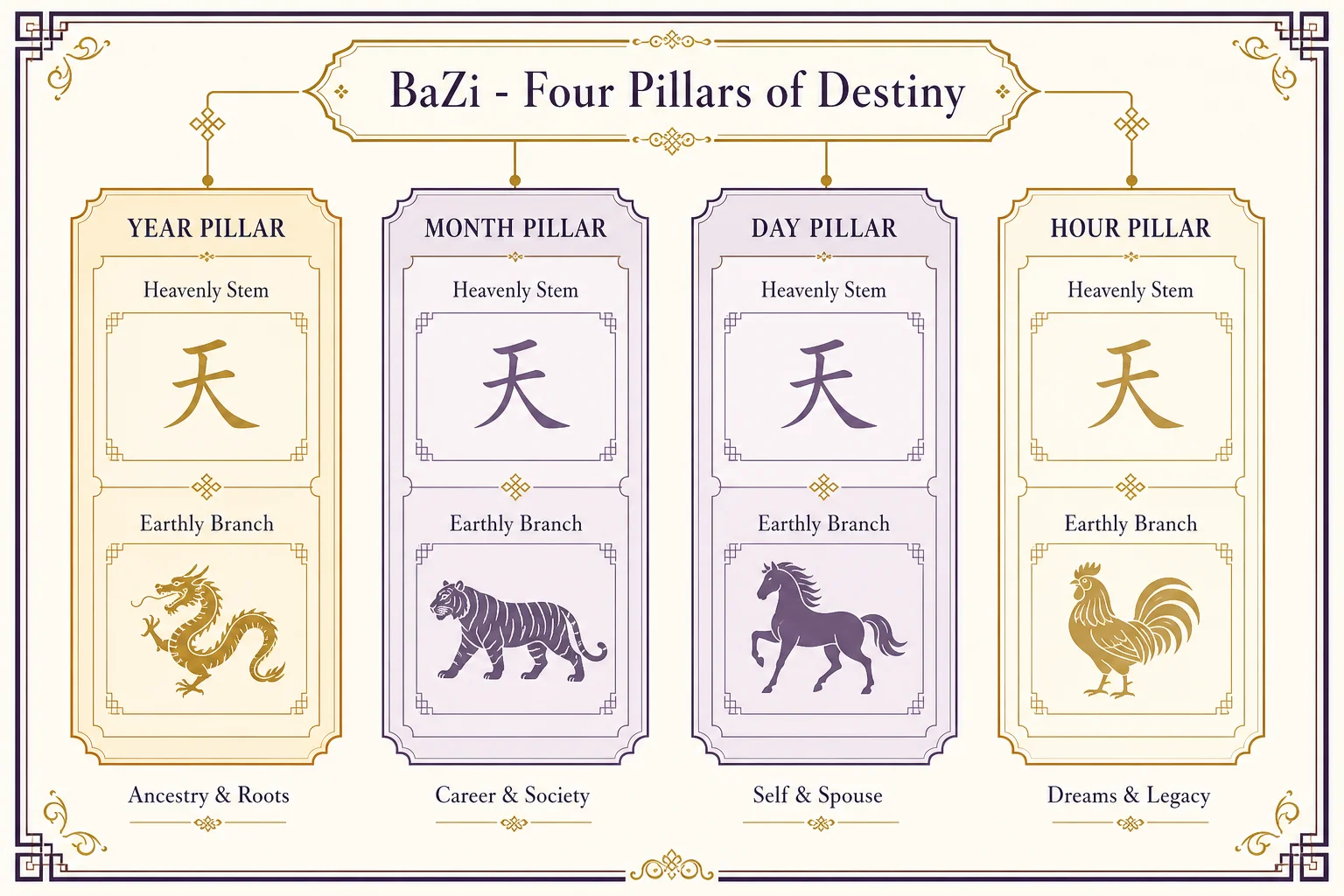
BaZi (八字), meaning "Eight Characters," is a Chinese astrological system with over 1,000 years of history, rooted in the 3,000-year-old stem-branch calendar (Four Pillars of Destiny, Chinese astrology). It translates the exact moment of your birth into a map of cosmic energies — not based on distant star constellations like Western astrology, but on the Five Elements (Wood, Fire, Earth, Metal, Water) and their dynamic interplay at the precise time you entered the world.
The foundational text Yuan Hai Zi Ping (渊海子平), compiled by Xu Zi Ping (徐子平) during the Song Dynasty (~10th century CE), established the Four Pillars system that we still use today. As recorded in the Chinese Text Project's digital edition: "The Year Pillar governs ancestors, the Month Pillar governs parents, the Day Pillar governs oneself, and the Hour Pillar governs descendants."
— Xu Zi Ping, Yuan Hai Zi Ping (渊海子平), Song Dynasty; accessed via Chinese Text Project
The "Eight Characters" come from Four Pillars, each representing a different dimension of your life:
| Pillar | Represents | Governs |
|---|---|---|
| Year Pillar | Ancestry & roots | Family background, early environment, generational patterns, grandparents |
| Month Pillar | Season & society | Career potential, social position, parents, the dominant energy of your chart |
| Day Pillar | Self & spouse | Your core identity (Day Master), personality, intimate relationships |
| Hour Pillar | Dreams & legacy | Inner aspirations, children, investments, later-life chapters |
Each pillar contains one Heavenly Stem (天干; Wikipedia) and one Earthly Branch (地支; Wikipedia) — together forming the "two characters" per pillar, and eight characters total. These characters interact through harmonies, clashes, and hidden dynamics to create your unique energetic blueprint.
Understanding Your Chart: A Component Guide
Day Master — Your Core Self
The Heavenly Stem of your Day Pillar is your "Day Master" (日主) — the single most important character in your chart. It represents your fundamental nature, like your Sun sign in Western astrology but more personalized. There are 10 Day Master types, each corresponding to one of the Five Elements in either Yang or Yin form:
木 Wood Stems
Yang Wood (甲): The towering tree — growth, persistence, leadership. Learn more →
Yin Wood (乙): The climbing vine — flexibility, grace, adaptability. Learn more →
火 Fire Stems
Yang Fire (丙): The blazing sun — warmth, charisma, visibility. Learn more →
Yin Fire (丁): The candle flame — precision, insight, quiet intensity. Learn more →
土 Earth Stems
Yang Earth (戊): The mountain — stability, trustworthiness, protection. Learn more →
Yin Earth (己): The fertile soil — nurturing, resourcefulness, patience. Learn more →
Metal Stems
Yang Metal (庚): The battle axe — discipline, justice, decisiveness. Learn more →
Yin Metal (辛): The jewelry gem — refinement, sensitivity, aesthetic sense. Learn more →
水 Water Stems
Yang Water (壬): The great ocean — power, wisdom, unstoppable momentum. Learn more →
Yin Water (癸): The morning dew — intuition, subtlety, gentle persistence. Learn more →
For a complete overview of all ten stems, visit our Heavenly Stems guide.
The Five Elements Balance
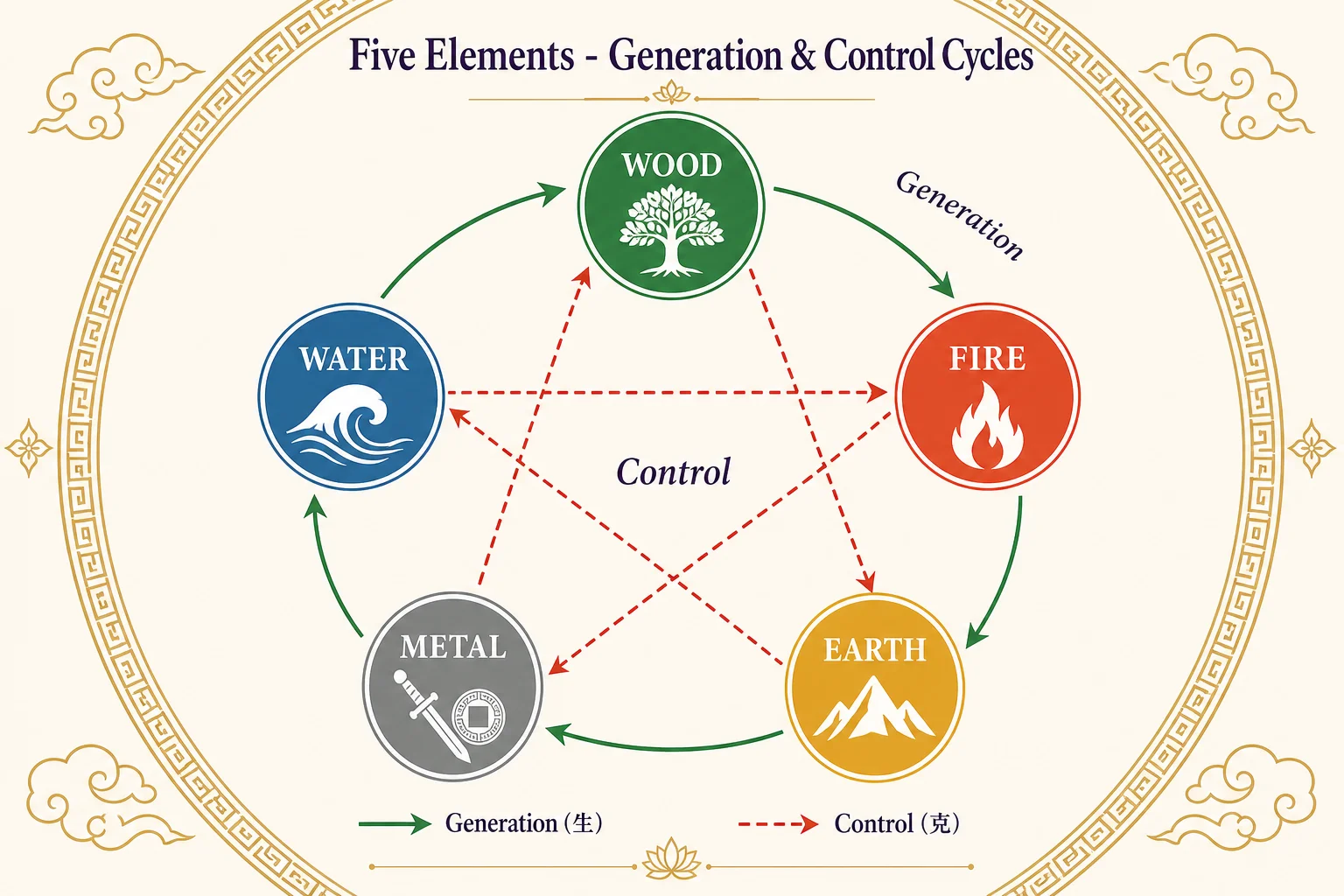
Your chart is scored by Five Elements & Seasonal Strength (五行; Wu Xing; 旺相休囚死) — Wood, Fire, Earth, Metal, and Water. Element presence is not the same as element strength: our engine weighs each stem and branch's hidden stems (principal 1.0 · middle 0.6 · residual 0.4), then applies seasonal influence (旺相休囚死) — the same branch counts differently in summer than in winter. The radar chart in your results reflects this weighted scoring, not a simple head-count.
The elements don't exist in isolation — they interact through two fundamental cycles:
- Generation Cycle (相生): Each element feeds and nourishes the next — Wood feeds Fire, Fire creates Earth (ash), Earth bears Metal, Metal collects Water, Water nourishes Wood. Understand the generation cycle →
- Control Cycle (相克): Each element restrains another — Wood parts Earth, Earth damsbs Water, Water extinguishes Fire, Fire melts Metal, Metal chops Wood. Understand the control cycle →
Explore each element in depth: Wood (木) · Fire (火) · Earth (土) · Metal (金) · Water (水)
Ten Gods (十神) — Your Personality Archetypes
The "Ten Gods" are the ten relational archetypes derived from the interaction between your Day Master element and every other element in your chart. Despite the name "gods," these are not deities — they're personality patterns and life themes that describe how you relate to wealth, authority, creativity, relationships, and self.
The Ten Gods fall into five pairs (one Yang, one Yin each):
| Category | Ten God | Theme |
|---|---|---|
| Self | Companion (比肩) | Independence, competition, self-reliance |
| Rob Wealth (劫财) | Ambition, risk-taking, social charisma | |
| Output | Eating God (食神) | Creativity, enjoyment, natural expression |
| Hurting Officer (伤官) | Rebellion, brilliance, unconventional thinking | |
| Wealth | Direct Wealth (正财) | Stable income, diligence, material security |
| Indirect Wealth (偏财) | Entrepreneurship, windfalls, generosity | |
| Power | Direct Officer (正官) | Authority, discipline, career advancement |
| Seven Killings (七杀) | Courage, transformation, overcoming adversity | |
| Resource | Direct Resource (正印) | Education, nurturing, maternal wisdom |
| Indirect Resource (偏印) | Intuition, eccentric knowledge, hidden talents |
Our complete Ten Gods guide explains each archetype in depth with real-world examples.
NaYin Elements — The Poetic Dimension
Beyond the basic Five Elements, BaZi uses a 60-cycle system called the Sexagenary Cycle (六十甲子; Wikipedia). Each of the 60 stem-branch combinations is associated with a specific NaYin element (纳音五行) — a poetic elemental resonance that adds texture and depth to your chart. For example, a Water stem-branch might carry the NaYin of "Ocean Water" (大海水), "Stream Water" (涧下水), or "Spring Water" (泉中水), each with distinct personality nuances.
Explore all 30 NaYin elements to discover the poetic dimension of your chart.
Da Yun — Your Life Chapters
Da Yun (大运), meaning "Great Luck," maps the 10-year life chapters that unfold from your birth. Each chapter brings a different elemental energy that interacts with your natal chart — some periods are naturally supportive (bringing opportunity and flow), while others present challenges that drive growth.
In your calculator results, click any Da Yun pillar to expand a detailed 10-year breakdown with year-by-year flow energy. This lets you see exactly when key life transitions are likely to occur.
Branch Interactions: The Hidden Dynamics in Your Chart
The twelve Earthly Branches (the Chinese zodiac animals) in your four pillars don't sit in isolation — they interact through a rich web of relationships that can dramatically alter your chart's meaning. Understanding these interactions is what separates a surface-level reading from a deep one.
As the Ming Dynasty scholar Wan Yu Wu (万育吾) wrote in San Ming Tong Hui (三命通会, "Comprehensive Treatise on the Three Fates," 1579 CE): "The harmonies and clashes among the branches are like the relationships among people — some bring joy and support, others bring conflict and transformation. The skilled practitioner reads not just the individual characters, but the conversation between them."
— Wan Yu Wu, San Ming Tong Hui (三命通会), Ming Dynasty (1579 CE); referenced via Wikipedia: Sanming Tonghui
六合 Six Harmonies
Six pairs of branches that blend and support each other — creating synergy, attraction, and partnership opportunities. Explore →
三合 Triple Harmonies
Three-branch alliances that form powerful elemental frames (e.g., Tiger-Horse-Dog = Fire frame), amplifying specific energies. Explore →
六冲 Six Clashes
Six opposing pairs that create tension, conflict, and sudden change — but also catalyze breakthroughs and transformation. Explore →
三刑 Three Punishments
Internal friction patterns that manifest as self-sabotage, legal issues, or health challenges — awareness is the first remedy. Explore →
六害 Six Harms
Subtle undermining patterns between branches — resentment, hidden obstacles, broken trust. Explore →
三会 Three Directions
Three same-element branches joining forces (e.g., Tiger-Rabbit-Dragon = Wood), creating seasonal powerhouse combinations. Explore →
Stems also interact through Five Combinations (天干五合) and Four Clashes (天干相冲), adding another layer of relational complexity.
True Solar Time: Why Precision Matters
Most BaZi calculators use your clock time directly — but your clock is based on a standardized timezone, not the sun's actual position. If you were born in a city far from your timezone's meridian, your clock time can be off by up to 45 minutes from true solar noon.
That difference can shift your Hour Pillar — and with it, an entire dimension of your chart. For example, someone born at 15:00 in western China (UTC+8 timezone but geographically closer to UTC+6) has a true solar time closer to 13:00, which falls in a different two-hour branch entirely.
This calculator's True Solar Time feature (in the Advanced section of the form) corrects for this by:
- Calculating the exact longitude of your birthplace
- Applying the Equation of Time — a correction for Earth's elliptical orbit and axial tilt
- Converting your clock time to the sun's actual position at your birth location
For most people, the correction is small and doesn't change the pillar. But if you were born near a branch boundary (e.g., 14:59 or 15:01) or in a geographically extreme location, True Solar Time can be the difference between an accurate chart and a wrong one.
True Solar Time is defined as "the hour angle of the true Sun, plus 12 hours," and differs from Mean Solar Time by the Equation of Time — a quantity that varies seasonally between approximately −14 and +16 minutes. The Equation of Time arises from Earth's elliptical orbit and axial tilt, as described in the NOAA Solar Position Calculator documentation.
— Based on astronomical standards from the Wikipedia article on Solar Time and NOAA's Solar Calculation algorithms
Why Can Two BaZi Calculators Give Different Results?
If you enter the same birth data into two different BaZi calculators and get different charts, both tools may be "working as designed" — they are just applying different conventions, and most never tell you which ones they use. Five decisions account for nearly all of the differences:
| Cause | What It Can Change |
|---|---|
| Solar-term boundary — which month a birth belongs to | Month Pillar (and sometimes Year Pillar near Li Chun) |
| True Solar Time — clock time vs. the sun's actual position | Hour Pillar |
| Historical daylight saving — whether pre-1991 DST rules are deducted | Effective birth time, and therefore any pillar |
| 23:00 day boundary — which day a late-night birth belongs to | Day Pillar and Hour Pillar |
| School conventions — late-Zi handling, luck-cycle direction, element weighting | Interpretation layers built on the same pillars |
The 12Zodiacs convention: month pillars switch at the exact minute of each solar term (computed from the JPL DE440s ephemeris, not approximated calendar dates); True Solar Time applies longitude and Equation-of-Time corrections automatically; historical DST is detected and deducted for the birth location and year; the day boundary follows the traditional 23:00 rule. Every rule is documented — see the full BaZi methodology — and the engine is locked by 736 automated assertions across 12 verification layers, with a publicly re-runnable validation report.
So when two calculators disagree: check the birth time first, then ask each tool how it handles the five decisions above. A calculator that documents its conventions is telling you something about its reliability; one that doesn't may simply be hiding them.
BaZi vs. Western Astrology: What's the Difference?
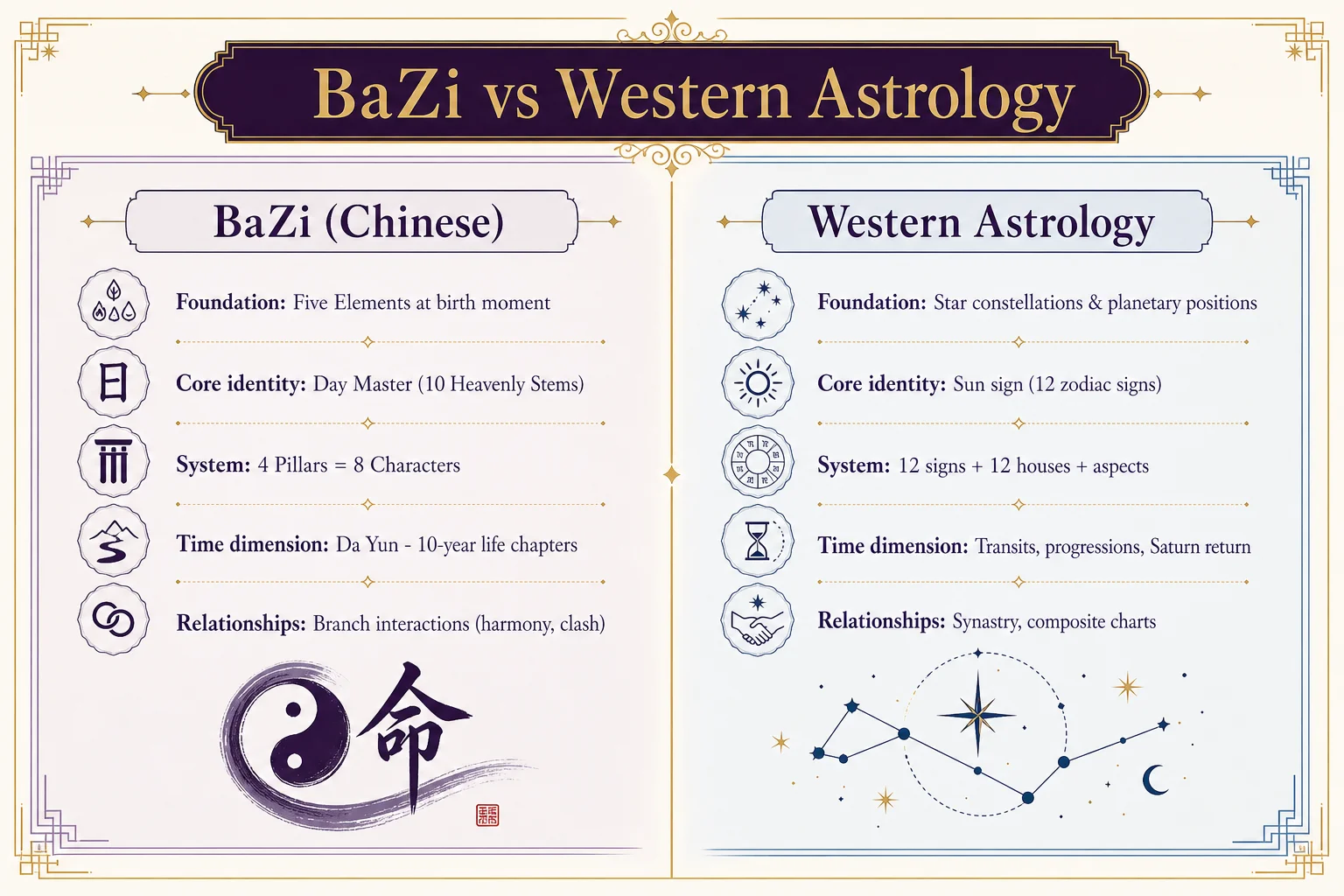
| Aspect | BaZi (Chinese) | Western Astrology |
|---|---|---|
| Foundation | Five Elements at birth moment | Star constellations & planetary positions |
| System | 4 Pillars × 2 characters = 8 Characters | 12 signs + 12 houses + planetary aspects |
| Core identity | Day Master (1 of 10 stems) | Sun sign (1 of 12 zodiac signs) |
| Time dimension | Da Yun — 10-year life chapters | Transits, progressions, Saturn return |
| Relationships | Branch interactions (harmony, clash, harm) | Synastry, composite charts |
| Strength analysis | Five Elements balance (radar chart) | Element modalities (fire, earth, air, water) |
| Best used for | Life timing, career strategy, energy balancing | Personality insight, emotional patterns, growth cycles |
Both systems offer valuable insights — they're complementary, not contradictory. Many people use BaZi for strategic life-timing decisions and Western astrology for emotional self-understanding. For a deeper dive into the full Chinese zodiac system, explore our complete Chinese Zodiac guide.
Explore More Chinese Zodiac Tools
Zodiac Compatibility Calculator
Discover your best (and worst) love, friendship, and work matches across all 12 Chinese zodiac signs. Check compatibility →
Zodiac Analyzer
Find your Chinese zodiac sign, lucky elements, colors, numbers, and directions in one comprehensive report. Analyze my sign →
Zodiac Years Chart
Complete reference chart of Chinese zodiac years from 1948 to 2031, including exact start and end dates. View years chart →
Daily Horoscope
Get today's personalized energy forecast for all 12 Chinese zodiac signs, updated daily. Read today's horoscope →
Lucky Elements Guide
Discover your sign's lucky colors, numbers, directions, and complementary elements for feng shui alignment. Find my lucky elements →
Personality Traits
In-depth personality analysis for all 12 Chinese zodiac signs — strengths, weaknesses, and hidden depths. Explore personalities →
All calculations on this page are performed locally in your browser. Your birth data is never transmitted, stored, or shared.
Authoritative References & Further Reading
Our BaZi calculator's methodology and educational content are based on classical texts and scholarly sources. The following references provide independent background reading:
Classical Texts
- 📖 Xu Zi Ping (徐子平), Yuan Hai Zi Ping (渊海子平) — Song Dynasty (~10th c. CE). The foundational text of Four Pillars BaZi. Read on Chinese Text Project ↗
- 📖 Wan Yu Wu (万育吾), San Ming Tong Hui (三命通会) — Ming Dynasty (1579 CE). Comprehensive treatise on BaZi theory, branch interactions, and destiny analysis. Wikipedia overview ↗
- 📖 Liu Bo Wen (刘伯温), Di Tian Sui (滴天髓) — Ming Dynasty. Essential commentary on elemental dynamics and chart pattern analysis.
- 📖 Qian Li Tong Sui (千里通髓) and Shen Feng Tong Kao (神峰通考) — Ming-Qing Dynasty works on advanced BaZi interpretation.
Modern Scholarly Sources & Encyclopedias
- 📚 Four Pillars of Destiny — Wikipedia's comprehensive overview of BaZi history, structure, and interpretation
- 📚 Heavenly Stems (天干) — The ten celestial stems that form the upper characters of each pillar
- 📚 Earthly Branches (地支) — The twelve terrestrial branches corresponding to zodiac animals
- 📚 Sexagenary Cycle (六十甲子) — The 60-year stem-branch cycle underlying all BaZi calculations
- 📚 Wu Xing (五行) — The Five Elements theory and its generation/control cycles
- 📚 Solar Time (True Solar Time) — Astronomical basis for our True Solar Time correction
- 📚 Equation of Time — The correction factor between mean and apparent solar time
- 📚 Chinese Zodiac — The twelve animal signs and their cultural significance
- 📚 Chinese Astrology — Historical and theoretical context of Chinese astrological systems
Frequently Asked Questions
Is this BaZi calculator really free?
Yes — 100% free with no sign-up, no account, and no paywall. You get the complete Four Pillars chart including Day Master analysis, Five Elements radar, Ten Gods, Da Yun luck periods, NaYin elements, and Shen Sha stars. There are no hidden fees, premium tiers, or locked features. Unlike some calculators that charge $9.99–$180 for deep readings, everything here is available to everyone.
How accurate is this BaZi calculator?
Our calculator uses the same astronomical standards as professional BaZi practitioners — and goes further in several areas where most online calculators fall short: the JPL DE440s ephemeris for True Solar Time correction, minute-level solar-term boundaries for month and year pillars (most tools switch at day granularity; we compare the exact minute the sun crosses each 15° longitude mark), and a verified Jia-Zi anchor for the day pillar that stays correct even for births between midnight and 6 AM. The Li Chun (立春) year boundary is applied to the exact minute. For verification, compare your chart with any professional practitioner's output — especially if you were born near a solar-term day, near midnight, or in an extreme-longitude city. Or inspect our public engine validation report, where every verification layer runs live — and the full methodology shows exactly how each pillar is derived.
Why do two BaZi calculators give different results for the same birth data?
Five conventions account for nearly all differences: the solar-term boundary (which decides the Month Pillar), True Solar Time versus clock time (which can shift the Hour Pillar by up to 45 minutes of equivalent time), historical daylight-saving rules, the 23:00 day boundary for late-night births, and each school's interpretive conventions. A calculator that documents which rules it applies — like the 12Zodiacs methodology with minute-level solar terms from the JPL DE440s ephemeris and 736 automated verification assertions — lets you verify its chart instead of guessing which convention caused a difference. See the full comparison table above.
What makes this calculator different from other online BaZi tools?
Four things most competitors don't do: (1) Minute-level solar-term switching — year and month pillars switch at the exact minute of Li Chun and each Jie term, not by calendar day; if you were born 10 minutes before Li Chun you get the old year, 10 minutes after, the new year. (2) Historical Daylight Saving Time — the engine knows DST rules back to 1918, including the 1974 US emergency daylight-saving period and Southern-Hemisphere seasons (January is summer in Sydney), and adjusts your clock time before solar conversion. (3) Extreme-longitude rollback — born at 1 AM in Kashgar (western China)? Your true solar time rolls back into the previous day, and the Day Pillar and Hour Pillar roll back together, correctly. (4) A consistent school, applied everywhere — see the next two questions. Every one of these claims is enforced by an automated test suite; the proof is public →
Which BaZi school does this calculator follow for 23:00 midnight births?
We follow the Zao-Wan Zi Shi (早晚子时) school — the standard used by classical references and mainstream Chinese professional software (Yuan Heng Li Zhen, Wen Zhen BaZi): if you were born between 23:00 and 24:00 (Late Zi), your Day Pillar stays with that calendar day, and the Hour Stem is derived from that day's stem; if you were born between 00:00 and 01:00 (Early Zi), your Day Pillar moves to the new day. Many online tools silently mix both conventions and can produce chart combinations that don't exist in any school — ours is applied consistently across the chart table, Five Elements weighting, and classical text lookups, so all three always agree.
Does the calculator handle international births, DST, and the Southern Hemisphere?
Yes. The engine includes a historical DST rulebook covering North America (including the 1974 energy-crisis emergency DST and the 1987/2007 rule changes), Europe, and Australia's reversed Southern-Hemisphere season (DST runs October–April there, so a January Sydney birth is correctly flagged as daylight time). When you select a city and birth date, DST is auto-detected with a checkbox you can override. And if you were born in a place like Kashgar, Urumqi, or Honolulu — where clock time and sun time diverge by hours — the True Solar Time correction can shift your chart into the previous day; the engine handles this day-rollback for all four pillars coherently.
How was this BaZi calculator tested for accuracy?
Beyond standard charts, the engine was stress-tested against extreme edge cases most users never hit but that silently break other tools: a Kashgar birth at 1 AM where solar time rolls back across midnight; two charts 15 minutes apart across the exact minute of Li Chun (one reads the old year, the other the new); a Sydney January birth requiring Southern-Hemisphere DST; and a birth just 3 minutes after a solar term, where the luck-cycle start age correctly computes to zero (luck begins in the birth year itself). The full engine is locked by an automated regression suite of 736 assertions across 12 verification layers — solar-term boundaries at minute precision, day pillars triple-checked from 1900 to 2100, Ten Gods full matrix, historical DST rules, and more. A single failed assertion blocks every deployment. See the live validation report → · Curious about the rules themselves? Read the full methodology →
What information do I need to calculate my BaZi chart?
You need three things: birth date (day/month/year), birth time (as precise as possible), and gender (which determines Da Yun direction). For maximum accuracy, also add your birth city in the Advanced section to enable True Solar Time correction. If you don't know your exact birth time, check "I don't know my birth time" — you'll get a three-pillar chart instead of four, with hour-dependent layers clearly marked as unavailable.
What if I don't know my exact birth time?
No problem. If you're unsure of your exact birth hour, check the "I don't know my birth time" box. The calculator will generate a 3-pillar chart (Year, Month, Day) — hour-dependent layers (Hour Pillar, some Da Yun details and interpretations) will be unavailable or less certain. Alternatively, use 12:00 PM as a baseline: it falls in the middle of the Wu (午) hour, though hour-specific readings then become approximations.
Is my birth data private? Do you store it?
Absolutely. All calculations happen locally in your browser. Your birth date, time, and location are never transmitted to any server, never stored in a database, and never shared with third parties — the only exception is the optional interpretation snippet you explicitly request, which sends derived chart symbols (not your raw birth data) to generate the reading. There are no tracking cookies on birth data. When you close the page, your data is gone. This is fundamentally different from calculators that require account creation or store your chart on their servers.
What is the difference between BaZi and Western astrology?
BaZi is based on the Five Elements (Wood, Fire, Earth, Metal, Water) at your exact birth moment, while Western astrology is based on planetary positions relative to star constellations. BaZi uses your Day Master (one of 10 Heavenly Stems) as your core identity, compared to the Sun sign in Western astrology. BaZi also maps your life in 10-year chapters (Da Yun), while Western astrology uses planetary transits. Many people find them complementary — BaZi for strategic life-timing, Western astrology for emotional insight. See the comparison table above.
Can BaZi predict my future?
BaZi is best understood as a timing and self-awareness tool, not a crystal ball. It reveals your natural tendencies, energetic strengths and weaknesses, and the timing of favorable and challenging periods — but it doesn't predetermine specific events. Think of it as a weather forecast for your life: knowing that a "storm period" is coming lets you prepare, and knowing your natural strengths helps you make better career and relationship decisions. Your choices and actions always matter more than the chart.
What is True Solar Time and why does it matter?
True Solar Time (真太阳时) is the sun's actual position at your birthplace, which can differ from your clock time by up to 45 minutes depending on how far your city is from your timezone's central meridian. This matters because BaZi uses 2-hour blocks for the Hour Pillar — if the True Solar Time correction shifts you across a block boundary, your entire Hour Pillar changes. If you were born near a boundary time (e.g., 14:59 or 15:01) or in a geographically extreme location, enabling this feature ensures accuracy. Read the full explanation above.
How do I use the "Copy Chart for AI Analysis" button?
After calculating your chart, click the "Copy Chart for AI Analysis" button. This copies your complete chart data along with a specialized prompt to your clipboard. Then open ChatGPT, Claude, or Gemini, paste (Ctrl+V / Cmd+V), and hit send. The AI will analyze your Four Pillars, Five Elements balance, and current Da Yun period, acting as your personal BaZi consultant. You can ask follow-up questions about career timing, relationship compatibility, or specific life decisions.
What are the Ten Gods (十神) in BaZi?
The Ten Gods are relational archetypes derived from how each element in your chart interacts with your Day Master. Despite the name "gods," they represent life themes like wealth, authority, creativity, and relationships. For example, Direct Wealth relates to stable income, Seven Killings to courage and overcoming adversity, and Eating God to creativity and enjoyment. Each appears in your chart with a percentage showing its strength. Explore our complete Ten Gods guide for deep-dive explanations.
Does the Chinese zodiac year start on January 1st or Lunar New Year?
Neither. In BaZi, the astrological year begins at Li Chun (立春), the solar term marking the start of spring — typically February 3–5. This is when the Year Pillar changes. If you were born in late January or early February, you belong to the previous zodiac year, not the new one. Many popular calculators get this wrong by using January 1st or the Lunar New Year. Our calculator correctly applies the Li Chun boundary.
Why does my BaZi year pillar differ from my Zi Wei Dou Shu year pillar?
If you were born between Li Chun and the Lunar New Year day, the two systems show different year pillars — and both are correct. BaZi follows the solar calendar: the Year Pillar switches at the exact moment of Li Chun, the classical rule of the Zi Ping tradition. Zi Wei Dou Shu follows the lunar calendar: its year stem switches on the Lunar New Year day itself. A birthday in that window therefore reads as different years in each system — our Zi Wei calculator and this BaZi calculator each follow their own system's classical rule.
Can I check compatibility between two people using BaZi?
While this calculator focuses on individual charts, BaZi compatibility analysis (合婚) compares two people's Four Pillars to assess relationship harmony, communication styles, and potential friction points. For zodiac-sign-level compatibility, use our Zodiac Compatibility Calculator. For a full BaZi-level comparison, generate both charts and use the AI export feature to ask about relationship dynamics.
Go Deeper: Zi Wei Dou Shu (Purple Star Astrology)
BaZi reads your eight characters; Zi Wei Dou Shu maps 60+ stars onto 12 Life Palaces — a domain-by-domain portrait of career, marriage, wealth and health. Traditional masters cross-validate both systems. Generate your free Zi Wei Dou Shu chart to see your palace map, Four Transformations and decade cycles — or inspect how that engine is proven correct in Zi Wei Engine Validation (835k assertions) and Zi Wei Methodology.