Chinese Zodiac Guide: The Story, Science & Soul Behind 2,000 Years of Animal Wisdom
A no-nonsense guide to how the Chinese zodiac actually works — the Great Race, the 60-year cycle, the five elements, and why your sign might not be what you think it is.
Here is something that still surprises me after years of studying this system: the Chinese zodiac is not a horoscope. It is not fortune-telling. It is a 2,000-year-old calendar technology — one that mapped time, personality, medicine, and relationships into a single framework long before personality tests existed. And somehow, it is still alive today, printed on red envelopes, consulted before weddings, and debated at family dinners across a billion households.
This guide covers everything: the twelve animals, the elements, the cycle mechanics, compatibility, and the deeper layers most people never hear about. If you just want to look up your sign quickly, use our zodiac sign finder. But if you want to understand why the system works the way it does — keep reading.
What Is the Chinese Zodiac, Really?
The Chinese zodiac (生肖, Shēngxiào, literally “born resembling”) is a 12-year repeating cycle where each year is assigned an animal. That much everyone knows. What most people miss is that the zodiac is actually built on top of a much older system — the Ten Heavenly Stems and Twelve Earthly Branches — which was originally a dry, technical astronomical calendar used by court astronomers during the Zhou Dynasty (1046–256 BCE).
The animals came later, as a folk layer on top. Think of it this way: the Stems and Branches were the operating system, and the animals were the user interface. Court astronomers needed precision. Ordinary people needed a story they could remember. The zodiac animals were that story.
The result is a system that operates on three levels simultaneously:
- The animal layer — 12 animals cycling every 12 years (what most people know)
- The element layer — 5 elements cycling every 2 years, creating 60 unique combinations
- The polarity layer — Yin and Yang alternating, adding a push-pull rhythm to everything
Most guides stop at the animals. I think that sells the system short. But we will get to the deeper layers. First, the basics.
The 12 Chinese Zodiac Animals: A Quick Tour
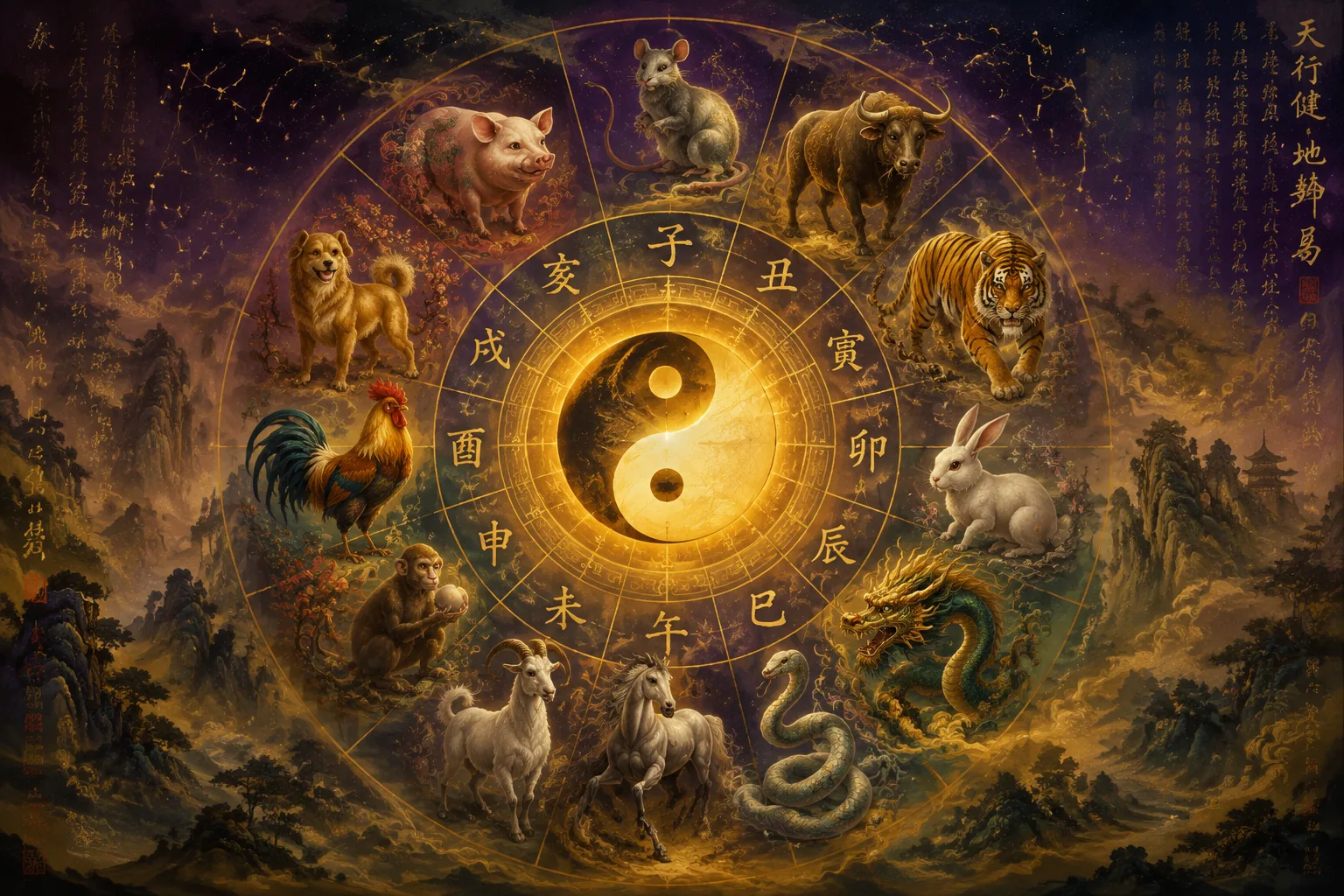
The animals always appear in this exact order, and the sequence has not changed in over two millennia. Here is the cycle, with the personality essence of each. For full trait breakdowns, our zodiac personality guide goes deep on each one.
| # | Animal | Chinese | Recent Years | Core Vibe |
|---|---|---|---|---|
| 1 | Rat | 鼠 (Shǔ) | 2020, 2008, 1996 | Sharp, resourceful, opportunistic |
| 2 | Ox | 牛 (Niú) | 2021, 2009, 1997 | Stubborn, dependable, unstoppable |
| 3 | Tiger | 虎 (Hǔ) | 2022, 2010, 1998 | Bold, competitive, born leader |
| 4 | Rabbit | 兔 (Tù) | 2023, 2011, 1999 | Gentle, diplomatic, quietly sharp |
| 5 | Dragon | 龙 (Lóng) | 2024, 2012, 2000 | Charismatic, ambitious, larger than life |
| 6 | Snake | 蛇 (Shé) | 2025, 2013, 2001 | Strategic, mysterious, patient |
| 7 | Horse | 马 (Mǎ) | 2026, 2014, 2002 | Energetic, free-spirited, restless |
| 8 | Goat | 羊 (Yáng) | 2027, 2015, 2003 | Creative, empathetic, artistic |
| 9 | Monkey | 猴 (Hóu) | 2028, 2016, 2004 | Clever, playful, endlessly adaptable |
| 10 | Rooster | 鸡 (Jī) | 2029, 2017, 2005 | Organized, honest, perfectionist |
| 11 | Dog | 狗 (Gǒu) | 2030, 2018, 2006 | Loyal, protective, no-nonsense |
| 12 | Pig | 猪 (Zhū) | 2031, 2019, 2007 | Generous, easygoing, hedonistic |
Every animal also has a fixed element, a Yin/Yang polarity, and a set of lucky colors and numbers. You can find the full breakdown in our lucky elements reference. For now, what matters is that each animal is not just a personality label — it is a time code. The Rat governs the hours 11 PM to 1 AM. The Horse governs 11 AM to 1 PM. The system maps animals to time itself.
The Great Race: How the Order Was Decided
Every culture has its origin myth. The Chinese zodiac has one of the best.
According to the most widely told version, the Jade Emperor — ruler of heaven — declared that the zodiac order would be decided by a race across a river. The first twelve animals to reach the other side would earn their place in the calendar.
What happens next is less a sporting event and more a character study.
The Rat, knowing it was the weakest swimmer, convinced the good-natured Ox to carry it across. As they neared the shore, the Rat jumped off the Ox’s nose and sprinted to first place. That is why the Rat leads the cycle — not because it is the strongest, but because it is the most strategic. I have always thought this says something profound about how Chinese culture views intelligence: raw power is admirable, but cleverness wins.
The Ox, betrayed but unbothered, took second. The Tiger fought the current for third. The Rabbit crossed by hopping across stones and a floating log. The Dragon — who could have flown — arrived fifth because it stopped to make rain for a drought-stricken village. (This detail matters. In most Western stories, the dragon would be the villain. Here, it is the hero who sacrifices its lead to help others.)
Then things get interesting. The Snake had hidden coiled around the Horse‘s leg. When the Horse charged toward the finish, the Snake uncoiled, the Horse reared back in fright, and the Snake slithered into sixth. The Horse settled for seventh.
The Goat, Monkey, and Rooster arrived together on a raft they found — the only team effort in the race. The Dog, an excellent swimmer, arrived a baffling eleventh because it could not resist playing in the water. And the Pig came dead last, having stopped mid-race to eat and take a nap.
Every position reveals a personality. And honestly, that is what makes this story endure — it is not really about animals crossing a river. It is about how different temperaments approach a challenge. You can read it as a 2,000-year-old personality test.
The 60-Year Cycle: Where Math Meets Myth
Here is the part where most guides lose people. Bear with me — it is worth understanding.
The 12 animals cycle every 12 years. But each year also carries one of five elements: Wood, Fire, Earth, Metal, and Water. The element changes every two years (one Yin year, one Yang year per element). When you combine 12 animals × 5 elements, you get 60 unique combinations before the pattern repeats.
This is called the Sexagenary Cycle (干支, Gānzhī), and it is one of the longest continuously used calendar systems in human history. The same animal comes back every 12 years, but the same animal-element combination only returns every 60 years. A Wood Dragon (2024) will not appear again until 2084. A Fire Horse (2026) will not return until 2086.
Why does this matter? Because two people born in Rat years can be quite different depending on their element. A Metal Rat (1960, 2020) is disciplined and precise. A Water Rat (1972, 2032) is adaptable and intuitive. Same animal, completely different flavor. If you have ever felt that your zodiac sign description does not quite fit you, the element is probably why.
For the full element breakdown — including how each element shapes each animal — our Five Elements guide covers it in depth. You can also explore individual elements: Wood, Fire, Earth, Metal, and Water.
Yin and Yang: The Pulse of the Cycle
The 12 animals alternate between Yin and Yang energy. Odd-numbered animals (Rat, Tiger, Dragon, Horse, Monkey, Dog) are Yang — active, outward, assertive. Even-numbered animals (Ox, Rabbit, Snake, Goat, Rooster, Pig) are Yin — receptive, inward, reflective.
This is not a hierarchy. Yang is not “better” than Yin. They are complementary forces — the same way day needs night, and expansion needs contraction. Every Yang sign is immediately followed by its Yin counterpart, creating a rhythm that keeps the whole system in balance.
Practically, this means a Dragon (Yang) and a Snake (Yin) sit right next to each other in the cycle but carry fundamentally opposite energies. The Dragon pushes outward with force. The Snake pulls inward with strategy. One charges, the other waits. This Yin-Yang pairing shows up everywhere in the zodiac — in compatibility, in personality dynamics, and in how different signs approach the same situation.
Why January Birthdays Are a Trap
If there is one thing I have seen confuse people more than anything else, it is this: the Chinese zodiac year does not start on January 1st. It starts on the Chinese New Year, which falls somewhere between January 21 and February 20.
This means if you were born in late January or early February, you might think you are one sign when you are actually the previous one. I have met people who went thirty years believing they were a Dragon, only to discover they were actually a Rabbit. It is the zodiac equivalent of finding out your adopted.
For example: the Year of the Horse begins on February 17, 2026. If you were born on February 10, 2026, you are still a Snake — not a Horse. The full zodiac years chart lists exact start and end dates for every year from 1924 to 2043, so you can check with certainty.
One more wrinkle: some BaZi practitioners use Li Chun (the Start of Spring, around February 4) rather than the Lunar New Year as the cutoff. The difference matters if you are getting a serious astrological reading. For casual purposes, the Lunar New Year date is the standard reference.
Chinese Zodiac Compatibility: Who Clicks With Whom
Compatibility in the Chinese zodiac is not random. It is based on the Six Harmonies (六合) and Three Trines (三合) — traditional groupings that describe which animal energies naturally support each other.
Without turning this into a matchmaking manual, here is the short version: animals that are four years apart tend to be highly compatible (trine partners), while animals that are six years apart tend to clash (opposite signs). The classic pairings are Rat-Ox, Tiger-Pig, Rabbit-Dog, Dragon-Rooster, Snake-Monkey, and Horse-Goat.
But here is my honest take: compatibility is more nuanced than “best match / worst match.” A Rat and a Horse are technically opposites, but opposites can create powerful dynamics if both people are self-aware. The full compatibility guide breaks down every pairing — best, worst, and the complicated ones in between.
2026: Year of the Fire Horse
We are currently in the Year of the Fire Horse (丙午, Bǐngwǔ), running from February 17, 2026 to February 5, 2027. This is a big deal, and here is why.
The Horse is already the most restless, freedom-loving sign in the zodiac. Add Fire — the element of passion, visibility, and rapid change — and you get a year that moves fast. The Fire Horse comes around only once every 60 years. The last one was 1966. The next will be 2086.
Historically, the Fire Horse has a fearsome reputation in Japanese culture (Hinoeuma), where women born in this year were once considered “dangerous” to marry. That superstition caused a measurable drop in Japan’s birth rate in 1966. Modern perspectives reject the superstition entirely — but it is a fascinating example of how zodiac beliefs can shape real-world behavior.
For practical purposes, 2026 is a year of momentum, bold decisions, and breaking free from stagnation. Whether that excites you or exhausts you probably depends on your own sign. Check your sign’s 2026 horoscope for specifics.
Inner Animals and Secret Animals: The Hidden Layers
Now we get to the part that separates casual zodiac fans from people who actually understand the system.
Your birth year animal is only one of four pillars. In traditional Chinese astrology, you also have:
- Inner Animal — your birth month, representing your inner self and emotional core
- True Animal — your birth day, representing your most authentic self
- Secret Animal — your birth hour, representing your hidden desires and potential
Most people only know their year animal. But the year animal is the most public, least personal layer — it is the face you show the world. Your inner animal (month pillar) reveals who you are in private. Your secret animal (hour pillar) reveals who you could become.
This is why two people born in the same year can feel like completely different personalities. They share the same year animal, but their month, day, and hour animals may be entirely different. The full system — BaZi (Four Pillars of Destiny) — maps all four pillars from your exact birth date and time.
Ben Ming Nian: Why Your Own Year Is the Riskiest
This one catches people off guard every time. You would think your own zodiac year — when your animal returns after a 12-year cycle — would be your luckiest year. In Chinese tradition, it is exactly the opposite.
Ben Ming Nian (本命年) is considered a year of turbulence and heightened risk. The logic is that you are “offending Tai Sui” (太岁) — the deity who governs that year — by being too similar to the year’s energy. It is like standing too close to a fire: warmth becomes a burn.
The traditional protections are practical and specific: wear red (underwear, bracelets, socks), avoid major risky decisions if possible, and carry a Tai Sui amulet. Whether you believe in the metaphysics or not, the psychological wisdom is sound — during years of big transition, extra caution is not a bad idea.
Our Ben Ming Nian guide covers the traditions, the Tai Sui system, and practical advice for navigating your zodiac year.
Chinese Zodiac vs. Western Astrology
People ask me this constantly, so let me settle it clearly.
The two systems are not competing. They are different maps of the same territory, drawn with different tools. Western astrology divides the year into 12 segments based on the Sun’s position (monthly signs). Chinese astrology divides time into cycles based on Jupiter’s 12-year orbit (yearly signs). Western uses four elements (Fire, Earth, Air, Water). Chinese uses five (Wood, Fire, Earth, Metal, Water).
The deeper difference is philosophical. Western astrology is psychological — it asks “who am I?” Chinese astrology is relational — it asks “how do I fit into the patterns around me?” One looks inward. The other looks at the web of relationships between you, time, and nature.
Neither is more “accurate” than the other. They are lenses, not truths. You can use both.
The Zodiac Across Asia: One System, Many Faces
The Chinese zodiac did not stay in China. It spread across East Asia centuries ago, and each culture adapted it.
- Vietnam replaced the Rabbit with the Cat — the only animal substitution in any version of the zodiac
- Japan uses the same 12 animals but sometimes swaps the Pig for a Wild Boar
- Korea keeps the same 12 animals as China
- Thailand and Cambodia have their own minor variations
The Cat substitution in Vietnam is the most interesting one. According to Vietnamese folklore, the Rat tricked the Cat the same way it tricked the Ox — by promising to wake the Cat for the race and then deliberately letting it oversleep. In Vietnam, this is why cats and rats are enemies. Same moral, different victim.
How the Chinese New Year Resets the Zodiac
The Chinese zodiac does not roll over at midnight on December 31st. It resets at Chinese New Year (春节, Chūn Jié), which is the most important holiday in Chinese culture.
Chinese New Year falls on the second new moon after the winter solstice. This places it somewhere between January 21 and February 20 each year. The exact date shifts because the Chinese calendar is lunisolar — it tracks both the phases of the moon and the position of the sun.
This is why the zodiac feels “late” compared to the Gregorian calendar. The 2026 Year of the Horse does not begin until February 17, meaning the first six weeks of 2026 are still technically under the Snake’s influence. If you have ever wondered why your “new year horoscope” felt off in January, this is why — the zodiac had not actually changed yet.
What Each Zodiac Year Means for Career
Different animals naturally excel in different professional environments. This is not about limiting yourself — it is about understanding where your energy flows most easily. The Ox thrives in structured, long-haul work. The Horse needs variety and autonomy. The Snake excels in strategic, behind-the-scenes roles. The Rooster is built for detail-oriented work where precision matters.
Our career guide by zodiac sign maps the natural professional strengths of each animal — and which careers tend to align (or clash) with each sign’s energy.
Frequently Asked Questions
How do I find my Chinese zodiac sign?
Find your birth year in our zodiac years chart, but pay attention to the exact start date. If you were born in January or early February, your sign may belong to the previous year. For the most accurate result, use the BaZi calculator with your exact birth date and time.
What are the 12 Chinese zodiac animals in order?
The order is: Rat, Ox, Tiger, Rabbit, Dragon, Snake, Horse, Goat, Monkey, Rooster, Dog, Pig. This sequence was set by the legendary Great Race organized by the Jade Emperor and has remained unchanged for over 2,000 years.
What is the 60-year cycle in the Chinese zodiac?
The 60-year cycle (Sexagenary Cycle) combines the 12 animals with the 5 elements (Wood, Fire, Earth, Metal, Water). Since each element lasts two years, it takes 60 years for any animal-element combination to repeat. For example, the Fire Horse (2026) last occurred in 1966 and will not return until 2086.
Which Chinese zodiac signs are most compatible?
Compatibility is based on the Six Harmonies and Three Trines system. The classic best matches are: Rat-Ox, Tiger-Pig, Rabbit-Dog, Dragon-Rooster, Snake-Monkey, and Horse-Goat. See the full compatibility guide for every pairing.
What is Ben Ming Nian and why is it unlucky?
Ben Ming Nian (本命年) is your zodiac year — when your birth animal returns every 12 years. Traditionally considered a year of turbulence because your energy “offends Tai Sui.” People wear red and take extra precautions during this year. Learn more in our Ben Ming Nian guide.
Is the Chinese zodiac based on the lunar or solar calendar?
Both. The Chinese calendar is lunisolar — it tracks both moon phases and solar positions. Most people reference the Lunar New Year as the zodiac cutoff, but some BaZi practitioners use Li Chun (Start of Spring, ~February 4) instead.
What is the difference between Chinese and Western zodiac?
Chinese zodiac is based on birth year and uses 12-year animal cycles with 5 elements. Western zodiac is based on birth month and uses 12 monthly signs with 4 elements. They are different systems, not competing ones.
What does the Year of the Fire Horse mean for 2026?
The Fire Horse (丙午) is a once-in-60-years combination that brings intense energy, rapid change, and a push for freedom. It runs from February 17, 2026 to February 5, 2027. The Fire Horse is historically associated with bold action and breaking from convention.
About This Guide
This guide is part of 12Zodiacs.com‘s knowledge base — a collection of over 350 pages covering every aspect of the Chinese zodiac, from individual personality traits to Heavenly Stems and Ten Gods in BaZi astrology. Our methodology page explains how we compile and verify the traditional sources referenced throughout the site.
The zodiac system described here is based on classical Chinese astronomical texts, traditional calendar calculations, and the BaZi (Four Pillars) framework. We distinguish clearly between established cultural traditions and modern interpretations. If you spot an error or have a question, we welcome feedback.
Further reading: Start with our main zodiac hub to find your sign, then explore your compatibility, career outlook, and lucky elements.
Ready to Go Deeper? Get Your Full BaZi Chart
Your zodiac animal is just the beginning. Your birth year, month, day, and hour each carry a hidden pillar — together they form your unique Four Pillars of Destiny (BaZi). Discover your Day Master, hidden stems, and luck cycles with our free calculator.
Get My Free BaZi Reading →Takes 30 seconds · No signup required · Based on classical ZiPing method