
Creek-Water (大溪水)
大溪水 · One of the 30 NaYin elemental combinations
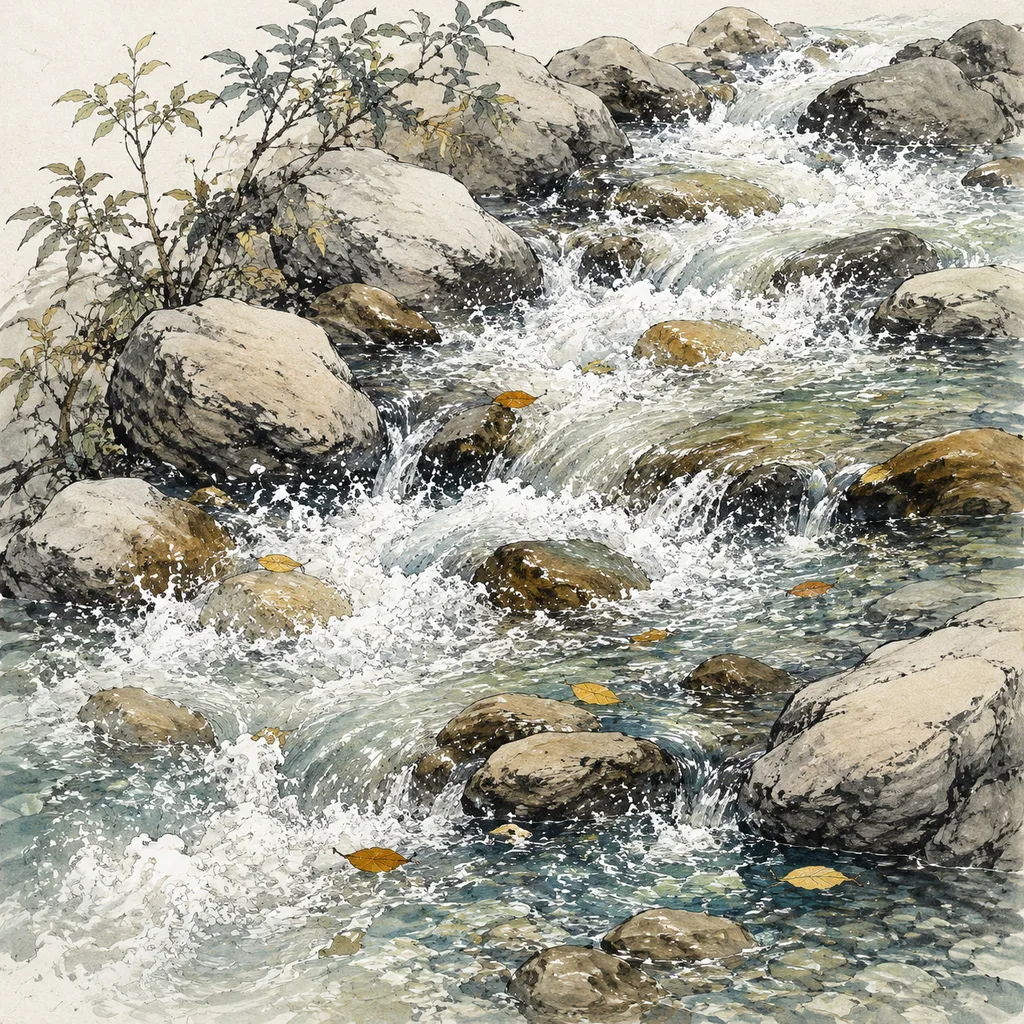
大溪水 (Dà Xī Shuǐ) translates literally to 'Creek-Water' or 'Great Stream Water.' Picture a lively mountain brook tumbling over rocks, gathering speed as it merges into a swift stream, its white water sparkling in sunlight. Ancient astrologers chose this metaphor to represent a subtype of Water element that is neither stagnant nor oceanic—it is water in joyful, purposeful motion. This page explores the essence, classical roots, personality traits, life applications, and pillar variations of Creek-Water, offering insight into how this dynamic energy shapes those born under its influence.
What Creek-Water truly represents is the spirit of refreshment in constant motion.
The San Ming Tong Hui (三命通会) by Ming dynasty scholar Wan Min Ying (1587) states: '大溪水者,惊涛薄岸,骇浪浮天,光涵万里之宽,碧倒千山之影。&...
The inner landscape of a Creek-Water person mirrors the brook: lively, refreshing, and always in motion.
| NaYin Name | Creek-Water (大溪水) |
| Element | Water (水) |
| Ganzhi Pillars | 甲寅, 乙卯 (Yang Wood, Yin Wood) Stems |
| Associated Animals | Tiger, Rabbit |
| Years in 60-Year Cycle | 1914, 1974, 1915, 1975 |
| Classical Source | 《三命通会》明·万民英,1587 · 卷三十「论纳音取象」 |
Key Takeaways
- Creek-Water represents joyful momentum — lively water that energizes everyone it flows past.
- This NaYin describes people with infectious energy and natural ability to refresh stale situations.
- The creek metaphor warns about overflow: powerful currents need mindful channeling.
- Classical texts describe water emerging into bright yang energy, surging eastward, growing ever larger.
What Creek-Water Truly Represents
What Creek-Water truly represents is the spirit of refreshment in constant motion. Unlike Stream-Water, which patiently trickles underground, or Ocean-Water, which holds vast stillness, Creek-Water is the energetic brook that leaps over stones, splashing life into everything it touches. Its character is like the first thaw of spring—a cascading torrent that cleanses the landscape and nourishes new growth. This water does not hoard; it gives freely, its momentum carrying away debris and inviting vitality. The mountain brook does not question its path—it flows around obstacles, finding its way downstream with an effortless, joyful determination. Those who embody Creek-Water share this trait: they move through life not by force, but by persistent, lively engagement, creating ripples of energy wherever they go.
The Classical Record
The San Ming Tong Hui (三命通会) by Ming dynasty scholar Wan Min Ying (1587) states: '大溪水者,惊涛薄岸,骇浪浮天,光涵万里之宽,碧倒千山之影。' This translates to: 'Creek-Water is startling waves breaking on the banks, fearsome billows surging to the sky; its light spans ten thousand li, its jade-green surface mirrors a thousand mountains.' The quote emphasizes its extraordinary, forceful nature—water that is alive with momentum, not passive. The concept of qi here pertains to the wood stems (甲寅, 乙卯) that the water nourishes, making it a 'self-diseased' yet unceasing flow. The Yu Xiao Bao Jian commentary adds that Creek-Water's qi is like thunder in spring: it awakens dormant life. This classical record frames Creek-Water as a subtype of exceptional vitality, always pressing forward to reach the vast ocean of its destiny.
大溪水者,惊涛薄岸,骇浪浮天,光涵万里之宽,碧倒千山之影。
— 《三命通会》明·万民英,1587 · 卷三十「论纳音取象」
甲寅: 甲寅,自病之水,乙卯自死之水,虽然死病,土不能克,盖支干二木可以制土。
乙卯: 乙卯,自死之水,虽然死病,土不能克,盖支干二木可以制土。
The Inner Landscape
The inner landscape of a Creek-Water person mirrors the brook: lively, refreshing, and always in motion. They bring energy to every room, their enthusiasm contagious as a sparkling current. Consider the pattern we see in someone born under Creek-Water: they typically start with a restless youth, flitting between interests like water skipping over stones, before a turning point—often a sudden realization or external push—that channels their scattered vitality into a focused stream. Their strength lies in their ability to rejuvenate others; they are natural motivators and connectors. Yet, like a brook that can overflow its banks, they may struggle with emotional volatility or spreading themselves too thin. Under pressure, they don't stagnate but can become overwhelming, their 'white water' turning into a flood. The key for them is to learn mastery over steady flow—to remain lively without losing direction, refreshing without eroding the banks of their own boundaries.
Work, Money, and Love under Creek-Water
In career, Creek-Water individuals thrive in roles that involve movement, communication, or creative refreshment—journalism, travel, entertainment, entrepreneurship, or any field where they can be the catalyst for change. Their financial tendencies mirror the brook's flow: they earn with vigor but spend freely, often on experiences or projects that bring joy to themselves and others. They may need to build 'reservoirs' of savings to avoid dry spells. In love and partnership, they seek a companion who appreciates their dynamism and can anchor them without damming their spirit. The ideal partner is like a riverbank—stable, supportive, yet allowing the water to dance. They bring excitement and spontaneity to relationships, but must guard against restlessness that can erode commitment. Their love is a lively stream: refreshing when channeled, but capable of washing away foundations if unchecked.
Two Doorways into Creek-Water
Creek-Water manifests differently in its two pillar combinations, each adding a distinct flavor. 甲寅 (Wood Tiger) years: 1914, 1974. Here the stem is strong Wood (甲) on a Tiger, which fuels the water with robust, yang energy. This combination produces individuals like Leonardo DiCaprio (1974) and Joaquin Phoenix (1974)—actors known for intense, passionate performances that sweep audiences along. The Tiger's boldness makes this Creek-Water more assertive, a waterfall of creative force. In contrast, 乙卯 (Wood Rabbit) years: 1915, 1975. The stem is yin Wood (乙) on a Rabbit, lending a softer, more adaptive flow. Notable figures include Angelina Jolie (1975) and Tiger Woods (1975)—individuals whose influence is wide-ranging but more graceful, like a broad stream meandering through plains. The Rabbit's sensitivity tempers the water's rush, making it more nurturing and diplomatic. Both pillars share the core Creek-Water vitality, but Tiger roars while Rabbit glides.
Embracing Your Creek-Water Nature
Embracing your Creek-Water nature means honoring your need for motion and your gift of refreshment. The practical wisdom of this nayin lies in its lesson: flow with purpose. Like a brook that nourishes without depleting itself, you can share your energy while maintaining your course. When life presents obstacles, remember the water's persistence—it does not stop; it finds a new path. To discover whether this energy appears in your chart, explore your full BaZi reading and see how the elements dance in your own destiny.
Discover whether Creek-Water appears in your chart. Calculate your free BaZi reading →
Your birth data stays in your browser and is never stored or shared.
References & Classical Sources
This page draws on the following primary sources, cross-referenced with our in-house library of 16+ classical BaZi texts:
- San Ming Tong Hui (三命通会) — Wan Minying (万民英), Ming Dynasty, 1587. Volume 30, “On NaYin Imagery”. Core quote: “大溪水者,惊涛薄岸,骇浪浮天,光涵万里之宽,碧倒千山之影。”
- Yu Xiao Bao Jian (玉霄宝鉴) — Song Dynasty. Supplementary notes on 大溪水 pillars.
- Yan Dongsou’s Commentary (阎东叟注) — Song Dynasty.
- Di Tian Sui (滴天髓) — Ming/Song Dynasty. Cross-referenced for Water-element behavioral patterns.
- Zi Ping Zhen Quan (子平真诠) — Shen Xiaozhan, Qing Dynasty. Referenced for Nayin classification methodology.
All translations by the 12Zodiacs Editorial Team, reviewed against the original classical Chinese. Full methodology available on our Methodology page.
More in NaYin Elements
Forest Wood · Gold Leaf Metal · Hairpin Metal · Hearth Fire · Heavenly Water · Highway Earth · Lamp Fire · Lightning Fire