
Hairpin-Metal (钗钏金)
钗钏金 · One of the 30 NaYin elemental combinations
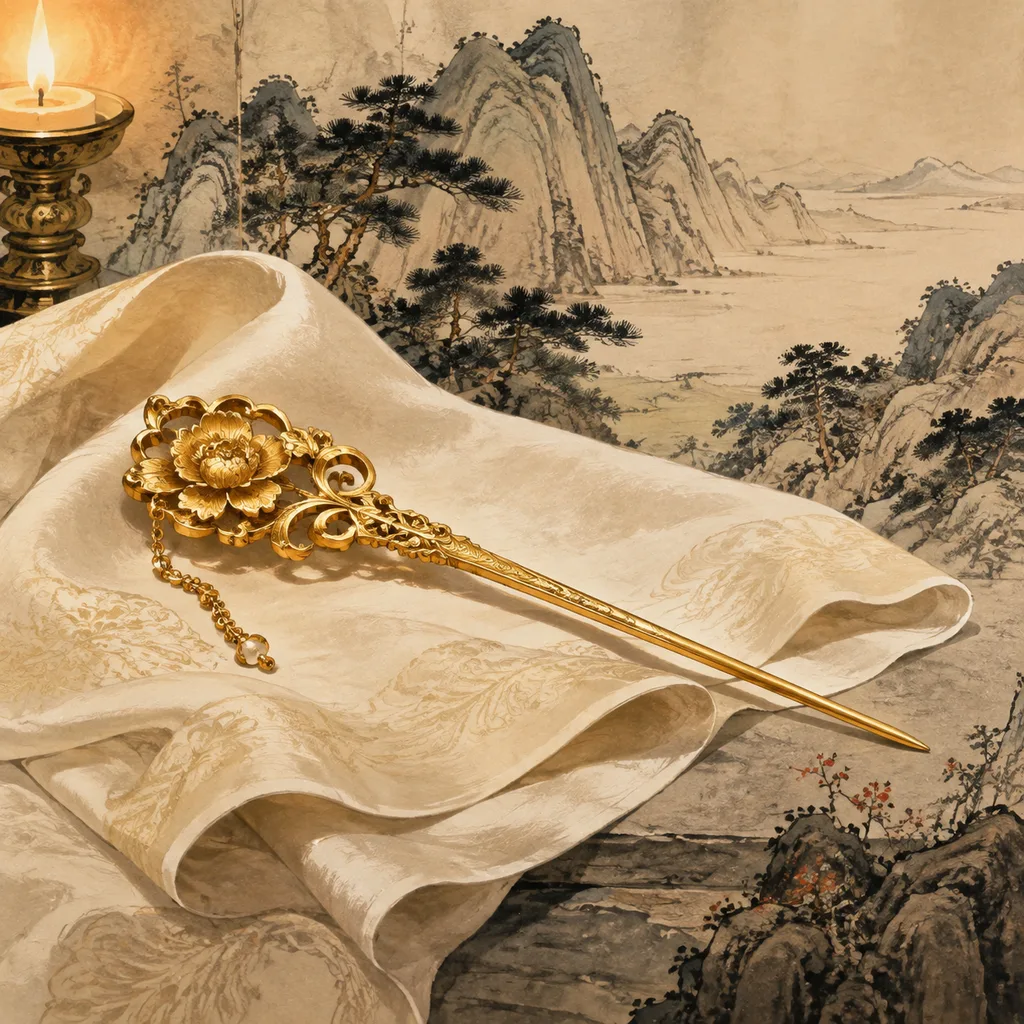
The Hairpin-Metal (钗钏金) is one of the thirty NaYin subtypes, born from the ancient Chinese art of mapping the heavens onto earthly elements. Its name evokes a scene of intimacy: a woman gently tucking a gold hairpin into her coiled hair, the metal catching candlelight. This is not the metal of swords or armor, but of personal adornment—precious, crafted, worn close to the heart. The hairpin holds significance only to the one who wears it and perhaps a few others who draw near. Ancient astrologers chose this metaphor to describe a Metal that is refined, cherished, and deeply human. In the pages that follow, we will explore the essence of Hairpin-Metal through its classical roots, its expression in personality, career, love, and its two pillar forms.
The Hairpin-Metal image teaches that true value often lies in the small, the crafted, the intimate.
The *San Ming Tong Hui* (《三命通会》), compiled by the Ming dynasty scholar Wan Minying (万民英) in 1587, describes Hairpin-M...
Across hundreds of charts we've catalogued, Hairpin-Metal-born individuals show a notable tendency toward creati...
| NaYin Name | Hairpin-Metal (钗钏金) |
| Element | Metal (金) |
| Ganzhi Pillars | 庚戌, 辛亥 (Yang Metal, Yin Metal) Stems |
| Associated Animals | Dog, Pig |
| Years in 60-Year Cycle | 1910, 1970, 2030, 1911, 1971, 2031 |
| Classical Source | 《三命通会》明·万民英,1587 · 卷三十「论纳音取象」/ 阎东叟注 |
Key Takeaways
- Hairpin-Metal represents intimate preciousness — metal that is valuable because it is personal, not industrial.
- This NaYin describes people whose worth is felt in close relationships, not measured by public metrics.
- The hairpin metaphor warns: don’t let your value depend on being displayed. You’re precious even when put away.
- Classical texts describe forged metal resting in boudoirs, its work complete, beautiful in stillness.
Unpacking the Image
The Hairpin-Metal image teaches that true value often lies in the small, the crafted, the intimate. A gold hairpin is not meant for battle; it adorns beauty, quietly enhancing what is already there. This Metal does not cut or separate like Sword-Metal; rather, it binds—holding hair in place, symbolizing loyalty or love. It is a metal of tenderness, artistry, and memory. Unlike Gold-Leaf-Metal, which is flat and applied to surfaces, Hairpin-Metal is three-dimensional, shaped to fit perfectly against the skin. It carries the warmth of the one who wears it, absorbing their energy. In character, this translates to someone who values personal connections over public acclaim, craftsmanship over mass production, and subtle influence over overt power. The hairpin's prong may be sharp, but it is never used to wound—only to secure something beautiful.
Wisdom from the Source Texts
The *San Ming Tong Hui* (《三命通会》), compiled by the Ming dynasty scholar Wan Minying (万民英) in 1587, describes Hairpin-Metal as: '钗钏金者,美容首饰之金,增光腻肌,偎红倚翠,枕玉眠香之珍宝也。' In plain English: 'Hairpin-Metal is the gold of beauty and adornment, adding luster to soft skin, nestling against red and leaning on green, a treasure to sleep on jade pillows and dream with fragrance.' This passage emphasizes the metal's role in enhancing beauty and comfort—it is intimate and personal, not functional in a coarse sense. The concept of qi here is about refinement; the metal's energy is gentle and nurturing, meant to support and uplift. Yan Dongsou's notes add that this metal 'brings out the best in those who wear it' but can become 'too attached to appearances if not balanced.' The classical sources agree: Hairpin-Metal's power lies in its ability to create beauty and closeness, but it must guard against vanity.
钗钏金者,美容首饰之金,增光腻肌,偎红倚翠,枕玉眠香之珍宝也。
— 《三命通会》明·万民英,1587 · 卷三十「论纳音取象」/ 阎东叟注
庚戌: 庚戌,坚成之金,不可见火,恐有所伤,若得水土相之为贵。
Yan Dongsou: “庚戌,火墓之金,有刚烈自恃之暴,秋冬庶几沉厚,春夏动生悔吝,君子执兵刑之权,小人恣犷悍之性。”
辛亥: 辛亥,坚成之金,不可见火,恐有所伤,若得水土相之为贵。
Yan Dongsou: “辛亥金,禀干健纯明中正之气,春秋冬三时吉,夏七吉三凶,贵格乘之,体仁守义,若带刑煞,肆暴贪功。”
Who You Are When No One Is Looking
Across hundreds of charts we've catalogued, Hairpin-Metal-born individuals show a notable tendency toward creating intimate, meaningful spaces—whether in relationships, homes, or creative work. They are the ones who remember the small details others forget: a favorite flower, a quiet anniversary. Their strength is in making others feel seen and cherished, much like a hairpin that frames the face. However, this same intimacy can be a challenge. Because their value feels so personal, they may struggle when others do not reciprocate their depth. They can become overly protective of their inner circle, resistant to change that threatens their close bonds. The hairpin's prong can also turn inward: they may be too hard on themselves, feeling that their worth depends on being 'precious' to someone. The key is to remember that a hairpin is still metal—it has resilience. It can be bent, reshaped, and still hold its beauty. Cultivating self-worth that does not rely on external validation is their life lesson.
Career Currents, Financial Tides, and Matters of the Heart
Career paths that resonate with Hairpin-Metal are those involving craft, curation, or personal service: jewelry design, hairstyling, art restoration, counseling, or any role where attention to intimate detail matters. These individuals thrive when they can work with their hands or their heart, creating something that touches one person deeply rather than millions superficially. Financially, they tend to spend on quality over quantity—a single gold hairpin rather than a box of trinkets. They may be generous with those they love, but cautious with strangers. In love, Hairpin-Metal patterns mirror the adornment: they seek a partner who appreciates their subtle offerings, who notices the new hairpin or the carefully chosen gift. They may take time to open up, but once committed, they are fiercely loyal. The challenge is not to smother; the hairpin holds gently, not tightly. A balance of closeness and freedom is essential for lasting partnership.
The Twin Faces of Hairpin-Metal
Hairpin-Metal appears in two pillar combinations, each adding a distinct flavor. The first is 庚戌 (Metal Yang + Earth Yang, Dog branch). Notable figures include Mother Teresa (born 1910), whose selfless service to the poorest embodies the intimate, personal care of Hairpin-Metal on a global stage. The Dog adds loyalty and a protective instinct. Here, the metal becomes a gift to others, worn not for oneself but for the world's forgotten. The second is 辛亥 (Metal Yin + Water Yang, Pig branch). Ronald Reagan (born 1911) exemplifies this pillar's charisma and ability to connect with people on a personal level, even in politics. The Pig brings indulgence and enjoyment of life's pleasures. This Hairpin-Metal enjoys being admired, but can lean toward self-gratification. Both pillars share the core of precious adornment, but 庚戌 serves, while 辛亥 shines. Together, they show the full spectrum of Hairpin-Metal: from humble service to radiant charm.
A Daily Practice for Hairpin-Metal
For those touched by Hairpin-Metal, a daily practice might be to ask: 'What small, beautiful thing have I created or noticed today?' It could be a kind word, a neat arrangement of objects, or a moment of presence with a loved one. This nayin reminds us that life's richness is not in grand achievements but in the intimate details we craft and cherish. To discover whether this energy appears in your chart, explore your full BaZi reading.
Discover whether Hairpin-Metal appears in your chart. Calculate your free BaZi reading →
Your birth data stays in your browser and is never stored or shared.
References & Classical Sources
This page draws on the following primary sources, cross-referenced with our in-house library of 16+ classical BaZi texts:
- San Ming Tong Hui (三命通会) — Wan Minying (万民英), Ming Dynasty, 1587. Volume 30, “On NaYin Imagery”. Core quote: “钗钏金者,美容首饰之金,增光腻肌,偎红倚翠,枕玉眠香之珍宝也。”
- Yu Xiao Bao Jian (玉霄宝鉴) — Song Dynasty. Supplementary notes on 钗钏金 pillars.
- Yan Dongsou’s Commentary (阎东叟注) — Song Dynasty.
- Di Tian Sui (滴天髓) — Ming/Song Dynasty. Cross-referenced for Metal-element behavioral patterns.
- Zi Ping Zhen Quan (子平真诠) — Shen Xiaozhan, Qing Dynasty. Referenced for Nayin classification methodology.
All translations by the 12Zodiacs Editorial Team, reviewed against the original classical Chinese. Full methodology available on our Methodology page.
More in NaYin Elements
Creek Water · Forest Wood · Gold Leaf Metal · Hearth Fire · Heavenly Water · Highway Earth · Lamp Fire · Lightning Fire