
Stream-Water (涧下水)
涧下水 · One of the 30 NaYin elemental combinations
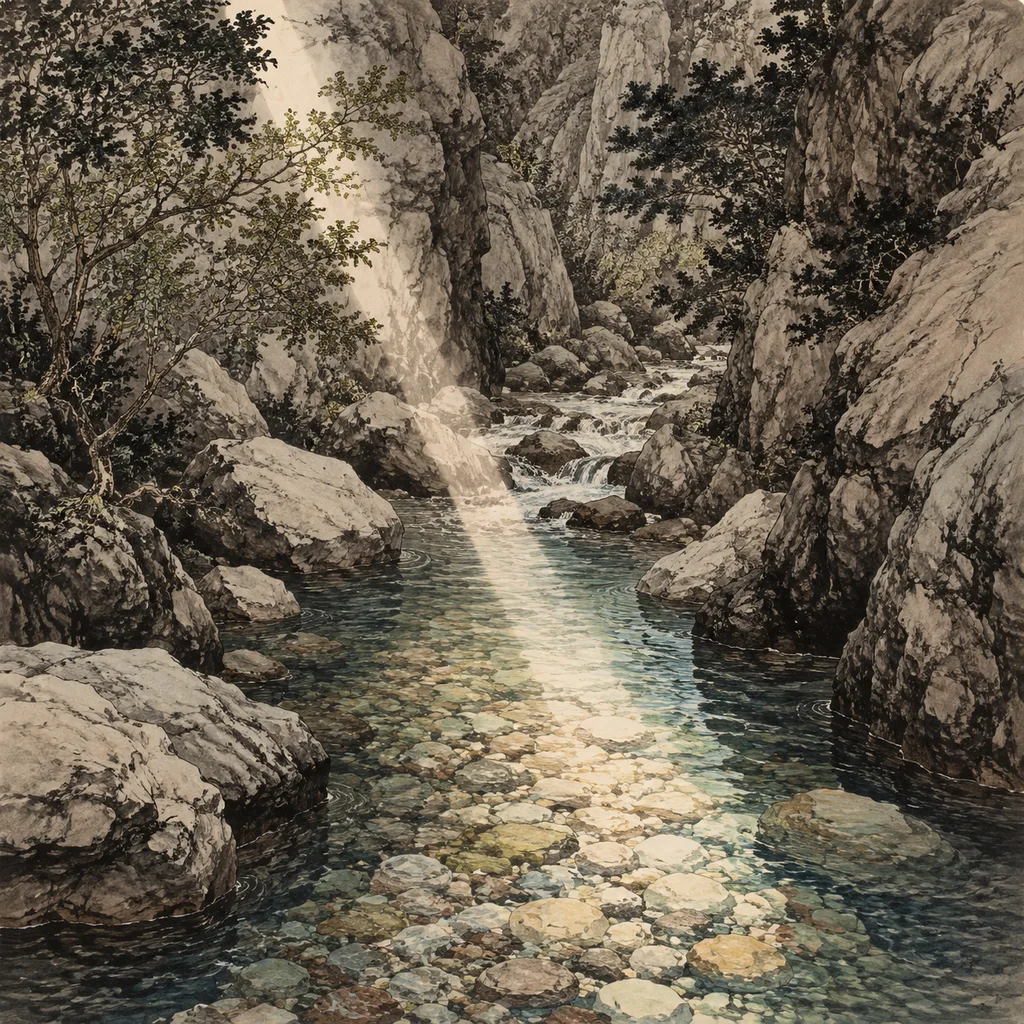
Imagine a stream that winds through a mountain gorge—its water so clear you can see each pebble on the bed, its flow steady and unhurried, yet over time it carves canyons into solid stone. This is 涧下水 (Jiàn Xià Shuǐ), Stream-Water, one of the thirty NaYin types in Chinese metaphysics. The name literally translates to 'water in a ravine,' evoking a scene of purity, persistence, and quiet strength. Ancient astrologers chose this metaphor to describe a specific subtype of the Water element—not the roaring power of a great river, nor the vast depth of an ocean, but the subtle, persistent energy of a mountain stream. This page explores what it means to carry this energy: its essence, classical roots, personality traits, and how it manifests in career, wealth, relationships, and across the two pillars. Discover the quiet power of the stream.
Stream-Water is the quiet force of nature: clear, cool, and persistent.
The classical text 《三命通会》 (San Ming Tong Hui) from the Ming dynasty, compiled by Wan Mingying in 1587, describes Stre...
My teacher often emphasized that Stream-Water is the most misunderstood of all NaYin types because people mistake its...
| NaYin Name | Stream-Water (涧下水) |
| Element | Water (水) |
| Ganzhi Pillars | 丙子, 丁丑 (Yang Fire, Yin Fire) Stems |
| Associated Animals | Rat, Ox |
| Years in 60-Year Cycle | 1936, 1996, 1937, 1997 |
| Classical Source | 《三命通会》明·万民英,1587 · 卷三十「论纳音取象」/ 《五行要论》 |
Key Takeaways
- Stream-Water represents gentle persistence — strength that flows patiently through the hardest stone.
- This NaYin describes people whose clarity and consistency achieve what force never could.
- The stream metaphor teaches that small, steady efforts compound into enormous results over time.
- Classical texts describe water flowing underground, clear and cool, finding its path without rushing.
The Essence of Stream-Water
Stream-Water is the quiet force of nature: clear, cool, and persistent. Unlike Creek-Water, which rushes and overflows, or Heavenly-Water, which falls from above in grand showers, Stream-Water flows gently through narrow gorges. Its strength lies not in force but in consistency—a single drop, repeated over millennia, can wear away granite. This image teaches that true power is not always loud; it is the steady drip that eventually creates a canyon. The stream does not fight the stone; it finds the cracks, seeps through, and patiently follows its path. It is pure because its source is high and clean, free from sediment. Those who embody Stream-Water energy may appear unassuming, yet they possess a deep, unyielding resolve. They adapt, flow around obstacles, and eventually reach their destination—not through speed, but through unwavering direction.
Voices from the Classics
The classical text 《三命通会》 (San Ming Tong Hui) from the Ming dynasty, compiled by Wan Mingying in 1587, describes Stream-Water: '涧下水者,山环细浪,雪涌飞湍,相连南北之流,对峙坎离之泯。' This translates to: 'Stream-Water is the water of the mountain ravine—fine waves circling the peaks, snowmelt surging into flying rapids; streams that link south and north, facing each other between the powers of Water and Fire.' The essence here is purity and naturalness. The water is not stagnant; it circulates, stays clear because it constantly moves. In the context of qi, Stream-Water represents a refined, untainted energy that flows naturally without corruption. The Yu Xiao Bao Jian adds that such water 'likes to be nurtured by metal and fears earth that blocks its path.' This classical view emphasizes that Stream-Water thrives when supported (by Metal, which produces Water) and suffers when obstructed (by excessive Earth). The key insight: this is a sensitive energy that needs the right environment to flourish, but once unimpeded, it flows with remarkable persistence.
涧下水者,山环细浪,雪涌飞湍,相连南北之流,对峙坎离之泯。
— 《三命通会》明·万民英,1587 · 卷三十「论纳音取象」/ 《五行要论》
丙子: 丙子,自旺之水,阳上阴下,精神俱全,禀之者天资旷达,识量渊深,春夏为济物之气,多建利泽之功。
丁丑: 丁丑,福聚之水,最爱金生,忌辛未、丙辰、丙戌相刑破也。
Character and Temperament
My teacher often emphasized that Stream-Water is the most misunderstood of all NaYin types because people mistake its quietness for weakness. In reality, Stream-Water individuals possess an inner strength that is both resilient and adaptable. Like a stream that finds its way through rock, they are persistent problem-solvers. They may appear calm and reserved, but their determination runs deep. Strengths include clarity of thought, purity of intention, and the ability to sustain effort over long periods. They are honest, loyal, and deeply principled—once they commit to a cause or relationship, they are unwavering. Challenges arise when they encounter blockages: they can become stuck, passive, or withdrawn if they feel obstructed. They may struggle with assertiveness, preferring to flow around conflict rather than confront it directly. Their emotional world is deep and sometimes hidden, like an underground current. To grow, Stream-Water types must learn when to persist and when to find a new path, and to trust that their steady nature will eventually carve through any obstacle.
Stream-Water in Career, Wealth, and Relationships
In career, Stream-Water individuals thrive in roles requiring patience, precision, and long-term dedication. They excel as researchers, engineers, craftsmen, writers, or healers—professions where steady effort yields results. They are not suited for high-pressure, fast-paced environments that demand quick decisions and loud self-promotion. Financially, they are prudent and cautious, preferring to save and invest slowly rather than chase risky gains. Money flows to them gradually, like water collecting in a pool, and they manage it with care. In relationships, Stream-Water types are deeply loyal and devoted partners. They love quietly but steadfastly, often expressing affection through acts of service rather than grand gestures. They seek emotional security and a partner who respects their need for space and depth. However, they may struggle with expressing their needs directly, sometimes holding back until the dam bursts. Communication is key: they need to learn to speak their truth, even if it feels like disturbing the calm surface.
The Two Pillars of Stream-Water
Stream-Water appears in two pillar combinations: 丙子 (Bing Zi, Yang Fire Rat) and 丁丑 (Ding Chou, Yin Fire Ox). Though both share the same NaYin, the stem and branch add distinct flavors. 丙子, with Yang Fire stem and Rat branch, is like a stream warmed by sunlight—energetic, expressive, and more outgoing. Notable individuals born in 丙子 years include John McCain (1936), George Washington (1732), Prince Harry (1984), Al Gore (1948), and Jimmy Carter (1924). These figures often exhibit the stream's persistence combined with fire's visibility. 丁丑, with Yin Fire stem and Ox branch, is like a stream flowing through a fertile valley—grounded, steady, and practical. Notable examples include Jack Nicholson and Morgan Freeman, both born in 1937. The Ox branch adds a layer of endurance and methodical nature. While 丙子 Stream-Water flows with a sparkle, 丁丑 Stream-Water moves with quiet determination. Both share the core traits of clarity and persistence, but the former is more sociable, the latter more reserved.
Living with Stream-Water Energy
Living with Stream-Water energy means embracing the power of persistence over force. This NaYin teaches that the softest water can overcome the hardest stone—not in a day, but over time. Practical wisdom: stay true to your source, keep your intentions pure, and trust the slow journey. When blocked, seek the cracks; when clear, flow freely. Stream-Water reminds us that greatness is not always loud—it can be a steady, quiet carving of one's path. To discover whether this energy appears in your chart, explore your full BaZi reading and see how the streams of your destiny flow.
Discover whether Stream-Water appears in your chart. Calculate your free BaZi reading →
Your birth data stays in your browser and is never stored or shared.
References & Classical Sources
This page draws on the following primary sources, cross-referenced with our in-house library of 16+ classical BaZi texts:
- San Ming Tong Hui (三命通会) — Wan Minying (万民英), Ming Dynasty, 1587. Volume 30, “On NaYin Imagery”. Core quote: “涧下水者,山环细浪,雪涌飞湍,相连南北之流,对峙坎离之泯。”
- Yu Xiao Bao Jian (玉霄宝鉴) — Song Dynasty. Supplementary notes on 涧下水 pillars.
- Yan Dongsou’s Commentary (阎东叟注) — Song Dynasty.
- Di Tian Sui (滴天髓) — Ming/Song Dynasty. Cross-referenced for Water-element behavioral patterns.
- Zi Ping Zhen Quan (子平真诠) — Shen Xiaozhan, Qing Dynasty. Referenced for Nayin classification methodology.
All translations by the 12Zodiacs Editorial Team, reviewed against the original classical Chinese. Full methodology available on our Methodology page.
More in NaYin Elements
Creek Water · Forest Wood · Gold Leaf Metal · Hairpin Metal · Hearth Fire · Heavenly Water · Highway Earth · Lamp Fire