
Spring-Water (泉中水)
泉中水 · One of the 30 NaYin elemental combinations
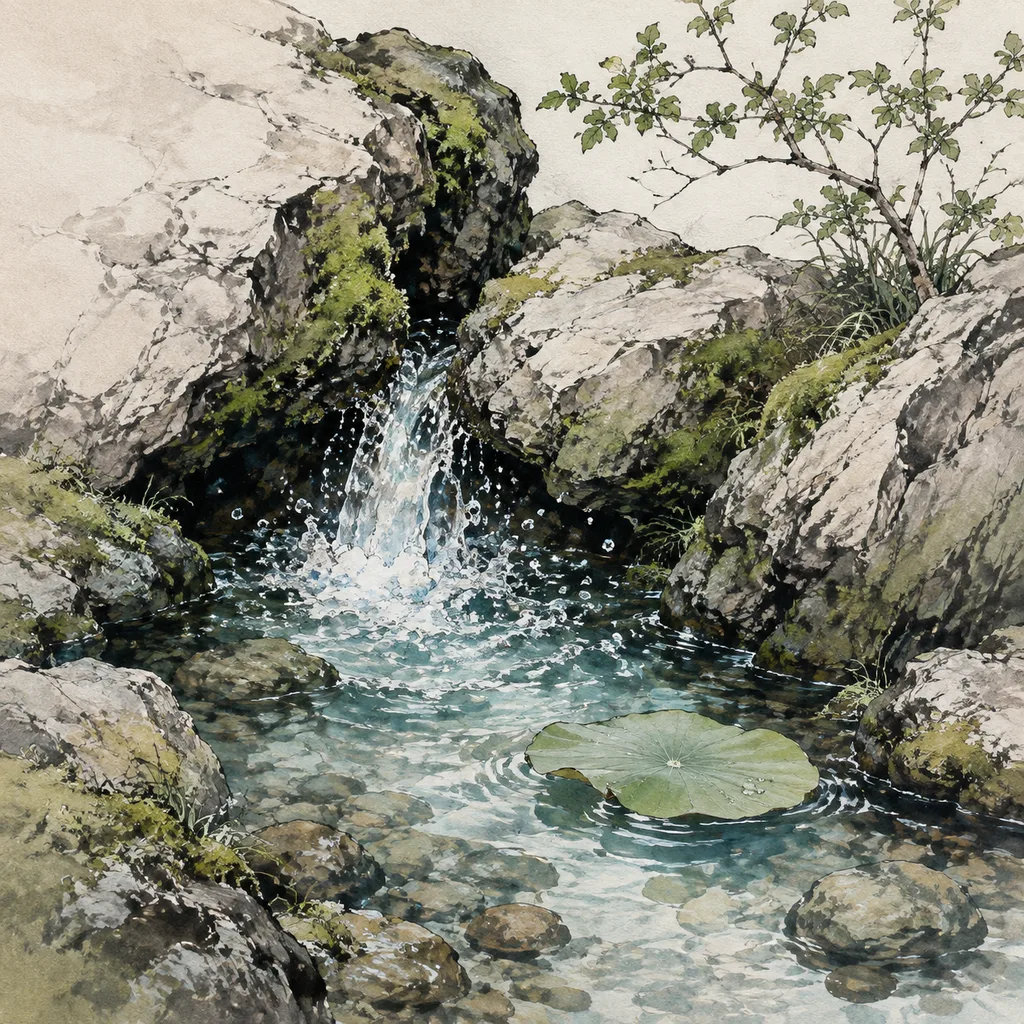
Spring-Water, or 泉中水 (Quán Zhōng Shuǐ), is one of the thirty Na Yin (纳音) elemental types in Chinese metaphysics. The name evokes a vivid image: water welling up from deep underground, clear, cold, and refreshing. Unlike Stream-Water that flows on the surface or River-Water that rushes along, Spring-Water emerges from hidden depths—its purity comes from being filtered through layers of earth and stone.
Spring-Water represents the source, not the stream.
The San Ming Tong Hui (三命通会) by Wan Minying (1587) describes Spring-Water: '泉中水者,寒泉清冽,取养不穷,八家凿之以同饮,万民资之以生活。此水生于金...
The inner world of Spring-Water mirrors its physical image: deep, clear, and cool.
Ancient astrologers chose this metaphor to represent a specific combination of Heavenly Stem and Earthly Branch, capturing a personality that is deep, self-contained, and quietly powerful. This page explores the essence, classical roots, personality traits, life applications, and variations of Spring-Water, offering insight into those born under this unique elemental signature.
| NaYin Name | Spring-Water (泉中水) |
| Element | Water (水) |
| Ganzhi Pillars | 甲申, 乙酉 (Yang Wood, Yin Wood) Stems |
| Associated Animals | Monkey, Rooster |
| Years in 60-Year Cycle | 1944, 2004, 1945, 2005 |
| Classical Source | 《三命通会》明·万民英,1587 · 卷三十「论纳音取象」/ 《五行要论》 |
Key Takeaways
- Spring-Water represents deep-sourced clarity — wisdom that bubbles up from far below the surface.
- This NaYin describes people whose insight feels fresh and original because it comes from a profound source.
- The spring metaphor teaches that the purest water needs protection from contamination.
- Classical texts describe water rising from the earth, inexhaustible, drawn from wells that never run dry.
What Spring-Water Truly Represents
Spring-Water represents the source, not the stream. Its clarity is not superficial but earned by rising through dark, silent strata. The image teaches that true depth requires patience: water does not force its way up; it seeps, gathers pressure, and finally emerges with a steady, inexhaustible flow. This is a character built on inner reserves, not flashy expression.
Spring-Water individuals often have a well of thoughts and emotions that others cannot easily see—they are the quiet ones who surprise you with sudden insight, like a spring that appears where none seemed to exist. Another metaphor: just as a spring sustains a community for generations, these people are foundational, providing stability and nourishment to those around them without seeking recognition. They are the original spring of a great river—modest at the source but destined to shape landscapes downstream.
The Classical Record
The San Ming Tong Hui (三命通会) by Wan Minying (1587) describes Spring-Water: '泉中水者,寒泉清冽,取养不穷,八家凿之以同饮,万民资之以生活。此水生于金而出于木,故喜见金为福。' Translation: 'Spring-Water is a cold spring, clear and pure, drawing nourishment without end. Eight households dig it to drink together; ten thousand people rely on it for life. This water is born from Metal and emerges through Wood, therefore it delights in seeing Metal for blessing.' The text highlights two key concepts: first, the inexhaustible nature of spring water—it never runs dry, symbolizing enduring vitality.
Second, the elemental interplay: Spring-Water is 'born from Metal' (meaning Metal generates Water in the Five Elements cycle) and 'emerges through Wood' (Wood channels or reveals the water). Thus, encountering Metal in a chart is auspicious, as it strengthens the source. The Yu Xiao Bao Jian (玉霄宝鉴) commentary adds that this water’s qi is cool and penetrating, and it must find a proper outlet to avoid stagnating. The per-pillar quotes from 甲申 and 乙酉 further nuance: 甲申 water is 'self-generating' with flowing qi, while 乙酉 is 'self-defeating' yet can be balanced by many Metals.
泉中水者,寒泉清冽,取养不穷,八家凿之以同饮,万民资之以生活。此水生于金而出于木,故喜见金为福。
— 《三命通会》明·万民英,1587 · 卷三十「论纳音取象」/ 《五行要论》
甲申: 甲申,自生之水,其气流衍,宜有所归,亦藉金生,不忌众土,特嫌戊申、庚子之土。
乙酉: 乙酉,自败之水,假众金以相之,盖我气既弱,藉母以育。
The Inner Landscape
The inner world of Spring-Water mirrors its physical image: deep, clear, and cool. These individuals possess a quiet intensity—they are not the loudest in the room, but their words carry weight. In my years of reading charts, I've noticed that Spring-Water-born individuals often have a hidden reservoir of creativity or wisdom that emerges only after prolonged reflection, much like a spring that must be dug before it flows. They are natural confidants, drawing others with their calming presence, yet they guard their own privacy fiercely.
Strengths include patience, resourcefulness, and a knack for seeing the essence of things—they filter out noise like rock filters sediment. Challenges arise when they feel blocked: a spring without an outlet becomes stagnant. They may struggle with expressing emotions directly, preferring to let feelings seep out slowly. Over time, they can become overly self-reliant, forgetting that even a spring needs rain to replenish. Their clarity can also turn into coldness if they withdraw too much. The key is to remember that a spring's purpose is to flow outward, nourishing others while staying connected to its source.
Work, Money, and Love under Spring-Water
In career, Spring-Water flourishes in roles that require depth and patience: research, psychology, writing, or any field where steady, non-flashy contribution is valued. They make excellent advisors or mentors, as their insights often come from a place of quiet observation. Financially, they tend to be conservative savers, building wealth slowly like a spring accumulating underground. They distrust get-rich-quick schemes and prefer assets with intrinsic value—real estate, quality investments that 'flow' over time.
However, they must guard against being too risk-averse; a spring that never spends its water becomes a marsh. In love, Spring-Water individuals are loyal and deep-feeling, but they may take a long time to open up. They need partners who respect their need for solitude and who are willing to 'dig' patiently to reach their depths. Once trust is established, their love is like an artesian well: constant, refreshing, and life-giving. They are most compatible with those who provide warmth (Fire) or structure (Earth), helping them channel their flow constructively.
Two Doorways into Spring-Water
Spring-Water manifests with two distinct nuances depending on its Earthly Branch. The 甲申 pillar (Wood on Yang Water) combines the self-generating energy of Jia Wood with the Metal Monkey’s sharpness. Notable figures include Larry Ellison (1944), Eleanor Roosevelt (1884), and Theresa May (1956). Here, Spring-Water becomes strategic and ambitious—the water flows with a clear direction, carving its path through obstacles. These individuals often rise to leadership through sheer persistence and mental agility.
The 乙酉 pillar (Wood on Yin Water) pairs soft Yin Wood with the Rooster’s meticulous nature. Aung San Suu Kyi (1945), Steve Martin (1945), and Eric Clapton (1945) exemplify this variant. The water here is more artistic and introspective; it may appear 'self-defeating' per classical texts, but this vulnerability allows for profound creativity and emotional depth. Both pillars share the core Spring-Water essence—depth, clarity, and hidden strength—but 甲申 channels it into worldly achievement, while 乙酉 expresses through art and inner transformation.
Embracing Your Spring-Water Nature
To embrace your Spring-Water nature is to honor both your depth and your need to flow. The wisdom of this Na Yin lies in balance: stay connected to your inner source, but do not hoard its waters. Let your clarity refresh others; let your stillness anchor a chaotic world.
Remember that a spring that never gives becomes a stagnant pool. Growth comes from allowing your hidden reserves to nourish your life outward—in your work, relationships, and creative expressions. If you feel blocked, examine what 'earth' or 'wood' might be constricting your flow. To discover whether this energy appears in your chart, explore your full BaZi reading.
Discover whether Spring-Water appears in your chart. Calculate your free BaZi reading →
Your birth data stays in your browser and is never stored or shared.
References & Classical Sources
This page draws on the following primary sources, cross-referenced with our in-house library of 16+ classical BaZi texts:
- San Ming Tong Hui (三命通会) — Wan Minying (万民英), Ming Dynasty, 1587. Volume 30, “On NaYin Imagery”. Core quote: “泉中水者,寒泉清冽,取养不穷,八家凿之以同饮,万民资之以生活。此水生于金而出于木,故喜见金为福。”
- Yu Xiao Bao Jian (玉霄宝鉴) — Song Dynasty. Supplementary notes on 泉中水 pillars.
- Yan Dongsou’s Commentary (阎东叟注) — Song Dynasty.
- Di Tian Sui (滴天髓) — Ming/Song Dynasty. Cross-referenced for Water-element behavioral patterns.
- Zi Ping Zhen Quan (子平真诠) — Shen Xiaozhan, Qing Dynasty. Referenced for Nayin classification methodology.
All translations by the 12Zodiacs Editorial Team, reviewed against the original classical Chinese. Full methodology available on our Methodology page.
More in NaYin Elements
Creek Water · Forest Wood · Gold Leaf Metal · Hairpin Metal · Hearth Fire · Heavenly Water · Highway Earth · Lamp Fire