
Pomegranate-Wood (石榴木)
石榴木 · One of the 30 NaYin elemental combinations
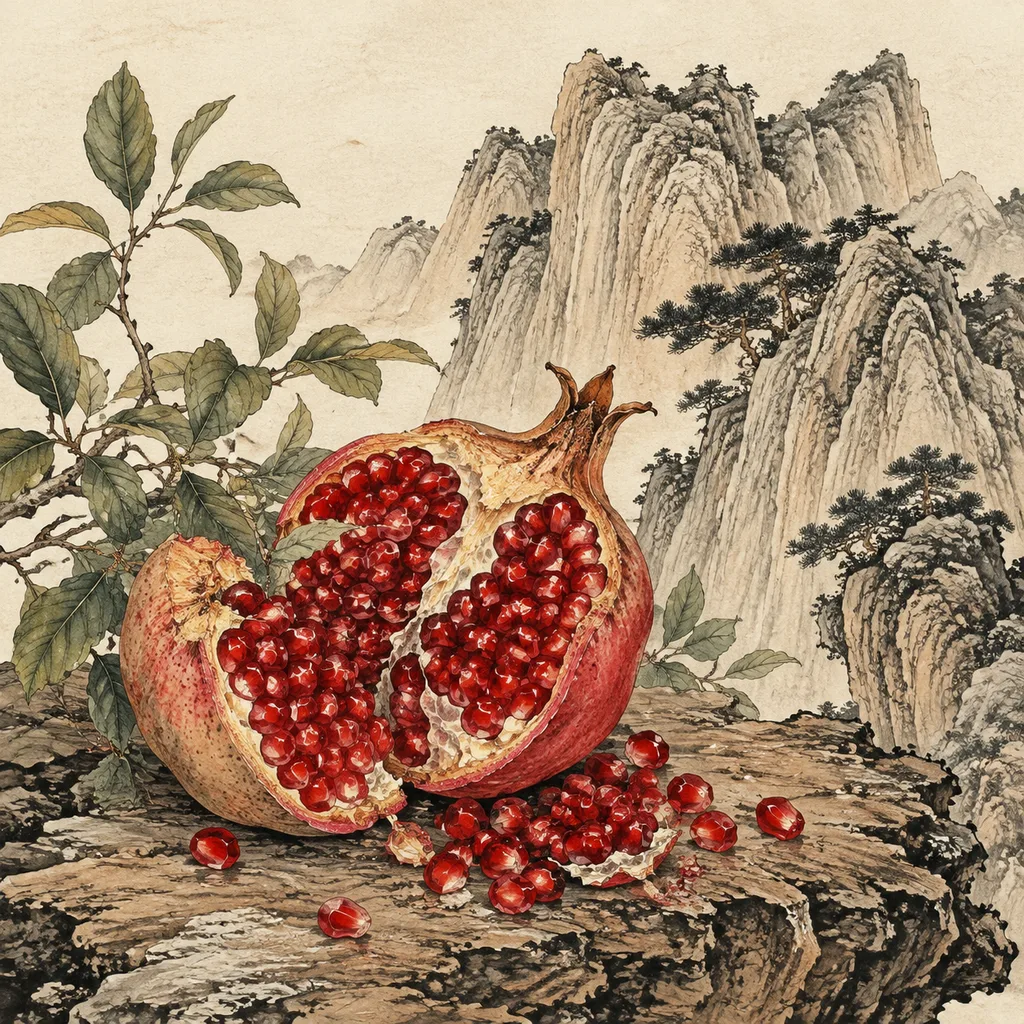
石榴木, or Pomegranate-Wood, evokes the image of a gnarled tree that bears fruit so abundant it splits its own husk, revealing a dense cluster of jewel-like seeds. This is not the towering canopy of Forest-Wood that offers shade, nor the Mulberry-Wood that feeds silkworms—it is a wood that thrives in hardship, where other trees wither under the summer sun. Ancient astrologers chose this metaphor to describe an elemental subtype that produces its finest work under pressure, storing sweetness within a tough exterior. The pomegranate's many seeds symbolize a person of immense inner resources, capable of generating ideas, wealth, and relationships from the most constrained circumstances. This page explores the essence of Pomegranate-Wood, its classical foundations, personality traits, life applications, and the two pillar combinations that host this unique energy.
Pomegranate-Wood represents a paradox: it is wood born of metal, a tree that reaches its peak vitality precisely when...
The San Ming Tong Hui (Three Lives Comprehensive Guide) by Wan Minying (1587) describes Pomegranate-Wood with these w...
My teacher often emphasized that Pomegranate-Wood is the most misunderstood of all NaYin types because people see the...
| NaYin Name | Pomegranate-Wood (石榴木) |
| Element | Wood (木) |
| Ganzhi Pillars | 庚申, 辛酉 (Yang Metal, Yin Metal) Stems |
| Associated Animals | Monkey, Rooster |
| Years in 60-Year Cycle | 1920, 1980, 1921, 1981 |
| Classical Source | 《三命通会》明·万民英,1587 · 卷三十「论纳音取象」/ 《五行要论》 |
Key Takeaways
- Pomegranate-Wood represents productive resilience — abundant fruit born specifically from the hardest conditions.
- This NaYin describes people whose best work emerges under pressure, producing more than seems possible.
- The pomegranate metaphor teaches: ripe fruit must eventually crack open. Vulnerability at the right moment is abundance.
- Classical texts describe wood in metal’s domain, turning adversity into productivity, uniquely thriving where others perish.
What Pomegranate-Wood Truly Represents
Pomegranate-Wood represents a paradox: it is wood born of metal, a tree that reaches its peak vitality precisely when other trees decline. The San Ming Tong Hui states, 'Other trees perish at midday, are buried by evening, yet only Pomegranate-Wood revives during the monkey hour.' This is wood that must be cut to bear fruit—its best work emerges from pressure, not ease. The pomegranate's thick, leathery rind mirrors a personality that guards its inner wealth, revealing it only when cracked open by necessity. Inside, the ruby seeds are countless, each a potential idea or project. This internal abundance is the key: Pomegranate-Wood does not spread outward like branches, but condenses inward like fruit. It is a storage tank of creativity and resilience, forged in adversity. Where Forest-Wood shelters others and Mulberry-Wood feeds them, Pomegranate-Wood endures alone, producing treasures that are only visible when the outer shell breaks.
The Classical Record
The San Ming Tong Hui (Three Lives Comprehensive Guide) by Wan Minying (1587) describes Pomegranate-Wood with these words: '石榴木者,性辛如姜,花红似火,数颗枝头,累累多子,房内莹莹。' The same text notes why this wood stands apart: '观他木至午而死,唯此木至午而旺,取其性之偏也。' In plain English: 'Pomegranate-Wood, with its pungent nature like the five flavors, has abundant flowers and abundant fruit. Other woods die at the hour of noon (fire) and are entombed at the hour of the sheep (earth), but only Pomegranate-Wood, when it reaches the monkey hour (metal), draws new vitality. Its nature is as firm and chaste as metal.' This passage explains the unique qi cycle: while most trees decline in summer (noon) and are buried in late summer (sheep), Pomegranate-Wood flourishes in autumn (monkey), because its metal stem (Geng or Xin) gives it an affinity for the season of harvest. The 'pungent' taste refers to the astringent quality of pomegranate, which in Chinese medicine constricts and preserves energy. The Yu Xiao Bao Jian (Jade Box Treasure Mirror) adds that Pomegranate-Wood 'is like a general who endures defeat to win the war,' emphasizing its patient, strategic nature.
石榴木者,性辛如姜,花红似火,数颗枝头,累累多子,房内莹莹,干支纯金而纳音属木。
— 《三命通会》明·万民英,1587 · 卷三十「论纳音取象」/ 《五行要论》
庚申: 庚申,石榴木,夏旺,故喜戊午,盖火官旺而石榴木性得时。
辛酉: 辛酉,失位之木,木困金乡,乘之者涉世多艰,惟对癸卯金,则刚柔相济,挺拔出群。
The Inner Landscape
My teacher often emphasized that Pomegranate-Wood is the most misunderstood of all NaYin types because people see the tough exterior and assume it is cold or unyielding, when in fact it is the most generous of woods—giving everything when the time is right. The pomegranate does not bloom for show; its flowers are small, but each becomes a seed. People born under this sign often appear reserved or even prickly, but inside they contain a universe of ideas, emotions, and ambitions. Strengths include remarkable endurance: like the tree that fruits in the autumn frost, they produce their best work under deadlines or crisis. They are natural hoarders of resources—knowledge, money, relationships—but not out of greed; they are saving for a future harvest. Challenges include a tendency to resist opening up, even to loved ones, for fear of being consumed. They may hoard so much that they forget to share, leading to isolation. The sweetness of their nature is hidden, like the juice inside the pomegranate's tough skin. They need the right 'cut'—a challenge or a crisis—to release their abundance. Without pressure, they can stagnate, feeling frustrated by a lack of opportunity to prove their worth. They have a philosophical bent, often pondering the meaning of suffering and growth.
Work, Money, and Love under Pomegranate-Wood
In career, Pomegranate-Wood thrives in fields that require endurance and produce tangible results from limited conditions. They make excellent surgeons, researchers, financial analysts, or craftsmen—any role where precision and internal resourcefulness matter. They are not suited for fast-paced sales or constant social interaction; they prefer deep work over broad networks. Financially, they are savers and investors with a long view. They accumulate slowly, like the pomegranate filling with seeds, and are reluctant to spend unless the investment yields a guaranteed return. They may appear frugal, but they are generous when the cause is worthy—especially in helping others build self-sufficiency. In love, they are loyal but guarded. They need partners who respect their need for space and who understand that their love, like the pomegranate's sweetness, must be discovered. They are not initially demonstrative, but once they open, they are deeply committed and protective. They may attract partners who are more openly emotional, providing a balance. The key to their relationships is patience: they need time to trust before they reveal their inner jewels.
Two Doorways into Pomegranate-Wood
Pomegranate-Wood appears in two pillar combinations, each with a distinct flavor. The 庚申 (Geng Shen, Metal Monkey) pillar carries a stem of Yang Metal, giving it a harder, more resilient quality. Those born in 1920 or 1980—like Ryan Gosling and Yao Ming—embody a toughness that masks creativity. Gosling's intense, brooding roles and Yao Ming's endurance as an athlete reflect the Monkey's restless, clever energy combined with Pomegranate-Wood's inner drive. This pillar is called 'self-extinguishing wood' in classical texts, meaning it must be cut by fire (passion or crisis) to reveal its worth. The 辛酉 (Xin You, Metal Rooster) pillar has a stem of Yin Metal, making it more refined but also more vulnerable. Those born in 1921 or 1981—like Fan Bingbing, Beyonce, and Serena Williams—display a polished exterior that hides immense creative power. The Rooster's showmanship combines with Pomegranate-Wood's fruitfulness: Beyonce's meticulous artistry and Serena's grit on the court are both expressions of this pillar. Classical texts say this wood is 'displaced' and must borrow fire to discipline metal—meaning these individuals need external challenges to unlock their full potential.
Embracing Your Pomegranate-Wood Nature
Pomegranate-Wood teaches that the richest harvests come from the most difficult soil. If you carry this energy, remember that your toughness is not a flaw—it is the rind that protects your sweetness. The world may see a closed shell, but you know the abundance within. Your growth lies not in becoming softer, but in learning when to let the right pressures crack you open. Let your fruits be a gift, not a burden. To discover whether this energy appears in your chart, explore your full BaZi reading.
Discover whether Pomegranate-Wood appears in your chart. Calculate your free BaZi reading →
Your birth data stays in your browser and is never stored or shared.
References & Classical Sources
This page draws on the following primary sources, cross-referenced with our in-house library of 16+ classical BaZi texts:
- San Ming Tong Hui (三命通会) — Wan Minying (万民英), Ming Dynasty, 1587. Volume 30, “On NaYin Imagery”. Core quote: “石榴木者,性辛如姜,花红似火,数颗枝头,累累多子,房内莹莹。”
- Yu Xiao Bao Jian (玉霄宝鉴) — Song Dynasty. Supplementary notes on 石榴木 pillars.
- Yan Dongsou’s Commentary (阎东叟注) — Song Dynasty.
- Di Tian Sui (滴天髓) — Ming/Song Dynasty. Cross-referenced for Wood-element behavioral patterns.
- Zi Ping Zhen Quan (子平真诠) — Shen Xiaozhan, Qing Dynasty. Referenced for Nayin classification methodology.
All translations by the 12Zodiacs Editorial Team, reviewed against the original classical Chinese. Full methodology available on our Methodology page.
More in NaYin Elements
Creek Water · Forest Wood · Gold Leaf Metal · Hairpin Metal · Hearth Fire · Heavenly Water · Highway Earth · Lamp Fire