
Sand-Earth (沙中土)
沙中土 · One of the 30 NaYin elemental combinations
The term 沙中土 (Shā Zhōng Tǔ) literally translates to 'Sand in the Earth' or 'Sand-Earth'. Picture a vast desert where grains of sand shift with every breeze, taking the shape of their container—a dune, a footprint, a glass bottle. Unlike the packed solidity of Roadside-Earth or the fired rigidity of Roof-Earth, Sand-Earth is loose, granular, and infinitely adaptable. Ancient astrologers chose this metaphor to describe an Earth subtype that lacks fixed form but possesses latent potential—a ground that moves with wind and water, settling only when conditions are right. This page explores the essence, classical roots, personality traits, life applications, and pillar variations of Sand-Earth, revealing how this nayin influences those born under its sway.
The Essence of Sand-Earth lies in its paradox: formlessness as both freedom and vulnerability.
Voices from the Classics: The 《三命通会》 (San Ming Tong Hui) by Wan Minying (1587) states: '沙中土者,土库在辰而绝在巳,而天本丙丁之火至辰为...
Character and Temperament: Sand-Earth individuals are the chameleons of the nayin world.
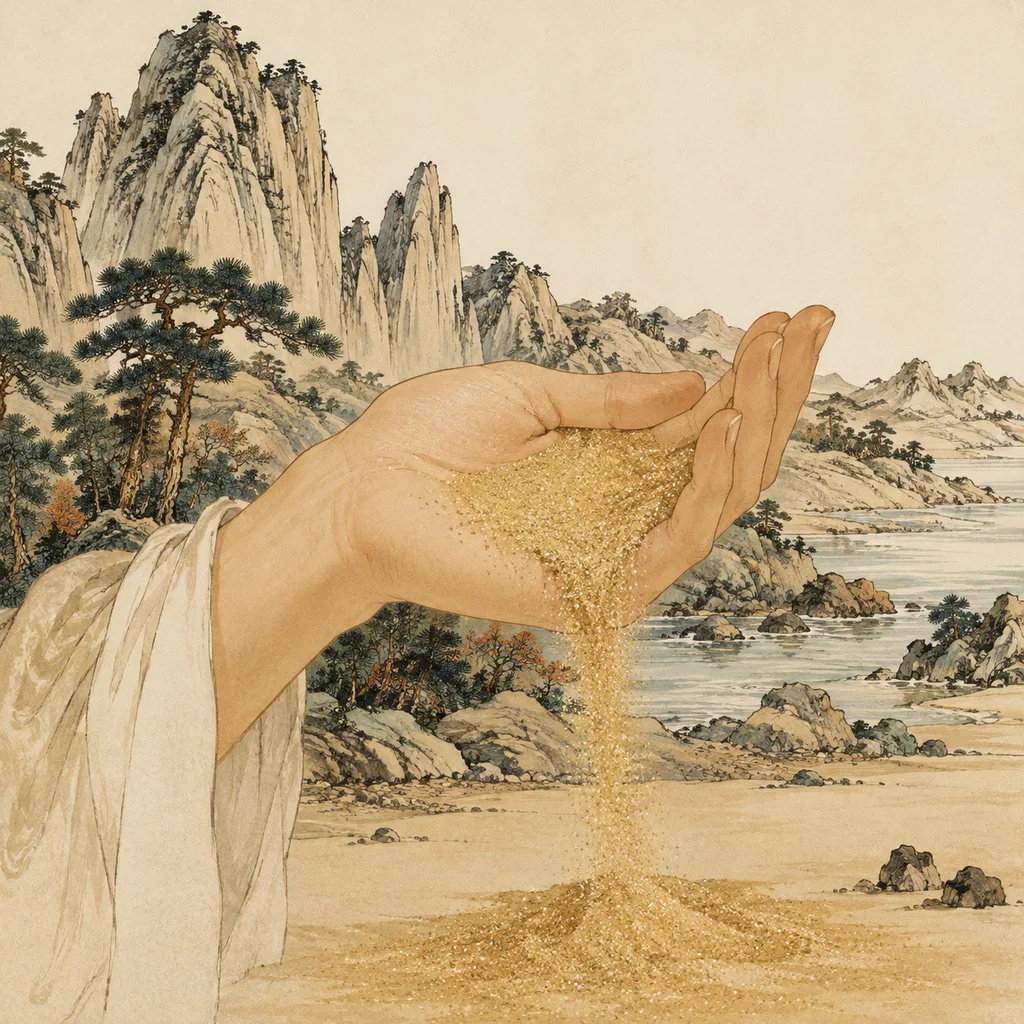
| NaYin Name | Sand-Earth (沙中土) |
| Element | Earth (土) |
| Ganzhi Pillars | 丙辰, 丁巳 (Yang Fire, Yin Fire) Stems |
| Associated Animals | Dragon, Snake |
| Years in 60-Year Cycle | 1916, 1976, 1917, 1977 |
| Classical Source | 《三命通会》明·万民英,1587 · 卷三十「论纳音取象」/ 《五行要论》 |
Key Takeaways
- Sand-Earth represents radical adaptability — earth that shapes itself to fit any container.
- This NaYin describes people who thrive in diverse environments by matching their surroundings.
- The sand metaphor carries a critical choice: who and what you surround yourself with determines your form.
- Classical texts describe earth that is most moist, most alive — where growth is still future.
The Essence of Sand-Earth
The Essence of Sand-Earth lies in its paradox: formlessness as both freedom and vulnerability. Grains of sand, unbound by clay or fire, can pour through fingers or build dunes that swallow entire cities. This image teaches that Sand-Earth individuals are inherently adaptable—they mold to circumstances, taking the shape of their environment. Yet this same quality can make them feel undefined, like a landscape that erodes with each storm. A sandcastle is magnificent but temporary; a desert is vast but barren. The key lesson is structure: sand needs a shell, a frame, a purpose to hold it together. Without boundaries, it scatters. With them, it can become glass—transparent, strong, and beautiful. This duality—potential versus instability—runs through every aspect of Sand-Earth's character.
Voices from the Classics
Voices from the Classics: The 《三命通会》 (San Ming Tong Hui) by Wan Minying (1587) states: '沙中土者,土库在辰而绝在巳,而天本丙丁之火至辰为冠带,而临官在巳,土既张绝,得旺火生之而复兴,故曰沙中土。' In plain English: 'Sand-Earth is Earth whose treasury is in Chen (Dragon) and whose extinction is in Si (Snake). The heavenly stems Bing and Ding Fire reach coronation in Chen and official in Si. Earth, having expanded and then become extinct, receives vigorous Fire to give birth to it again, hence it is called Sand-Earth.' This describes the qi cycle: Earth's energy peaks in Chen (where Fire is crowned) and declines in Si. The 'death' of Earth in Si is not absolute—it is revived by the abundant Fire of the Heavenly Stems, just as parched sand can be reinvigorated by warmth. The 《玉霄宝鉴》 (Yu Xiao Bao Jian) adds that this Earth is 'scattered but not extinguished,' emphasizing its resilient yet diffuse nature.
沙中土者,土库在辰而绝在巳,而天本丙丁之火至辰为冠带,而临官在巳,土既张绝,得旺火生之而复兴,故曰沙中土。
— 《三命通会》明·万民英,1587 · 卷三十「论纳音取象」/ 《五行要论》
丙辰: 丙辰,自库之土,厚且壮,喜甲辰火,恶戊辰木,此土凡木不能伤,盖丙火也。
丁巳: 丁巳,自绝之土,又不为绝,盖一土居二火之下,在父母之乡,乘天属之恩,故不为绝,木不能克,火多益佳。
Character and Temperament
Character and Temperament: Sand-Earth individuals are the chameleons of the nayin world. They absorb the energy of their surroundings, making them empathetic, flexible, and creative—but also prone to losing themselves in others' expectations. In my years of reading charts, I've noticed that Sand-Earth-born individuals often excel in careers requiring fluid adaptation, such as teaching, counseling, or the arts, yet they struggle with long-term commitment unless they find a 'container'—a stable partner, a clear goal, or a disciplined routine. Strength: they can navigate social situations with ease, shifting tone and demeanor like sand reshaped by the wind. Weakness: they may feel 'blown about,' lacking a solid core. A Sand-Earth person might have many hobbies but no mastery, many friends but shallow bonds. The challenge is to find a vessel—a craft, a philosophy, a relationship—that gives their granular nature shape and purpose.
Sand-Earth in Career, Wealth, and Relationships
Sand-Earth in Career, Wealth, and Relationships: In career, Sand-Earth thrives in roles that value flexibility: consulting, journalism, event planning, or any field where each day brings a new landscape. They are natural mediators, absorbing friction and reshaping conflict into consensus. Financially, they ebb and flow—money comes and goes like grains through a sieve unless they create a container. A disciplined savings plan or a tangible asset (like property) acts as a firm boundary. In love, Sand-Earth partners are deeply attentive, molding themselves to their beloved's needs. However, they risk becoming a doormat or resenting the loss of self. The healthiest relationships provide both closeness and space—a frame that holds the sand without crushing it. They need a partner who sees their shape-shifting as a gift, not a flaw, and who offers gentle structure without control.
The Two Pillars of Sand-Earth
The Two Pillars of Sand-Earth: The Dragon pillar (丙辰, Bing Chen) and the Snake pillar (丁巳, Ding Si) both hold Sand-Earth, but with different flavors. 丙辰 (Dragon) combines Yang Fire stem with Earth branch; it is described as 'self-buried treasure Earth, thick and robust.' Dragon Sand-Earth is more stable—like sand packed into a solid dune. Notable figures: Gregory Peck (1916), Reese Witherspoon (1976), Benedict Cumberbatch (1976), Chadwick Boseman (1976), Roald Dahl (1916). These individuals often exhibit grounded creativity and enduring influence. In contrast, 丁巳 (Snake) pairs Yin Fire stem with Fire branch—a self-extinguishing Earth that is 'weak but not dead.' Snake Sand-Earth is more volatile, like sand whipped by a desert storm. Notable figures: John F. Kennedy (1917), Kanye West (1977). They tend to be dynamic, trailblazing, and prone to dramatic shifts in fortune. The Dragon builds; the Snake ignites.
Living with Sand-Earth Energy
Living with Sand-Earth Energy: The wisdom of Sand-Earth lies in embracing structure without losing fluidity. Like a sand mandala, beauty emerges when each grain knows its place—yet the whole can be swept away in an instant. The practice is to find a container that honors your adaptability: a daily ritual, a creative project, a community that values your shape-shifting gift. Remember, sand can become glass under intense heat—transformed, transparent, and strong. To discover whether this energy appears in your chart, explore your full BaZi reading and see how the elements shape your life's landscape.
Discover whether Sand-Earth appears in your chart. Calculate your free BaZi reading →
Your birth data stays in your browser and is never stored or shared.
References & Classical Sources
This page draws on the following primary sources, cross-referenced with our in-house library of 16+ classical BaZi texts:
- San Ming Tong Hui (三命通会) — Wan Minying (万民英), Ming Dynasty, 1587. Volume 30, “On NaYin Imagery”. Core quote: “沙中土者,土库在辰而绝在巳,而天本丙丁之火至辰为冠带,而临官在巳,土既张绝,得旺火生之而复兴,故曰沙中土。”
- Yu Xiao Bao Jian (玉霄宝鉴) — Song Dynasty. Supplementary notes on 沙中土 pillars.
- Yan Dongsou’s Commentary (阎东叟注) — Song Dynasty.
- Di Tian Sui (滴天髓) — Ming/Song Dynasty. Cross-referenced for Earth-element behavioral patterns.
- Zi Ping Zhen Quan (子平真诠) — Shen Xiaozhan, Qing Dynasty. Referenced for Nayin classification methodology.
All translations by the 12Zodiacs Editorial Team, reviewed against the original classical Chinese. Full methodology available on our Methodology page.
More in NaYin Elements
Creek Water · Forest Wood · Gold Leaf Metal · Hairpin Metal · Hearth Fire · Heavenly Water · Highway Earth · Lamp Fire