
Wax-Metal (白蜡金)
白蜡金 · One of the 30 NaYin elemental combinations
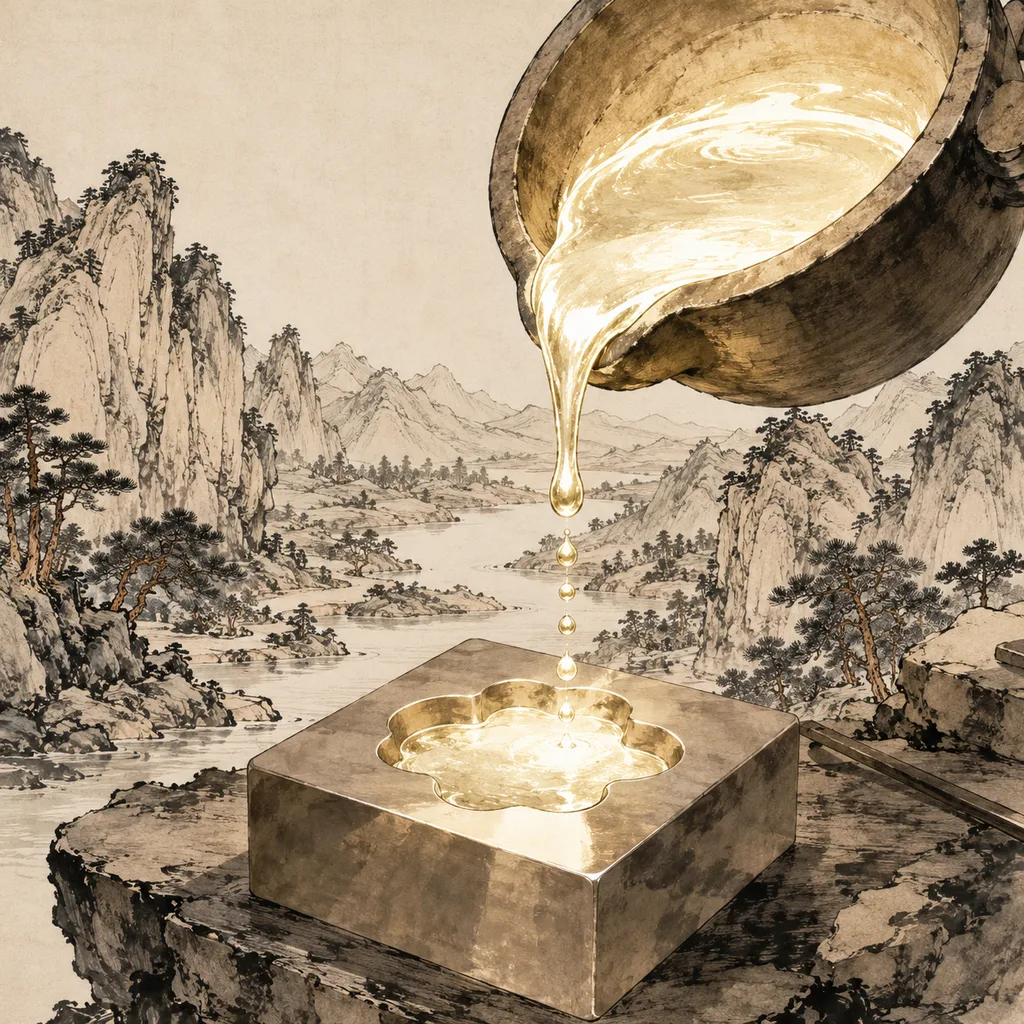
白蜡金 (Bái Là Jīn), or Wax-Metal, evokes the image of pure white gold being poured into molds—molten, luminous, and infinitely malleable. This is metal in its most pristine state, before it hardens into a sword or is buried as treasure. In Chinese metaphysics, this NaYin captures the beauty of the unformed, a substance of immense potential awaiting the artisan's hand.
Unpacking the image of Wax-Metal reveals a character forged from the purest, most malleable metal—a nature that is br...
The San Ming Tong Hui (三命通会) describes Wax-Metal as '昆山片玉,洛浦遗金,交栖日月之光,凝聚阴阳之气,形明体洁,乃金之正色也。' Translated: ...
Consider the pattern we see in someone born under Wax-Metal: they typically drift through early life with a sense of ...
Ancient astrologers chose this metaphor to describe a personality shaped by purity and adaptability, yet defined by the tension between raw potential and the pressure to take shape. This page explores the essence of Wax-Metal, its classical foundations, personality traits, life applications, and the distinct flavors it takes in the two pillar combinations of 庚辰 and 辛巳.
| NaYin Name | Wax-Metal (白蜡金) |
| Element | Metal (金) |
| Ganzhi Pillars | 庚辰, 辛巳 (Yang Metal, Yin Metal) Stems |
| Associated Animals | Dragon, Snake |
| Years in 60-Year Cycle | 1940, 2000, 1941, 2001 |
| Classical Source | 《三命通会》明·万民英,1587 · 卷三十「论纳音取象」/ 阎东叟注 / 《玉霄宝鉴》 |
Key Takeaways
- Wax-Metal represents pure potential — metal that is still being shaped, still choosing its form.
- This NaYin describes people with extraordinary adaptability who can reinvent themselves.
- The wax metaphor warns: gold that stays too soft loses its recognized value.
- Classical texts describe jade from the Kunlun mountains, gold from clear waters, sunlight and moonlight fused.
Unpacking the Image
Unpacking the image of Wax-Metal reveals a character forged from the purest, most malleable metal—a nature that is brilliant, clean, and highly adaptable. Unlike the rigid sword or the hidden treasure, Wax-Metal is all about becoming. It is gold that has not yet been stamped into a coin, ready to receive any form. This teaches us about flexibility and the power of innocence: those born under this sign carry a childlike clarity and an openness to life's shaping forces.
Yet, the image also warns: if the mold is flawed, the metal will take on that imperfection. The artisan's skill—or lack thereof—determines the outcome. So, Wax-Metal individuals must choose their influences wisely. They are like liquid light, capable of becoming a delicate filigree or a sturdy ingot, but they need the right heat and guidance to solidify into their best selves.
Wisdom from the Source Texts
The San Ming Tong Hui (三命通会) describes Wax-Metal as '昆山片玉,洛浦遗金,交栖日月之光,凝聚阴阳之气,形明体洁,乃金之正色也。' Translated: 'Wax-Metal is like a piece of jade from the Kunlun Mountains, or gold left by the Luo River. It basks in the light of sun and moon, gathers the qi of yin and yang, and its form is bright and pure—the true color of metal.' This emphasizes the metal's untainted, radiant nature—a substance of high quality that has not yet been worked.
The Yu Xiao Bao Jian adds: '庚辰、辛巳,未成器金,宜见火,兼辛巳自生,巳为火,得之者,光辉日新。' Meaning: these are metals not yet made into tools; they benefit from seeing fire, and with the self-born fire of 辛巳, they shine ever brighter. The concept of qi here is vital: Wax-Metal embodies a concentrated, balanced qi that is waiting to be activated by life's experiences.
白蜡金者,昆山片玉,洛浦遗金,交栖日月之光,凝聚阴阳之气,形明体洁,乃金之正色也。
— 《三命通会》明·万民英,1587 · 卷三十「论纳音取象」/ 阎东叟注 / 《玉霄宝鉴》
庚辰、辛巳,未成器金,宜见火,兼辛巳自生,巳为火,得之者,光辉日新。
— Yu Xiao Bao Jian (玉霄宝鉴)
庚辰: 庚辰,气聚之金,不用火制,其器自成,火盛反丧其器,病绝火无害。
Yan Dongsou: “庚辰之金,具刚健沉厚之德,禀聪明疏通之性。秋冬秀颖宏实,春夏祸福倚伏。入格,则兼资文武,带煞,则好弄兵权。”
辛巳: 辛巳,自生之金,精神具足,体气完备,炎烈炽化而不亡。
Yan Dongsou: “辛巳金,为自生学堂,具英明瑰奇之德,秋冬得力十全,春夏七凶三吉。”
Who You Are When No One Is Looking
Consider the pattern we see in someone born under Wax-Metal: they typically drift through early life with a sense of unformed brilliance—talented but directionless, like gold that hasn't decided what to become. They might try many careers, hobbies, or relationships, collecting experiences like an artisan gathering tools. Before a turning point—often a crisis that forces them to commit—they resist final forms, fearing that any single shape will limit their potential. That turning point might be a creative breakthrough, a demanding project, or a relationship that demands their full presence.
Once they find their mold, they pour themselves into it with remarkable focus and purity. Strengths include an innate clarity of mind, a clean moral compass, and a talent for adaptation. Challenges involve indecision, a tendency to remain 'unformed' too long, and being too impressionable—taking on the flaws of their environment. Like wax, they can be heated and reshaped, but they must guard against becoming brittle or losing their essential brightness.
Career Currents, Financial Tides, and Matters of the Heart
In career, Wax-Metal individuals thrive in roles that allow them to shape raw material into finished form—arts, craftsmanship, design, teaching, or any field where they can apply their purity and adaptability. They make excellent mentors because they understand the process of becoming. Financially, they tend to be cautious yet generous, preferring to accumulate resources slowly rather than gamble. However, they must beware of being too malleable with money—lending easily or investing in unworthy schemes.
In love, they seek partners who can be their 'artisan'—someone who sees their potential and helps them take shape, yet respects their need for freedom. Early relationships may be experimental, but once they commit, they form deep, pure bonds. The image of molten gold suggests passion that can cool into something solid and beautiful, but also the risk of being poured into the wrong mold—a love that hardens into resentment if the fit is poor.
The Twin Faces of Wax-Metal
Wax-Metal manifests differently in its two pillar combinations. 庚辰 (Metal Yang, Dragon) is like gold poured on a stormy day—the Dragon's vigor adds a restless energy. Those born in 1940 or 2000 (like Al Pacino, John Lennon) often display a raw, creative force that must be channeled. The San Ming Tong Hui says 庚辰 is '气聚之金' (qi-gathered metal) that needs no fire to shape it—it forms itself, but too much fire harms it.
In contrast, 辛巳 (Metal Yin, Snake) is self-born metal, already containing its own fire (巳 is fire). Those born in 1941 or 2001 (like Bob Dylan) embody a more refined, intellectual brilliance—the metal is already heated from within. Yan Dongsou notes that 辛巳 has '英明瑰奇之德' (a virtue of bright and rare genius). Both pillars share the Wax-Metal essence, but 庚辰 is more robust and self-sufficient, while 辛巳 is more delicate and inwardly luminous.
A Daily Practice for Wax-Metal
For Wax-Metal, the daily practice is to ask: 'What am I becoming?' This NaYin teaches that purity and malleability are gifts, but they require intention. You are not meant to stay liquid forever; the world needs you to take a shape that brings your brilliance to life.
Spend time each day in quiet reflection, visualizing the form you wish to embody—not as a rigid destiny, but as a guiding mold. And when you feel the heat of pressure, remember that fire can refine or damage; choose your artisans wisely. To discover whether this energy appears in your chart, explore your full BaZi reading.
Discover whether Wax-Metal appears in your chart. Calculate your free BaZi reading →
Your birth data stays in your browser and is never stored or shared.
References & Classical Sources
This page draws on the following primary sources, cross-referenced with our in-house library of 16+ classical BaZi texts:
- San Ming Tong Hui (三命通会) — Wan Minying (万民英), Ming Dynasty, 1587. Volume 30, “On NaYin Imagery”. Core quote: “白蜡金者,昆山片玉,洛浦遗金,交栖日月之光,凝聚阴阳之气,形明体洁,乃金之正色也。”
- Yu Xiao Bao Jian (玉霄宝鉴) — Song Dynasty. Supplementary notes on 白蜡金 pillars.
- Yan Dongsou’s Commentary (阎东叟注) — Song Dynasty.
- Di Tian Sui (滴天髓) — Ming/Song Dynasty. Cross-referenced for Metal-element behavioral patterns.
- Zi Ping Zhen Quan (子平真诠) — Shen Xiaozhan, Qing Dynasty. Referenced for Nayin classification methodology.
All translations by the 12Zodiacs Editorial Team, reviewed against the original classical Chinese. Full methodology available on our Methodology page.
More in NaYin Elements
Creek Water · Forest Wood · Gold Leaf Metal · Hairpin Metal · Hearth Fire · Heavenly Water · Highway Earth · Lamp Fire