
Five Element Generation Cycle (五行相生)
五行相生 · Earthly Branch dynamics in BaZi
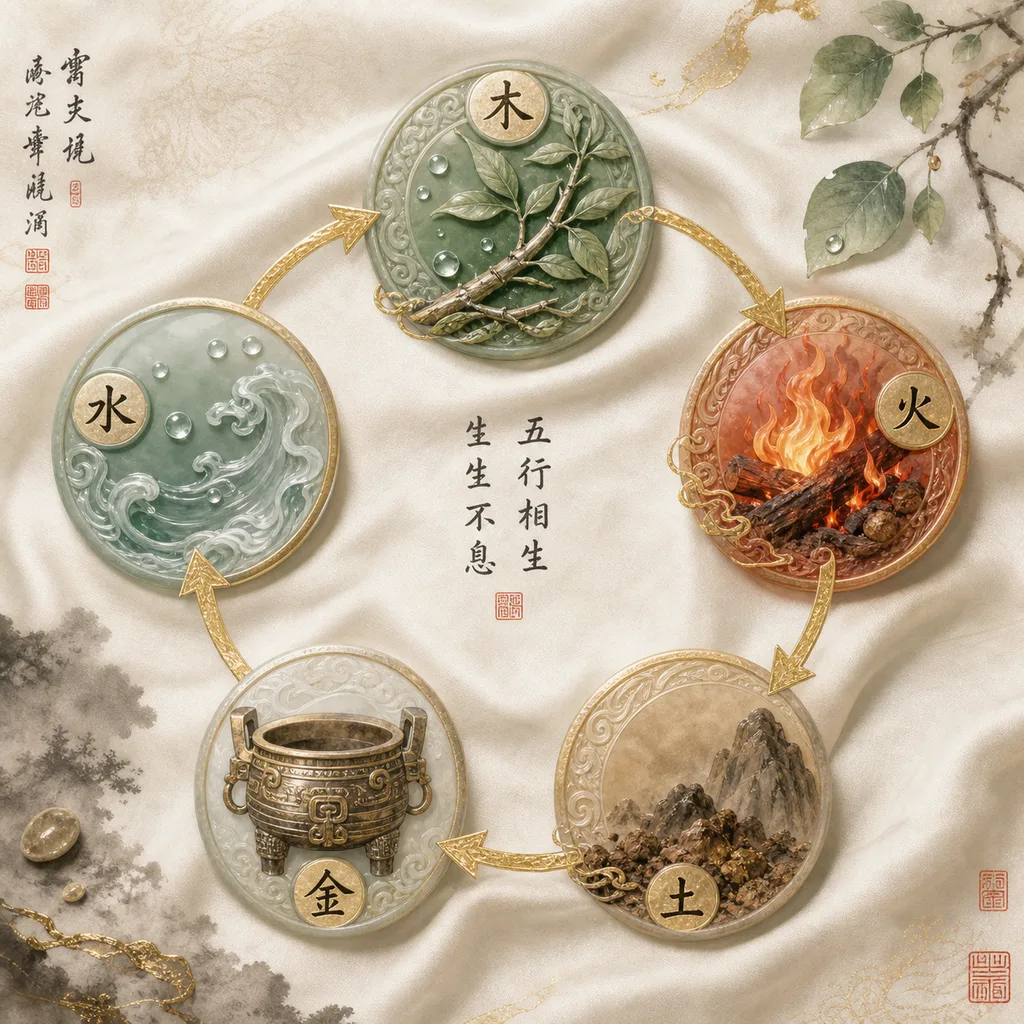
In BaZi astrology, the Generating Cycle (Xiang Sheng) (相生) is the fundamental nurturing dynamic of the Five Elements, applying equally to Heavenly Stems (天干) and Earthly Branches (地支). The nourishing cycle of Five Elements where each element generates the next: Wood generates Fire, Fire generates Earth, Earth generates Metal, Metal generates Water, Water generates Wood.
The generating element is consumed (泄, xie) in the process. Excessive generation weakens the source, making balance crucial.
Generation maps directly to the ten-god system: Resource generates Self, Self generates Output, Output generates Wealth, Wealth generates Power, Power generates Resource.
The generation cycle mirrors nature: Wood (Spring) fuels Fire (Summer), Fire creates Earth (transition), Earth produces Metal (Autumn), Metal yields Water (Winter), Water nourishes Wood (Spring).
| Quick Facts | |
|---|---|
| Chinese Name | 五行相生 (Wu Xing Xiang Sheng) |
| Category | Element Cycle |
| Interaction Type | Creative cycle |
| Number of Interactions | 5 generative pairs |
| Core Mechanism | Each element nourishes and gives life to the next in a continuous cycle. |
| Transformation Rule | No transformation of elements; energy is transferred and consumed. |
| Hidden Stem Role | Hidden stems reveal the true intensity and direction of the generative flow. |
| Directional Pattern | Follows seasonal progression: Wood (East) → Fire (South) → Earth (Center) → Metal (West) → Water (North). |
| Classical Source | Shang Shu (尚書), Great Plan Chapter (洪範), and Wu Xing Da Yi (五行大義) |
| Practical Significance | Determines which elements strengthen or deplete the Day Master, revealing life path and timing. |
Generation is a two-way flow
The generating element is consumed (泄, xie) in the process. Excessive generation weakens the source, making balance crucial.
Foundation of Ten Gods
Generation maps directly to the ten-god system: Resource generates Self, Self generates Output, Output generates Wealth, Wealth generates Power, Power generates Resource.
Seasonal logic governs cycles
The generation cycle mirrors nature: Wood (Spring) fuels Fire (Summer), Fire creates Earth (transition), Earth produces Metal (Autumn), Metal yields Water (Winter), Water nourishes Wood (Spring).
The Mechanics of Creative Flow
Five Element Generation (五行相生) is the fundamental creative cycle in BaZi, describing how each element nourishes and gives rise to the next. The cycle is: Wood generates Fire, Fire generates Earth, Earth generates Metal, Metal generates Water, and Water generates Wood. This sequence is not arbitrary but rooted in the natural world: wood burns to create fire; fire reduces matter to ash (earth); earth compresses into metal; metal melts into liquid (water); water sustains plants (wood). In BaZi, generation occurs between any two elements in the natal chart, luck pillars, or annual pillars. The generating element (生者) is the ‘mother’ and the generated element (受生者) is the ‘child.’ The interaction is directional: the mother gives energy to the child, but in doing so, the mother is weakened—a concept known as 泄 (xie, leakage). This depletion is critical: if the mother is strong, it can sustain generation; if weak, excessive generation may drain it entirely. Practitioners assess the strength of the generating element and the demand of the generated element to determine whether the cycle is healthy or problematic. For example, if Wood generates Fire but Wood is weak, the Fire may be insufficient, or the Wood may be exhausted, leading to imbalance.
Hidden Stems: The True Current
Hidden stems (藏干) within the earthly branches reveal the nuanced reality behind Five Element Generation. While the surface branch represents the main element, hidden stems show the internal energy composition that can alter the generative flow. For instance, the branch of Earth (e.g., 辰, 丑) may contain Water, Wood, or Metal hidden stems, which can change how generation occurs. If the branch is Earth and it generates Metal, but the Earth branch contains a hidden Water stem, the generation might leak into Water instead, disrupting the expected cycle. Similarly, a Fire branch (e.g., 午) contains hidden Earth and sometimes Wood; when Fire generates Earth, the hidden Wood can further fuel Fire, amplifying generation. Conversely, hidden stems can also create conflicting cycles: a branch that appears to generate another may actually deplete it if its hidden stem is the element being generated. For example, a Metal branch (e.g., 申) contains Water; if Metal generates Water, the hidden Water reinforces the generation, but if the branch is expected to generate Water but the hidden stem is Earth, the Earth may block the flow. Practitioners must analyze hidden stems to gauge the true direction and intensity of generation. This is especially important in the ‘four corners’ (四正) branches—子午卯酉—where the hidden stem is the same as the branch, making generation pure but intense. In contrast, branches with multiple hidden stems (e.g., 辰, 戌, 丑, 未) introduce complexity, requiring careful evaluation of which stem dominates and how it interacts with other elements.
Transformation: When Conditions Align
In BaZi, Five Element Generation does not inherently transform elements; rather, it transfers energy. However, under specific conditions, generation can lead to transformation (化气) when combined with other factors like harmony combinations (六合) or directional combinations (三合). For example, when Wood generates Fire and the Fire is strong, and the Wood is also strong, the combination may transform into a pure Fire structure if there is a harmony combination present (e.g., 寅午戌合火). Similarly, if Earth generates Metal and the Metal is abundant, and the Earth is stable, the energy may transform into a Metal structure via a directional combination (e.g., 巳酉丑合金). The key conditions for transformation are: (1) the generating element must be strong and the generated element must be strong enough to receive; (2) there must be no destructive elements (e.g., clash or harm) that break the flow; (3) the season must support the generated element (e.g., Fire generated in summer is more likely to transform than in winter). If conditions fail, generation remains but does not transform. For instance, if Wood generates Fire but the Fire is weak and the Wood is also weak, the generation is ineffective and may even lead to depletion. Practitioners look for transformation in the natal chart and luck pillars to identify major life themes: a transformation into the Day Master’s element can indicate a period of strength and success, while a transformation into a conflicting element may signal challenges.
Real-World Manifestations in Readings
In a BaZi reading, Five Element Generation manifests across all life areas. Career: If the Day Master generates the Output (食神/伤官), the person is creative and expressive, often in arts or communication. If Output generates Wealth (正财/偏财), their creativity produces material gain. If Wealth generates Power (正官/七杀), financial success brings responsibility or authority. Conversely, if Power generates Resource (正印/偏印), the person learns through discipline and structure. Relationships: The generation cycle between the Day Master and the Spouse Star (妻星/夫星) indicates harmony or tension. For example, if the Day Master (e.g., Wood) generates Fire (Output), and Fire generates Earth (Wealth), the spouse may be supportive and nurturing. But if the generation is excessive (e.g., Wood too weak to generate Fire), the person may feel drained by the relationship. Health: Each element corresponds to organs: Wood (liver), Fire (heart), Earth (spleen), Metal (lungs), Water (kidneys). Excessive generation can overwork an organ. For instance, weak Wood generating Fire may lead to liver deficiency and heart palpitations. Timing: Luck pillars and annual pillars activate generation cycles. A pillar that generates the Day Master’s Resource (印) brings learning and support; a pillar that generates Output brings creativity; a pillar that generates Wealth brings financial opportunity. Practitioners examine the strength of the generating element and the season to predict the outcome: a strong generating element in its own season yields positive results, while a weak one in an opposing season may cause stress.
Classical Roots and Modern Application
The Five Element Generation cycle is first recorded in the ‘Great Plan’ chapter (洪範) of the Shang Shu (尚書), where it states: ‘Water soaks and descends; Fire blazes and ascends; Wood bends and straightens; Metal is malleable and changes; Earth allows sowing and reaping.’ This describes the inherent qualities of each element, which naturally lead to generation: water nourishes wood, wood fuels fire, fire creates ash (earth), earth yields metal, metal melts into water. The Wu Xing Da Yi (五行大義) elaborates, explaining that generation is a mother-child relationship where the mother gives without expectation, but the child’s growth depletes the mother. This classical teaching emphasizes balance: the cycle is healthy only when each element is neither too strong nor too weak. In modern practice, this translates to assessing the Day Master’s strength and the role of generation in the ten-god system. For example, a strong Day Master that generates Output is seen as productive; a weak Day Master that generates Output may be overextending. Modern practitioners also integrate psychological and career coaching, using generation cycles to guide clients toward activities that nourish their element. For instance, a Wood Day Master might be advised to engage in creative projects (Fire) to generate joy, but also to ensure they have enough Water (Resource) to replenish. The classical wisdom remains the foundation: generation is the creative force of the universe, and understanding its flow allows one to align with natural rhythms.
Frequently Asked Questions
What does Five Element Generation mean in BaZi?
Five Element Generation (五行相生) is the creative cycle where each element nourishes the next: Wood → Fire → Earth → Metal → Water → Wood. In BaZi, it shows how energy flows between elements in your chart, indicating which elements strengthen or deplete your Day Master. It is the basis for the ten-god system and helps interpret career, relationships, and health. For example, if your Day Master is Wood and it generates Fire, you express creativity; if Fire generates Earth, your creativity produces tangible results.
Is Five Element Generation good or bad?
Five Element Generation is inherently neutral; its effect depends on context. It is beneficial when the generating element is strong and the generated element needs support, creating a harmonious flow. It becomes problematic when the generating element is weak and is drained (泄) excessively, leading to depletion. For example, a weak Wood generating strong Fire can exhaust the Wood, causing burnout. Practitioners evaluate the balance of the entire chart and the season to determine if generation is constructive or destructive.
How does Five Element Generation affect relationships/marriage?
In relationships, generation cycles between the Day Master and the Spouse Star (妻星/夫星) indicate harmony or tension. For instance, if your Day Master (e.g., Metal) generates Water (Output), and Water generates Wood (Wealth), the spouse may be supportive and creative. If the generation is excessive (e.g., weak Metal generating strong Water), you may feel emotionally drained. The presence of generation in the spouse’s pillar or luck pillars can indicate periods of mutual support or strain, depending on element strengths.
How does Five Element Generation affect career and wealth?
Career and wealth are directly linked to generation cycles. The Day Master generates Output (食神/伤官), which represents skills and creativity—essential for career success. Output generates Wealth (正财/偏财), meaning creative work leads to financial gain. Wealth generates Power (正官/七杀), where money brings authority or responsibility. A strong generation chain indicates a smooth career path; a broken chain suggests obstacles. For example, a Fire Day Master generating Earth (Output) can succeed in service industries, but if Earth is weak, wealth may be elusive.
What is the difference between Five Element Generation and other similar relations?
Five Element Generation is a creative cycle, unlike destructive cycles (e.g., Five Element Control) which regulate and suppress. Compared to harmony combinations (e.g., 六合), generation is a one-way flow that transfers energy, while harmony combinations merge elements into a new one. Directional combinations (三合) also create a new element but involve three branches. Generation is more fundamental and continuous, while combinations are specific events. Generation does not transform elements unless combined with other conditions, whereas combinations always transform.
How do practitioners resolve or work with Five Element Generation in a reading?
Practitioners first identify the Day Master and assess its strength based on the season and other elements. Then they trace the generation cycle: which elements generate the Day Master (Resource) and which it generates (Output). If generation is excessive and depleting the Day Master, they recommend strengthening the generating element (e.g., using the element’s season or adding it via feng shui) or reducing the demand (e.g., avoiding overwork). If generation is weak, they suggest activities that enhance the generated element. For example, a weak Wood Day Master generating Fire might be advised to rest (Water) and nurture Wood (e.g., spending time in nature).