
Rampart-Earth (城头土)
城头土 · One of the 30 NaYin elemental combinations
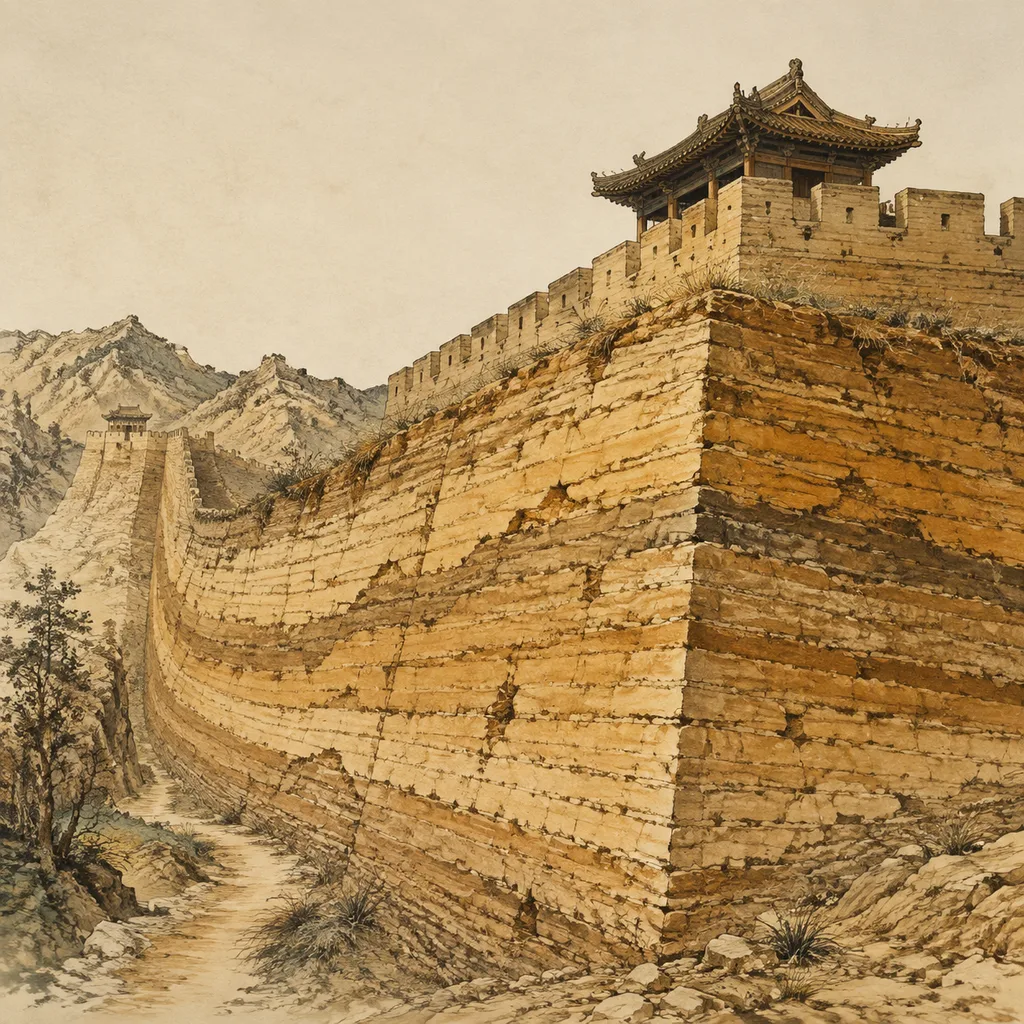
Rampart-Earth (城头土, Chéng Tóu Tǔ) translates literally to 'rampart earth' — the earth of city walls and fortifications. In the system of Na Yin, it evokes the image of the towering, fortified ramparts that once surrounded ancient Chinese capitals—massive, structured barriers built to withstand centuries of assault. Unlike the loose soil of a roadside or the finished clay of a roof, Wall-Earth is purposefully raised, compacted, and shaped into defensive walls that define the boundary between the civilized inner city and the wild outer world. Ancient astrologers chose this metaphor for a specific subtype of Earth energy: one that represents protection, organization, and steadfast endurance. This page explores the symbolism, classical records, personality traits, life applications, and pillar manifestations of Wall-Earth, offering a complete guide to this powerful Na Yin.
Wall-Earth represents the principle of structured defense—not passive waiting, but active, organized protection.
The San Ming Tong Hui (三命通会) describes Rampart-Earth as 'the rampart of the celestial capital, the golden city o...
The personality of Wall-Earth is best understood through its physical image: a sturdy, elevated wall that defines bou...
| NaYin Name | Rampart-Earth (城头土) |
| Element | Earth (土) |
| Ganzhi Pillars | () |
| Associated Animals | |
| Years in 60-Year Cycle | See BaZi Calculator |
| Classical Source | 《三命通会》明·万民英,1587 |
Key Takeaways
- Wall-Earth represents organized, purposeful protection — strength that is structural, not passive.
- This NaYin describes people who are the fortress others lean against in times of crisis.
- The wall metaphor carries a dual lesson: protection and separation. The strongest walls have gates.
- Classical texts describe imperial ramparts, jade barriers, golden cities.
What Wall-Earth Truly Represents
Wall-Earth represents the principle of structured defense—not passive waiting, but active, organized protection. The physical image teaches that true strength is not about aggression but about creating clear boundaries that preserve what lies within. Like the massive bricks of a city wall, individuals with this energy are built to last; they have a solid, unshakeable core that resists pressure and time. The metaphor also speaks to elevation: Wall-Earth is raised above the surrounding landscape, suggesting a perspective that sees both the big picture and the details of daily life within the walls. It is not packed roadside ground, which is merely a temporary path for travelers, nor is it a finished house roof, which shelters only a single dwelling. Wall-Earth is a communal defense, a barrier that protects a whole city, and those who carry it feel a sense of responsibility for the collective. They are the guardians of order, the ones who ensure that the chaos outside does not breach the peace inside. Their strength is in their structure—the careful organization of their lives, the clarity of their values, and their unwavering commitment to what they protect.
The Classical Record
The San Ming Tong Hui (三命通会) describes Rampart-Earth as 'the rampart of the celestial capital, the golden city of the emperor's realm.' The original Chinese quote: '城头土者,天京玉垒,帝里金城,龙盘千里之形,虎踞四维之势。' This translates to: 'Rampart-Earth is the jade rampart of the heavenly capital, the golden city of the imperial domain—coiling like a dragon across a thousand li, crouching like a tiger on all four quarters.' The text emphasizes that this earth embodies the majesty of great defenses: vast in scale and commanding in position. The Yu Xiao Bao Jian (玉霄宝鉴) adds that Wall-Earth 'holds the qi of the center and manifests as a bulwark; it is the support of all things within its domain.' The concept of qi here is vital: the qi of Wall-Earth is dense, stable, and protective, like the energy of a well-ordered state. Unlike scattered earth that disperses energy, Wall-Earth channels and concentrates it, creating a fortress of purpose. These classical sources highlight that this Na Yin is not about personal comfort but about societal duty and enduring strength.
The Inner Landscape
The personality of Wall-Earth is best understood through its physical image: a sturdy, elevated wall that defines boundaries. These individuals are natural protectors—they take their responsibilities seriously and are often seen as the pillars of their families, workplaces, or communities. They value structure, order, and clarity. Unlike the Roadside-Earth (路边土), which is easily traveled over and lacks a defined shape, Wall-Earth is unyielding and deliberate. Where Roadside-Earth people might adapt to any passing influence, Wall-Earth individuals remain steadfast, holding their ground even under pressure. Similarly, unlike the Roof-Earth (屋上土) which finishes a house and provides a capping protection, Wall-Earth is a perimeter defense—it does not complete a structure but encloses and guards it. This means Wall-Earth personalities are less focused on internal refinement and more on external security. Strengths include loyalty, practicality, and endurance. They are excellent planners and organizers, able to see potential threats and prepare for them. However, their challenges are rigidity and defensiveness. Just as a wall can become a prison, these individuals may build barriers that isolate them from emotional intimacy or new experiences. They can be overly cautious, resistant to change, and sometimes suspicious of what lies outside their established boundaries. The key lesson for Wall-Earth is to remember that walls have gates—protection does not require complete isolation.
Work, Money, and Love under Wall-Earth
In career and life, Wall-Earth energy finds natural expression in roles that involve protection, organization, and clear boundaries. These include military, security, law enforcement, urban planning, architecture, engineering, and any profession that builds or maintains systems of order. Wall-Earth individuals excel as project managers, administrators, and in logistics where their ability to create structure from chaos shines. Financially, they are conservative and methodical. They prefer secure investments and long-term savings over risky ventures. Like a wall that accumulates earth over time, they build wealth steadily, brick by brick. They are not flashy spenders but will invest heavily in what protects their future—home, health insurance, and education for their children. In love and partnership, Wall-Earth people are loyal and protective partners. They show love by providing stability and safety, often taking on the role of the dependable anchor. They value commitment and may be slow to open up, needing to trust that their partner is 'inside the walls' before showing vulnerability. Challenges arise when they become too controlling or closed off, mistaking emotional distance for strength. A healthy relationship for Wall-Earth requires a partner who respects their need for structure while encouraging them to occasionally open the gates.
Two Doorways into Wall-Earth
Wall-Earth manifests differently depending on which pillar it occupies in the Ba Zi chart. In the year pillar, it represents the ancestral and early-life environment. A Wall-Earth year pillar suggests a family or upbringing that emphasized security, tradition, and clear rules. These individuals often inherit a sense of duty from their lineage, growing up in a household that valued order and protection. Notable years for Wall-Earth include Geng Wu (庚午) and Yi Chou (乙丑). In the day pillar, Wall-Earth governs the self and the spouse. Here, the energy becomes personal—the person themselves embodies the fortress mentality. They are likely to be very protective of their identity and their intimate relationship, sometimes erecting walls even in marriage. The day pillar Wall-Earth individual seeks a partner who is either equally strong or who respects their need for boundaries. The contrast between the two pillars is subtle but significant: the year pillar Wall-Earth is a wall built by ancestors, while the day pillar Wall-Earth is a wall built by the self. The former describes the inherited environment; the latter describes the personal character.
Embracing Your Wall-Earth Nature
Wall-Earth teaches the wisdom of boundaries—knowing when to build them and when to open them. The wall does not exist to imprison, but to protect the life and culture within the city. As you embrace your Wall-Earth nature, remember that strength includes the ability to let the right people in. The most fortified cities have strong gates that can open to welcome allies. Your practical, protective energy is a gift to those you love and to the structures you uphold. To discover whether this energy appears in your chart, explore your full BaZi reading.
Discover whether Wall-Earth appears in your chart. Calculate your free BaZi reading →
Your birth data stays in your browser and is never stored or shared.
References & Classical Sources
This page draws on the following primary sources, cross-referenced with our in-house library of 16+ classical BaZi texts:
- San Ming Tong Hui (三命通会) — Wan Minying (万民英), Ming Dynasty, 1587. Volume 30, “On NaYin Imagery”. Core quote: “”
- Yu Xiao Bao Jian (玉霄宝鉴) — Song Dynasty. Supplementary notes on 城头土 pillars.
- Yan Dongsou’s Commentary (阎东叟注) — Song Dynasty.
- Di Tian Sui (滴天髓) — Ming/Song Dynasty. Cross-referenced for Earth-element behavioral patterns.
- Zi Ping Zhen Quan (子平真诠) — Shen Xiaozhan, Qing Dynasty. Referenced for Nayin classification methodology.
All translations by the 12Zodiacs Editorial Team, reviewed against the original classical Chinese. Full methodology available on our Methodology page.
Related NaYin Pillars
The City-Wall Earth (城头土) resonance covers two pillars of the 60-year cycle:
- Wall-Earth Tiger — 戊寅 (Wu-Yin), years 1938, 1998
- Wall-Earth Rabbit — 己卯 (Ji-Mao), years 1939, 1999
Note: City-Wall Earth (城头土) is distinct from Wall-Earth (壁上土), which governs the 庚子 Geng-Zi Rat and 辛丑 Xin-Chou Ox pillars.
More in NaYin Elements
Creek Water · Forest Wood · Gold Leaf Metal · Hairpin Metal · Hearth Fire · Heavenly Water · Highway Earth · Lamp Fire