
Forest-Wood (大林木)
大林木 · One of the 30 NaYin elemental combinations
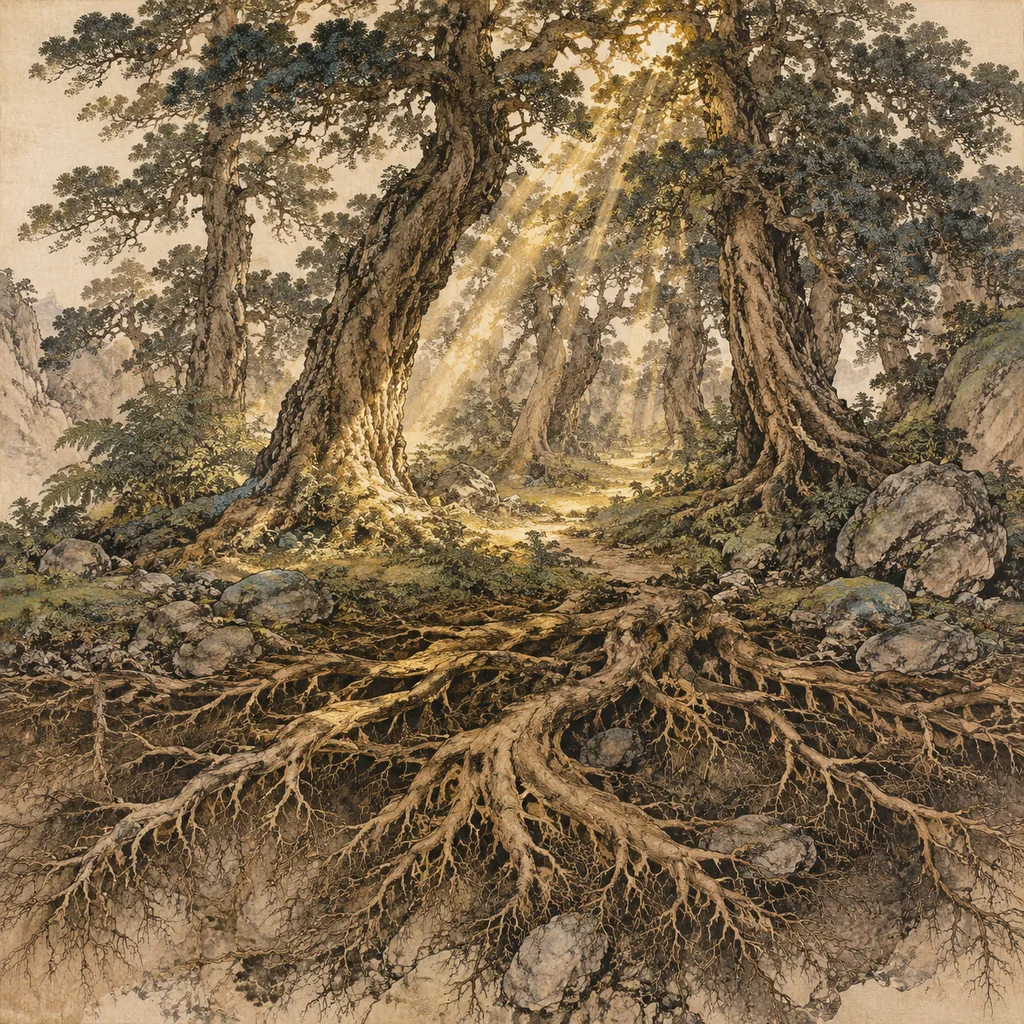
大林木 (Dà Lín Mù) translates literally to 'Great Forest Wood.' The image it evokes is not a single tree, no matter how mighty, but a vast, ancient forest—a canopy so dense that sunlight filters through in shafts, a ground woven with roots supporting countless lives. This is the power of the collective, of shelter and scale. Ancient astrologers chose this specific metaphor for the Wood element under the Earthly Branches of Dragon and Snake because it captures a unique synergy: Wood growing from Earth, not as isolated trunks but as an ecosystem. In Chinese metaphysics, this NaYin symbolizes individuals who thrive through connection, whose strength lies in their ability to nurture and be part of something larger. This page unpacks the image, explores classical commentary, reveals the personality of those born under this sign, and guides you through its applications in career, finances, love, and daily life.
The image of Forest-Wood teaches that true strength is communal.
The classical source text 《三命通会》 (San Ming Tong Hui) by Ming dynasty scholar Wan Minying, compiled in 1587, states: &...
My teacher often emphasized that Forest-Wood is the most misunderstood of all NaYin types because people see the gran...
| NaYin Name | Forest-Wood (大林木) |
| Element | Wood (木) |
| Ganzhi Pillars | 戊辰, 己巳 (Yang Earth, Yin Earth) Stems |
| Associated Animals | Dragon, Snake |
| Years in 60-Year Cycle | 1928, 1988, 1929, 1989 |
| Classical Source | 《三命通会》明·万民英,1587 · 卷三十「论纳音取象」 |
Key Takeaways
- Forest-Wood represents strength through scale and community, not individual might.
- This NaYin describes people who create environments where others thrive.
- The forest metaphor teaches generosity of spirit and the importance of breadth over depth.
- Classical texts describe branches reaching the sky, roots intertwining underground.
Unpacking the Image
The image of Forest-Wood teaches that true strength is communal. Unlike a lone pine that stands defiant against the wind, or a willow that bends to survive, Forest-Wood is about scale and shelter. Imagine walking into an ancient canopy—the air is cool, the ground soft with humus, and the sound of wind is a murmur through countless leaves. Each tree is interconnected by a mycelial network, sharing nutrients and warnings. This is not a solitary endurance but a collective resilience. The character of Forest-Wood is not that of an individual hero but of a community builder, a provider of shade and stability. The metaphor reveals that those with this NaYin are natural hosts, creating environments where others can thrive. Their power is in their roots—deep, extensive, binding the earth—and in their branches, which rise not to dominate the sky but to form a roof for all beneath. Challenges arise when they forget that a forest needs both old growth and new shoots; they may resist change or become overprotective, stifling the very ecosystem they seek to sustain.
Wisdom from the Source Texts
The classical source text 《三命通会》 (San Ming Tong Hui) by Ming dynasty scholar Wan Minying, compiled in 1587, states: '大林木者,枝干撼风,柯条撑月,耸壑昂霄之德,凌云蔽日之功。' In plain English: 'The Great Forest Wood—its branches and trunks shake the wind, its boughs prop up the moon; it has the virtue of towering over valleys and soaring to the sky, the power of climbing the clouds and shading the sun.' This quote emphasizes the wood's robustness and its role as a structural foundation. The image is of a forest so massive that its branches can 'hold up the moon,' a poetic exaggeration for immense scale and resilience. The image of 'shaking the wind and propping up the moon' suggests towering scale and quiet resilience—Forest-Wood individuals are natural supports in society, reliable and unyielding. The concept of qi here is one of solid Earth (the stems 戊 and 己) nourishing robust Wood, creating a synergy that makes the wood resistant to harm. The Yu Xiao Bao Jian (Jade Box Treasure Mirror) commentary adds that this wood flourishes with water and avoids metal, as Earth produces Metal but Wood is the mother of Fire, so the cycle is delicate. The classical interpretation warns that while Forest-Wood is strong, it must be planted in the right season—spring and summer are auspicious, autumn and winter bring decline.
大林木者,枝干撼风,柯条撑月,耸壑昂霄之德,凌云蔽日之功。
— 《三命通会》明·万民英,1587 · 卷三十「论纳音取象」
戊辰: 戊辰,两土下木,众金不能克,盖土生金,有子母之道,得水生之,为佳。
Yan Dongsou: “戊辰木,为华星发秀之林,喜春夏,忌秋冬。”
己巳: 己巳,为近火之木,金自此生于我无伤,忌见生旺之金。
Yan Dongsou: “己巳木,为不负顶日之柯,主文章秀拔。”
Who You Are When No One Is Looking
My teacher often emphasized that Forest-Wood is the most misunderstood of all NaYin types because people see the grandeur of the forest and assume those born under it are extroverted leaders. In truth, many Forest-Wood individuals are quiet anchors, not loud pioneers. Their strength is in stillness and service. Imagine a forest: it does not chase the sun; it stands, and the sun finds it. Similarly, Forest-Wood personalities attract people and opportunities through their steady presence. They are natural mentors, creating safe spaces for growth. Their strengths include patience, loyalty, and an almost uncanny ability to see the big picture. They build systems—families, teams, organizations—that last. Challenges arise from their very density: they can become inflexible, resistant to change, and overly protective of their 'understory.' A forest that never allows new light can become stagnant. Forest-Wood individuals may struggle with letting go of control or accepting that not everything needs to be under their canopy. They also face a tension between their need for community and their occasional desire for solitude—every forest has clearings. Emotionally, they can be deeply nurturing but also prone to carrying others' burdens until they themselves are depleted. The key lesson is to remember that a healthy forest requires both growth and decay; they must learn to release what no longer serves the whole.
Career Currents, Financial Tides, and Matters of the Heart
In career, Forest-Wood thrives in roles that involve building, nurturing, or protecting large systems. Think of architects of public parks, conservationists, educators, hospital administrators, or CEOs of cooperative businesses. They excel where they can create structures that benefit many—like a forest that provides timber, oxygen, and habitat. They are less suited for cutthroat competition or solitary freelance work. Financially, Forest-Wood tends toward conservatism and abundance through accumulation. Like a forest that stores carbon and water, they build wealth slowly, investing in real estate, land, or long-term assets. They may struggle with risk-taking but can be generous once established, funding community projects or family trusts. In love, Forest-Wood partners are deeply committed and protective. They seek relationships that feel like a shared ecosystem—mutually supportive, with room for both individual growth and collective strength. However, they can become possessive or overly enmeshed, mistaking control for care. The ideal partner is someone who respects their need for deep roots while also encouraging new growth. A Forest-Wood individual in love is like a mature tree that shelters a smaller sapling—nurturing but also dominant if not mindful. They must learn that a forest thrives on diversity, not monoculture.
The Twin Faces of Forest-Wood
Forest-Wood manifests differently in its two pillar combinations, each shaped by its Earth stem. The first, 戊辰 (Yang Earth on Dragon), corresponds to years like 1928 and 1988. Notable figures include Li Ka-shing, Rihanna, Adele, Stephen Curry, and Conor McGregor. The Dragon adds dynamism and ambition. This Forest-Wood is like a forest on a mountain slope—sturdy, exposed to wind, but commanding. These individuals often rise to prominence through sheer scale of effort, building empires (Li Ka-shing) or becoming global icons (Rihanna, Adele). Their wood is 'earth-covered,' suggesting a need to break through obstacles. The second, 己巳 (Yin Earth on Snake), corresponds to 1929 and 1989, with figures like Audrey Hepburn, Taylor Swift, and Avicii. The Snake brings wisdom, subtlety, and a connection to hidden depths. This Forest-Wood is like a forest in a valley—lush, mysterious, and more artistic. Hepburn's elegance, Swift's storytelling, and Avicii's melodic productions all reflect a wood that is refined and emotionally resonant. While Dragon Forest-Wood builds structures, Snake Forest-Wood weaves narratives. Both share the core of community and shelter, but the Dragon leans outward (building the forest's canopy), while the Snake leans inward (exploring the forest's roots).
A Daily Practice for Forest-Wood
Each day, ask yourself: Am I being a forest or a fortress? A forest provides shelter, but a fortress shuts out life. Practice letting one small thing grow without your direct control—a project you delegate, a relationship you trust, a plan you leave unfinished. The wisdom of Forest-Wood is that your strength multiplies when you support others to grow alongside you. To discover whether this energy appears in your chart, explore your full BaZi reading.
Discover whether Forest-Wood appears in your chart. Calculate your free BaZi reading →
Your birth data stays in your browser and is never stored or shared.
References & Classical Sources
This page draws on the following primary sources, cross-referenced with our in-house library of 16+ classical BaZi texts:
- San Ming Tong Hui (三命通会) — Wan Minying (万民英), Ming Dynasty, 1587. Volume 30, “On NaYin Imagery”. Core quote: “大林木者,枝干撼风,柯条撑月,耸壑昂霄之德,凌云蔽日之功。”
- Yu Xiao Bao Jian (玉霄宝鉴) — Song Dynasty. Supplementary notes on 大林木 pillars.
- Yan Dongsou’s Commentary (阎东叟注) — Song Dynasty.
- Di Tian Sui (滴天髓) — Ming/Song Dynasty. Cross-referenced for Wood-element behavioral patterns.
- Zi Ping Zhen Quan (子平真诠) — Shen Xiaozhan, Qing Dynasty. Referenced for Nayin classification methodology.
All translations by the 12Zodiacs Editorial Team, reviewed against the original classical Chinese. Full methodology available on our Methodology page.
More in NaYin Elements
Creek Water · Gold Leaf Metal · Hairpin Metal · Hearth Fire · Heavenly Water · Highway Earth · Lamp Fire · Lightning Fire