
Mountain-Fire (山头火)
山头火 · One of the 30 NaYin elemental combinations
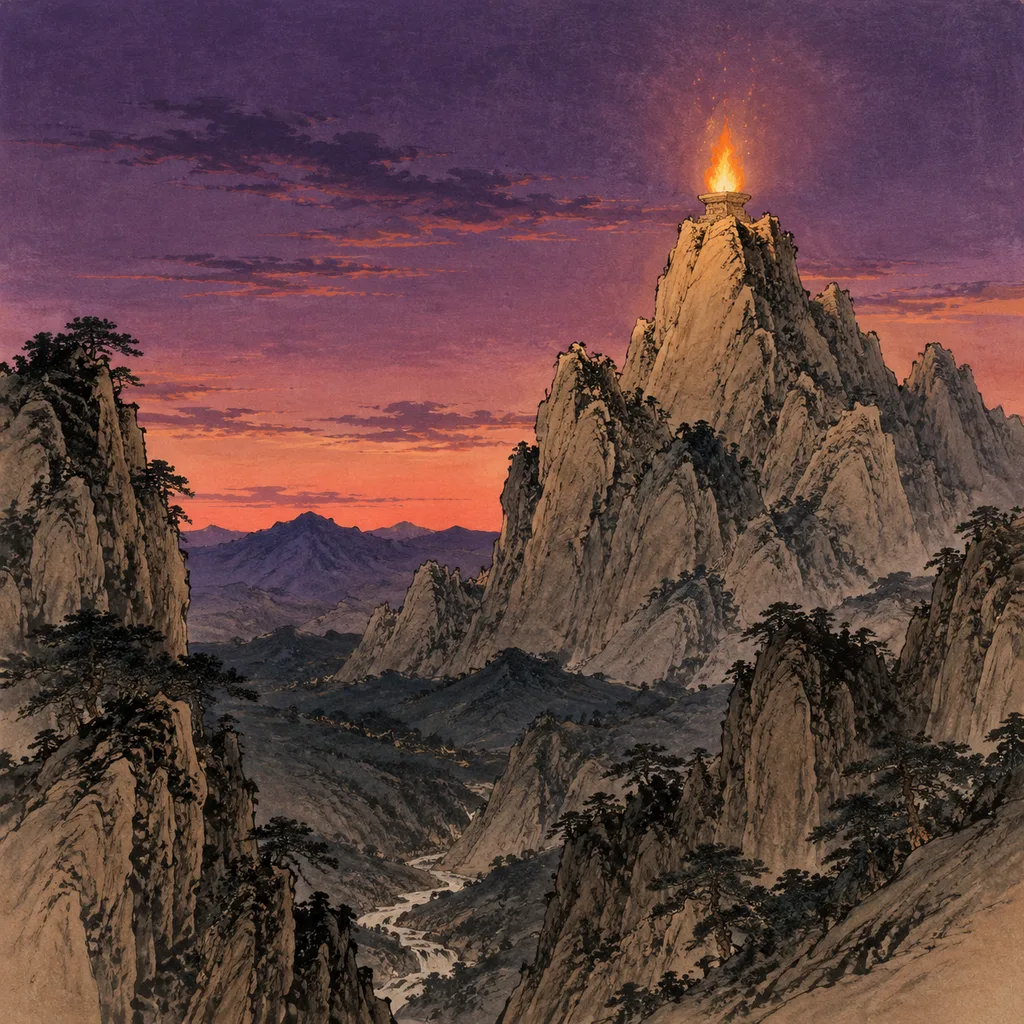
The Mountain-Fire (山头火) evokes the image of a beacon blazing atop a remote peak, its flames visible for miles across darkened valleys. In Chinese metaphysics, this is not the contained hearth fire of daily life nor the fleeting spark of lightning, but a signal fire deliberately set to announce a presence, to guide travelers, or to warn of change. The ancient astrologers chose this metaphor to capture a specific elemental subtype: fire that is elevated, commanding, and transformative. It is a fire that clears the old brush, making way for renewal. On this page, we explore the essence of Mountain-Fire—its classical roots, its influence on personality, and how it manifests across life domains and pillar combinations.
The image of Mountain-Fire is layered with meaning.
The *San Ming Tong Hui* (三命通会) by Ming scholar Wan Minying offers this foundational description: '山头火者,野焚燎原,延烧极目...
Consider the pattern we see in someone born under Mountain-Fire: they typically spend their early years feeling an in...
| NaYin Name | Mountain-Fire (山头火) |
| Element | Fire (火) |
| Ganzhi Pillars | 甲戌, 乙亥 (Yang Wood, Yin Wood) Stems |
| Associated Animals | Dog, Pig |
| Years in 60-Year Cycle | 1934, 1994, 1935, 1995 |
| Classical Source | 《三命通会》明·万民英,1587 · 卷三十「论纳音取象」/ 《五行要论》 |
Key Takeaways
- Mountain-Fire represents transformative visibility — a beacon that everyone sees and few can ignore.
- This NaYin describes people with the power to clear old patterns and make way for the new.
- The mountaintop metaphor means their impact is far-reaching, but not everything old needs to burn.
- Classical texts describe light cast from the highest point, returning to rest when its work is done.
Unpacking the Image
The image of Mountain-Fire is layered with meaning. At its simplest, it is a fire on a summit—visible from great distances, a point of orientation in the landscape. But this is also a fire that shifts the terrain: it burns away deadwood and undergrowth, forcing the ecosystem to regenerate. For those born under this nayin, life is often a series of declarations—moments when they must stand tall and be seen, even if it means destruction of the old. The beacon symbolizes a calling to leadership or public witness; the wildfire aspect speaks to their capacity for radical change. Two metaphors anchor this: first, the lighthouse on a cliff—always shining, never hidden, guiding others through storms. Second, the controlled burn set by forest rangers—a deliberate blaze that prevents greater catastrophe. Mountain-Fire individuals carry both roles: they illuminate paths and they purge what no longer serves.
Wisdom from the Source Texts
The *San Ming Tong Hui* (三命通会) by Ming scholar Wan Minying offers this foundational description: '山头火者,野焚燎原,延烧极目,依稀天际斜辉,仿佛山头落日,此乃九月烧荒,衰草尽燎之火也。' Translated: 'Mountain-Fire is the wild burn that sweeps the plain, its blaze stretching as far as the eye can see—like a slanting glow on the horizon's edge, like the setting sun upon the mountain top. This is the fire of the ninth month, when the withered grass is burned away.' The key concept here is the 'qi' of the fire—its quality of being both elevated and expansive. Unlike other fire types, Mountain-Fire's qi is directed upward and outward, seeking the heights. The *Yu Xiao Bao Jian* adds that this fire requires strong support from Wood to sustain its brilliance; without it, the flame may flicker or burn out prematurely.
山头火者,野焚燎原,延烧极目,依稀天际斜辉,仿佛山头落日,此乃九月烧荒,衰草尽燎之火也。
— 《三命通会》明·万民英,1587 · 卷三十「论纳音取象」/ 《五行要论》
甲戌: 甲戌,自库之火,不嫌众水,只忌壬戌,所谓墓中受克,其患难逃。
乙亥: 乙亥,伏明之火,其气湮郁而不发,藉己亥、辛卯、己巳、壬午发未木生之,则精神旺相。
Who You Are When No One Is Looking
Consider the pattern we see in someone born under Mountain-Fire: they typically spend their early years feeling an inner restlessness, as if they are meant for something larger but cannot name it. They might take on roles that feel too small—a competent employee, a reliable friend—yet all the while, a quiet fire smolders. The turning point often comes when they are forced to take a stand: a whistleblower revealing corruption, a community organizer rallying neighbors against an injustice, or an artist whose work finally breaks through public indifference. At that moment, the beacon is lit. Strengths include an uncanny ability to see the big picture and inspire others; they are natural leaders in crisis. Challenges include a tendency to burn bridges (literally and metaphorically) when frustrated, and a loneliness that comes from being perpetually 'above' others. Like a mountaintop fire, they can feel isolated even as everyone watches them. Their intensity can overwhelm those who prefer the steady warmth of a hearth.
Career Currents, Financial Tides, and Matters of the Heart
Career paths that resonate with Mountain-Fire are those where visibility and transformation are assets: public speaking, activism, emergency response, forestry or environmental management, broadcasting, or any role that involves guiding others through uncertainty. They thrive when their work has a mission. Financially, Mountain-Fire individuals often experience dramatic swings—they can amass wealth quickly through bold ventures, then lose it by overextending. Their relationship with money mirrors the fire's nature: it is a tool for making an impact, not for hoarding. In love, they seek partners who are not intimidated by their intensity. They need someone who can stand on equal ground, yet also appreciate the warmth of the fire. Early relationships may be turbulent, marked by passionate beginnings and sudden endings—like a wildfire that consumes everything in its path. Later, they often find stability with a partner who understands the need for periodic renewal, who helps them tend the fire without letting it rage out of control.
The Twin Faces of Mountain-Fire
Mountain-Fire appears in two pillar combinations, each coloring the same image with different nuances. The 甲戌 (Wood Yang on Dog) pillar, seen in years 1934 and 1994, is described in the classics as 'self-storing fire' that fears only the vast ocean of 壬戌. This fire is steady, enduring, and resistant to external extinguishing—like a beacon built on solid rock. Notables include Justin Bieber (1994), whose career ignited early and burned brightly in the global spotlight. The 乙亥 (Wood Yin on Pig) pillar, from 1935 and 1995, is called 'hidden brightness fire' that must borrow Wood to flourish. This fire is more dependent on external fuel—relationships, environment, or spiritual practice—to reach its full height. Examples include the Dalai Lama (1935) and Luciano Pavarotti (1935), both of whom required supportive conditions (Tibetan Buddhism, operatic training) to shine. The Pig's Water element can dampen the fire, making it more introspective and less outwardly explosive than the Dog variant.
A Daily Practice for Mountain-Fire
Mountain-Fire teaches that visibility is a responsibility. Your light can guide others, but it also attracts storms. A daily practice might involve intentional 'burning'—letting go of one outdated belief or habit each week, creating space for new growth. The fire's wisdom is that destruction and creation are two sides of the same flame. If you suspect this energy runs through your chart, the next step is to see where it sits in your BaZi—whether it is the pillar of your year, month, day, or hour. Each placement tells a different story about how you signal your presence in the world. To discover whether this energy appears in your chart, explore your full BaZi reading.
Discover whether Mountain-Fire appears in your chart. Calculate your free BaZi reading →
Your birth data stays in your browser and is never stored or shared.
References & Classical Sources
This page draws on the following primary sources, cross-referenced with our in-house library of 16+ classical BaZi texts:
- San Ming Tong Hui (三命通会) — Wan Minying (万民英), Ming Dynasty, 1587. Volume 30, “On NaYin Imagery”. Core quote: “山头火者,野焚燎原,延烧极目,依稀天际斜辉,仿佛山头落日,此乃九月烧荒,衰草尽燎之火也。”
- Yu Xiao Bao Jian (玉霄宝鉴) — Song Dynasty. Supplementary notes on 山头火 pillars.
- Yan Dongsou’s Commentary (阎东叟注) — Song Dynasty.
- Di Tian Sui (滴天髓) — Ming/Song Dynasty. Cross-referenced for Fire-element behavioral patterns.
- Zi Ping Zhen Quan (子平真诠) — Shen Xiaozhan, Qing Dynasty. Referenced for Nayin classification methodology.
All translations by the 12Zodiacs Editorial Team, reviewed against the original classical Chinese. Full methodology available on our Methodology page.
More in NaYin Elements
Creek Water · Forest Wood · Gold Leaf Metal · Hairpin Metal · Hearth Fire · Heavenly Water · Highway Earth · Lamp Fire