
Five Element Control Cycle (五行相克)
五行相克 · Earthly Branch dynamics in BaZi
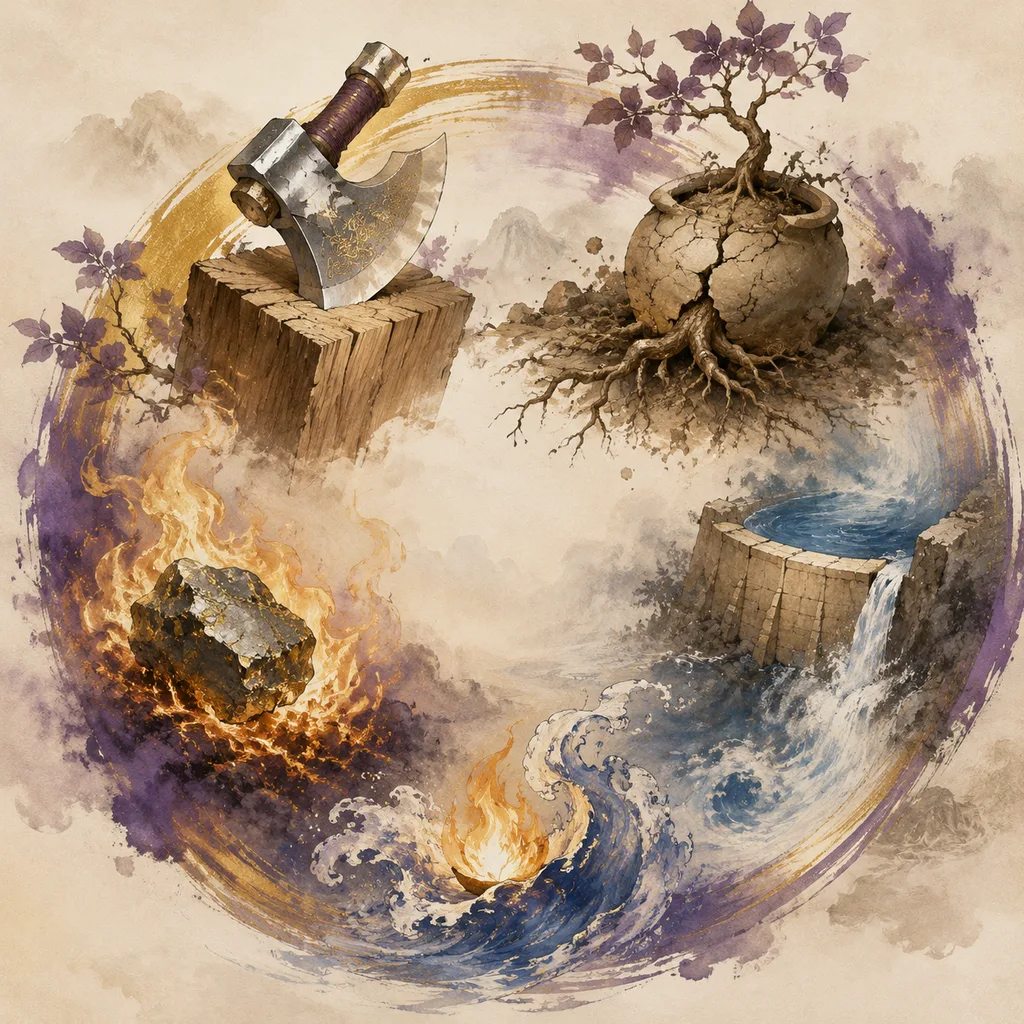
In BaZi astrology, the Controlling Cycle (Xiang Ke) (相克) is one of the fundamental interactions between Earthly Branches (地支). The restraining cycle of Five Elements where each element controls another: Wood controls Earth, Earth controls Water, Water controls Fire, Fire controls Metal, Metal controls Wood.
Five Element Control is a regulatory mechanism that provides boundaries and accountability, similar to a manager overseeing an employee. It is not inherently negative but essential for order.
If the controlled element is excessively strong, it can rebel against the controller, turning the tables. This principle, called 反侮, is critical in determining actual dynamics in a chart.
The control cycle directly maps to ten gods: Self controls Wealth, Wealth controls Resource, Resource controls Output, Output controls Power, Power controls Self. Understanding control strength is key to interpreting these stars.
| Quick Facts | |
|---|---|
| Chinese Name | 五行相克 (Wu Xing Xiang Ke) |
| Category | Element Cycle |
| Interaction Type | Control cycle |
| Number of Interactions | 5 control pairs |
| Core Mechanism | Each element restrains another in a regulatory cycle, creating balance through discipline. |
| Transformation Rule | No elemental transformation; control enforces order without altering substance. |
| Hidden Stem Role | Hidden stems reveal the true strength and nature of the controlling and controlled elements, affecting whether control holds or reverses. |
| Directional Pattern | Alternating positions: each element controls the one two steps ahead in the generation cycle. |
| Classical Source | Shang Shu (尚書), Great Plan Chapter (洪範), and Wu Xing Da Yi (五行大義) |
| Practical Significance | Determines Power (officer) stars that discipline the Day Master and Wealth stars that the Day Master controls. |
Control creates structure, not destruction
Five Element Control is a regulatory mechanism that provides boundaries and accountability, similar to a manager overseeing an employee. It is not inherently negative but essential for order.
Reverse insult when controlled element is strong
If the controlled element is excessively strong, it can rebel against the controller, turning the tables. This principle, called 反侮, is critical in determining actual dynamics in a chart.
Foundation for Wealth and Power ten gods
The control cycle directly maps to ten gods: Self controls Wealth, Wealth controls Resource, Resource controls Output, Output controls Power, Power controls Self. Understanding control strength is key to interpreting these stars.
The Structural Mechanics of Control
Five Element Control operates on a strict positional logic derived from the generation cycle. Each element controls the element two steps ahead in the generative sequence. For example, Wood generates Fire, but Wood controls Earth, which is generated by Fire. This creates an alternating pattern of dominance: Wood → Earth, Earth → Water, Water → Fire, Fire → Metal, Metal → Wood. The control cycle ensures that no single element becomes too powerful without a counterbalance. In BaZi, this is not a clash but a disciplinary relationship. The controlling element acts like a regulator, imposing limits. For instance, when Wood (represented by Yin or Yang Wood in the heavenly stems) appears in a branch, it restrains Earth (stems like Wu or Ji) in the same or interacting pillars. The strength of control depends on the relative elemental force, seasonal support, and presence of hidden stems. A strong controller can effectively discipline a weaker controlled element, but if the controlled element is robust due to many supports, the control may be ineffective or even backfire.
Hidden Stem Dynamics in Control
Hidden stems (藏干) within earthly branches are crucial for assessing control. They reveal the inner composition and actual strength of the elements involved. For example, the branch Chen (龙) contains hidden stems Wu (戊 Earth), Yi (乙 Wood), and Gui (癸 Water). If Chen is the controlled element, the presence of Yi Wood (which controls Earth) inside Chen can modify the interaction: the Wood hidden stem may resist control from an external Wood element, or it may reinforce the control if aligned. Similarly, hidden stems can empower the controlled element to rebel. In the control relationship, the hidden stems of the controlling branch determine how much authority it wields. For instance, a Zi (子 Water) branch contains only Gui (癸 Water), making its control over Fire (Wu or Ding) pure and strong. But a Hai (亥 Water) branch contains Ren (壬 Water) and Jia (甲 Wood); the Wood hidden stem can weaken the water’s control over Fire because Wood consumes Water. Thus, surface-level control may be deceptive without analyzing hidden stems. Practitioners must examine all hidden stems to gauge the true dynamic.
Transformation and Conditions for Control
Unlike combination or harmony, Five Element Control does not transform elements. It is a regulatory force that maintains the status quo. However, control can be negated or reversed under specific conditions. The key condition is relative strength: if the controlled element is significantly stronger than the controller, a ‘reverse insult’ (反侮) occurs. For example, normally Water controls Fire, but if Fire is extremely strong (e.g., many Fire branches and stems, summer season) and Water is weak, Fire can overpower Water, turning the controller into the controlled. This is not a transformation but a reversal of dominance. Another condition is the presence of a third element that intervenes. For instance, if Metal controls Wood, but Water (which generates Wood) is present, Water can weaken Metal’s control by producing Wood. The interaction is also affected by seasonal strength: an element in its own season is robust and less likely to be controlled. In BaZi reading, if a control relationship appears in a chart but conditions for reversal are met, the ten gods associated with control (e.g., Power star) may behave oppositely, indicating authority that is actually weak or challenged.
Real-World Manifestation in BaZi Readings
In practice, Five Element Control directly influences career, relationships, health, and timing. For career, the Power star (officer) is the element that controls the Day Master. If the control is strong and balanced, it indicates a disciplined career path, authority, and respect. If control is excessive, it suggests oppression, stress, or overbearing bosses. The Wealth star is the element the Day Master controls, representing resources, income, and management. A healthy control over Wealth indicates financial acumen; if control is too weak, money slips away. In relationships, control plays out in dynamics: for a Wood Day Master, Earth is Wealth (spouse), and Metal is Power (authority). If Earth is strongly controlled by Wood, the native may dominate their partner. Healthwise, each element corresponds to organs: Wood controls Earth (spleen/stomach), so imbalance can cause digestive issues. Timing is crucial: when a luck pillar or year introduces a strong controlling element, it can trigger events like promotions (if control is positive) or conflicts (if excessive). For example, a Metal Day Master encountering Fire control in a luck pillar may face regulatory challenges or career changes.
Classical Wisdom and Modern Interpretation
The classical source for Five Element Control is the Shang Shu (尚書), Great Plan Chapter (洪範), which states: ‘Water controls Fire, Fire controls Metal, Metal controls Wood, Wood controls Earth, Earth controls Water.’ This establishes the cycle as a natural order of checks and balances. The Wu Xing Da Yi (五行大義) expands on this, explaining that control prevents excess and maintains harmony. In ancient times, this was applied to statecraft: the ruler (like the controlling element) must discipline but not dominate. Modern interpretation in BaZi retains this essence but emphasizes flexibility. Control is not absolute; it is a dynamic interaction influenced by strength, season, and hidden stems. Today, practitioners view control as a tool for balance. For instance, if a chart has too much Wood (creativity), adding Metal (control) through feng shui or naming can bring discipline. But if Wood is weak, Metal control could be harmful. The classical teaching that ‘control without generation leads to stagnation’ reminds us that pure control without nurturing elements can create rigidity. Thus, a balanced chart often has a mix of control and generation cycles.
Frequently Asked Questions
What does Five Element Control mean in BaZi?
Five Element Control (五行相克) is a regulatory cycle where each element restrains another: Wood controls Earth, Earth controls Water, Water controls Fire, Fire controls Metal, Metal controls Wood. In a BaZi chart, it creates boundaries and discipline. It determines which elements are Power stars (controlling the Day Master) and Wealth stars (controlled by the Day Master). Control is not inherently bad; it provides structure and accountability. However, excessive control or reverse control (when the controlled element rebels) can indicate imbalance.
Is Five Element Control good or bad?
Five Element Control is neutral; its effect depends on context. Balanced control brings discipline, order, and success in career and relationships. Excessive control can lead to oppression, stress, or health issues. When the controlled element is too strong, reverse control occurs, turning the tables. In BaZi, a healthy amount of control is necessary for the Day Master to manage Wealth and handle Power. Too little control may indicate lack of ambition or boundaries. Practitioners assess the strength of elements and the overall chart balance to judge if control is beneficial.
How does Five Element Control affect relationships/marriage?
In relationships, the element the Day Master controls is the Wealth star, often representing the spouse. For a male, Wealth is the wife; for a female, the Power star (controlling the Day Master) represents the husband. If the Day Master strongly controls Wealth, the native may dominate the partner. If control is weak, the partner may be independent. Control also influences compatibility: two charts with complementary control cycles can balance each other. For example, a Wood Day Master (controls Earth) may pair well with an Earth Day Master (controlled by Wood) if the control is moderate.
How does Five Element Control affect career and wealth?
Career and wealth are directly tied to control. The Power star (element controlling the Day Master) represents career authority, promotions, and discipline. A strong but balanced Power star indicates leadership and respect. Excessive Power can mean job stress or micromanagement. The Wealth star (element controlled by the Day Master) represents income, resources, and financial management. If the Day Master controls Wealth well, the native is good with money. Weak control may lead to financial loss. Timing of control cycles in luck pillars can trigger career changes or wealth opportunities.
What is the difference between Five Element Control and other similar relations?
Five Element Control differs from Clash (六冲) and Harm (六害). Clash is a direct confrontation between opposite branches, often causing disruption. Harm is a subtle undermining, like a slow leak. Control is a regulatory force, not a conflict. Unlike Combination (六合) or Three Harmony (三合), which transform elements, control does not transform; it only disciplines. Control is also distinct from Generation (相生), which nurtures. In practice, control provides structure, while generation supports growth. A chart often has both, and their interaction must be balanced.
How do practitioners resolve or work with Five Element Control in a reading?
Practitioners first assess the strength of the controlling and controlled elements using seasonal factors, hidden stems, and supports. If control is excessive, they recommend strengthening the controlled element or introducing an element that generates it. For example, if Metal controls Wood too strongly, adding Water (which generates Wood) can mitigate. If control is too weak, they suggest strengthening the controller. In feng shui, colors or objects representing the needed element can be used. In naming, characters with the missing element can be chosen. The goal is to achieve balance, not eliminate control.