
Tiger and Snake Compatibility: Love, Friendship & Work
In a Nutshell
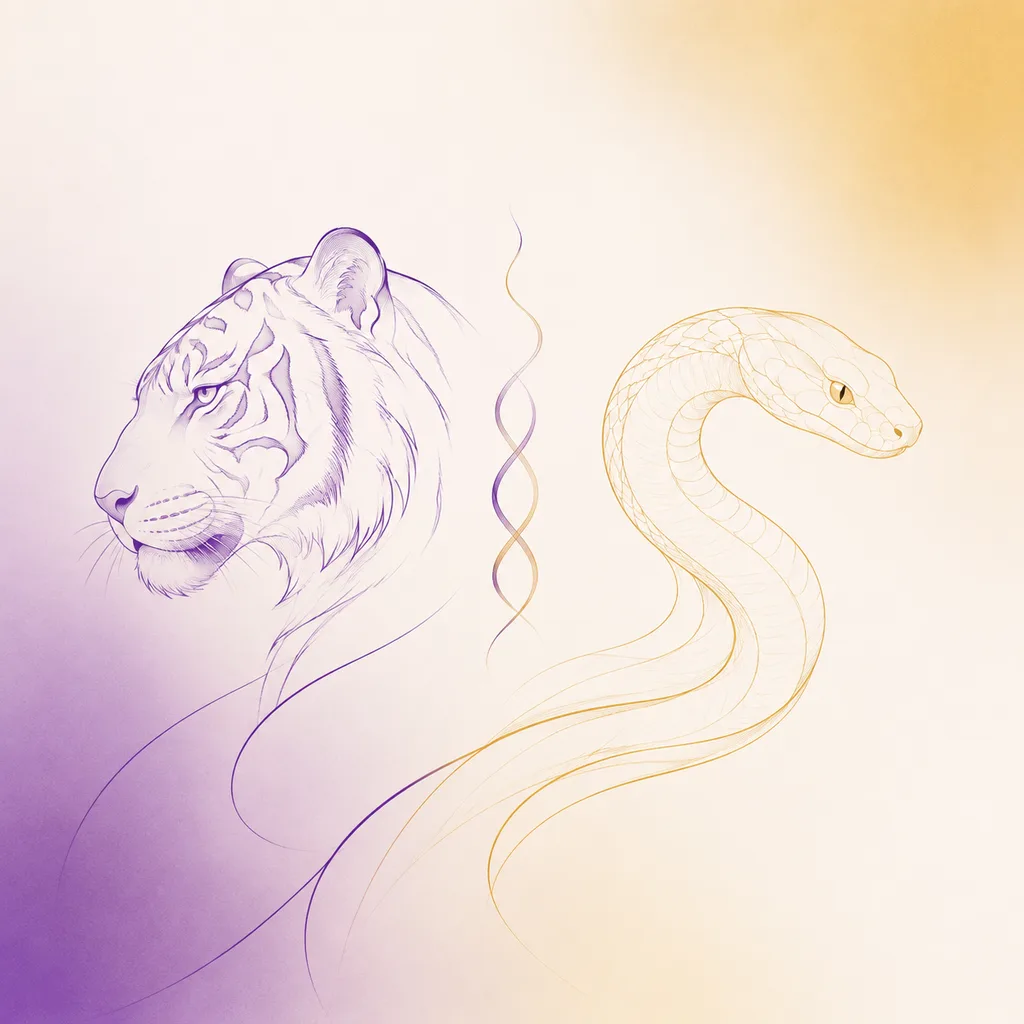
Tiger and Snake form a challenging match. Tiger's bold, direct nature clashes with Snake's subtle, strategic approach. While Tiger charges ahead, Snake prefers to observe and plan, leading to misunderstandings. Their dynamic requires patience to bridge the gap between action and contemplation.
The Bond Between Tiger and Snake: A Classical Foundation
In BaZi, the Tiger and Snake share a complex cosmic alignment known as the Six Harms. This is not a harmonious union like the Six Combinations; instead, it signifies that good intentions can lead to unintended harm. The Tiger’s bold, initiating wood clashes with the Snake’s cunning, intense fire, creating friction despite mutual respect. Their connection is dynamic but requires careful navigation to avoid misunderstandings.
The Element Dynamic
The Tiger’s Yang Wood (Jia) feeds the Snake’s Yin Fire (Ding) in a nurturing Sheng cycle—wood produces fire. This elemental flow is like a forest fueling a wildfire: the Tiger provides inspiration, resources, and growth, while the Snake transforms these into brilliant, strategic action. However, the fire can become overwhelming, consuming the wood too quickly. For this pairing, the key lies in balancing generosity with self-preservation, ensuring the Tiger’s support does not burn out the very source of its strength.
Two Natures in Tension: The Warrior and the Sage
The Tiger’s Inner World
The Tiger embodies Yang Wood — the nature of a great tree: towering, unyielding, growing upward with relentless force. Among the twelve signs, the Tiger carries the most raw courage — instinctive boldness that charges forward before doubt can set in. Yin Wood represents early spring’s explosive growth: maximum upward force, maximum defiance of containment.
Internally, the Tiger carries an inner fire that fuels their ambition and a deep-seated drive to succeed. This gives them overwhelming force paired with burning ambition. They lead from the front, fight for what they believe, and refuse to back down. Their defining tension is honor versus pragmatism — they want to do right, but their definition of “right” is often filtered through ego.
The Snake’s Inner World
The Snake embodies Yin Fire — the nature of a candle flame in a dark room: subtle, intense, illuminating what others miss. Among the twelve signs, the Snake carries the most penetrating insight — intuitive perception that sees beneath surfaces to hidden truth. Si Fire represents early summer’s first warmth: subtle but transformative.
Internally, Si stores Bing Fire (hidden brilliance), Wu Earth (hidden ambition), and Geng Metal (hidden precision). This gives Snakes extraordinary inner complexity: simultaneously intuitive and strategic, perceptive and private. They operate on multiple levels — what they show is never the whole story. Their defining tension is depth versus openness — they see everything but reveal little.
Where They Tangle
The YinSi Harm carries a unique cruelty: “good intentions lead to unintended harm.” The element dynamic is productive — Wood produces Fire, meaning the Tiger’s energy naturally fuels the Snake. In theory, this should be nourishing. In practice, the harm manifests through a specific pattern: the Tiger, acting boldly and with genuine good intentions, inadvertently threatens the Snake’s carefully maintained privacy and strategic position.
The Tiger operates in the open — charging forward, making noise, drawing attention. The Snake operates in the shadows — observing, analyzing, maintaining strategic advantage through concealment. When the Tiger’s bold actions illuminate spaces the Snake prefers dark, the Snake experiences it as exposure and threat. When the Snake’s hidden strategies are revealed by the Tiger’s indiscriminate energy, trust breaks down. The Tiger meant well; the Snake was harmed anyway. This is the essence of the YinSi dynamic.
Love and Romance: Boldness Meets Mystery
The Tiger in love is fiercely passionate and protective. They pursue with boldness — grand gestures, public declarations, an intensity that sweeps the other person off their feet. When they commit, they commit absolutely. What they need most is admiration and loyalty.
The Snake in love is intense, possessive, and deeply private. They attract through mystery and depth rather than bold pursuit. Once committed, they love with fierce exclusivity. Their romance language is insight: they show love by understanding the other person more deeply than anyone else. What they need most is privacy and depth.
The YinSi Harm in romance manifests as the Tiger’s transparency inadvertently violating the Snake’s need for privacy. The Tiger, proud of the relationship, wants to share everything — introducing the Snake to friends, posting on social media, talking openly about their love. The Snake experiences this exposure as violation: their private world being dragged into the light. The Tiger doesn’t understand why the Snake is upset (“I was just being proud of us!”); the Snake can’t explain why exposure feels like betrayal (“If you really cared, you’d protect my privacy”).
Why It Scores 54/100
The productive Wood-Fire element dynamic gives genuine chemistry and complementary potential. The score reflects the specific harm pattern — not elemental opposition but good intentions causing unintended damage. With awareness of the transparency-privacy tension, this pairing can navigate the harm successfully. The Tiger’s energy does fuel the Snake; the Snake’s depth does ground the Tiger. The work is in learning how to express these strengths without triggering the harm pattern.
Marriage and Long-Term Potential
The Tiger-Snake marriage has real potential because Wood produces Fire — the Tiger’s boldness energizes the Snake, and the Snake’s depth gives the Tiger a profound anchor. The YinSi Harm predicts a specific failure mode, not general incompatibility.
The Exposure Pattern
The harm manifests most dangerously in social situations. The Tiger, proud and protective, tends to be outspoken about the relationship — sharing details, making public declarations, drawing attention to the partnership. The Snake, private and strategic, experiences each public exposure as a security breach. When the Tiger tells friends about a private matter, the Snake feels betrayed. When the Snake retreats into privacy, the Tiger feels shut out. This cycle, repeated over years, erodes the trust that both signs value intensely.
The Loyalty Question
Both signs are fiercely loyal — the Tiger through open devotion, the Snake through exclusive possession. But their definitions of loyalty conflict. For the Tiger, loyalty means being publicly committed and vocally proud. For the Snake, loyalty means protecting the relationship’s privacy and never exposing its inner workings. When the Tiger’s public loyalty violates the Snake’s private loyalty standard, the Snake questions the Tiger’s commitment. When the Snake’s withdrawal feels like secrecy, the Tiger questions the Snake’s trust.
What Can Work
The productive element dynamic is a genuine asset. The fix is boundary-setting around privacy: agreeing in advance what’s shareable and what’s private. The Tiger must learn that protecting the Snake’s privacy IS an act of love, not a restriction. The Snake must learn that the Tiger’s openness IS loyalty, not betrayal. Both must expand their definition of what commitment looks like.
The Gender Lens: Why Direction Matters
Tiger Man + Snake Woman
The Tiger man is born to lead — charismatic, protective, and unafraid. His romance is big gestures and fierce loyalty. He’s proud of his partner and wants the world to know it.
The Snake woman is magnetic, mysterious, and fiercely private. She reads people with X-ray precision and guards her inner world with quiet ferocity. She needs privacy and depth, not public display.
The dynamic: His public pride meets her private nature. He shares relationship details with friends; she experiences each share as exposure. He doesn’t understand her secrecy; she doesn’t understand his need for external validation.
Snake Man + Tiger Woman
The Snake man is mysterious, intense, and strategically brilliant. He operates on levels most people can’t perceive. His love is deep, exclusive, and protective — but always private.
The Tiger woman is magnificent — bold, fierce, and unapologetically herself. She leads rather than follows. She needs a partner who can match her energy and appreciate her boldness without trying to contain it.
The dynamic: His strategic privacy meets her bold transparency. She wants to charge forward together; he wants to position carefully behind the scenes. She experiences his caution as hesitation; he experiences her boldness as recklessness that exposes his strategies.
Friction 1: The Transparency-Privacy War
The Tiger operates openly; the Snake operates privately. When the Tiger shares relationship details that the Snake considers private, the Snake experiences it as betrayal. When the Snake withholds information for strategic reasons, the Tiger experiences it as distrust. The harm cycle: the Tiger’s transparency inadvertently exposes the Snake, the Snake withdraws, the Tiger feels shut out, the Tiger overcompensates with more openness, which exposes the Snake further.
Friction 2: The Pace-and-Strategy Conflict
The Tiger charges forward; the Snake positions strategically. When making decisions, the Tiger wants to act boldly and immediately; the Snake wants to analyze, position, and optimize. The Tiger’s speed ruins the Snake’s strategies; the Snake’s caution kills the Tiger’s momentum. Neither approach is wrong, but they’re incompatible in execution.
Friction 3: The Unintended Harm Pattern
The YinSi Harm’s signature: the Tiger, acting with genuine good intentions, inadvertently harms the Snake. The Tiger introduces the Snake to someone they didn’t want to meet; the Tiger mentions something the Snake wanted kept quiet; the Tiger’s bold move disrupts a careful position the Snake was maintaining. The Tiger is bewildered by the Snake’s anger; the Snake can’t believe the Tiger didn’t see the damage.
Friendship and Business Partnerships
As Friends
Tiger-Snake friendships work best when both appreciate the other’s mode of engagement without trying to change it. The Tiger brings energy, adventure, and boldness; the Snake brings insight, strategy, and depth. Shared intellectual interests — philosophy, strategy games, debate — create common ground where both thrive. The key risk: the Tiger’s openness about the friendship inadvertently exposes the Snake’s private affairs.
As Business Partners
In business, the Tiger-Snake partnership combines the two most powerful leadership archetypes: the bold front-leader and the strategic back-brain. The Tiger is the public face — inspiring, bold, willing to charge into challenges. The Snake is the strategic mind — reading markets, anticipating moves, positioning advantage. Together they can be extraordinarily effective. The key risk: the Tiger’s public statements inadvertently reveal the Snake’s strategies, or the Snake’s behind-the-scenes maneuvering makes the Tiger feel manipulated. The solution: regular private strategy sessions where both share full information, and clear agreements about what can be said publicly.
Beyond the Zodiac: The Full BaZi Picture
An important note on accuracy: Chinese zodiac compatibility examines one layer of a complete BaZi (Four Pillars) chart — the year branch. In a full BaZi reading, compatibility is assessed across all four pillars, considering each person’s Day Master, elemental balance, structural pattern, and current 10-year luck phase. The Tiger-Snake Six Harm is moderate, mitigated by the productive Wood-produces-Fire dynamic.
The Tiger-Snake harm is like a bonfire built too close to a tent — the fire (Tiger’s energy) is meant to warm, but proximity causes unintended damage. The full BaZi chart reveals whether there are elements that create safer distance: Earth to ground the Tiger’s boldness and give the Snake stable ground, Water to moderate the Fire and add flow, or Metal to give both signs a shared focus for their combined intensity. The productive element dynamic gives this pairing real potential — the harm is navigable with awareness.
Use our BaZi calculator to see your complete chart →
Practical Advice for Tiger and Snake
- Create explicit privacy agreements. Categorize topics as “public,” “selective,” or “private.” The Tiger honors the categories; the Snake practices full transparency within the “private” tier. This prevents the transparency-privacy war that defines the harm pattern.
- Develop impact awareness. Before acting in any situation that affects your partner, pause and ask: “Could this inadvertently harm them?” The Tiger must learn this; the Snake must communicate boundaries proactively, not reactively.
- Separate decision domains. The Tiger leads in boldness-required situations; the Snake leads in strategy-required situations. When both apply, set timelines that respect both approaches.
- The Tiger must protect the Snake’s privacy as an act of love. Not everything proud needs to be shared publicly. Guarding your partner’s private world is loyalty in their language.
- The Snake must practice transparency with the Tiger. Strategic privacy is fine for the outside world, but in love, your partner needs the full picture. Withholding breeds distrust; transparency builds the alliance the relationship needs.
Frequently Asked Questions
How strong is the bond between Tiger and Snake?
The Tiger and Snake share a bond rated 54 out of 100, reflecting a Six Harms (Liu Hai) dynamic—a subtle, hidden drain that can erode connection over time. While not overtly conflicting, this pairing requires conscious effort to avoid accumulating misunderstandings. The Tiger’s boldness and the Snake’s strategic nature can complement each other when both are aware of the underlying tension. With mutual awareness and adjustment, the bond can be meaningful, but it’s not naturally effortless.
Is romance promising between Tiger and Snake?
Romance between Tiger and Snake scores 57 out of 100, indicating moderate potential but significant challenges. The Six Harms (Liu Hai) dynamic often leads to ‘accumulated misunderstanding’—small, unspoken grievances that build over time. The Tiger’s passionate impulsiveness may clash with the Snake’s need for control and privacy. However, the Wood-Fire elemental flow (Tiger’s Wood fuels Snake’s Fire) can create warmth if both communicate openly. Success depends on addressing those ‘off’ feelings before they become cracks.
Can Tiger and Snake sustain a lifelong partnership?
Yes, a lifelong partnership is possible, but it requires deliberate effort. With an overall compatibility of 54, the Six Harms (Liu Hai) relationship demands constant awareness of the subtle draining effect. The Tiger must temper impulsiveness to avoid triggering the Snake’s jealousy, while the Snake should express concerns rather than retreating into secrecy. If both commit to honest communication and mutual respect, their differences can balance—the Tiger brings energy, the Snake provides wisdom. It’s a marathon, not a sprint.
Are Tiger and Snake naturally friendly with each other?
Friendship between Tiger and Snake scores 52 out of 100, often characterized by surface harmony with hidden competition. The Six Harms (Liu Hai) dynamic means they may get along well publicly but feel subtly misunderstood or rivalrous privately. The Tiger’s boldness can intimidate the Snake, while the Snake’s reserve may frustrate the Tiger. To build genuine friendship, both must voice hidden discomforts honestly—often they discover the other feels the same way. Honesty is the antidote to this covert drain.
How does the Tiger-Snake duo perform in business?
In business, the Tiger-Snake partnership scores 52 out of 100, reflecting a mix of potential and pitfalls. The Tiger’s courage and leadership can drive innovation, while the Snake’s strategic thinking and insight provide depth. However, the Six Harms (Liu Hai) dynamic can cause subtle friction—the Tiger may see the Snake as overly secretive, and the Snake may view the Tiger as reckless. Success requires clear roles and open communication to prevent misunderstandings from undermining collaboration. When aligned, they can be formidable.
What’s the nature of the Tiger and Snake connection?
The Tiger-Snake connection is classified as a Six Harms (Liu Hai) relationship, meaning a subtle, hidden drain exists between them. Unlike overt conflicts, this dynamic involves accumulating discomfort—good intentions can lead to resentment if not managed. The Tiger’s Wood element fuels the Snake’s Fire, creating a nurturing flow, but the Tiger’s impulsiveness and the Snake’s possessiveness can create covert tension. The key is awareness: both must address small issues before they fester. With effort, this pairing can transform hidden harm into mutual growth.
How well do Tiger parents and Snake children bond?
Tiger parents and Snake children can form a loving bond, but the Six Harms (Liu Hai) dynamic requires careful navigation. The Tiger parent’s bold, direct style may clash with the Snake child’s sensitive, strategic nature—leading to the child feeling pressured or misunderstood. The Tiger should temper impulsiveness and give the Snake space, while the Snake child should learn to express feelings openly. With patience, the Tiger’s courage can inspire the child, and the Snake’s wisdom can teach the parent depth. The Wood-Fire flow supports warmth, but awareness is crucial.
Money and Financial Alignment
Financially excellent. The Tiger’s bold investing and risk-taking generate income, while the Snake’s shrewd, strategic nature multiplies it. Wood feeding fire enhances this wealth cycle: the Tiger’s passion fuels the Snake’s calculated moves. Joint ventures thrive as the Tiger’s charisma attracts opportunities and the Snake’s wisdom safeguards profits. However, the Tiger’s unpredictability may clash with the Snake’s need for privacy, requiring trust in each other’s financial roles.
Lucky Elements at a Glance
| Element | Tiger | Snake |
|---|---|---|
| Lucky Numbers | 1, 3, 4 | 2, 8, 9 |
| Lucky Colors | blue, grey, orange | black, red, yellow |
| Flowers | cineraria, anthurium | orchid, cactus |
| Gems | sapphire | opal |
More Compatibility Matches
Tiger & Rat · Tiger & Ox · Tiger & Rabbit · Tiger & Dragon · Tiger & Horse · Tiger & Goat