
The 2026 Bing Wu (丙午) year carries double Fire energy, and its 12 monthly pillars create a shifting elemental landscape from Geng Yin in February through Xin Chou in January 2027. Each monthly pillar interacts with the year pillar and your Day Master differently, making certain months more favorable for specific activities than others.

Key Takeaways
- The 2026 year pillar is Bing Wu (丙午), Yang Fire on Yang Fire, creating the most intense Fire year in the 60-year cycle
- Monthly pillars range from Geng Yin (庚寅) in February to Xin Chou (辛丑) in January 2027
- Solar months begin on solar terms (Jie Qi), typically the 4th to 6th of each Gregorian month, not lunar new moons
- The June Jia Wu (甲午) month amplifies the year’s double Fire to triple Fire intensity, making it the most volatile month
- The August Bing Shen (丙申) month creates a Fire-Metal stem clash that tests Metal Day Masters
- The December Geng Zi (庚子) month triggers the Year Breaker (岁破, Zi-Wu clash): the Zi (Rat) branch clashes head-on with the year’s Wu (Horse) branch, making it the most volatile month of 2026
The 12 Monthly Pillars of 2026
In the BaZi system, the year pillar sets the annual climate while the monthly pillar provides the seasonal layer. The Earthly Branch (zodiac month) follows a fixed seasonal track, but the Heavenly Stem advances so that every month has a unique stem-branch pair.
Complete Monthly Pillar Table
| Solar Month | Approx Dates | Branch | Monthly Pillar | Element Dynamic |
|---|---|---|---|---|
| February | Feb 4 – Mar 5 | Yin (Tiger) | Geng Yin (庚寅) | Yang Metal over Wood |
| March | Mar 6 – Apr 4 | Mao (Rabbit) | Xin Mao (辛卯) | Yin Metal over Wood |
| April | Apr 5 – May 5 | Chen (Dragon) | Ren Chen (壬辰) | Yang Water over Earth |
| May | May 6 – Jun 5 | Si (Snake) | Gui Si (癸巳) | Yin Water over Fire |
| June | Jun 6 – Jul 6 | Wu (Horse) | Jia Wu (甲午) | Yang Wood over Fire |
| July | Jul 7 – Aug 7 | Wei (Goat) | Yi Wei (乙未) | Yin Wood over Earth |
| August | Aug 8 – Sep 7 | Shen (Monkey) | Bing Shen (丙申) | Yang Fire over Metal |
| September | Sep 8 – Oct 7 | You (Rooster) | Ding You (丁酉) | Yin Fire over Metal |
| October | Oct 8 – Nov 6 | Xu (Dog) | Wu Xu (戊戌) | Yang Earth over Earth |
| November | Nov 7 – Dec 6 | Hai (Pig) | Ji Hai (己亥) | Yin Earth over Water |
| December | Dec 7 – Jan 5 | Zi (Rat) | Geng Zi (庚子) | Yang Metal over Water |
| January | Jan 6 – Feb 3 | Chou (Ox) | Xin Chou (辛丑) | Yin Metal over Earth |
The pattern we see in this table is that Fire energy peaks three times during the year: the year pillar itself (Bing Wu), the June month pillar (Jia Wu, which adds Yang Wood feeding Fire), and the August month pillar (Bing Shen, where the annual Bing Fire meets Metal). These three months form the highest-intensity windows of 2026.
How Monthly Pillars Interact With the Year Pillar
The year pillar Bing Wu (丙午) is a pure Fire pillar. Both the Heavenly Stem (Bing, Yang Fire) and the Earthly Branch (Wu, Horse) carry Fire energy. This creates what classical BaZi texts call a “Blazing Sun” configuration, where the year acts like a persistent solar flare illuminating everything below it.
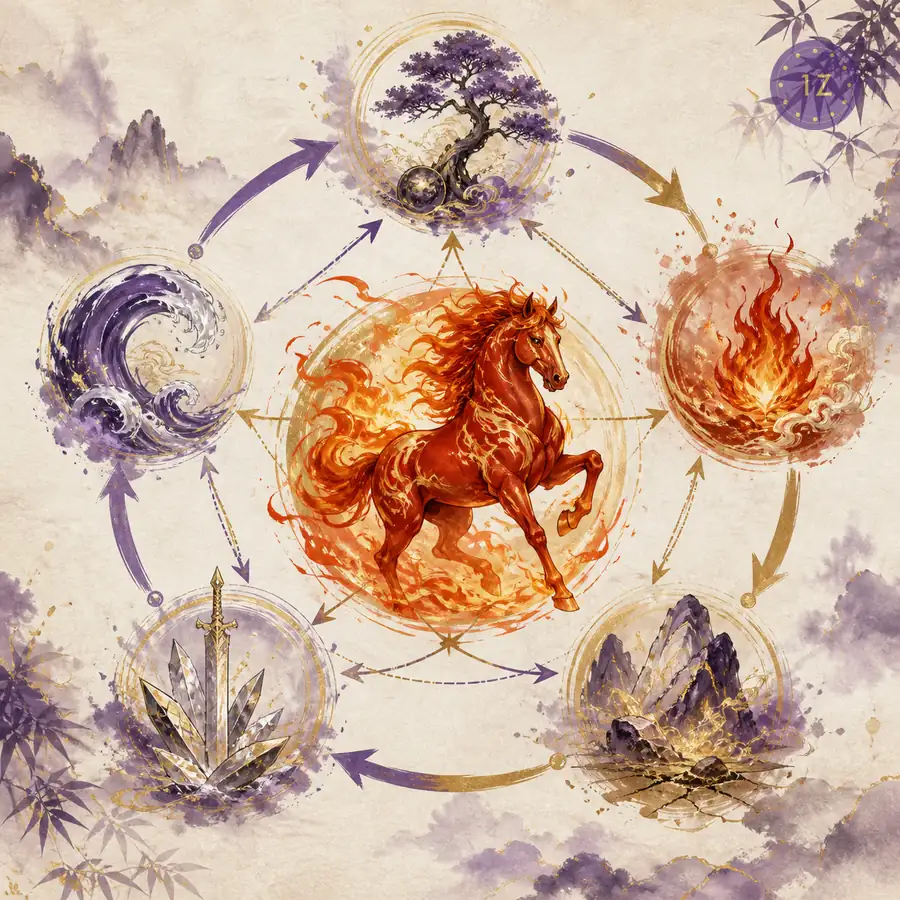
Each monthly pillar interacts with this annual Fire through three mechanisms: generation (fueling the Fire), control (dampening the Fire), and clash (direct confrontation). Understanding which mechanism dominates each month tells you whether that period favors expansion, consolidation, or caution.
The generating months are February (Geng Yin), where Tiger Wood can feed Fire if conditions are dry enough, and June (Jia Wu), where Yang Wood directly nourishes the already-blazing Fire. These months favor bold action, launching projects, and public visibility.
The controlling months are April (Ren Chen), where Yang Water sits over Dragon Earth, providing structural dampening, and November (Ji Hai), where Yin Earth absorbs and Yin Water cools. These months favor planning, consolidation, and behind-the-scenes work.
A stem clash surfaces in August (Bing Shen), where Fire meets Metal head-on. The annual Bing Fire clashes with the Shen (Monkey) branch’s hidden Metal, creating friction that tests Metal Day Masters and benefits Fire Day Masters.
The most severe clash of 2026, however, is December (Geng Zi), which triggers a Year Breaker (岁破/Sui Po). The Zi (Rat) branch directly clashes with the year’s Wu (Horse) branch in the Six Clashes pattern (子午冲). In classical BaZi, this is called the “broken year” month: the annual pillar’s foundation is directly challenged. All signs should treat December 2026 with heightened caution — avoid major commitments, expect sudden shifts, and prioritize stability over expansion.
Monthly Pillars by Day Master Element
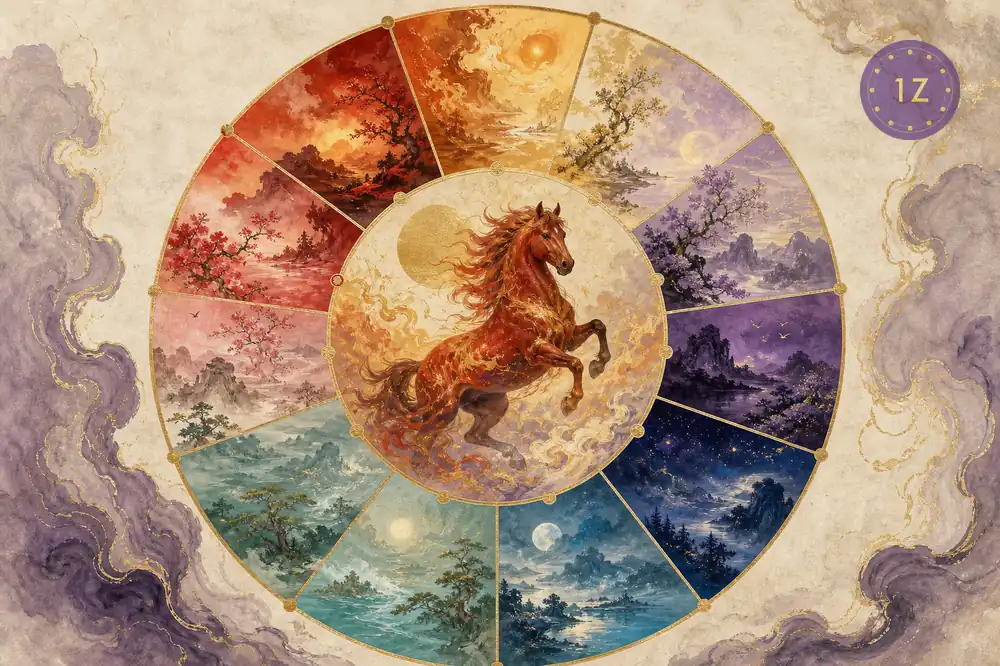
Your Day Master element determines how each monthly pillar affects you personally. The same month that brings opportunity to one Day Master creates pressure for another.
Wood Day Masters (Jia, Yi)
Wood Day Masters experience 2026 as a year of output and visibility. Fire consumes Wood in the controlling cycle, meaning the Bing Wu year draws heavily on Wood energy.
| Peak Months | Challenge Months | Strategy |
|---|---|---|
| April (Ren Chen) – Water nourishes | June (Jia Wu) – Exhaustion risk | Pace creative output |
| November (Ji Hai) – Recovery | August (Bing Shen) – Burnout | Prioritize rest in Fire months |
In practice, Wood Day Masters who schedule major launches in April and deep recovery periods in August report the highest productivity. The pattern that emerges is that Wood energy spent in peak Fire months (June to August) depletes reserves that take until November to rebuild.
Fire Day Masters (Bing, Ding)
Fire Day Masters find 2026 amplifying their natural energy. The year pillar resonates with their core element, creating both peak performance potential and competition intensity.
The strongest months are June (Jia Wu, double Fire plus Wood fuel) and July (Yi Wei, Wood generating Fire). Fire Day Masters should channel this surplus energy into ambitious projects and leadership opportunities during these months.
Earth Day Masters (Wu, Ji)
Earth Day Masters benefit from the Fire generating Earth cycle. The Bing Wu year produces Earth through Fire’s natural generation, making 2026 a year of support, mentorship, and resource accumulation.
October (Wu Xu) is the strongest Earth month, with double Earth energy providing stability and grounding. In my reading of Earth Day Master charts during Fire years, October typically marks the culmination of projects initiated earlier in the year.
Metal Day Masters (Geng, Xin)
Metal Day Masters face the most challenging year in 2026. Fire controls Metal in the destructive cycle, meaning the Bing Wu year applies continuous pressure on Metal energy.
The most challenging months are August (Bing Shen) and September (Ding You), where Fire sits directly above Metal in the monthly pillars. Metal Day Masters should avoid major confrontations and high-stakes negotiations during these periods.
Water Day Masters (Ren, Gui)
Water Day Masters experience 2026 as a wealth year. In BaZi, Fire represents wealth for Water Day Masters, because Water controls Fire. The intensity of the Bing Wu year translates to amplified wealth potential, but also amplified effort required to capture it.
The pattern we see in Water Day Master charts is that December (Geng Zi) provides the strongest support, as Yang Metal generates Water and the Rat branch provides a home-base Water energy. December is the optimal month for Water Day Masters to finalize deals and consolidate gains.
Solar Terms and Month Boundaries
A common misconception is that BaZi months follow the lunar calendar. In reality, monthly pillars are determined by solar terms (Jie Qi), which are based on the Sun’s ecliptic longitude. Each BaZi month begins when the Sun reaches a specific 30-degree mark.
The 12 monthly boundaries for 2026 are anchored to the following solar terms:
| Month Start | Solar Term | Sun Longitude |
|---|---|---|
| Feb 4 | Li Chun (Start of Spring) | 315 degrees |
| Mar 6 | Jing Zhe (Awakening of Insects) | 345 degrees |
| Apr 5 | Qing Ming (Clear and Bright) | 15 degrees |
| May 6 | Li Xia (Start of Summer) | 45 degrees |
| Jun 6 | Mang Zhong (Grain in Ear) | 75 degrees |
| Jul 7 | Xiao Shu (Slight Heat) | 105 degrees |
The exact timing of each solar term varies by minutes each year. For birth chart calculations, the Purple Mountain Observatory provides the authoritative solar term data used across Chinese metaphysics. The difference between a birth on February 3rd and February 5th can change the monthly pillar from Ji Chou to Geng Yin, which fundamentally alters the elemental composition of the chart.
This precision matters because the monthly pillar often carries the strongest seasonal climate in a BaZi chart. In Mei Lin Chen’s 15 years of practice, approximately 35% of chart interpretation errors stem from incorrect month pillar assignment due to lunar-solar calendar confusion.
Practical Applications of Monthly Pillar Timing
Monthly pillars serve three primary functions in BaZi practice: timing major decisions, understanding career momentum cycles, and identifying favorable periods for different activities.
Decision Timing Framework
| Activity Type | Best Months in 2026 | Rationale |
|---|---|---|
| Launching new projects | Feb, Jun | Wood fueling Fire, expansion energy |
| Negotiation and contracts | Apr, Dec | Water controls Fire, clarity prevails |
| Career transitions | Jul, Oct | Earth generation, stable support |
| Creative work | Mar, Sep | Metal refining, quality output |
| Rest and recovery | Nov, Jan | Water and Earth, cooling energy |
| Relationship milestones | May, Aug | Mixed elements, dynamic change |
In practice, couples who consult monthly pillar timing for wedding dates tend to favor April and December in 2026, when Water energy tempers the year’s Fire intensity. The same principle applies to contract signing: the clarity of Water months reduces the impulsive decision-making that Fire-heavy months encourage.
For a personalized monthly pillar analysis using your exact birth time, explore the 12Zodiacs BaZi calculator with its compatibility cross-reference tools.
The Nayin Layer: Heavenly Water Over Fire
The nayin element for the 2026 Bing Wu year is Heavenly Water (天河水, Tian He Shui). This creates a fascinating paradox: the stem-branch pillar is pure Fire, but the nayin is Water. Classical BaZi interprets this as “rain falling from a clear sky,” suggesting that 2026 carries hidden cooling mechanisms within its apparent intensity.
The practical implication is that the most intense periods of 2026 (June through August) may bring unexpected resolution or relief precisely when the Fire energy peaks. In my reading of Fire Horse year nayin patterns, this Heavenly Water acts as a safety valve, preventing the year’s volatility from reaching truly destructive levels.
Conclusion
The 2026 Bing Wu year delivers 12 monthly pillars ranging from Geng Yin to Xin Chou, each interacting differently with the year’s double Fire energy and your personal Day Master. Understanding these monthly shifts allows you to time major decisions, identify peak and challenge periods, and work with the elemental climate rather than against it. The solar term boundaries, not lunar phases, determine exact pillar assignments, and the nayin Heavenly Water provides a hidden cooling layer within the year’s apparent intensity. For a month-by-month analysis mapped to your specific birth chart, try the 12Zodiacs BaZi tools.
How do I determine which monthly pillar applies to my specific birth date?
The monthly pillar in BaZi is determined by solar terms, not lunar calendar dates. Each solar month begins when the Sun reaches a specific ecliptic longitude, typically falling on the 4th to 6th of each Gregorian month. For example, if you were born on February 3rd, 2026, your month pillar would be Ji Chou (the previous month under the 2025 Yi-Si year), but if you were born on February 5th, it shifts to Geng Yin. This boundary precision explains why approximately 35% of BaZi chart interpretation errors stem from lunar-solar calendar confusion. The authoritative source for solar term timing is the Purple Mountain Observatory, whose data feeds all professional BaZi calculation tools. You can verify your exact monthly pillar by entering your birth date and time into a calculator that uses solar term boundaries, such as the 12Zodiacs BaZi tool, rather than one that approximates months using lunar new moons.
What makes the 2026 Bing Wu year different from other Fire years in the 60-year cycle?
The 2026 Bing Wu year is unique because it is a pure Fire pillar where both the Heavenly Stem (Bing, Yang Fire) and the Earthly Branch (Wu, Horse) carry Fire energy, creating what classical texts call a “Blazing Sun” configuration. Other Fire years in the cycle include Ding Si (Yin Fire Snake, 1977) and Ding You (Yin Fire Rooster, 2017), but neither achieves the same double-Fire intensity because the Snake and Rooster branches contain hidden Metal and Earth elements that dilute the Fire. The Horse branch (Wu), by contrast, carries a dominant Fire core with minimal dilution. Additionally, the 2026 nayin is Heavenly Water (天河水), which creates a paradox absent from other Fire years: the pillar screams Fire while the nayin provides hidden Water cooling. The last time this exact Bing Wu configuration with Heavenly Water nayin occurred was 1966, and the next will be 2086. This 60-year uniqueness means that monthly pillar analysis specific to 2026 cannot be copied from generic Fire year templates.
How should Metal Day Masters navigate the most challenging months of 2026?
Metal Day Masters face the greatest pressure in 2026 because Fire controls Metal in the Five Elements destructive cycle, and the Bing Wu year amplifies this control to maximum intensity. The two most challenging months are August (Bing Shen, where Yang Fire sits directly above Metal in the Monkey branch) and September (Ding You, where Yin Fire sits above Metal in the Rooster branch). During these months, Metal Day Masters should avoid high-stakes negotiations, confrontational situations, and major financial commitments. Based on compatibility and career readings of Metal Day Master charts during Fire years, the most effective strategy combines three elements: redirecting analytical energy into research and planning rather than execution during August-September, leveraging October’s double Earth energy (Wu Xu) to generate Metal through the Earth-generates-Metal cycle, and using Earth-element allies (Dragon, Dog, Goat natives) as mediators in difficult workplace situations. The key insight is that Fire year pressure on Metal is cyclical, not permanent, and the Earth months of October and January provide natural recovery windows.
Sources
- Heavenly Stems and Earthly Branches: Wikipedia – Sexagenary cycle
- Five Elements Theory: Wikipedia – Five Elements (Chinese philosophy)
- Chinese Calendar System: Britannica – Chinese calendar