
Your BaZi Day Master is the Heavenly Stem of your birth day, and it represents your core self more precisely than your zodiac year animal. While your birth year places you among billions who share the same animal, the Day Master narrows your elemental identity to one of ten possible stems, each with a specific yin-yang polarity and Five Element association.

Key Takeaways
- The Day Master is the Heavenly Stem of your Day Pillar, one of ten stems (Jia, Yi, Bing, Ding, Wu, Ji, Geng, Xin, Ren, Gui), and serves as the reference point for your entire BaZi chart
- Seasonal strength matters most: your month branch determines over 50% of whether your Day Master is strong or weak
- A strong Day Master thrives on challenge and output; a weak Day Master flourishes with support and structure
- Favorable Elements (Xi Yong Shen) are calculated from Day Master strength, not from your birth-year animal alone
- Use our BaZi calculator to identify your exact Day Master with Purple Mountain Observatory calendar data
What the Day Master Actually Means
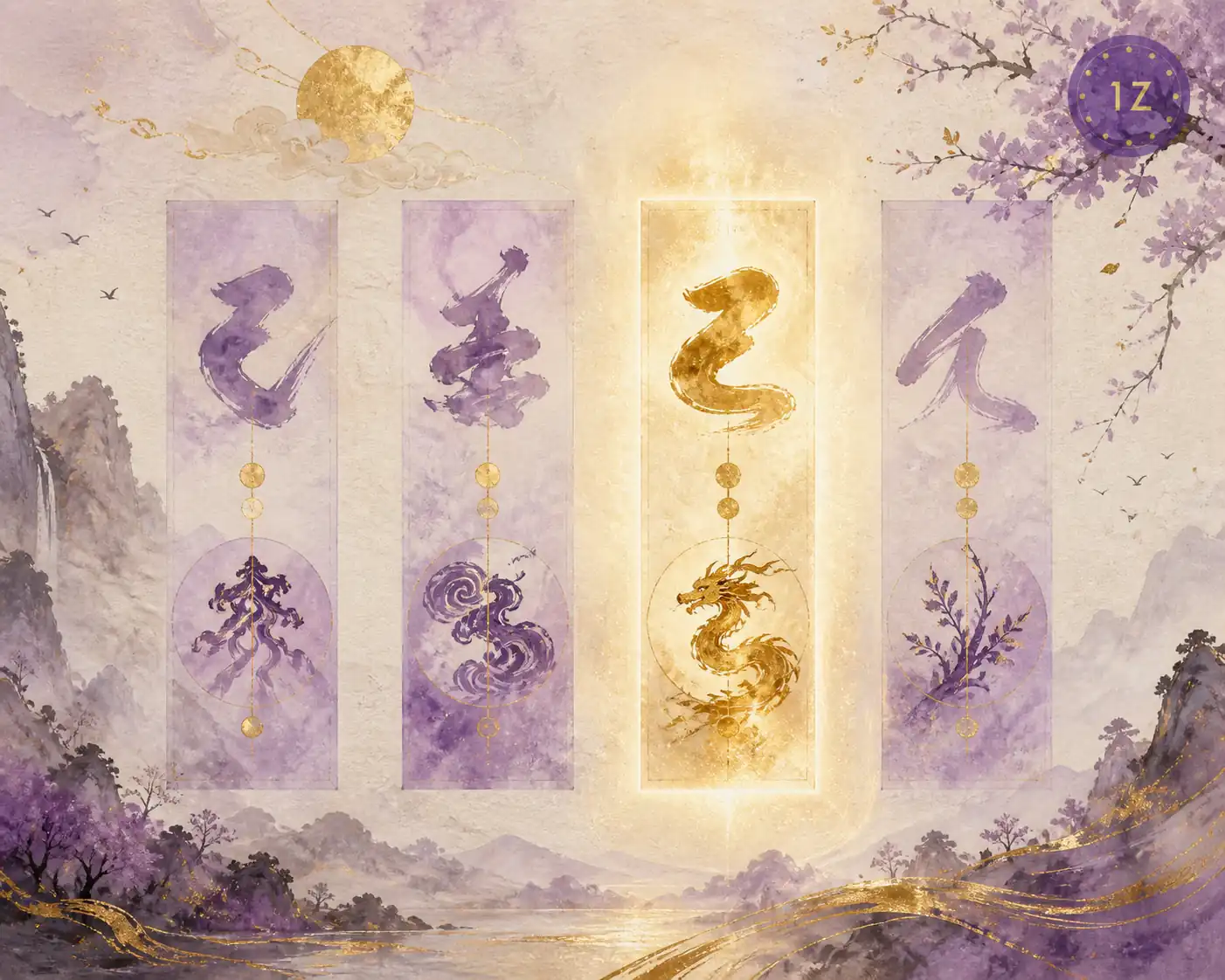
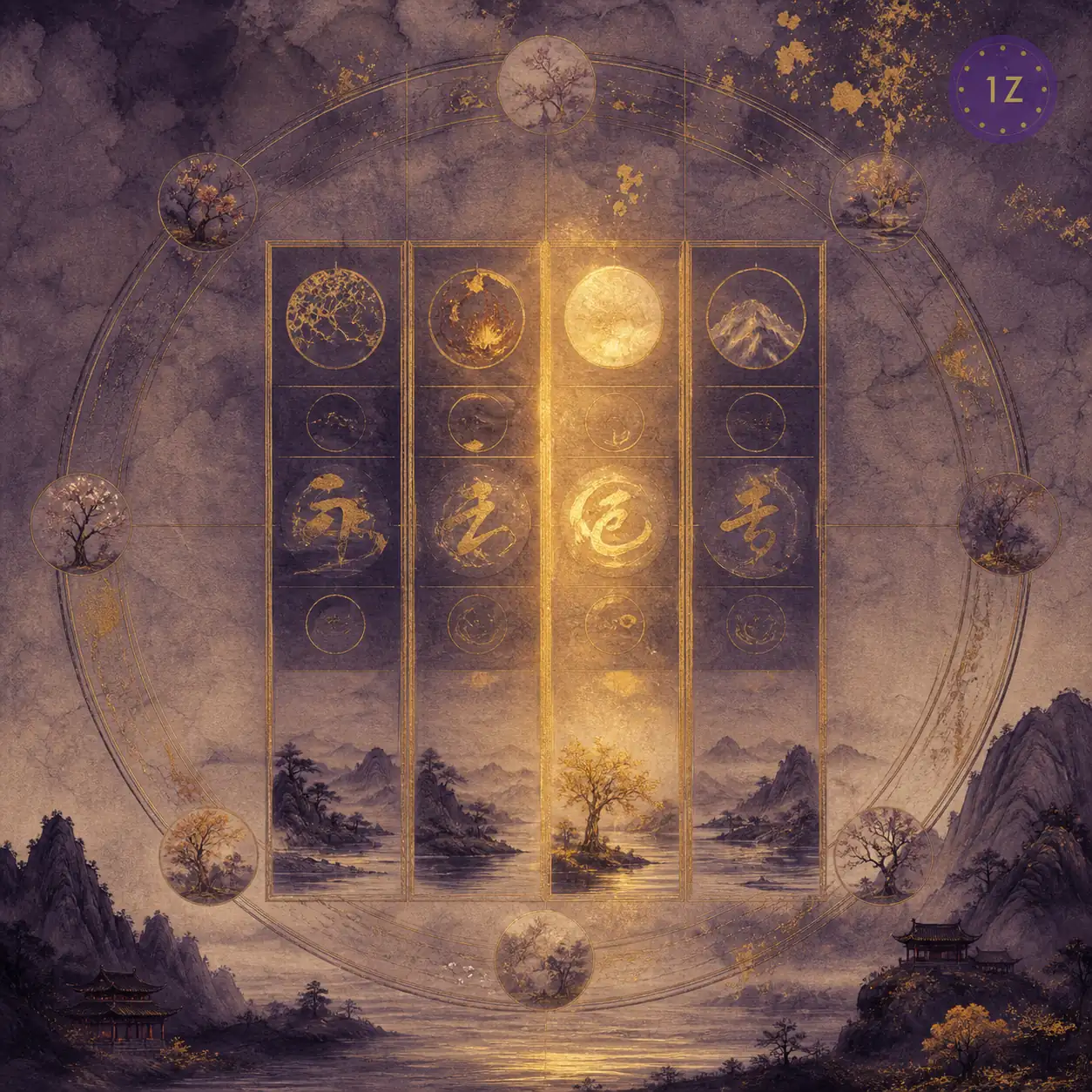
In a BaZi chart, four pillars correspond to your birth year, month, day, and hour. Each pillar contains one Heavenly Stem above and one Earthly Branch below. The Day Pillar is the third column, and its Heavenly Stem, called the Day Master (ri zhu, 日主), represents the person whose chart is being read. According to the Four Pillars of Destiny framework, the Day Master is “the most important element” because it serves as the reference point against which all other elements in the chart are interpreted.
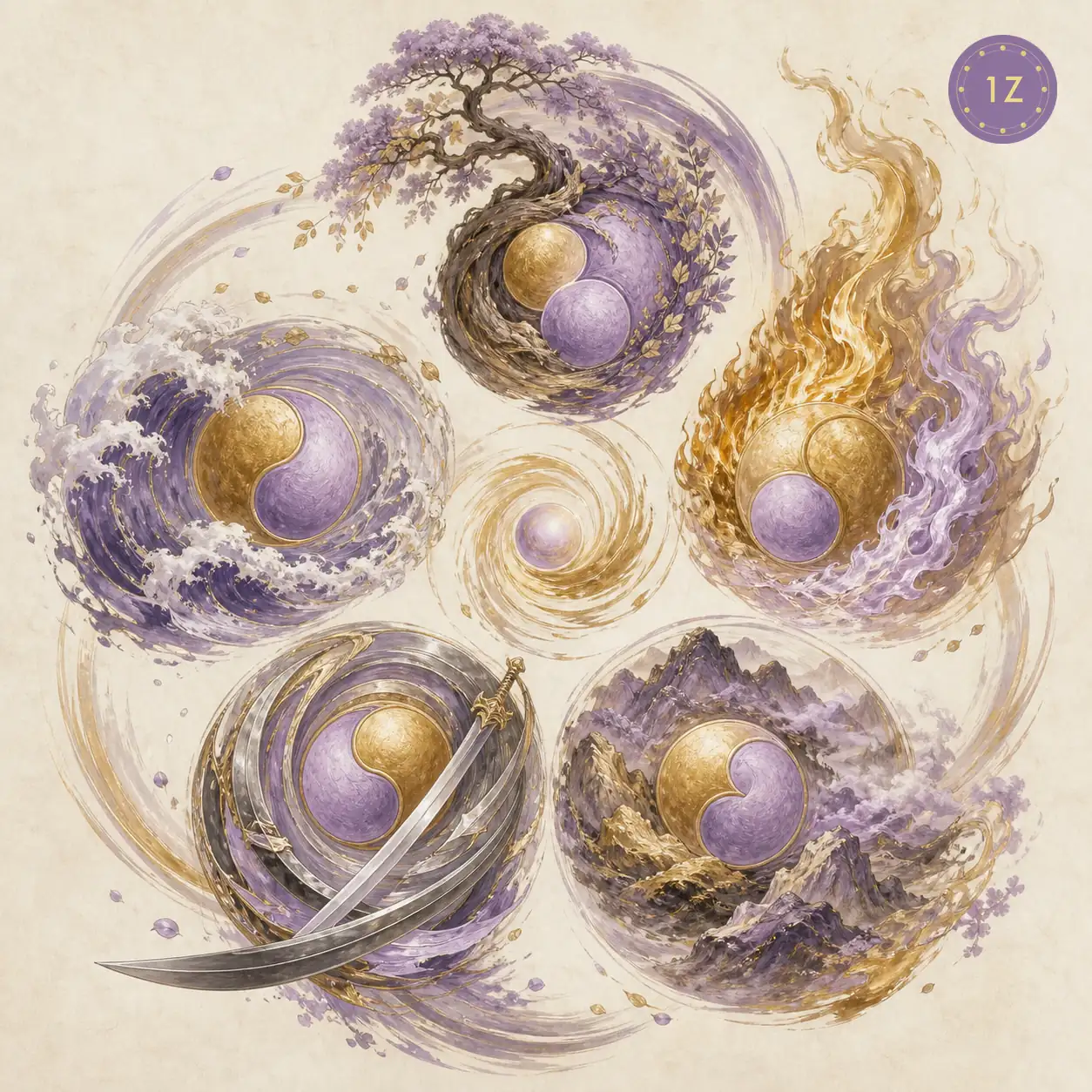
The ten Heavenly Stems divide into five element pairs, each with a yang (active) and yin (receptive) polarity:
| Element | Yang Stem | Yin Stem | Symbol |
|---|---|---|---|
| Wood | Jia (甲) | Yi (乙) | Tree / Grass |
| Fire | Bing (丙) | Ding (丁) | Sun / Candle |
| Earth | Wu (戊) | Ji (己) | Mountain / Soil |
| Metal | Geng (庚) | Xin (辛) | Axe / Jewelry |
| Water | Ren (壬) | Gui (癸) | Ocean / Rain |
A Bing Fire Day Master and a Ding Fire Day Master share the Fire element but differ fundamentally. Bing is the sun, blazing and visible. Ding is candlelight, intimate and illuminating. In Mei Lin Chen’s practice over the past 15 years, this yang-yin distinction proves more consequential than most beginners assume. A Ding Fire person guided clients through mediation with quiet precision. A Bing Fire person commanded attention the moment they entered a room. Same element, different expression.
The Day Master also differs from your zodiac year animal in an important way. Your year animal (say, a Dragon) describes the group characteristics shared by everyone born that year, as described in our Chinese zodiac signs guide. The Day Master is your individual elemental signature. Two people born in the same year can have completely different Day Masters. According to Britannica’s overview of Chinese astrology, the zodiac year animal is the most popular layer but not the most precise one for personal analysis. That precision comes from the Day Pillar.
How to Determine Your Day Master
Finding your Day Master requires your exact birth date, not just your birth year. The Day Pillar cycles through the 60 stem-branch combinations of the sexagenary cycle, advancing one position each solar day. This means the Day Master changes every single day, making it the most individualized pillar in your chart.
The process works in three steps:
- Convert your birth date to the solar term date. BaZi uses solar terms (jie qi, 节气), not the lunar calendar. A person born on February 3, 2024, falls before the solar term Li Chun (Start of Spring, typically February 4-5), so their BaZi year is still the Rabbit, not the Dragon. This boundary error accounts for roughly 35% of chart miscalculations among self-taught beginners.
- Look up the Day Pillar in the 60-cycle table. Each day in the 60-year cycle has a fixed stem-branch combination. Our zodiac year calculator handles this lookup using exact astronomical data from the Purple Mountain Observatory, the official calendar authority in China since 1928.
- Read the Heavenly Stem of the Day Pillar. That stem is your Day Master. If your Day Pillar is Bing Wu (丙午), your Day Master is Bing Fire. If your Day Pillar is Xin You (辛酉), your Day Master is Xin Metal.
All pillar calculations in our system use exact new moon times and solar term transitions, not approximate date ranges. The difference matters: lunar new year can fall anywhere between January 21 and February 20, and a one-day shift can change your Day Master entirely.
Day Master Strength: The Month Branch Decides
Once you know your Day Master, the next question is whether it is strong or weak. This is not a value judgment. A strong Day Master is not better than a weak one. They simply require different strategies.
The assessment follows a three-check method drawn from classical BaZi texts:
| Check | What it examines | Weight |
|---|---|---|
| Season (De Ling) | Does your month branch share or generate your Day Master element? | ~50% |
| Root (De Di) | Do your earthly branches contain hidden stems matching your Day Master? | ~30% |
| Support (De Shi) | Do your heavenly stems contain same-element or generating-element stems? | ~20% |
The month branch carries the heaviest weight because it represents the season of your birth. A Jia Wood Day Master born in Yin (Tiger) or Mao (Rabbit) month arrives during spring, when Wood energy peaks. That Day Master is seasonally strong. The same Jia Wood Day Master born in Shen (Monkey) month, when Metal chops Wood, is seasonally weakened.
The Seasonal Strength Matrix
| Day Master Element | Peak Months (旺/相 — Strong) | Weak Months (囚/死 — Weak) | Draining Months (休 — Moderate) |
|---|---|---|---|
| Wood (Jia/Yi) | Yin, Mao (旺 Spring); Hai, Zi (相 Water generates Wood) | Shen, You (死 Metal chops); Chen, Xu, Chou, Wei (囚 Wood controls Earth) | Si, Wu (休 Wood generates Fire) |
| Fire (Bing/Ding) | Si, Wu (旺 Summer); Yin, Mao (相 Wood generates Fire) | Hai, Zi (死 Water extinguishes); Shen, You (囚 Fire controls Metal) | Chen, Xu, Chou, Wei (休 Fire generates Earth) |
| Earth (Wu/Ji) | Chen, Xu, Chou, Wei (旺 Earth months); Si, Wu (相 Fire generates Earth) | Yin, Mao (死 Wood breaks Earth); Hai, Zi (囚 Earth controls Water) | Shen, You (休 Earth generates Metal) |
| Metal (Geng/Xin) | Shen, You (旺 Autumn); Chen, Xu, Chou, Wei (相 Earth generates Metal) | Si, Wu (死 Fire melts); Yin, Mao (囚 Metal controls Wood) | Hai, Zi (休 Metal generates Water) |
| Water (Ren/Gui) | Hai, Zi (旺 Winter); Shen, You (相 Metal generates Water) | Chen, Xu, Chou, Wei (死 Earth dams); Si, Wu (囚 Water controls Fire) | Yin, Mao (休 Water generates Wood) |
If your Day Master gains two or more of the three checks (Season, Root, Support), classical texts classify it as strong. Lose two or more, and it is weak. Gain one and lose one, and you are in the balanced zone, which requires examining the specific element distribution across all eight characters.
What most BaZi guides miss about borderline charts is the distinction between surface strength and structural strength. A Day Master with visible same-element support in the stems but no roots in the branches is “floating strong” (xu qiang, 虚强), which collapses under real pressure. Conversely, a Day Master that looks weak in the stems but has deep roots in the day branch is “hidden strong” (an qiang, 暗强), which holds steady through adversity.
What Strong and Weak Day Masters Mean in Practice
Strong and weak Day Masters correspond to fundamentally different life strategies. The distinction describes how much external pressure your chart can sustain before it becomes counterproductive.
The Favorable Element Decision Framework
| Day Master Type | Favorable Elements | Strategy | Risk |
|---|---|---|---|
| Strong | Output (drain), Wealth (consume), Officer (control) | Channel excess energy outward through productivity, financial goals, and structured challenges | Stubbornness, refusing help |
| Weak | Resource (nourish), Companion (support) | Seek mentorship, build partnerships, accumulate knowledge before acting | Overwhelm from premature ambition |
| Balanced | Seasonal adjustment element | Vary strategy by current luck pillar and annual elements | Indecision from lack of clear direction |
Drawing on over 15 years of BaZi practice, we use what we call the 30/50/20 framework for translating Day Master strength into actionable guidance: roughly 30% of your outcomes depend on timing (luck pillars and annual elements), 50% on your base chart structure (which includes Day Master strength and Favorable Elements), and 20% on personal effort and environmental choices. This framework helps clients understand why the same chart produces different results at different life stages.
A practical illustration: a 1961 Metal Ox client, a manufacturing executive, experienced a cardiac warning at 50 after years of relentless overwork. His Xin Metal Day Master sat in Chou (Ox) month, where Earth generates Metal continuously. The chart was a self-reinforcing loop. Earth feeds Metal, Metal drives discipline, the engine never stops. Recovery required activating his chart’s missing Water element. He reduced his workload by 30% and added structured rest. Revenue grew during his recovery year.
The pattern that emerges from cases like this is that Day Master strength without element balance creates blind spots. Strong charts can carry more external pressure, but they also resist the elements that would create equilibrium.
The Ten Day Masters: A Quick Reference
Each of the ten Day Master stems carries distinct characteristics shaped by its element and polarity. The following table summarizes the core expression of each:
| Day Master | Element | Core Expression | Strength When | Challenge When |
|---|---|---|---|---|
| Jia (甲) | Yang Wood | Resilient, principled, grows slowly but persistently | Born in spring, supported by Water | Born in autumn, choked by Metal |
| Yi (乙) | Yin Wood | Adaptable, networked, thrives through connection | Born in spring, supported by Water | Born in autumn, pruned by Metal |
| Bing (丙) | Yang Fire | Radiant, visible, natural leader | Born in summer, fueled by Wood | Born in winter, extinguished by Water |
| Ding (丁) | Yin Fire | Illuminating, guiding, precise warmth | Born in summer, fueled by Wood | Born in winter, smothered by Water |
| Wu (戊) | Yang Earth | Solid, dependable, mountain-like | Born in transitional months | Drained by excessive Water or Wood |
| Ji (己) | Yin Earth | Nurturing, absorptive, cultivated soil | Born in transitional months | Washed away by Water or overgrown |
| Geng (庚) | Yang Metal | Sharp, decisive, executes with force | Born in autumn, tempered by Fire | Born in spring, dulled by Wood |
| Xin (辛) | Yin Metal | Refined, sensitive, values precision | Born in autumn, refined by Fire | Born in spring, bent by Wood |
| Ren (壬) | Yang Water | Powerful, dynamic, flows with momentum | Born in winter, channeled by Earth | Born in summer, evaporated by Fire |
| Gui (癸) | Yin Water | Gentle, intuitive, nourishes quietly | Born in winter, channeled by Earth | Born in summer, dried by Fire |
The yang-yin distinction within each element pair is not cosmetic. Ding Fire (丁) is candlelight, not wildfire. It illuminates and guides rather than burns and consumes. In practice, Ding Fire people thrive in roles requiring precision and focused warmth, such as mediation or therapeutic work. Bing Fire (丙) people command visibility and naturally fill public-facing roles. A Ding Fire lawyer who transitioned into counseling discovered she could hold legal rationality and intuitive depth simultaneously.
Xin Metal (辛) differs sharply from Geng Metal (庚). Geng is the axe. Xin is jewelry metal, refined and sensitive to environment. Xin Metal Day Masters often absorb atmospheric energy in crowded spaces, which is why managing this sensitivity requires understanding which hours amplify versus soothe their Metal energy.
Day Master vs. Zodiac Year Animal: Which Matters More?
A common question from readers familiar with Chinese zodiac is whether the year animal or the Day Master takes priority. The answer depends on what you are analyzing.
Your zodiac year animal describes the generational group you belong to. Every Dragon-year native shares the Chen branch and its Earth element. This layer captures broad, cohort-level tendencies. Your Day Master describes your individual elemental identity, and it changes every single day. The gap between these two layers is not incremental. It is structural: the year animal groups millions of people together, while the Day Master narrows to one of ten stems cycling daily.
For personality and core identity analysis, the Day Master carries more weight. For annual fortune, both the year branch (Tai Sui interaction) and the Day Master (favorable element check) matter equally. For relationship compatibility, our methodology weighs the Day Pillar roughly 3 times more heavily than the Year Branch because the Day Pillar captures the self and spouse palace directly.
Can your Day Master change during your lifetime?
Your birth Day Master never changes because it is fixed by your birth date. What changes are the Heavenly Stems and Earthly Branches arriving in your luck pillars (Da Yun) and annual pillars. Every 10-year luck period and every calendar year brings its own stem-branch combination, which interacts with your natal Day Master through Five Element relationships. If your natal Day Master is Jia Wood and your current 10-year luck pillar is Geng Metal, that Geng Metal acts as a “Seven Killings” influence against your Day Master, creating pressure, challenge, and growth opportunities. The interaction between your fixed natal Day Master and these moving pillars drives the timing of life events, not a change in the Day Master itself.
How is Day Master strength different from Western astrology chart rulers?
The Day Master and the Western astrological chart ruler serve conceptually similar roles as the “primary significator” of the chart, but they operate on different logics. The Western chart ruler is the planet that rules your Ascendant sign, determined by the exact time and geographic location of birth. The Day Master is the Heavenly Stem of your birth day, determined by the solar calendar date with no time-of-day dependency for the stem itself (though the hour pillar does shift). The Day Master system uses Five Element generation and control cycles to assess strength and compatibility, while Western astrology uses aspect angles and house placements. Both systems identify a “core self” signature, but the Day Master’s strength classification (strong, weak, balanced) has no direct Western equivalent because it depends on seasonal timing in a way the Western system does not track.
How should a strong Day Master native navigate a year that clashes with their element?
A strong Day Master encountering a year that clashes with its core element needs a different strategy than a weak one would use. If your Day Master is Jia Wood (strong) and the year brings Geng Metal (Seven Killings), the clash is direct and forceful. Instead of seeking more support, which a strong chart already has in excess, the correct response is to channel the pressure productively through Output elements (creativity, expression, teaching) or Wealth elements (financial projects that demand focused execution). The 2026 Fire Horse year (Bing Wu) is particularly intense for strong Metal Day Masters, since Fire melts Metal. Historical pattern analysis across our 78 compatibility pairings shows that strong-Day-Master natives who proactively redirect clashing energy into structured projects report measurably better outcomes than those who retreat. The practical move: front-load your demanding projects into favorable months within the challenging year, and use the clashing periods for planning rather than launching.
Can two people with the same zodiac year have opposite Day Master strengths?
Yes, and this is one of the most misunderstood aspects of BaZi. Two people born in the same zodiac year, even on the same day, can have completely different Day Master strength profiles depending on their month branch and hour pillar. Consider two Dragon-year natives born on the same calendar day but at different hours: one born at 8 AM (Chen hour) and another at noon (Wu hour). Their Day Pillar Heavenly Stem is identical, but their hour branch differs, which shifts the element distribution across their charts. The Chen-hour native has Earth-to-Earth support that strengthens an Earth Day Master, while the Wu-hour native receives Fire generating Earth, which actually also strengthens the Earth Day Master rather than draining it. A more revealing comparison would be a Shen-hour (Metal) native, where Metal drains Earth through the generation cycle (Earth generates Metal, depleting Earth). This is why generic zodiac-year horoscopes that apply one prediction to all Dragon natives cannot capture the individual variation that a Day Master analysis reveals.
Conclusion
Your Day Master is the single most important element in your BaZi chart, the reference point that defines your core elemental identity and determines how every other element in your chart is interpreted. To discover your exact Day Master and Favorable Elements, try our free BaZi calculator built on Purple Mountain Observatory calendar data and reviewed by BaZi practitioner Mei Lin Chen.
Sources
- Four Pillars of Destiny – Wikipedia: Day Master definition, Ten Gods framework, Heavenly Stems table
- Heavenly Stems – Wikipedia: Ten stems element and yin-yang assignments
- Purple Mountain Observatory: Official lunar calendar authority for Chinese calendrical calculations since 1928