
On a Geng day, the Monkey hour carries exactly one hour pillar: Jia Shen (甲申), pairing number 21 of the sexagenary cycle’s 60 pairings, in force from 15:00 to 17:00. The Five Rats rule (五鼠遁, the count that turns a day stem into hour stems) opens every Geng day at Bing Zi and walks eight steps to reach it. Below sit that count, the twelve-hour table, and the star reading Jia brings to a birth chart.

Key Takeaways
- The answer: a Geng day’s Shen hour pillar is Jia Shen (甲申), sexagenary pairing number 21.
- The route: a Geng day opens at Bing Zi (丙子), and stem and branch advance eight steps together to the Monkey hour.
- Two roads reach this pillar: a Geng year arrives at Jia Shen through the Five Tigers month count, a Geng day through the Five Rats hour count.
- The reading: the Jia stem arrives as Indirect Wealth (偏财) for a Geng Day Master, and the Shen branch is the Day Master’s own Lu seat.
- The edges: births before 15:00 read the Goat hour, from 17:00 the Rooster hour, and the 23:00 rollover changes the counting anchor itself.
One Jia Shen Pillar, Two Roads In: the Hour Route on a Geng Day Birth Chart
The hour pillar is the fourth of the four pillars, and its branch comes from the clock: the Monkey branch owns the window from 15:00 to 17:00, the ninth of the day’s 12 hour windows. Its stem comes from the day stem through the Five Rats rule, a place no clock shows. A Geng day fixes Bing Zi at the Rat hour, and the walk from there is fixed arithmetic.
Two classical roads lead to this one pillar, and they are worth lining up side by side.
| Five Tigers road (month pillar) | Five Rats road (hour pillar) | |
|---|---|---|
| Builds from | the year stem | the day stem |
| A Geng chart opens at | Wu Yin (戊寅), month 1 | Bing Zi (丙子), hour 1 |
| Reaches Shen as | the seventh month | the ninth hour |
| Landing | Jia Shen (甲申), pairing 21 | Jia Shen (甲申), pairing 21 |
Both mnemonics pair Yi with Geng, and both counts walk the branches toward Shen; different anchors and different distances, one identical landing. The Five Tigers month route for a Geng year is the one our Geng-year Shen-month walkthrough follows step by step.
That agreement doubles as an audit: if a chart’s month and hour pillars disagree about Jia Shen, one count was copied wrong. For most Metal natives, the surprise is arithmetic: eight small steps instead of a memorized list. If you carry a Jia Shen hour, that count is your fastest self-check, and the Monkey’s place among the twelve branches sits on our Chinese zodiac hub.
From Bing Zi to Jia Shen: the Five Rats Count on a Geng Day
The count starts at midnight, where the Rat window from 23:00 to 01:00 opens every day’s hour sequence. The Five Rats rule hands a Geng day the stem Bing there, setting Bing Zi (丙子), sexagenary pairing number 13. From that anchor the two counters move in lockstep, the stem one of ten positions per hour, the branch one of twelve.
Eight steps later both arrive together, past Ding Chou, Wu Yin, Ji Mao, Geng Chen, Xin Si, Ren Wu, and Gui Wei, and the ninth window takes Jia: eight stem-steps, eight branch-steps, one pillar, the same output a deterministic lookup returns.
I tell Geng-day clients to treat the hour stem like a signature: small, last, and the one character no clock face will ever show you. The gap between a counted hour stem and a remembered one is not philosophy; it is arithmetic. Count it once and the pillar never needs memory again.
The Twelve Hour Pillars of a Geng Day on Any Birth Chart
Here is the whole day, row by row, each pillar returned by the deterministic lookup; the Monkey row is the answer, the other eleven its neighbors.
| Clock window | Branch (animal) | Hour pillar |
|---|---|---|
| 23:00-01:00 | Zi (Rat) | Bing Zi (丙子) |
| 01:00-03:00 | Chou (Ox) | Ding Chou (丁丑) |
| 03:00-05:00 | Yin (Tiger) | Wu Yin (戊寅) |
| 05:00-07:00 | Mao (Rabbit) | Ji Mao (己卯) |
| 07:00-09:00 | Chen (Dragon) | Geng Chen (庚辰) |
| 09:00-11:00 | Si (Snake) | Xin Si (辛巳) |
| 11:00-13:00 | Wu (Horse) | Ren Wu (壬午) |
| 13:00-15:00 | Wei (Goat) | Gui Wei (癸未) |
| 15:00-17:00 | Shen (Monkey) | Jia Shen (甲申) |
| 17:00-19:00 | You (Rooster) | Yi You (乙酉) |
| 19:00-21:00 | Xu (Dog) | Bing Xu (丙戌) |
| 21:00-23:00 | Hai (Pig) | Ding Hai (丁亥) |
The stem column repeats the count: Bing, Ding, Wu, Ji, Geng, Xin, Ren, Gui, then Jia at the Shen row. The pairings are consecutive rungs of the sixty-pair ladder, rung 13 down to rung 24, so whatever your birth chart holds elsewhere, the hour row above is already settled.
The Hour Pillar’s Meaning on a Geng Day Birth Chart: Wealth Star, Lu Seat, Fruit Palace
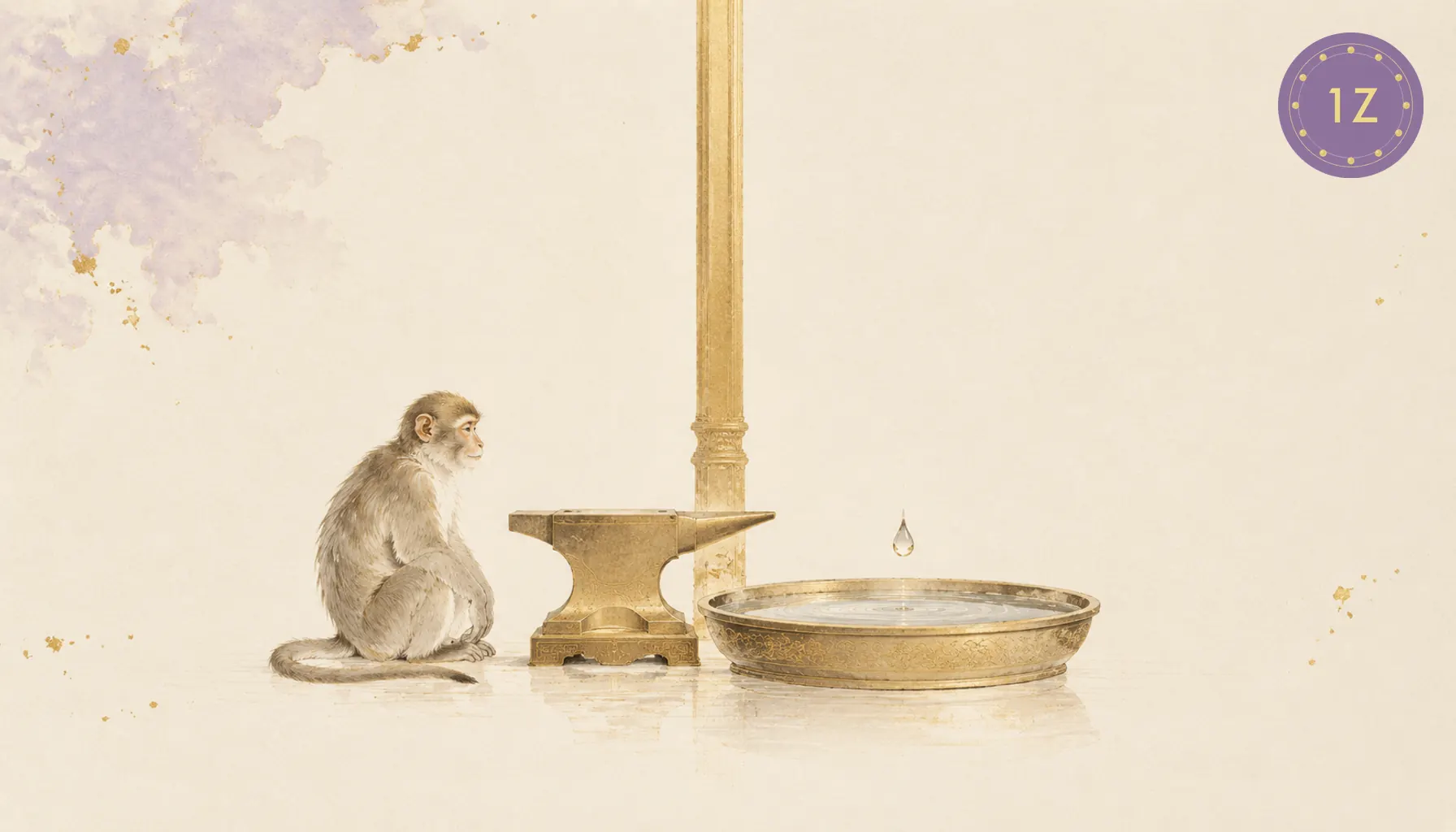
Inside a full chart the hour column is the fruit seat of the four-pillar plant, root, seedling, flower, fruit, and it carries the children, the later years, and the private circle from about age 49 onward.
For a Geng Day Master, the Heavenly Stem of the day pillar, the Jia hour stem arrives as the Wealth star. Metal controls Wood, and same-polarity Wealth reads as Indirect Wealth (偏财), the lookup’s exact output for Geng seeing Jia. Classically the star colors enterprise, windfalls, and openings rather than one salaried pot. The branch adds its own fact: the twelve-stage table places Geng’s Lu seat (临官, the Official-rank stage) at Shen, the Day Master’s own ranked ground in this hour. Whether that pairing matures is a whole-chart question, which a two-character pillar never answers alone.
Two table labels attach to the stem itself. Jia sits at its Extinction seat on Shen in the twelve-stage arc, and stage names locate a stem on a fixed circuit, grading position rather than fortune. That said, the star is worth reading first and the stage label second, because Extinction frightens readers who have never seen that arc. The nayin label, the pillar’s poetic element name, is Well Water (泉中水), a Water name over a branch whose Metal generates Water. Shen’s own profile reads like a workshop: Geng Metal as main qi, Ren Water as middle qi, Wu Earth as residual qi, an anvil with its own quenching trough.
The branch also carries its two fixed relationships. Shen sits directly across the wheel from Yin, the Tiger’s branch, one of the six clash pairs. On a Geng day, the Monkey hour and the Tiger hour (Wu Yin, 03:00 to 05:00) therefore stand in permanent opposition. Across our 78-pair dataset every animal holds exactly one secret friend and exactly one clash partner, and Shen’s friend is Si, the Snake: that bond scores 94 out of 100 under our scoring framework, read in full on the Snake-Monkey pair page. Our methodology page documents the framework behind the number. On a Geng day the friend hour is Xin Si, 09:00 to 11:00.
One client of mine, a 1980 Metal Monkey, lived the branch’s signature: four companies founded, four handed to new owners, a practice now spent mentoring the founders who followed. I read that record as the Indirect Wealth pattern in motion, and still one layer of what a whole chart would say.
Clock Edges on a Geng Day Birth Chart: 15:00 and 17:00
The Monkey window runs from 15:00 to 17:00 sharp, and the pillar flips on both edges. A birth at 14:59 still reads the Goat hour, Gui Wei (癸未); from 15:00 the pillar reads Jia Shen; from 17:00 the Rooster hour, Yi You (乙酉), takes over. Windows 2 hours wide tile the clock 12 times over, without gaps.
Edge minutes deserve the most respect in the whole lookup: hospital clocks round, family memory rounds further, and a birth recorded as just after three may not be. If your birth sits near either edge, I run both windows through the calculator and let the recorded time decide.
Is the Jia Shen hour pillar the same as the Jia Shen month pillar in a Geng year, and why do both rules agree?
The same Jia Shen pairing arrives by two roads: the month pillar in a Geng year through the Five Tigers count, the hour pillar on a Geng day through the Five Rats count. Both classical rules pair Yi with Geng, and any Yi day runs the identical hour count, so the agreement is structural rather than accidental. The anchors differ, Wu Yin for the month road and Bing Zi for the hour road, and so do the distances, six branch-steps from Yin against eight from Zi, yet both walks land Jia on Shen. The rules stay independent too: on a Jia or Ji day the Shen hour comes out Ren Shen (壬申), the lookup’s own row for that day stem, while the table on this page answers the Geng day in question.
If the clock reads 23:40 on a Geng day, which hour pillar applies and why?
A 23:40 birth on a Geng day is not a Monkey hour question, because the clock left the Shen window more than six hours earlier. The hour in play is the late Zi window (夜子时), 23:00 to 24:00. Schools differ on how its stem attaches: one reading gives late Zi the next day’s anchor, another keeps the current day’s. The early Zi window, 00:00 to 01:00, is the uncontroversial one, and a 00:30 birth on a Geng day reads Bing Zi (丙子) from the same day’s count. Either way, 23:40 never returns Jia Shen; the Monkey window had closed by 17:00, and the day boundary needs settling before any hour pillar is written.
How do I find the Yi Gui Noble and Wen Chang hours on a Geng day?
The Yi Gui Noble (天乙贵人) and the Wen Chang Scholar Star (文昌) park in three windows of a Geng day, straight from the classical tables. For a Geng-stem Day Master, the Yi Gui Noble sits at the Ox and Goat branches (Chou-Wei), which puts it in the Ding Chou hour, 01:00 to 03:00, and the Gui Wei hour, 13:00 to 15:00. The Wen Chang Scholar Star sits at the Pig (Hai), so the Ding Hai hour, 21:00 to 23:00, carries the scholar’s placement; classically it marks the Lu, the official seat, of the day stem’s Eating God, and Geng’s Eating God is Ren, whose Lu sits at Hai. Stars of this class shade how a chapter tends to feel, they do not schedule events, and your own Shen hour needs no borrowed star to matter.
Sources
Four Pillars of Destiny, Wikipedia: the four-pillar framework.
Ba Zi Hour Pillar, Wikibooks: the day-stem to hour-stem tables mirroring the table above.
Chinese Text Project: the open library holding the classical texts behind the hour rule’s mnemonic.
Conclusion
Count the eight steps once and the pillar never needs memory again: a Geng day opens at Bing Zi, the Monkey hour lands at Jia Shen, and the table above settles every window in between. To see the hour column inside your own four pillars, run the 12Zodiacs BaZi calculator and read the hour row against this table.