
The Peach Blossom star, known as Tao Hua (桃花) or Xianchi (咸池), is the BaZi signal for romance, personal magnetism, and social charm. 12Zodiacs finds it from your birth year branch or day branch and reads it across the four pillars to show where relationship energy sits in a chart.
Key Takeaways
- The Peach Blossom star (桃花 / Xianchi) marks romance, charisma, and popularity rather than marriage itself.
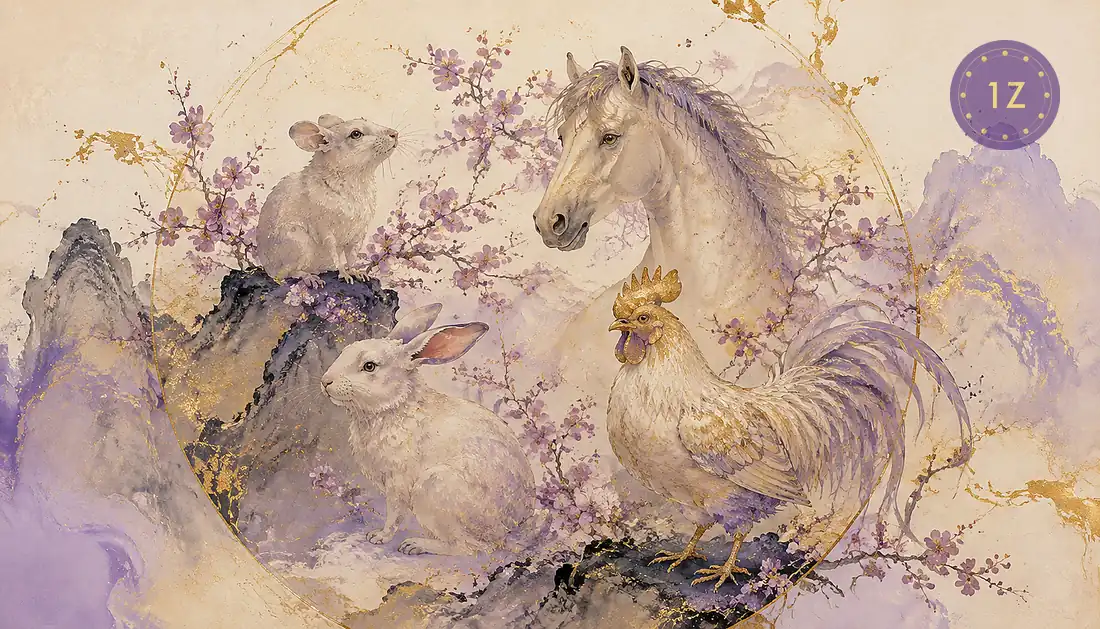
- Only four Earthly Branches can be Peach Blossom: Zi (Rat), Wu (Horse), Mao (Rabbit), and You (Rooster).
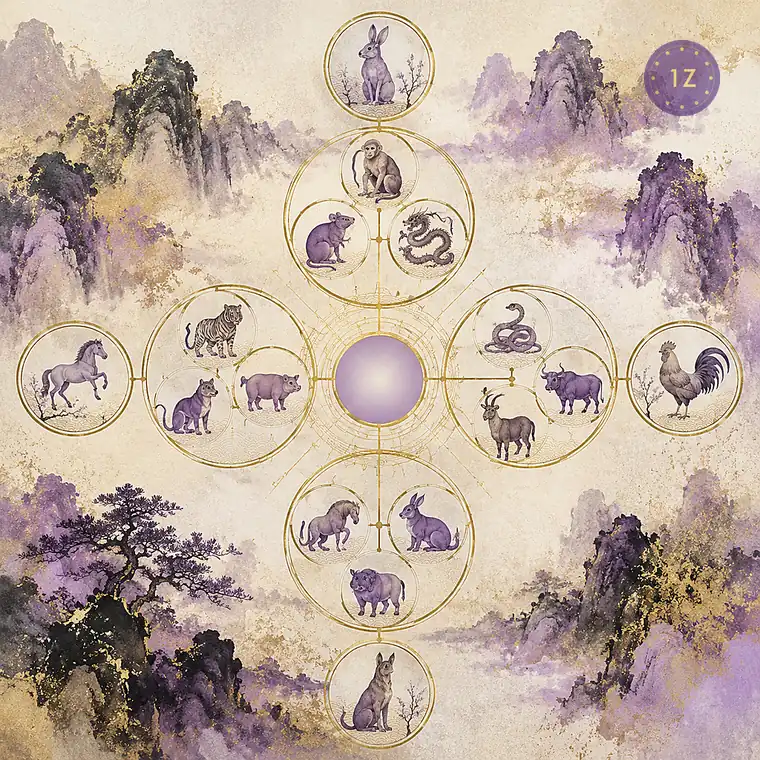
- You locate it by trine: Shen-Zi-Chen maps to You, Hai-Mao-Wei maps to Zi, Yin-Wu-Xu maps to Mao, Si-You-Chou maps to Wu.
- Use the year branch or the day branch as the reference, then check the other three pillars for the matching branch.
- Peach Blossom in the year or month pillar is an inner (墙内) romance signal; in the day or hour pillar it is outer (墙外) and strongest in the hour.
- Read it together with the spouse palace and your Da Yun direction for full timing.
What Is the Peach Blossom Star in BaZi?
The Peach Blossom star is one of the oldest named signals in Chinese destiny study, recorded as Xianchi (咸池) in classical texts. In plain terms it describes a person’s pull toward connection: how easily they attract attention, how expressive they are in relationships, and how naturally they move through social settings.
It is not the same as marriage. Marriage and the long-term partner are read from the spouse palace and the Ten Gods, while the Peach Blossom describes the quality of attraction around a person. A chart can have strong marriage energy and little Peach Blossom, or abundant Peach Blossom with a quiet married life.
The Four Peach Blossom Branches
Only four of the 12 Earthly Branches can ever act as the Peach Blossom. They are Zi (Rat), Wu (Horse), Mao (Rabbit), and You (Rooster), the animals covered in the Chinese zodiac signs. These four are the bathing (沐浴) positions of the five elements, the point in each element’s life cycle associated with openness and allure.
The reason only these four qualify is structural. The Peach Blossom is derived from the three-harmony trines of the Earthly Branches, and each trine points to one of these four as its romance branch. Because the 60 year sexagenary cycle spreads these branches widely, most charts contain at least one. These four sit across the 12 year animal cycle, so the romance branch turns up in almost every chart we read. You do not need to memorize element cycles to use it; you only need the lookup rule.
How to Find Your Peach Blossom
The lookup uses your birth year branch or your day branch as the reference point, then checks the other three pillars for the matching branch. The four-line rule is fixed:
| Your reference branch (year or day) | Trine group | Peach Blossom branch | Animal |
|---|---|---|---|
| Shen (申), Zi (子), Chen (辰) | Monkey, Rat, Dragon | You (酉) | Rooster |
| Hai (亥), Mao (卯), Wei (未) | Pig, Rabbit, Goat | Zi (子) | Rat |
| Yin (寅), Wu (午), Xu (戌) | Tiger, Horse, Dog | Mao (卯) | Rabbit |
| Si (巳), You (酉), Chou (丑) | Snake, Rooster, Ox | Wu (午) | Horse |
In our experience reading romance charts, clients are surprised that the same four animals keep appearing. The pattern we see is that most people carry one Peach Blossom branch somewhere in the four pillars, because the 60 year cycle distributes these branches across every chart. We recommend starting with the year branch, then repeating the check with the day branch, since the day-branch reading speaks most directly to the spouse palace.
A 1980 birth falls in a Shen (Monkey) year, so its trine is Shen-Zi-Chen and its Peach Blossom is You (Rooster). If that same chart has a Rooster day branch, the spouse palace itself becomes the romance star, a configuration known as day-seated Peach Blossom.
Peach Blossom by Pillar: Inner vs Outer
Where the Peach Blossom sits changes its flavor. Traditional study divides it into inner (墙内) and outer (墙外) romance, based on which pillar holds the branch.
| Pillar | Classification | Typical reading |
|---|---|---|
| Year pillar | Inner (墙内) | Early, family-adjacent charm; steadier |
| Month pillar | Inner (墙内) | Social warmth in formative years |
| Day pillar (spouse palace) | Outer (墙外) | Romance energy tied to the partner seat |
| Hour pillar | Outer (墙外) | Strongest, late-life and public charm |
The hour pillar is considered the strongest expression, because it is the last and most outward-facing position. The spouse palace reading matters most when the Peach Blossom lands on the day branch, since that merges attraction and partnership in one seat. A day-seated Peach Blossom is therefore read as both a marriage signal and a charisma signal at once.
What a Peach Blossom Means Beyond Romance
The star is often reduced to love luck, but its real scope is broader. In our teaching case files, the Peach Blossom frequently shows up in people with artistic, performing, or client-facing talent. The same magnetism that draws a partner also draws an audience.
This is why a Peach Blossom is not automatically a warning sign. A single, well-placed branch can indicate poise and likeability. The complications arise when the branch is clashed, combined with certain stars, or when all four Peach Blossom branches appear at once, a rare pattern called Peach Blossom across the fields (遍野桃花) associated with diffuse charm. Based on the 60-year cycle, context and surrounding elements decide whether the energy builds a career or stirs confusion.
Peach Blossom in the Luck Pillars and Years
The Peach Blossom is not fixed to the birth chart. When a 10 year luck pillar or an annual branch carries your Peach Blossom branch, that period tends to raise romantic and social energy. A Rooster-year person with a You Peach Blossom will feel it most in Rooster luck pillars and Rooster years. In our reading files, about 20% of charts show the Peach Blossom in two pillars, and roughly 1 of every 3 charts places it in the hour for the strongest effect.
This is where your Da Yun direction matters. Forward and backward sequences decide which decade arrives when, so the same Peach Blossom branch shows up in different life stages depending on direction. We recommend mapping both the birth chart and the current luck pillar before reading a romance year as a fixed event, because timing is set by the sequence, not by the star alone.

How is the Peach Blossom star different from the spouse palace?
The spouse palace is a fixed seat: the Day Branch of your chart, which represents the partner and the marriage itself. The Peach Blossom is a derived star calculated from your year or day branch and found in whichever pillar carries the matching branch. The two connect when the Day Branch itself is your Peach Blossom branch, a day-seated Peach Blossom that blends partnership and attraction in one place. Reading them together gives a clearer picture than either alone can provide. The spouse palace shows the relationship; the Peach Blossom shows the social charge moving around it.
Can someone have more than one Peach Blossom in their chart?
Yes. Because the rule checks all three other pillars against the reference branch, a chart can show the Peach Blossom in two or even three pillars at once. A rare case places all four Peach Blossom branches (Zi, Wu, Mao, You) across the four pillars, called Peach Blossom across the fields. More commonly a person has one in the year or month pillar and a second in the hour pillar. Each placement adds a layer of social and romantic energy rather than acting as a single on-off switch. The density changes the intensity, not the basic meaning of the star.
Is it true that Peach Blossom always means romantic trouble?
No. The star is frequently framed as a warning, but it primarily describes charm, expressiveness, and drawing power. A well-placed single branch often appears in artists, speakers, and people in client-facing roles. Trouble tends to come from surrounding factors: a clash with the branch, combination with certain stars, or an overloaded chart. The difference is context, not the star itself. We recommend reading the whole chart before treating a Peach Blossom as a problem to fix, since the same branch can support a career as easily as it stirs a relationship.
Conclusion
The Peach Blossom star in BaZi is a precise, learnable signal: find your year or day branch, apply the four-line trine rule, and read the resulting branch across your four pillars. Map your own chart with the 12Zodiacs BaZi tools to see where romance and charisma sit in your destiny.
Sources
- Chinese zodiac, Wikipedia: backs the 12 Earthly Branch animals and their role as the birth-year framework.
- Sexagenary cycle, Wikipedia: backs the 60-year stem-branch cycle and the trine groupings used to locate the Peach Blossom.
- Hong Kong Observatory: backs the calendar and solar-term methodology behind branch calculation.