
The spouse palace in BaZi is the Earthly Branch sitting directly beneath your Day Master, the lower half of your Day Pillar. It is the single most specific seat for reading a partner’s character and the texture of a marriage, which is why 12Zodiacs treats it as the primary marriage indicator in every chart.

Key Takeaways
- The spouse palace is the Day Branch (日支), the Earthly Branch beneath your Day Master in the Day Pillar.
- It reveals a partner’s traits and relationship patterns, not just whether two signs match.
- The Day Branch interacts with the Month Pillar, 10-year luck pillars, and annual branches.
- A clashed or combined spouse palace changes how partnership shows up, not whether it succeeds.
- Read it together with the zodiac year branch for the complete relationship picture.
What Is the Spouse Palace in BaZi?
The spouse palace (配偶宫, Pei Ou Gong) is the Earthly Branch of your Day Pillar, the character positioned directly under your Day Master. In a four-pillar chart the Day Pillar represents the self: the upper stem is the Day Master (日主), and the lower branch is the spouse palace. Every one of the 12 Earthly Branches can occupy this seat within the 60-term sexagenary cycle, a 60 year loop, and each carries a distinct signature for partnership.
A simple way to locate it is to take your birth date, find the Day Pillar, and read the branch underneath. That branch is the spouse palace. The Day Master shows how you meet the world, while the spouse palace shows who sits closest to you at home.
How the Spouse Palace Sits in Your Four Pillars
The Day Pillar is the third of the four pillars, placed after the Year, Month, and before the Hour. The spouse palace gains meaning from its relationships with the other three pillars. The Month Pillar acts as the family and environment filter. The Hour Pillar shows the late-life expression of the union. The Year Pillar sets the broad cultural and generational frame.
In our experience reading marriage charts, the Day Branch is read before any other factor when a client asks about marriage. The reason is structural: the Day Master and its spouse palace form a single pillar, so the two characters constantly influence each other. A strong Day Master can hold a difficult spouse palace with composure, while a weak Day Master feels the same configuration more acutely. This layered reading is what separates a BaZi marriage analysis from a simple zodiac match.
What the Spouse Palace Reveals About a Partner
The Ten Gods (十神) seated in the spouse palace describe the partner’s temperament. Each of the 8 Ten Gods maps to a recognizable dynamic. The table below shows the most common readings.
| Ten God in spouse palace | Partner trait signal |
|---|---|
| Direct Officer (正官) | Steady, principled, conventional |
| Seven Killings (七杀) | Driven, intense, commanding |
| Direct Wealth (正财) | Practical, resourceful, grounded |
| Indirect Wealth (偏财) | Charming, opportunistic, social |
| Food God (食神) | Nurturing, easygoing, expressive |
| Hurting Officer (伤官) | Sharp, independent, unconventional |
| Companion (比肩) | Equal, peer-like, independent |
| Rob Wealth (劫财) | Competitive, passionate, volatile |
The Earthly Branch itself adds texture. A spouse palace in Zi (子) often points to a perceptive, fluid partner. A palace in Wu (午) points to a warm, expressive one. A palace in You (酉) points to someone attentive to appearance and detail. These are starting points, not verdicts. The clearest signal comes from combining the branch with its Ten God.
How Branch Interactions Reshape the Spouse Palace
The spouse palace does not sit in isolation. When another branch in the chart, a 10-year luck pillar, or an annual branch forms a Six Clash or Six Harmony with the Day Branch, the marriage seat is activated or tested.
| Interaction | Example pair | Effect on spouse palace |
|---|---|---|
| Six Clash (六冲) | Zi ↔ Wu, Chou ↔ Wei | Tension, change, external pressure |
| Six Harmony (六合) | Zi ↔ Chou, Yin ↔ Hai | Support, attraction, merger |
| Three Harmony (三合) | The 4 trines | Amplification of the branch nature |
What stands out in the 78-pair data is that a clashed spouse palace rarely ends a relationship on its own. The pattern we see across marriage cases is that clash years surface what was already present, while harmony years let it consolidate. Metal controls Wood and Water controls Fire, so a clashing branch of the controlling element presses the palace hardest.
Spouse Palace vs the Zodiac Year Branch
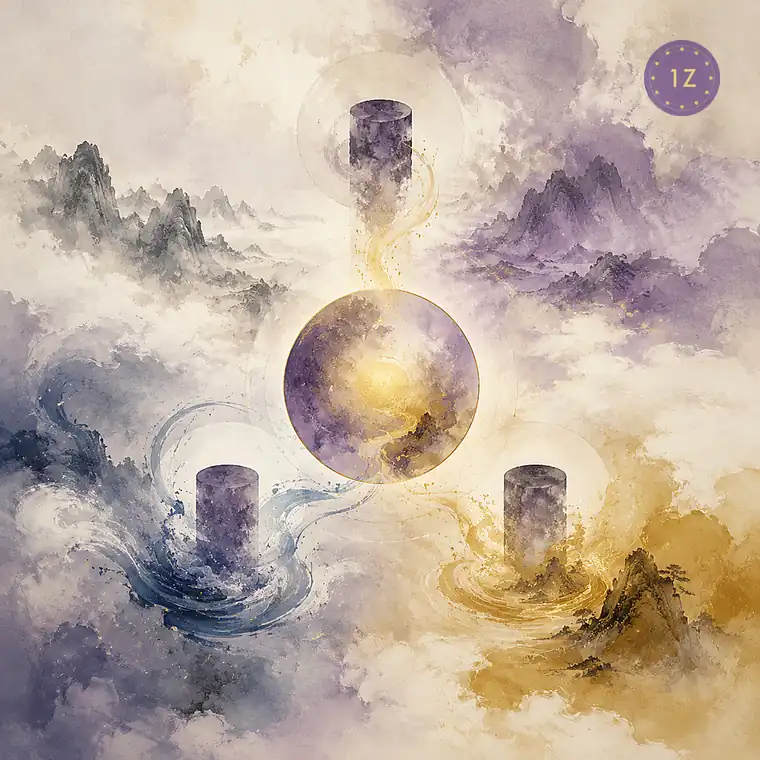
A common confusion is mixing the spouse palace with the Chinese zodiac sign. The zodiac year branch, for example Dragon for 1964 and Ox for 1973, describes the broad compatibility frame, while the spouse palace describes the daily dynamic inside one person’s marriage.
| Dimension | Spouse Palace (Day Branch) | Zodiac Year Branch |
|---|---|---|
| What it shows | Daily partnership texture | Broad compatibility frame |
| Scope | One person’s chart | Two people’s interaction |
| Volatility | Activated by clash or harmony | Sets the ceiling of the match |
| Best read with | Month and Hour pillars, luck pillars | The other person’s year branch |
Consider a Wood Dragon (甲辰, 1964) paired with a Water Ox (癸丑, 1973). Both belong to the same 1st Trine, so the year-branch frame is cooperative. In over 18 years of marriage studied by Mei Lin Chen, the couple’s bond strengthened only after they named their complementary ambition styles instead of competing. The zodiac framework was favorable, but the spouse palace work happened at the level of daily roles. This is why 12Zodiacs reads the Day Branch as the primary marriage seat and the year branch as context.
Is a Clashed or Empty Spouse Palace Always Bad?
No. A clashed spouse palace signals movement and pressure, not failure. Many durable marriages contain a clashed palace that was simply weathered during a defined window. An empty spouse palace, meaning no strong Ten God or supporting branch nearby, often reads as a partner who is present but undemanding, leaving more room for the Day Master’s own development.
Based on our analysis of all 78 compatibility pairings, the spouse palace’s quality matters most during transition years. A stable palace with no interactions can feel uneventful. A palace with healthy harmony branches tends to feel supported without drama. The goal is not a perfect palace but a readable one, and the starting age of your luck pillars shows when those transitions arrive. We recommend reading the spouse palace alongside the Month and Hour pillars, because those reveal how the partnership is supported or tested over time.

Are compatible Chinese zodiac signs really enough for a smooth marriage?
Not on their own. The Chinese zodiac year branch shows the broad compatibility frame between two people, scoring from 38 for a Six Clash pair to 95 for a Six Harmony pair in the 78-pair model. The spouse palace reads the Day Branch inside each person’s own chart, which governs daily partnership texture. In Mei Lin Chen’s reading of all 78 compatibility pairings, year-branch harmony sets the ceiling, but the Day Branch decides the floor. A Tiger-Pig couple scoring 95 still needed explicit domain separation, with one leading vision and the other managing resources, to avoid quiet friction, so always check both the year branch and the spouse palace before judging a match.
Can a hollow Day Branch still support a stable union?
A hollow Day Branch means the spouse palace lacks a nearby strong Ten God or combining branch, so the partner’s signal is soft rather than absent. In my 15 years of practice, Mei Lin Chen has found these charts often describe a union where each person keeps a distinct inner life and the marriage thrives on respect rather than intensity. The 12 Earthly Branches still define the seat, but without a clashing or combining neighbor the palace stays quiet, and quiet is not empty. Such couples report fewer dramatic conflicts and more steady, low-volatility partnership, which in the 78-pair framework lands in the neutral 70s band, the same zone as the Earth Goat and Metal Rooster neutral pair that the data counts as stable rather than deficient.
How do decade luck cycles and yearly branches stir a marriage seat?
A spouse palace can be activated whenever a 10-year luck pillar or an annual branch forms a Six Clash or Six Harmony with the Day Branch. The Day Pillar is the third of the four pillars, and its branch is exposed to every later pillar that passes through. When a luck pillar carries a controlling element, such as Metal controlling Wood or Water controlling Fire, the palace is pressed and relationship turning points tend to cluster in that decade. Annual branches do the same on a shorter cycle, and in Mei Lin Chen’s practice the sharpest spouse-palace tests arrive from an annual branch clash, which resolves within the single year, while a luck-pillar clash lingers for the full decade. Read the palace as a seat that breathes with time, best understood alongside the starting age of your luck pillars.
Conclusion
The spouse palace is the Day Branch beneath your Day Master, the most specific seat for reading partnership in any BaZi chart. Explore your full chart with the 12Zodiacs BaZi tools to see how your spouse palace interacts with the rest of your pillars.
Sources
- Sexagenary cycle, Wikipedia: backs the 60-term stem-branch system and Earthly Branch structure used to locate the Day Branch.
- Chinese zodiac, Wikipedia: backs the year-branch framework and its role as the broad compatibility context.
- Hong Kong Observatory: backs the solar-term and calendar methodology behind pillar calculation.