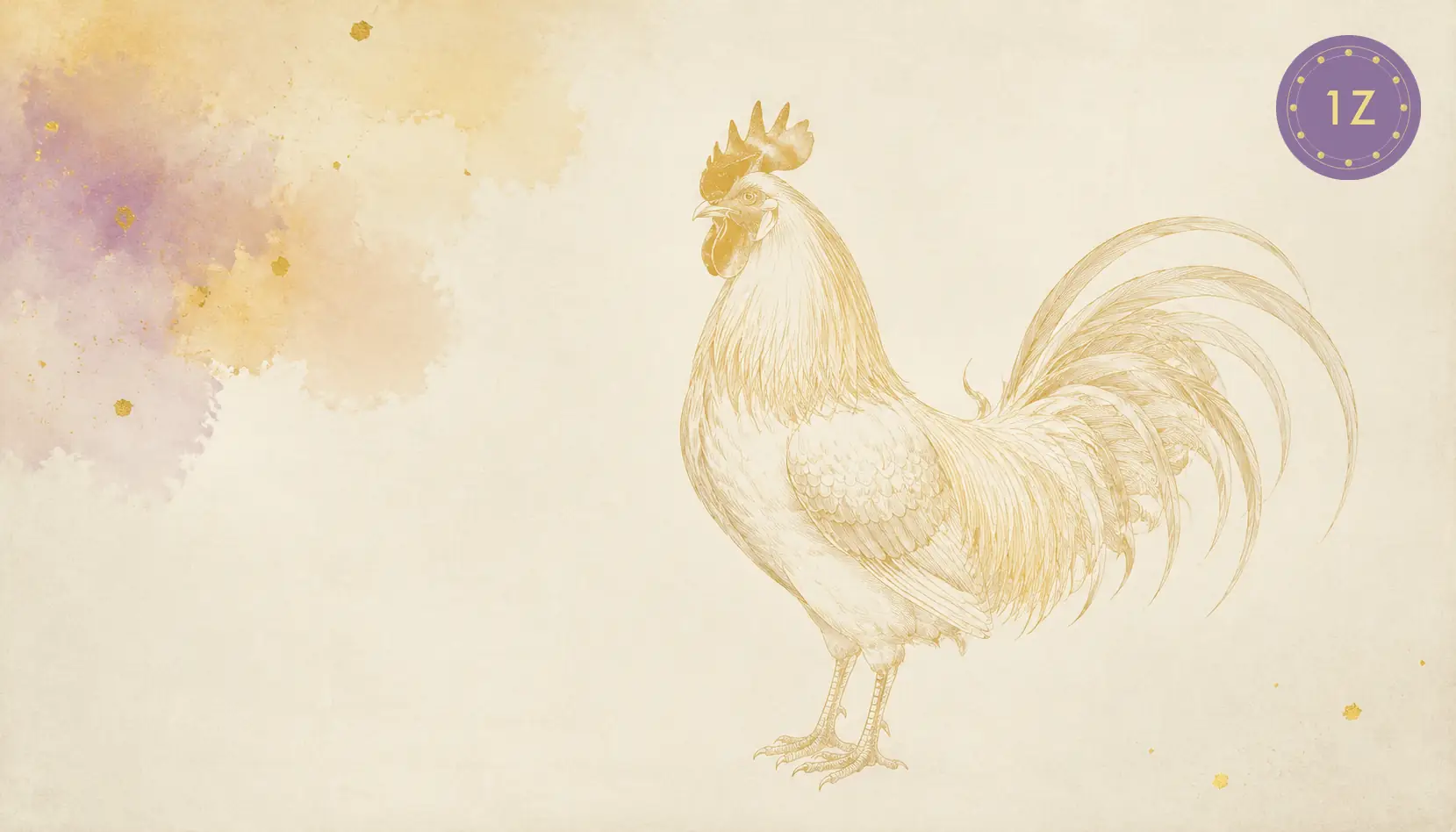

The Fire Rooster is the 丁酉 (Ding You) pairing, a Yin Fire stem sitting on the Rooster’s pure metal branch, born in 1957 and 2017 and returning in 2077. Fire controls Metal at the stem-branch level, so this sign carries its own tempering forge, a blade that finishes itself; this guide covers the structure, the luck anchors, and the pairings that hold.

Key Takeaways
- Fire Rooster years are 1957 and 2017 (Ding You, 丁酉), repeating every 60 years; the next arrives in 2077.
- The Rooster branch (酉) stores a single hidden stem, pure Xin metal, one of only 3 single-qi branches in the system.
- Yin Fire (丁, the candle) over pure metal gives the type its signature: precise flamboyance, detail at display quality.
- Best pairings: Dragon at 95 (Six Harmony) and Ox or Snake at 88-89 (2nd trine); hardest: Rabbit at 38 (Six Clash).
- Rooster hours run 17:00 to 19:00, the evening watch, and the sign anchors due west in the classical table.
- Check any birth year’s exact pairing with the zodiac year calculator.
What Makes 1957 and 2017 Fire Rooster Years
The pairing is 丁酉, Ding You: Yin Fire over the Rooster branch. Yin Fire (丁) is the candle and the lamp rather than the sun, fire that illuminates, flatters and refines rather than burns across fields; the Rooster branch is 酉, the purest metal branch in the system, carrying a single hidden stem of Xin with nothing mixed in. Fire controls Metal in the classical cycle, and a Fire stem seated on a Metal branch is exactly that control in miniature. The flame keeps the blade bright.
The lunar year of the Fire Rooster ran from January 31, 1957 to February 17, 1958, and its modern return from January 28, 2017 to February 15, 2018. Both windows matter for boundary babies: a January 2017 birth belongs to the Monkey year before the lunar new year, and the Four Pillars year line at Li Chun around February 3 adds its own small split. The same 丁酉 stamp returns in 2077, exactly 60 years after 2017.
The Mechanics: A Blade That Keeps Itself Polished
The Rooster branch is the system’s tuning fork. Among the 12 branches, only 3 carry a single hidden stem, 子 Zi, 卯 Mao and 酉 You, and the Rooster’s one note is pure Xin metal, the jewel and the finished instrument. No secondary qi, no remnant reserve: what you see is what the branch is. That structural honesty is why Rooster readings across the tradition keep circling back to precision and display.
Stack Yin Fire on that purity and the classical reading writes itself. The candle lights the showcase; the metal holds the edge. Competitor profiles describe the Fire Rooster as strong-willed, well-organized, media-friendly and thorough, with fengshuiweb noting PR and media careers specifically, and the chart agrees with the résumé. The gap most profiles leave open is stamina: Fire controlling Metal is work, and the Fire Rooster’s famous polish is maintenance, not gift, which is why the type that shines brightest also needs the most deliberate recovery.
Compatibility: The Pairings That Hold
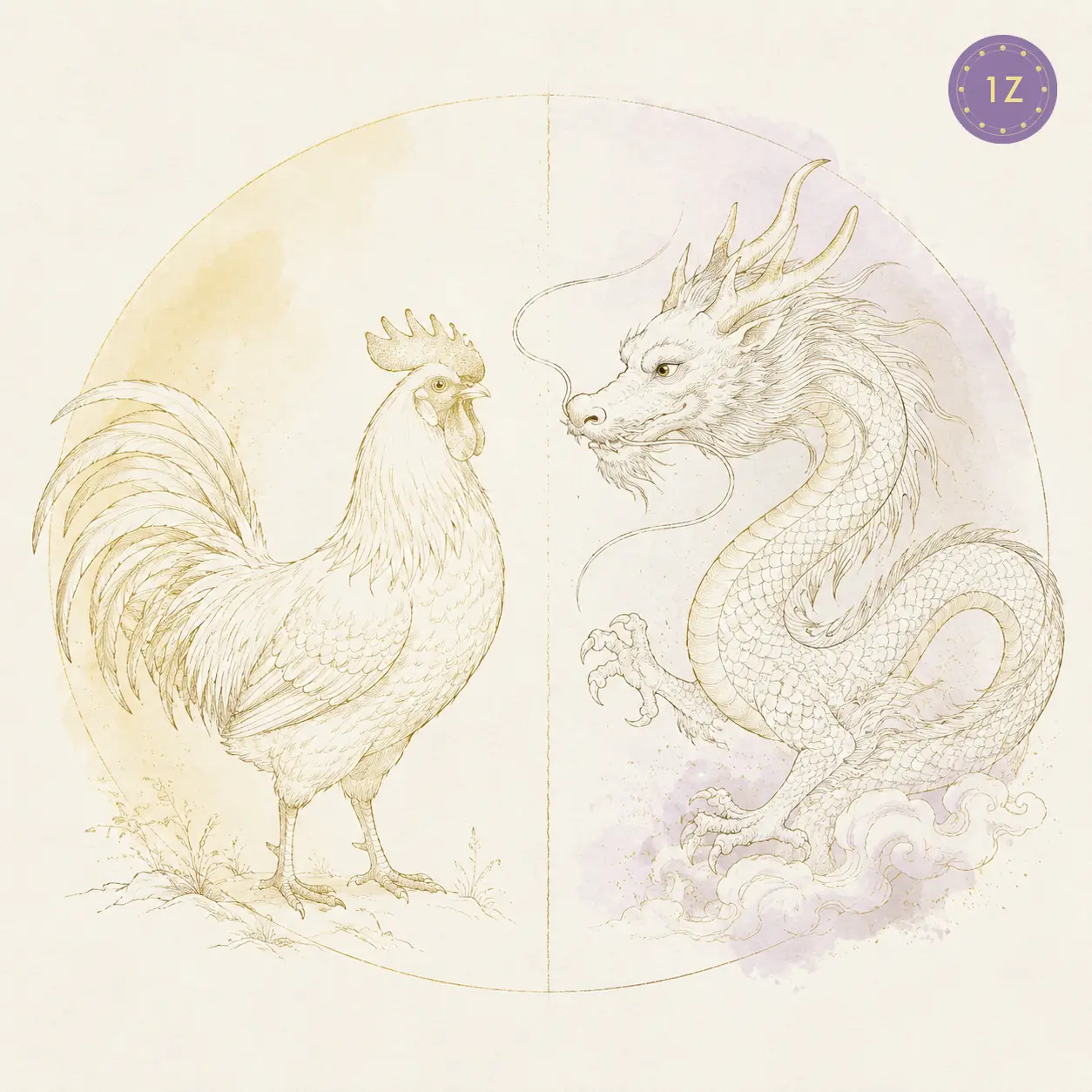
The Rooster’s branch mechanics set the matches. The Dragon is the secret friend at 95, the top of the 78-pair band, because 辰 and 酉 lock into the Six Harmony bond. The Rabbit is the direct opposite at 38, the 卯酉 clash of east against west, aesthetics against expedience.
| Pairing | Score | Bond | Branch mechanics |
|---|---|---|---|
| Rooster-Dragon | 95 | Six Harmony | 辰酉 bond; the Dragon’s earth element generates the Rooster’s metal |
| Rooster-Ox | 88-89 | 2nd trine | 巳酉丑 alliance, disciplined and principled |
| Rooster-Snake | 88-89 | 2nd trine | 巳酉丑 alliance, shared depth |
| Rooster-Dog | 55 | Six Harm | 酉戌 harm; subtle duty friction |
| Rooster-Rabbit | 38 | Six Clash | 卯酉 clash, the Rooster’s hardest room |
Who should the Rooster marry is a structure question with a clear winner. The Dragon pairing at 95 pairs display with engine: the Rooster polishes what the Dragon builds, and the harmony bond (辰酉) is one of the classical six. Based on our analysis of all 78 zodiac pairings, the Rooster sits inside the same top band the Tiger and Horse enjoy, with a Six Harmony anchor at 95 and trine support at 88-89. The trine allies Ox and Snake reward shared standards. The full matrix lives on the compatibility hub, and the Rooster sign page covers every Rooster year.
How 2026 Treats the Fire Rooster
The current year 丙午 is a Yang Fire Horse year, and for the Rooster it lands as amplifier rather than ally. Fire is the Rooster’s own stem element, so a double-fire public year hands the Fire Rooster exactly its favorite weather: stages, launches and more stages. The classical caution mirrors the type’s own mechanics. In practice, the caution is the calendar: fire that controls metal all year is expensive, and the 2026 advice for Rooster natives is to bank the visibility while scheduling the recovery that keeps the blade from dulling.
Direction notes stay constant across years: the Rooster anchors due west, and the classical lucky numbers for the sign run 5, 7 and 8, with gold as the signature color. In a fire-heavy year, the white and metallic tones of the branch element earn equal airtime.
Conclusion
The Fire Rooster is a candle over a blade: precision lit for display, maintenance mistaken for glamour. Find where your own chart keeps its fire and its metal with the free BaZi calculator on 12Zodiacs.
Why do Rooster descriptions sound vain, and is that reputation fair?
The vanity reading is a translation artifact more than a chart fact. The Rooster’s branch is pure Xin metal, the jewel, and Yin Fire is the candle placed beside it: the classical image is a lit showcase, which Western summaries flattened into preening. In our practice reading charts over the past 15 years, Fire Rooster natives run closer to craftsman-showman than peacock, caring intensely whether the work is seen at its best because the work itself is the self-portrait. The distinction matters for partners and managers. Praise the output specifically and the Rooster relaxes; praise nothing and the Rooster promotes itself, and the promotion is usually accurate.
Is it true that the Rabbit year is the Rooster’s enemy year?
The zodiac has no enemy years, only repeating structures, and the Rooster’s hardest structure is the Rabbit year. 卯 and 酉 sit in direct Six Clash opposition on the wheel, a 38-score pairing in our framework, so Rabbit years classically bring the Rooster friction, miscommunication and aesthetic disputes rather than catastrophe. A second, quieter pattern is Ben Ming Nian (本命年), the Rooster’s own year returning every 12 years, which tradition treats as heightened scrutiny from Tai Sui, managed with red accents and conservative commitments. The useful distinction for planning: clash years bring external opposition, return years bring internal audit, and the two call for different postures.
How should a 2017 Fire Rooster parent handle the school-age years?
The 2017 cohort is moving through primary school now, and the chart suggests structure over scolding. Fire Rooster children respond visibly to polish: marked improvement, displays of work, praise in public, and they wilt under blanket criticism, so the classical reading recommends specific praise for specific finished work rather than general encouragement. The Dragon bond at 95 has a practical parenting echo: Rooster children calm measurably around Dragon-year teachers, mentors and older cousins, the harmony branch doing its work through scheduling rather than theory. Screen-time boundaries deserve early negotiation; the branch loves a polished feed, and the stem will happily stay up polishing it.
Sources
- Rooster (zodiac), Wikipedia: branch placement, hours, sexagenary years for Ding You 1957 and 2017.
- Fire (wuxing), Wikipedia: Fire’s position in the control cycle over Metal.
- Five Elements and the Twelve Officials, Pacific College of Health and Science: element correspondences behind the personality reading.