
The Mulberry-Wood Rat
壬子 (Ren-Zi) · 桑柘木 (Mulberry-Wood) · Water Stem
The Mulberry-Wood Rat defines those born in 1972 and 2032 under the Ren-Zi (壬子) pillar. While mainstream astrology often classifies this year as the Water Rat based on its Heavenly Stem (壬 = Water), its deeper NaYin (纳音) resonance is Mulberry-Wood (桑柘木) — blending water’s core energy with wood’s expressive quality. This blend fosters abundant creativity, idealism, and relentless ambition. The Mulberry-Wood grants deep, resilient energy rather than flashy power, making this Rat a quietly enduring visionary.
A quick map: this is a Water year by its Heavenly Stem (壬 / Ren), while its NaYin is Mulberry-Wood (桑柘木), a Wood archetype — two parallel systems describing the same pillar, not a contradiction.
Quick Facts
| Years | 1912, 1972, 2032 |
| GanZhi | 壬子 (Ren-Zi) |
| NaYin | Mulberry-Wood (桑柘木 Sang-Zhe-Mu) |
| Stem Element | Water (壬) |
| NaYin Element | Wood (桑柘木) |
| Base Element | Water |
| Lucky Numbers | 3, 8, 25, 38 |
| Lucky Colors | Green, Teal, Brown |
| Lucky Direction | East, Southeast |
| NaYin Season | Spring |
| Trine Group | First Trine (Rat, Dragon, Monkey) |
| Sexagenary Position | #49 of 60 in the Jia-Zi cycle |
| Lunar Year Dates | 1912: 1912-02-18 to 1913-02-06 1972: 1972-02-15 to 1973-02-03 2032: 2032-02-? to 2033-02-? |
| Six Harmony (六合) | Ox — Secret Friend |
| Three Harmony (三合) | Rat · Dragon · Monkey (Water Trine) |
| Six Clash (六冲) | Horse — Opposing Force |
| Five Element Cycle | Generated by Water → Wood generates Fire → Controlled by Metal |
Rat Element Variants Compared
| NaYin Variant | Stem Name | GanZhi | Years | Stem Element |
|---|---|---|---|---|
| Sea-Metal Rat | Wood Rat | 甲子 | 1924, 1984 | Wood |
| Stream-Water Rat | Fire Rat | 丙子 | 1936, 1996 | Fire |
| Lightning-Fire Rat | Earth Rat | 戊子 | 1948, 2008 | Earth |
| Wall-Earth Rat | Metal Rat | 庚子 | 1900, 1960, 2020 | Metal |
| Mulberry-Wood Rat | Water Rat | 壬子 | 1912, 1972, 2032 | Water |
A Mulberry-Wood Rat doesn’t just chase opportunity; they cultivate it. The humble, nurturing wood tempers the Rat’s sharp instinct, turning quick wins into lasting value. They excel at building supportive networks, feeding others’ growth as naturally as mulberry leaves feed silkworms. In community organizing or grassroots entrepreneurship, they spot the overlooked threads and weave them into fabric that holds. Their edge: creating abundance not by taking, but by enabling others to thrive.
The same nurturing impulse can become self-effacement. A Mulberry-Wood Rat may prioritize others’ needs so habitually that their own ambitions wither on the vine. Their resourcefulness, usually a strength, turns into over-accommodation—solving everyone’s problems except their own. When the wood energy goes out of balance, they become the silent sacrifice: feeding silkworms until the tree is bare. They must learn that sustaining others requires first sustaining themselves.
The NaYin: Mulberry-Wood (桑柘木 Sang-Zhe-Mu)
In classical Chinese astrology, each of the 60 year-stem combinations carries a specific NaYin (纳音, “assigned tone”) — a poetic elemental melody refining the Five Elements into 30 archetypes. The Mulberry-Wood (桑柘木) NaYin represents a unique expression of the wood element.
Classical Sources
《三命通会》(Comprehensive Treatise on the Three Fates)
By 万民英 (Wan Minying), Ming Dynasty, 1587 — Volume 30, “On NaYin Elements”:
“桑柘木者,缯彩镒基,绮罗根本,士民飘飘之袂,圣贤楚楚之衣,此木供蚕为弧,其用甚大。”
“壬子,专位之木,遇死绝则富贵,生旺则贫贱,木多夭折,金多土盛为佳。”
Born in January or February?
There are two systems for determining your zodiac year. Folk tradition uses Lunar New Year (late Jan / early Feb). BaZi astrology uses Lichun (立春, Start of Spring, ~Feb 3–5). If your birthday falls in this boundary period, you might belong to the previous sign (Pig) under one system but the Mulberry-Wood Rat under another. Use our BaZi Calculator to determine your exact pillar based on Lichun.
Who they are
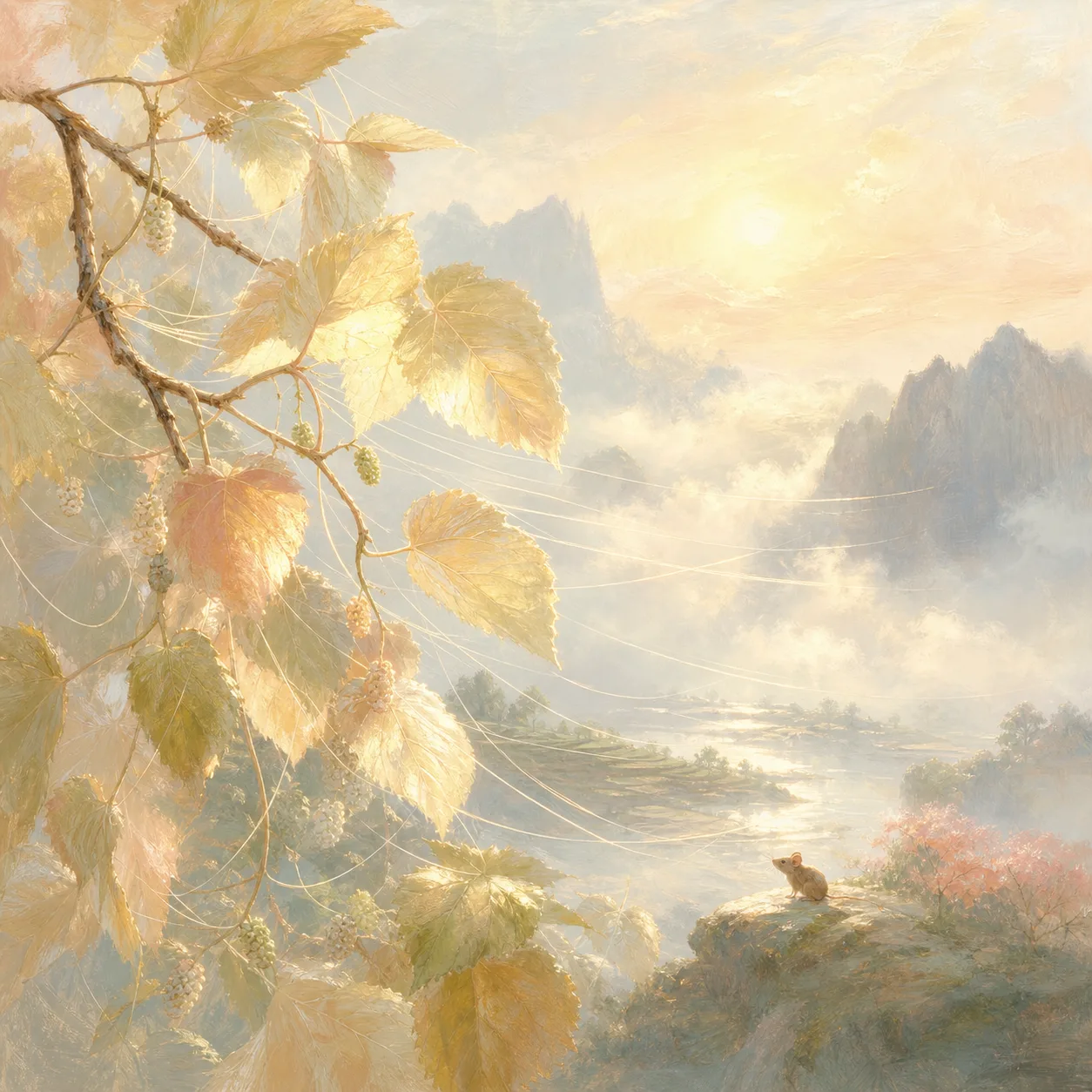
The Mulberry-Wood Rat is like a mulberry sapling growing beside a rushing river—its roots drink deep from the Water’s flow while its branches reach for the sun. The Sanming Tonghui (三命通会) describes this NaYin as ‘the foundation of silk and brocade, the root of elegant robes,’ suggesting a nature that is both nourishing and ornamental. This Rat does not merely scurry and hoard; it cultivates. The Water stem 壬 (Ren) and the Rat branch 子 (Zi) create a reservoir of native Water, yet the Mulberry-Wood (桑柘木) transforms that fluid intelligence into something with structure and aspiration. Unlike a Yang-Water Rat, who might overflow with restless energy, the Mulberry-Wood Rat channels its sharpness into long-term projects, like a silkworm spinning thread from leaf to cocoon. The classical text notes that this wood ‘is used for raising silkworms, its purpose is great,’ hinting at a life dedicated to patient, fruitful labor.
Yet there is a paradox here. The same Sanming Tonghui warns that when the wood is ‘born in death or extinction it brings wealth and honor, but when vigorous it brings poverty and baseness.’ This means the Mulberry-Wood Rat thrives on humility and restraint. When they try to force their growth—pushing too hard, grasping too much—the wood becomes brittle. Their true power lies in yielding, in the soft persistence of a mulberry branch that bends under snow but never breaks. They are dreamers with a practical streak, idealists who can build a business plan around a vision. The Rat’s native cleverness is here tempered by a silken patience, making them formidable in any arena that rewards both creativity and endurance.
At their best, they are the person who quietly builds an empire while others chase headlines. At their worst, they can become lost in elaborate fantasies, mistaking the blueprint for the building. The Mulberry-Wood Rat’s personality is a fabric of silk and steel—delicate in appearance, unyielding in purpose.
In love and partnership
In love, the Mulberry-Wood Rat crafts intricate emotional bonds. They approach romance with the Rat’s characteristic cleverness, but the Mulberry-Wood adds a layer of tender idealism. They remember the first time you mentioned your favorite flower, and they’ll plant it in a pot for your windowsill. Their love language is subtle and symbolic—a poem slipped into your bag, a shared meal cooked with ingredients that hold private meanings. The Water stem makes them emotionally fluent; they can read your moods like a seasoned sailor reads the sky. Yet the Wood element gives them a desire to nurture, to grow something lasting from the soil of affection.
Their greatest strength is their ability to adapt without losing their core. Like the mulberry tree that thrives in diverse soils, they can adjust to a partner’s needs while maintaining their own identity. But their blind spot is a tendency to idealize. They may fall in love with a person’s potential rather than their reality, spinning fantasies around a partner like silk around a cocoon. When reality proves less perfect, they can become disillusioned or withdraw into silent disappointment.
Their Liuhe (六合) match is the Ox, whose steady earth provides the structure their wood needs to root deeply. An Ox partner offers the grounded patience that balances the Rat’s restlessness. They also harmonize with the Dragon and Monkey (Sanhe / 三合), whose fire and metal energies can help shape their wood into something refined. In any union, the Mulberry-Wood Rat must learn to love the person in front of them, not the one in their imagination.
Professional destiny
In the professional realm, the Mulberry-Wood Rat excels in fields that require both strategic thinking and creative cultivation. The NaYin image of ‘fabric and brocade’ points naturally toward textiles, fashion, design, and any industry where aesthetics meet utility. They are the architect who considers how light falls on a building, the marketer who tells a story that sells, the entrepreneur who builds a brand with soul. The Water stem gives them fluency in communication and logistics—they thrive in roles that involve connecting people, ideas, or resources. Trade, diplomacy, media, and education all benefit from their blend of wit and warmth.
Their work style is methodical but not rigid. Like a silkworm spinning its thread, they approach projects with steady, incremental effort. They are not the flashiest person in the room, but they are often the one who finishes what they start. The classical text’s phrase ‘this wood is used for raising silkworms, its purpose is great’ captures their career trajectory: slow, patient, but ultimately producing something of immense value. They do well in research, artistic creation, and enterprise building—any path that rewards long-term commitment over quick wins.
The warning for them is the trap of perfectionism. The Mulberry-Wood Rat can become so fixated on the ideal that they never ship the product, never launch the project, never finish the novel. They must learn that a finished work, even imperfect, is worth more than a flawless draft that never leaves the drawer. Their career vulnerability is getting lost in planning and dreaming, mistaking motion for progress.
Physical and mental health
For the Mulberry-Wood Rat, health begins with the Water element’s domain: the kidneys, bladder, and reproductive system. The Rat’s native Water energy, amplified by the Ren stem, can create a tendency toward coldness and stagnation in these areas. They may feel chronically tired, have achy lower backs, or struggle with urinary issues if their Water becomes imbalanced. The Mulberry-Wood, however, offers a remedy: wood controls earth and generates fire, so nurturing the wood element helps regulate the Water. Think of the mulberry tree’s deep roots drawing moisture upward—this is the energetic movement they need.
Practical wellness practices include keeping the lower back and feet warm, avoiding excessive cold drinks, and eating black-colored foods like black beans, black sesame, and seaweed to support kidney energy. Early nights are crucial; the Rat’s natural nocturnal energy can lead to burnout if they don’t respect the body’s need for rest. The Mulberry-Wood quality also suggests they benefit from gentle, rhythmic exercise—tai chi, swimming, or walking in nature—that moves energy without forcing it. They should be especially mindful of overwork, as their patient, persistent nature can make them ignore fatigue until it becomes exhaustion. A weekly ritual of soaking in warm water with ginger or sea salt can help balance their Water and Wood, keeping their inner rivers flowing smoothly.
Money and prosperity
The Mulberry-Wood Rat’s financial personality is one of patient accumulation. They are not impulsive spenders; like a silkworm gathering mulberry leaves, they prefer to build resources steadily. The Water stem gives them a knack for networking—their wealth often flows through relationships, insider knowledge, and information arbitrage. They are the person who hears about an opportunity before it becomes public and knows exactly how to position themselves. The NaYin of Mulberry-Wood suggests that their fortune is tied to something that ‘grows’ over time—real estate, intellectual property, or a business that compounds slowly.
Their financial pitfall is over-investing in dreams. They may pour money into a passion project that never yields returns, or hold onto an asset out of sentimental attachment. The Mulberry-Wood Rat needs to balance their idealistic streak with hard-nosed financial discipline. They should build diverse income streams—like a tree with many branches—and avoid putting all their resources into one venture. A concrete practice is to set aside a ‘dream fund’ separate from their essential savings: 10% of income for speculative or creative projects, and the rest for stability. This way, they can feed their imagination without risking their security. Over time, their patience pays off: the Mulberry-Wood Rat often finds that their later years are far more prosperous than their early ones, as the seeds they planted finally bear fruit.
Evolution and self-mastery
The Mulberry-Wood Rat’s greatest growth edge is learning to balance vision with execution. They are natural dreamers, but dreams without boundaries become floods—the Water stem’s shadow. The NaYin of Mulberry-Wood teaches them that a mulberry tree must be pruned to yield the finest leaves for silkworms. They must learn to cut away what is not essential, to focus their energy on what truly matters. The classical text’s warning that ‘when vigorous it brings poverty and baseness’ is a direct call to restraint: not every idea needs to be pursued, not every opportunity seized.
A specific, actionable practice is the ‘one-year rule.’ Before launching any major project, they should sit with the idea for one full year—through all four seasons—to see if it still excites them. Use that time to research, plan, and test small iterations. This discipline channels their Water’s flow into a controlled stream. They can also benefit from a ‘completion ritual’: every quarter, finish one thing, no matter how small, and celebrate it. This builds the muscle of follow-through.
Aspirationally, the Mulberry-Wood Rat can become a master weaver of life—someone who takes raw threads of possibility and creates a weave of lasting beauty. They can be the quiet force behind a thriving community, the artist whose work outlives them, the entrepreneur who builds a legacy not just of profit but of purpose. Their potential is not in being the loudest Rat in the room, but in being the one whose roots go deepest, whose branches offer shade, and whose leaves feed the silkworms of tomorrow.
Mulberry-Wood Rat Years
| Year | GanZhi | Type | Details |
|---|---|---|---|
| 1912 | 壬子 | Mulberry-Wood Rat | View Profile → |
| 1972 | 壬子 | Mulberry-Wood Rat | View Profile → |
| 2032 | 壬子 | Mulberry-Wood Rat | View Profile → |
Famous Mulberry-Wood Rats
Notable figures born in 1912, 1972, 2032.
CEO of Google/Alphabet; the Rat's quiet command of the world's information.
Star of Prison Break; strategic thinking as performance.
Singin' in the Rain; dancer-actor whose precision reflected the Rat's calculated grace.
Luther, The Wire, Mandela: Long Walk to Freedom.
Best-selling rapper ever, 15 Grammys, 8 Mile, Lose Yourself Oscar.
Football legend, World Cup 1998 winner, Champions League coach.
A Six Harmony (六合) match — the secret friend combination, naturally aligned in energy and purpose.
People also ask
Which entrepreneurial ventures fit the Mulberry-Wood Rat profile?
Mulberry-Wood Rat individuals, born in 壬子 years like 1912 or 1972, thrive in ventures that combine their sharp intellect with creative growth. The 桑柘木 (Mulberry Wood) NaYin suggests businesses related to textiles, paper, or sustainable materials. They excel in consulting, education, or roles requiring strategic planning, as their wood energy fosters adaptability and networking. Avoid high-risk speculation; instead, focus on steady, long-term projects that allow their resourceful, rat-like cunning to flourish.
Which seasonal energies challenge Mulberry-Wood Rat health?
The Mulberry-Wood Rat’s 壬子 (Ren-Zi) pillar is dominated by Water (壬) and Rat (子水), making them prone to cold-damp conditions. Late autumn and winter (Metal and Water seasons) can exacerbate kidney or urinary issues, as well as joint stiffness. The 桑柘木 NaYin indicates they need to protect their liver and eyesight, as wood is weakened by excessive water. Counter these by staying warm, avoiding raw foods, and incorporating light exercise in spring when wood energy revives.
Which financial partnerships work for Mulberry-Wood Rat?
Mulberry-Wood Rats, with their 壬子 (Ren-Zi) energy, partner best with those who bring complementary fire or earth elements. Look for partners born in Snake (巳火) or Ox (丑土) years—their stable, warm energy balances the Rat’s water-dominant nature. The 桑柘木 NaYin favors collaborations in forestry, publishing, or artisan crafts. Avoid partnerships with Goat or Horse signs, as conflicting elements may create instability. Trust is key; the Rat’s shrewdness works well with a grounded ally.
What spiritual practices resonate with Mulberry-Wood Rat’s energy?
The 壬子 (Ren-Zi) Mulberry-Wood Rat connects deeply with water-based practices like flowing yoga, tai chi, or meditative walks near rivers. The 桑柘木 NaYin encourages grounding through gardening or working with wood—carving, bonsai, or forest bathing. Their sharp mind benefits from journaling or mindfulness to channel overthinking. Water-related rituals, such as offering at a fountain or using blue crystals, enhance their natural adaptability and inner calm.
Which relationships may shift for Mulberry-Wood Rat in 2026?
In 2026 (丙午 Fire Horse year), the Mulberry-Wood Rat (壬子) faces potential shifts with Horse and Goat signs due to clashing elements. The Horse’s fire may overheat the Rat’s water, causing tension in romantic or business ties. However, the 桑柘木 NaYin suggests growth through creative partnerships, especially with Tiger or Dog signs. Expect changes in friendships with those born in 1966 or 1978—clear communication will help navigate the dynamic energy.
What hidden potential does the Mulberry-Wood NaYin reveal?
The 桑柘木 (Mulberry Wood) NaYin for 壬子 reveals a quiet resilience—like a mulberry tree that nourishes silkworms, this Rat has untapped potential in nurturing others through education or art. They possess a flexible, enduring spirit that thrives in supportive roles rather than the spotlight. This wood energy also hints at a talent for weaving ideas into tangible results, much like turning silk into fabric. Their hidden strength lies in patience and subtle influence.
How does wood energy modify the classic Rat archetype?
Wood energy transforms the classic Rat’s survival instincts into a more collaborative and visionary drive. While typical Rats (子水) are cautious and calculating, the 壬子 Mulberry-Wood Rat adds creativity, idealism, and a desire for growth. The 桑柘木 NaYin makes them less materialistic and more focused on building lasting structures—whether in relationships or careers. They retain the Rat’s cleverness but express it through innovation and diplomacy, not just self-interest.
How does the Lichun (Start of Spring) boundary affect Mulberry-Wood Rat classification?
The Lichun boundary, marking the start of spring, is critical for 壬子 (Ren-Zi) Mulberry-Wood Rat classification. If born before Lichun in a given year (e.g., early 1912 or 1972), the animal sign may shift to the previous year’s (Pig), changing the Gan-Zhi pillar. This affects the NaYin—e.g., a pre-Lichun birth might yield 辛亥 (Metal Pig) instead. Always verify the exact solar date to ensure accurate BaZi analysis, as the Mulberry-Wood Rat’s energy is tied to the correct 壬子 pillar.
Why is 1912 called Mulberry-Wood Rat instead of Water Rat?
In mainstream Chinese astrology, 1912 is often called the Water Rat because its Heavenly Stem 壬 (Ren) corresponds to Water. However, the NaYin (纳音) system — a deeper layer of BaZi analysis — assigns this pillar the Mulberry-Wood (桑柘木) resonance. Both names refer to the same year: the Stem name (Water Rat) describes its foundational energy, while the NaYin name (Mulberry-Wood Rat) reveals its poetic-spiritual quality.
Want Your Personal Reading?
Get your complete BaZi chart with all four pillars, NaYin analysis, and life chapters.
Open Free BaZi Calculator →