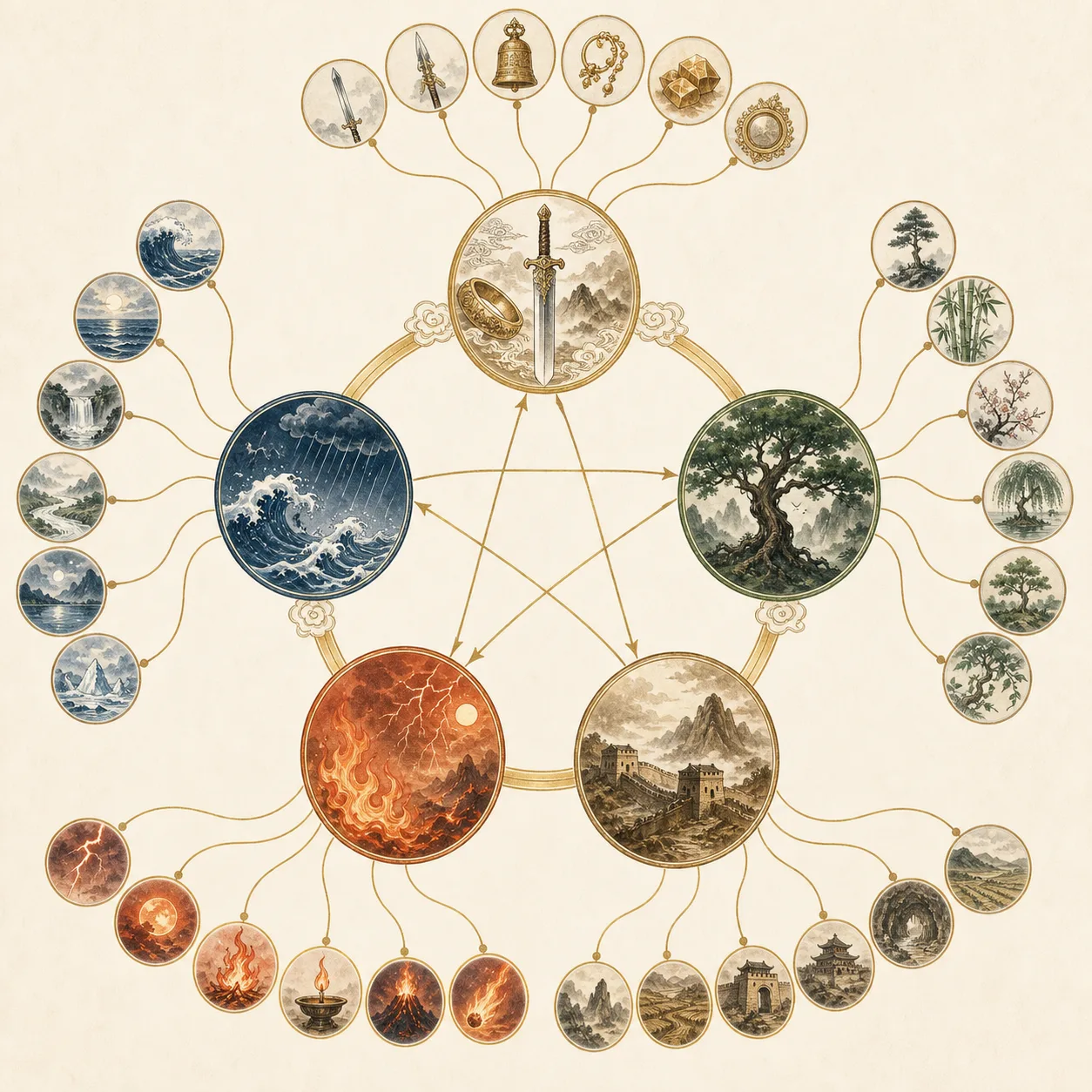
Beneath each pillar lies a poetic resonance — 30 distinct flavors that add texture to your chart.
The 30 NaYin Elements (纳音五行): Poetic Elemental Resonances in BaZi
NaYin (纳音) assigns poetic elemental subtypes to each of the 60 stem-branch pairs, yielding 30 distinct flavors—six per classical element. Rooted in texts like the *San Ming Tong Hui*, it adds texture beyond standard Five Element analysis, describing innate qualities such as "Metal in the Sea" or "Fire in the Furnace." While not used for day-master strength, NaYin enriches personality nuance and symbolic imagery in a chart.
Most students of Chinese metaphysics meet the Five Elements—Wood, Fire, Earth, Metal, and Water—as clean, archetypal forces. But the classical masters of BaZi (Four Pillars) read a far more textured map. Beneath the surface of each Heavenly Stem and Earthly Branch lies a hidden layer called NaYin (纳音), sometimes translated as "Sound of Nature" or "Rhythm of Life." This system expands the five elements into thirty distinct poetic subtypes, each with its own temperament, habitat, and existential flavor.
NaYin does not replace the standard Five Element analysis. Instead, it adds a deeper resonance—a way to sense the quality of a person's energy, much like hearing the difference between a flute and a drum. A Metal day master might be a sword or a piece of jewelry; a Water year might flow like a creek or stretch like an ocean. This page introduces the complete NaYin system and links to every one of the thirty individual profiles.
How It Works
The NaYin system is built from the sixty Jiazi (甲子) combinations—the full cycle of ten Heavenly Stems paired with twelve Earthly Branches. Each pair of consecutive Jiazi shares a single NaYin designation. For example, Jia Zi (甲子) and Yi Chou (乙丑) both belong to Sea Metal (海中金). This means there are exactly thirty unique NaYin names, each covering two of the sixty pillars.
The name of each NaYin is not arbitrary. Classical texts like San Ming Tong Hui (三命通会) describe these names as metaphors for the natural state of the element at a particular time and place. A sword is Metal that has been refined and sharpened; gold leaf is Metal that has been hammered thin for decoration. A creek is Water in motion, playful and quick; an ocean is Water in depth, slow and vast.
Why thirty? Because the ancient astrologers observed that the Five Elements in their pure form were too abstract to capture the full range of human temperament. Two people born in a Metal year could be as different as a blade and a hairpin. By assigning a poetic image to each pair of pillars, the NaYin system gives the reader a visceral sense of the element's expression—its habitat, its strengths, its shadows.
In practice, NaYin is most often consulted for the Year Pillar (which represents ancestry and early environment) and the Day Pillar (which represents the self). Some schools also use NaYin to assess compatibility between spouses or to gauge the flavor of a particular decade in the luck cycle. It is not a fortune-telling shortcut, but a refinement—a way to hear the music beneath the words.
The Five Elements and their 30 NaYin poetic subtypes
The 30 NaYin Varieties at a Glance
Each of the Five Elements produces six NaYin subtypes, each with its own poetic image. Use this table as a quick reference, then explore the individual varieties below.
Element
The 6 NaYin Varieties
Core Theme
Metal (金)
Sea Metal · Sword Metal · Wax Metal · Hairpin Metal · Gold-Leaf Metal · Sand Metal
From hidden treasure to sharpened blade
Water (水)
Creek Water · Stream Water · Ocean Water · River Water · Spring Water · Heavenly Water
Each of the 30 NaYin elements has a distinct poetic image and personality signature. Below, explore all 30 varieties organized by their parent element, with classical references from the San Ming Tong Hui (三命通会).
Metal NaYin Varieties (金)
Sea Metal
海中金 · Hai Zhong Jin
Jia Zi (甲子), Yi Chou (乙丑)
Gold ingots resting on the dark seabed, their gleam softened by deep currents and drifting silt.
Shadow SideWhen imbalanced, they sink into depths of secrecy, hoarding their brilliance like buried treasure, unwilling to let light touch their true value.
Core Quality
Stillness itself holds a sharp edge. Quiet confidence and inner refinement operate beneath a calm surface, where penetrating intellect waits like deep water.
San Ming Tong Hui describes Sea Metal as treasure hidden in the deep, needing fire to reveal its brilliance and earth to support its form; it thrives with the right timing and refinement.
Sword Metal
剑锋金 · Jian Feng Jin
Ren Shen (壬申), Gui You (癸酉)
A forged blade of cold steel, honed to a razor edge, gleaming with a deadly, crystalline light.
Best ExpressionSurgeon, Judge, Military Strategist, Precision Engineer, Master Swordsman, Forensic Analyst
Shadow SideWhen excessive, they slash through bonds and opportunities, leaving only severed threads and a blade too sharp to hold without cutting themselves.
Core Quality
Precision defines their inner code. A decisive mind cuts through ambiguity, driven by focused will and unyielding strength—mastery through discipline, not display.
San Ming Tong Hui: Sword Metal is the essence of the Ren and Gui waters, tempered by the fire of the forge. It is a weapon of authority, but must be sheathed in wisdom, lest it cut its own master.
Wax Metal
白蜡金 · Bai La Jin
Geng Chen (庚辰), Xin Si (辛巳)
A pale, unrefined silver ingot resting in cool earth, waiting for the fire of refinement to reveal its luster.
Best ExpressionJewelry design, precision engineering, watchmaking, metallurgy, surgical instruments, classical music performance
Shadow SideWhen excessive, they cling to an unrefined state, fearing the fire of change, and their softness hardens into a brittle shell that cracks under pressure.
Core Quality
They channel persistence into subtle refinement. Order and precision emerge gradually, each small improvement a quiet victory toward mastery.
San Ming Tong Hui describes Bai La Jin as metal formed in the earth, needing fire to temper; it symbolizes a person of refined talent who matures through adversity.
Hairpin Metal
钗钏金 · Chai Chuan Jin
Geng Xu (庚戌), Xin Hai (辛亥)
Gold filigree hairpins adorning a noblewoman's coiffure, gleaming softly in candlelit chambers.
Best ExpressionJewelry design, luxury goods curation, art restoration, financial planning, heritage preservation, high-end craftsmanship
Shadow SideWhen excessive, they become ornaments of vanity, adorning themselves with status until the filigree chokes their authentic self.
Core Quality
Elegance is their foundation. Dignified self-worth and meticulous care shape a desire for beauty and lasting value, approached with quiet confidence.
San Ming Tong Hui notes that Hairpin Metal is precious and ornate, suited for adornment rather than utility; it thrives with fire to shine and water to polish, but fears being buried or broken.
Gold-Leaf Metal
金箔金 · Jin Bo Jin
Ren Yin (壬寅), Gui Mao (癸卯)
Thin sheets of hammered gold, gleaming softly in moonlight, delicate yet enduring.
Best ExpressionJewelry design, Luxury goods curation, Art restoration, Precision engineering, High-end craftsmanship, Cultural heritage preservation
Shadow SideWhen excessive, they stretch themselves impossibly thin, shimmering on the surface yet tearing at the slightest strain, isolating in fragile beauty.
Core Quality
Like gilded surface, resilience lies beneath. They prefer subtle influence over force, valuing precision and beauty as the warp and weft of their inner world.
San Ming Tong Hui notes that Gold-Leaf Metal is precious but fragile, requiring the warmth of fire and the nourishment of water to realize its brilliance, yet it fears being buried by earth.
Sand Metal
砂石金 · Sha Shi Jin
Jia Wu (甲午), Yi Wei (乙未)
Gold dust scattered on sun-scorched earth, glinting through cracked soil and dry grass.
Shadow SideWhen excessive, they scatter like dust in the wind, unable to coalesce into solid form, their glint lost in the vast dryness of indecision.
Core Quality
Endurance is their pulse. Grounded and practical, they withstand pressure without outward display, steady in conviction and unyielding in quiet strength.
San Ming Tong Hui describes Sand Metal as metal formed from earth's dust, requiring fire to refine and water to nourish, symbolizing strength that emerges through adversity.
Water NaYin Varieties (水)
Creek Water
大溪水 · Da Xi Shui
Jia Yin (甲寅), Yi Mao (乙卯)
A rushing mountain stream swelling into a vast river, carrying fallen petals and moonlight through deep gorges.
Best ExpressionHydrology, Marine biology, Travel writing, Expedition leadership, Environmental activism, Water resource management
Shadow SideWhen excessive, they flood their own banks, rushing into every crevice with restless energy, eroding their path into chaotic torrents.
Core Quality
Moving with constant forward motion, they embody adventurous spirit. Change and flow are natural allies, and adaptability becomes courage in motion.
San Ming Tong Hui describes Da Xi Shui as 'the water of great torrents, vast and uncontainable, needing the earth of mountains to channel its force.'
Stream Water
涧下水 · Jian Xia Shui
Bing Zi (丙子), Ding Chou (丁丑)
A quiet stream threading through dark valleys, its silver surface reflecting moonlight and hidden stones.
Best ExpressionHydrology, Environmental science, Counseling, Philosophy, Water resource management, Research
Shadow SideWhen excessive, they meander into hidden eddies, circling the same doubts until their flow slows to a stagnant mirror of fear.
Core Quality
Not speed but depth guides them. Calm introspection and emotional resilience allow steady progress, adapting to obstacles while valuing inner clarity over recognition.
San Ming Tong Hui: Stream water is gentle yet penetrating, nourishing all it touches; it thrives when combined with earth and wood, but fears excessive fire that dries its source.
Ocean Water
大海水 · Da Hai Shui
Ren Xu (壬戌), Gui Hai (癸亥)
Vast dark ocean under a moonless sky, waves rolling with hidden depth and silent power.
Best ExpressionMarine biology, Oceanography, Hydrology, Philosophy, Deep-sea exploration, Environmental policy
Shadow SideWhen excessive, they drown in their own profundity, pulled under by tidal emotions that swallow all light and leave them gasping for direction.
Core Quality
Expansive mind seeks to encompass all. Profound understanding and inner stillness operate with timeless confidence, a sense of vastness within.
San Ming Tong Hui: Ocean Water is vast and boundless, nourishing all things, but its depth can be isolating; it thrives with the support of earth and the clarity of metal.
River Water
长流水 · Chang Liu Shui
Ren Chen (壬辰), Gui Si (癸巳)
A long, winding river flowing through deep valleys, its waters calm yet ceaseless, reflecting the sky.
Best ExpressionHydrology, Environmental engineering, Logistics, Maritime trade, Water conservation, Philosophy
Shadow SideWhen excessive, they drift without a current, their ceaseless flow becoming a passive surrender to every bend, never carving their own course.
Core Quality
They navigate life's currents without force. Patience and persistence draw from quiet endurance, adapting with a deep sense of inner flow.
San Ming Tong Hui: Long flowing water is vast and enduring, nourishing all things, but if it overflows its banks, it brings chaos and stagnation.
Spring Water
泉中水 · Quan Zhong Shui
Jia Shen (甲申), Yi You (乙酉)
A clear spring emerging from a mountain crevice, flowing quietly through mossy stones into a hidden valley.
Best ExpressionHydrology, environmental science, philosophy, writing, traditional medicine, water conservation
Shadow SideWhen excessive, they seal their source, letting moss and silt clog the crevice, and the once-clear stream becomes a murky pool of hesitation.
Core Quality
A deep well of clarity resides within. Self-contained and resourceful, they adapt effortlessly, finding peace in solitude and simplicity.
San Ming Tong Hui describes Quan Zhong Shui as water that nourishes but is easily disturbed; it thrives in stillness and is harmed by rushing, favoring quiet persistence over forceful action.
Heavenly Water
天河水 · Tian He Shui
Bing Wu (丙午), Ding Wei (丁未)
Rainwater falling from the Milky Way, silver droplets merging into a celestial river under moonlight.
Best ExpressionHydrology, Astronomy, Philosophy, Poetry, Environmental Science, Spiritual Counseling
Shadow SideWhen excessive, they dissolve into the celestial expanse, losing earthly anchor, their silver droplets evaporating before they ever touch the ground.
Core Quality
Intuition connects them to the unseen. Serene adaptability and quiet flowing strength seek harmony, a spiritual clarity that moves without noise.
San Ming Tong Hui describes Tian He Shui as rain from the heavens, nourishing all things but also capable of flooding; it values the earth (Wu) to contain its flow.
Wood NaYin Varieties (木)
Forest Wood
大林木 · Da Lin Mu
Wu Chen (戊辰), Ji Si (己巳)
A vast forest of towering trees, roots entwined in deep earth, canopy reaching for misty skies.
Best ExpressionForestry, Environmental Conservation, Agriculture, Real Estate Development, Education, Traditional Medicine
Shadow SideWhen imbalanced, they become a dense canopy that blocks all light, their roots strangling new growth, and the forest turns into a suffocating maze.
Core Quality
Growth and stability intertwine. Grounded yet expansive, they nurture and shelter, thriving on gradual progress and integrity as their root system.
San Ming Tong Hui describes Da Lin Mu as wood of the open fields, thriving in vast spaces, symbolizing endurance and the capacity to shelter all beings, but requiring proper soil and rain to flourish.
Pine Wood
松柏木 · Song Bai Mu
Geng Yin (庚寅), Xin Mao (辛卯)
A lone pine rooted in sheer cliff, enduring wind and frost, its needles piercing the clouds.
Best ExpressionForestry, Environmental conservation, Architecture, Civil engineering, Military, Endurance sports
Shadow SideWhen excessive, they stand too tall and too alone, their roots gripping the cliff so tightly they crack the stone, isolating themselves in rigid endurance.
Core Quality
Firmness is their constitution. They stand slow and steady, valuing integrity and long-term endurance over quick gains, with unshakable quiet confidence.
San Ming Tong Hui: Pine wood is noble and upright, like a great tree that withstands harsh winters; it thrives in adversity but fears being uprooted by sudden storms.
Willow Wood
杨柳木 · Yang Liu Mu
Ren Wu (壬午), Gui Wei (癸未)
Willow branches swaying by a riverbank, roots drinking from spring water, leaves catching morning mist.
Best ExpressionLandscape design, Environmental consulting, Diplomacy, Counseling, Traditional medicine, Arts and crafts
Shadow SideWhen excessive, they bend so far they forget their trunk, swaying with every breeze until their roots loosen and they drift downstream without will.
Core Quality
Flexibility becomes their rhythm. Bending without breaking, they thrive in change, guided by harmony and subtle timing rather than force.
San Ming Tong Hui describes Willow Wood as 'soft and yielding, yet rooted in water; it flourishes in spring but fears strong winds and dry earth.'
Plain Wood
平地木 · Ping Di Mu
Wu Xu (戊戌), Ji Hai (己亥)
A vast plain of wild grass under a low sky, roots gripping the earth, resilient against wind and drought.
Best ExpressionAgriculture, horticulture, real estate, environmental conservation, traditional medicine, education
Shadow SideWhen excessive, they flatten into a monotonous expanse, roots gripping the same dry soil, resistant to any storm that might bring renewal.
Core Quality
What sets them apart is unpretentious steadiness. They find security in nurturing what exists, patient and reliable, attuned to life's natural cadence.
San Ming Tong Hui describes Plain Wood as grass on open ground—flourishing in spring but vulnerable to frost. It values the support of earth and water, yet fears metal's cutting edge.
Pomegranate Wood
石榴木 · Shi Liu Mu
Geng Shen (庚申), Xin You (辛酉)
A pomegranate tree heavy with ripe fruit, its wood dense and dark, seeds glistening like crimson jewels.
Best ExpressionHorticulture, forestry, woodworking, gemology, pharmacology, sustainable agriculture
Shadow SideWhen excessive, they seal their seeds behind a dense, dark husk, guarding their fruit so fiercely that it rots from within, untouched and unshared.
Core Quality
Inner richness drives deliberate growth. Self-contained resilience builds deep roots, finding satisfaction in slow, tangible results.
San Ming Tong Hui describes Geng Shen and Xin You as wood of the pomegranate, noting its fruit is sweet but the wood is hard—symbolizing a nature that yields rewards only after long cultivation.
Mulberry Wood
桑柘木 · Sang Zhe Mu
Ren Zi (壬子), Gui Chou (癸丑)
Mulberry trees by a riverbank, their leaves rustling in the wind, roots drinking from the water's edge.
Best ExpressionAgriculture, horticulture, forestry, environmental conservation, education, traditional crafts
Shadow SideWhen excessive, they cling to the riverbank, their roots so entrenched that they ignore the water's rise, and their leaves wither in stubborn stillness.
Core Quality
They draw strength from quiet persistence. Nurturing growth and resilience, they cultivate meaning over time, grounded in patience and purpose.
San Ming Tong Hui describes Sang Zhe Mu as wood that grows near water, symbolizing resilience and nourishment, but warns it thrives only with proper care and can wither under drought or flooding.
Fire NaYin Varieties (火)
Sky Fire
天上火 · Tian Shang Huo
Wu Wu (戊午), Ji Wei (己未)
A blazing sun suspended above the horizon, casting radiant light across the heavens at noon.
Best ExpressionLeadership, Public Speaking, Politics, Creative Direction, Astronomy, Energy Management
Shadow SideWhen excessive, they blaze at zenith, blinding all who look, and their radiant intensity scorches the earth below into barren ash.
Core Quality
Luminosity radiates from within. Expansive vision and conviction illuminate, inspire, and elevate through sheer presence—a fundamental clarity that warms all.
San Ming Tong Hui: Sky Fire shines brightly, but needs wood to sustain its flame and water to temper its brilliance; without balance, it consumes itself.
Lamp Fire
覆灯火 · Fu Deng Huo
Jia Chen (甲辰), Yi Si (乙巳)
A small lamp flame flickering in a dark room, casting warm, steady light against the encroaching night.
Best ExpressionEducator, Counselor, Spiritual Guide, Researcher, Writer, Healer
Shadow SideWhen excessive, they flicker and sputter, burning their small wick too fast, and the warm glow becomes a frantic, anxious dance against the dark.
Core Quality
Illumination is their calling. Quiet persistent warmth guides and nurtures, perceptive and intuitive, finding purpose in fostering understanding around them.
San Ming Tong Hui describes Lamp Fire as a light that shines in darkness, valued for its ability to illuminate the unseen, but it requires a wick and oil to sustain its flame.
Hearth Fire
炉中火 · Lu Zhong Huo
Bing Yin (丙寅), Ding Mao (丁卯)
A hearth fire burning steadily in a stone furnace, casting warm, flickering light on cold mountain nights.
Best ExpressionEnergy sector, culinary arts, hospitality, heating and utilities, motivational speaking, community leadership
Shadow SideWhen excessive, they smolder in the hearth, hoarding their coals and refusing to share warmth, until the stone walls crack from the trapped heat.
Core Quality
Transformation fuels their spirit. Steady warmth turns raw energy into sustaining power, confident and generous, with quiet authority that draws others near.
San Ming Tong Hui describes Hearth Fire as a contained blaze that needs fuel and air; it shines brightest when tended with care, but can suffocate if sealed too tightly.
Lightning Fire
霹雳火 · Pi Li Huo
Wu Zi (戊子), Ji Chou (己丑)
A sudden crack of lightning splitting the night sky, igniting dry grass into a brief, brilliant blaze.
Best ExpressionEmergency response, crisis management, firefighting, military strategy, motivational speaking, investigative journalism
Shadow SideWhen excessive, they strike without warning, igniting everything in a flash, then leave only charred remnants and a silence of regret.
Core Quality
Sudden inspiration sparks immediate action. Raw courage and a need to reveal what is hidden make their temperament electrifying, restless, and alive.
San Ming Tong Hui describes Lightning Fire as born of the void, striking with sudden power; it needs wind and rain to be controlled, otherwise it burns without measure.
Mountain Fire
山头火 · Shan Tou Huo
Jia Xu (甲戌), Yi Hai (乙亥)
Wildfire cresting a mountain ridge at dusk, embers scattering into the darkening sky.
Best ExpressionEntrepreneurship, Leadership, Public Speaking, Renewable Energy, Creative Direction, Social Activism
Shadow SideWhen excessive, they rage up the slopes, consuming all in their path, their embers scattering far but their blaze consuming their own foundation.
Core Quality
Visionary drive elevates their core. Radiant expansive spirit seeks to inspire and transform, bold pioneering warmth that cannot stay hidden.
San Ming Tong Hui describes Mountain Fire as a high beacon that shines far, but its light is best seen from a distance; it needs the support of earth and wood to sustain its blaze.
Mountain-Base Fire
山下火 · Shan Xia Huo
Bing Shen (丙申), Ding You (丁酉)
A campfire at dusk beneath a mountain ridge, embers glowing warm against cooling stone.
Best ExpressionForestry, geology, environmental science, traditional medicine, teaching, culinary arts
Shadow SideWhen excessive, they bank their flames low, smoldering under the mountain's shadow, and their heat turns inward, scorching their own spirit.
Core Quality
Warmth without spotlight defines them. Grounded and resilient, they draw strength from stillness and reflection, quietly confident in self-contained glow.
San Ming Tong Hui: Mountain-Base Fire is a hidden flame, needing the earth of the mountain to sustain it; it thrives in quiet, stable conditions and fears strong winds or floods.
Earth NaYin Varieties (土)
Wall Earth
城头土 · Cheng Tou Tu
Wu Yin (戊寅), Ji Mao (己卯)
A high city wall of packed earth, standing firm against wind and rain, its ramparts etched with time.
Best ExpressionCivil engineering, urban planning, real estate, agriculture, geology, public administration
Shadow SideWhen excessive, they build ramparts so high that no one can enter, and the fortress becomes a prison, with the gate sealed from within.
Core Quality
Building solid foundations is their instinct. Methodical patience and inner strength create order and stability, brick by brick.
San Ming Tong Hui describes Wall Earth as the rampart of the palace, symbolizing protective strength and the ability to withstand external pressures, yet it requires proper maintenance to avoid crumbling.
Wall Earth (Plaster)
壁上土 · Bi Shang Tu
Geng Zi (庚子), Xin Chou (辛丑)
Clay pressed against a wooden frame, drying into a fortress wall that shelters the courtyard.
Best ExpressionCivil engineering, Urban planning, Real estate development, Heritage conservation, Construction management, Security services
Shadow SideWhen excessive, they harden into a dry crust, cracking under the weight of their own defense, and the shelter becomes a crumbling barrier.
Core Quality
Fortification precedes action. They value stability and order, methodically constructing enduring structures, quietly resilient and protective of their ground.
San Ming Tong Hui describes Wall Earth as the rampart of the palace, symbolizing protective strength that must be reinforced with water and wood to avoid cracking under dryness.
Roadside Earth
路旁土 · Lu Pang Tu
Geng Wu (庚午), Xin Wei (辛未)
A dusty road under scorching noon sun, hardened by countless footsteps, yet sprouting resilient grass.
Best ExpressionAgriculture, civil engineering, real estate, environmental conservation, logistics, public administration
Shadow SideWhen excessive, they compact into a rutted path, worn by every passerby yet too hard to sprout, their resilience turning into barren stubbornness.
Core Quality
Duty anchors their steady progress. Pragmatic resilience finds security in tangible results and enduring effort, slow but unshakable.
San Ming Tong Hui describes Roadside Earth as soil formed by dust and trampled paths, capable of supporting growth but requiring the nourishment of water and the warmth of fire to be productive.
Sand Earth
沙中土 · Sha Zhong Tu
Bing Wu (丙午), Ding Wei (丁未)
Sun-scorched earth beneath a blazing noon sky, cracked yet holding, warm dust rising in golden haze.
Best ExpressionAgriculture, real estate, construction, geology, environmental engineering, traditional crafts
Shadow SideWhen excessive, they bake into cracked, parched ground, holding their shape only through sheer dryness, and any rain washes them into dust.
Core Quality
An inner fire fuels their grounded endurance. Practical intensity builds stability from within, valuing patience and self-sufficiency above all.
San Ming Tong Hui describes Sand Earth as fertile yet dry, needing water to nurture growth; it symbolizes a foundation that supports life but requires external nourishment to flourish.
Roof Earth
屋上土 · Wu Shang Tu
Bing Xu (丙戌), Ding Hai (丁亥)
A thatched roof over a warm hearth, rain streaming off eaves into dark, fertile soil.
Shadow SideWhen excessive, they become a thatch so thick that rain cannot penetrate, and the soil beneath dries out, starving the roots they were meant to nourish.
Core Quality
Security is their architecture. They build lasting comfort and tradition, steady and reliable, nurturing their immediate world with protective care.
San Ming Tong Hui describes Roof Earth as the sheltering ridge of a house, symbolizing protection and the final layer of completion, yet it is vulnerable to wind and rain without proper support.
Highway Earth
大驿土 · Da Yi Tu
Wu Shen (戊申), Ji You (己酉)
A vast earthen road stretching across an ancient plain, baked hard by sun and worn by countless travelers.
Best ExpressionCivil engineering, urban planning, logistics, agriculture, real estate development, public infrastructure management
Shadow SideWhen excessive, they stretch into an endless, unyielding road, trampled by countless journeys, yet their own path is so worn they cannot turn aside.
Core Quality
Enduring systems are their legacy. Deep sense of duty and reliability thrive on tangible progress, finding satisfaction in structures that last.
San Ming Tong Hui describes Da Yi Tu as the earth of highways and thoroughfares, symbolizing a path that connects all directions, but requires the right timing and support to be fully utilized.
The NaYin system is a tool of refinement, not replacement. When you read a BaZi chart, the standard Five Elements tell you the what—which forces are present and how they interact. NaYin tells you the how—the texture and tone of those forces in a specific life.
Start by looking at your Day Pillar. Its NaYin describes your core temperament—the flavor of your inner self. Then examine your Year Pillar, which often points to the environment you were born into or the legacy of your family. If the NaYin of your Year and Day Pillars clash or harmonize, you may notice a corresponding tension or ease in your relationship with your roots.
Compatibility readings also benefit from NaYin. Two people with the same elemental element can still have very different rhythms—a Creek Water and an Ocean Water may both be Water, but one moves quickly while the other moves deeply. Recognizing these differences helps you understand why some relationships feel effortless and others require translation.
Finally, NaYin can color your interpretation of luck cycles. When a ten-year luck pillar arrives with a particular NaYin, it suggests not just the element of the period, but its mood—whether the coming decade feels more like a spring rain or a thunderstorm.
How Practitioners Use NaYin Today
NaYin (纳音) functions as a poetic overlay on the standard Five Element framework. While your Day Master (日主) reveals your core elemental constitution, NaYin adds a textural layer—the "material" and "climate" of that element in your chart. It answers not what you are, but how you express it.
Example: Two Metal Day Masters, Two Lifetimes
Consider a Geng Metal (庚金) Day Master born in a Hai (亥) year—this is “Sea Metal” (海中金). This person's metal is submerged, patient, and reflective. They accumulate wisdom quietly, often excelling in research, finance, or deep strategy—strength through depth, not flash. Contrast this with a Geng Metal born in a Shen (申) year—“Sword Metal” (剑锋金). This metal is forged, sharp, and visible. They are direct, decisive, and naturally suited to leadership, litigation, or surgery. Same Day Master, radically different temperament—NaYin explains the divergence.
Relationship Compatibility via Imagery
Practitioners also examine NaYin harmony in partnerships. A “Fire of the Mountain” (山头火) and “Earth by the Roadside” (路旁土)—fire warms earth, earth supports fire—suggests a nurturing, stabilizing bond. But pair that same fire with “Water of the Great River” (大河水)—the river extinguishes the mountain flame—indicating a dynamic where one partner constantly feels drained. These poetic images offer a gut-check on emotional chemistry beyond the Five Element cycles.
The Practitioner’s Caveat
NaYin is supplementary, never primary. It cannot replace the rigorous analysis of Day Master strength, seasonal support (season), and the productive/controlling cycles between the Ten Heavenly Stems and Twelve Earthly Branches. Instead, it serves as a poetic overlay—a flavor or texture that seasoned practitioners consult for nuance, such as the quality of a person’s temperament, hidden talents, or the subtle timing of a life transition. When used with restraint, NaYin enriches a reading without muddying the structural logic. The wise practitioner treats it like a fine spice: a pinch enhances the dish, but a heavy hand overwhelms the palate.
Classical Sources & References
The NaYin (纳音) element system originates from Tang Dynasty scholarship and is codified in the following classical texts, available via the Chinese Text Project (CText):
Li Hai Zi Ping (李虚中命书, c. Tang Dynasty) — Attributed to Li Xuzhong, this is the earliest known text to systematize the NaYin Five Elements alongside the sexagenary cycle. Read on CText →
San Ming Tong Hui (三命通会, 1599) — The most comprehensive Ming Dynasty encyclopedia of BaZi, containing extensive NaYin tables and poetic interpretations for all 60 sexagenary pairs. Read on CText →
Yuan Hai Zi Ping (渊海子平, c. 14th century) — While primarily focused on Ten Gods, this foundational manual also discusses NaYin in the context of pillar analysis. Read on CText →
How is NaYin different from the regular Five Elements in my chart?
The regular Five Elements describe the fundamental nature of your stems and branches—their elemental type and interactions. NaYin adds a poetic layer that describes the quality of that element in a specific pair of pillars. For example, two Metal day masters are both Metal, but one may be a sword (decisive, sharp) and the other gold leaf (decorative, delicate).
Which pillar should I focus on for NaYin?
Most practitioners start with the Day Pillar, which represents your core self and inner nature. The Year Pillar is also important, as it reflects your family background and early environment. Some schools also use NaYin to assess the mood of luck pillars in ten-year cycles.
Can NaYin predict compatibility between two people?
Yes, but it is a subtle tool. Two people with the same element can have very different NaYin expressions—one Water may be a rapid creek, another a deep ocean. Comparing NaYin helps you see whether two people's energies flow together or clash, but it should be read alongside the full chart, not in isolation.
Is NaYin used in other schools of Chinese metaphysics?
Yes. NaYin appears in Feng Shui, date selection (Ze Ri), and some schools of Zi Wei Dou Shu. In Feng Shui, NaYin is sometimes used to assess the energy of a mountain or water star. However, it is most prominently featured in BaZi, where it adds depth to the reading of the sixty Jiazi pillars.
What is NaYin in Chinese astrology?
NaYin (纳音) refers to the system of Five Elements that further refines the basic elements of Wood, Fire, Earth, Metal, and Water into 30 poetic sub-elements. Each NaYin element is derived from the 60 sexagenary pairs (干支), providing a more nuanced understanding of an individual's destiny and characteristics in BaZi (八字).
How many NaYin elements are there?
There are 30 NaYin elements, each corresponding to a specific combination of the Heavenly Stems (天干) and Earthly Branches (地支) in the sexagenary cycle. These elements offer a more detailed interpretation of the Five Elements in a person's BaZi chart.
What is the difference between NaYin and regular Five Elements?
While the regular Five Elements categorize energies broadly, NaYin provides a more intricate and poetic interpretation of these elements through specific imagery and characteristics. NaYin elements are derived from the sexagenary pairs, allowing for a deeper analysis of personality and destiny.
How do I find my NaYin element?
To find your NaYin element, you first need to determine your BaZi chart, which consists of four pillars: Year, Month, Day, and Hour. Each pillar has a corresponding Heavenly Stem and Earthly Branch, and by identifying the specific pair, you can reference the NaYin table to discover your unique NaYin element.
What do the 30 NaYin poetic names mean?
The 30 NaYin poetic names represent various natural phenomena, objects, and concepts that embody the essence of the corresponding elements. Each name provides symbolic imagery that can be interpreted to gain insights into personality traits, life challenges, and potential paths in life.
Can NaYin elements predict personality traits?
Yes, NaYin elements can offer insights into personality traits, as each element is associated with specific characteristics and behaviors. By analyzing the NaYin element in conjunction with the overall BaZi chart, practitioners can gain a deeper understanding of an individual's strengths, weaknesses, and tendencies.
Reviewed byMei Lin Chen, BaZi Practitioner & Cultural Translator
Last reviewed:
Our editorial team sources content from 16+ classical texts —
including San Ming Tong Hui, Yuan Hai Zi Ping, and
Di Tian Sui. Mei Lin Chen brings 15+ years of family-lineage
BaZi study to every interpretation on this page.
Learn about our team →