
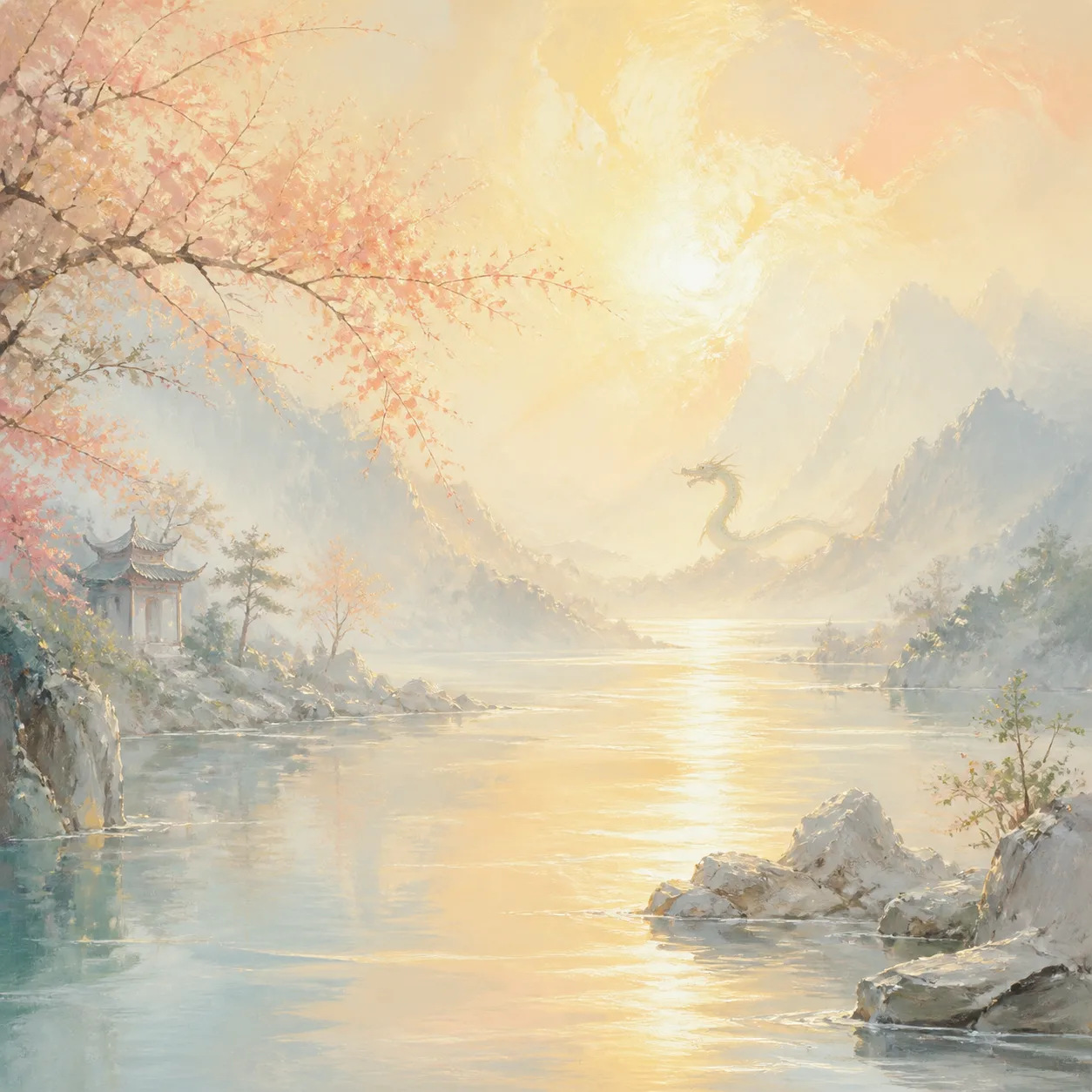
The River-Water Dragon
壬辰 (Ren-Chen) · 长流水 (River-Water) · Water Stem
The Water Dragon (壬辰 Ren-Chen, River-Water 长流水) appears in 1952 and 2012. This combination blends the Dragon’s natural ambition with the wisdom, flexibility, and social grace of Water, though it can also bring volatility and indecisiveness. The River-Water NaYin grants exceptional adaptability and resilience, like an endless flowing river that continuously finds its way to the sea.
Quick Facts
| Years | 1952, 2012 |
| GanZhi | 壬辰 (Ren-Chen) |
| NaYin | River-Water (长流水 Chang-Liu-Shui) |
| Element | Water (Water Stem) |
| Base Element | Earth |
| Lucky Numbers | 1, 6, 13, 49 |
| Lucky Colors | Blue, Black, Silver |
| Lucky Direction | North |
| NaYin Season | Winter |
| Trine Group | First Trine (Rat, Dragon, Monkey) |
| Sexagenary Position | #29 of 60 in the Jia-Zi cycle |
| Lunar Year Dates | 1952: 1952-01-27 to 1953-02-14 2012: 2012-01-23 to 2013-02-10 |
| Six Harmony (六合) | Rooster — Secret Friend |
| Three Harmony (三合) | Rat · Dragon · Monkey (Water Trine) |
| Six Clash (六冲) | Dog — Opposing Force |
| Five Element Cycle | Generated by Metal → Water generates Wood → Controlled by Earth |
Dragon Element Variants Compared
| Variant | GanZhi | Years | Stem Element |
|---|---|---|---|
| Forest-Wood Dragon | 戊辰 | 1928, 1988 | Earth |
| Wax-Metal Dragon | 庚辰 | 1940, 2000 | Metal |
| River-Water Dragon ← You are here | 壬辰 | 1952, 2012 | Water |
| Lamp-Fire Dragon | 甲辰 | 1904, 1964, 2024 | Wood |
| Sand-Earth Dragon | 丙辰 | 1916, 1976 | Fire |
The River-Water Dragon flows with a vision as vast as the horizon, merging the Dragon’s innate ambition with an unstoppable, adaptable current. This combination excels at steering long-term strategies that require both bold foresight and fluid adjustment—think pioneering new markets or orchestrating large-scale social movements. Their strength lies in turning grand dreams into sustained momentum, moving obstacles aside with quiet persistence rather than brute force. The unique edge is a relentless forward motion that reshapes landscapes without losing direction.
Yet this endless flow can become a flood of overextension. The River-Water Dragon may spread their energy too thinly, chasing every tributary of opportunity instead of channeling depth. The shadow of constant movement is a difficulty with stillness—they can rush past necessary reflection or dismiss boundaries as temporary dams. When out of balance, their adaptability turns into restlessness, and their grand vision lacks the anchoring earth to build lasting structures. Learning when to meander and when to carve deep channels is essential.
The NaYin: River-Water (长流水 Chang-Liu-Shui)
In classical Chinese astrology, each of the 60 year-stem combinations carries a specific NaYin (纳音, “assigned tone”) — a poetic elemental melody refining the Five Elements into 30 archetypes. The River-Water (长流水) NaYin represents a unique expression of the water element.
Classical Sources
《三命通会》(Comprehensive Treatise on the Three Fates)
By 万民英 (Wan Minying), Ming Dynasty, 1587 — Volume 30, “On NaYin Elements”:
“长流水者,混混无穷,滔滔不竭,就下必纳于东南,顺流自归于辰巳。此水喜金生养,金要白蜡、钗钏。”
“壬辰,自库之水,若池沼水积之地,忌金来决破,若再见壬辰,是谓自刑,别辰无咎。”
Born in January or February?
There are two systems for determining your zodiac year. Folk tradition uses Lunar New Year (late Jan / early Feb). BaZi astrology uses Lichun (立春, Start of Spring, ~Feb 3–5). If your birthday falls in this boundary period, you might belong to the previous sign (Rabbit) under one system but the Water Dragon under another. Use our BaZi Calculator to determine your exact pillar based on Lichun.
Who they are
Picture a river that has carved its course through the dragon’s spine of the earth—this is the 壬辰 Dragon, whose soul is the ‘Long-Flowing Water’ (长流水, Chang-Liu-Shui). Unlike the thunderous waterfall or the stagnant pond, this is a water that moves with purpose, gathering momentum from every bend and obstacle. The Dragon’s natural charisma and ambition are here tempered by a fluid intelligence that never rushes but never truly stops. Where a Fire Dragon might burn out in a blaze of glory, the River-Water Dragon endures, adapting its path around rocks rather than shattering against them.
Yet this very adaptability carries a shadow. The Sanming Tonghui (三命通会) speaks of 壬辰 as ‘self-storing water’ (自库之水), a reservoir that can become stagnant if not fed by living currents. The Dragon’s earth branch (辰) acts as a riverbed, giving structure to the water stem (壬), but this also creates a tension: the water wants to flow freely, while the earth seeks to contain. This inner conflict manifests as a personality that is simultaneously visionary and hesitant, capable of grand plans yet prone to second-guessing at the moment of execution. They are the strategist who can see a thousand moves ahead but sometimes freezes at the first check.
The classical text warns that ‘if it meets another 壬辰, it is called self-punishment’—a reminder that this pairing can become its own worst enemy when isolated. Among the zodiac, the River-Water Dragon thrives in the Water Trine (三合) with Rat and Monkey, where the currents of wisdom, ambition, and resourcefulness merge into an unstoppable flood. But alone, or in the wrong company, the river can turn inward, carving ravines of self-doubt. The paradox of this Dragon is that its greatest strength—its fluidity—is also its greatest vulnerability: without clear banks, it can lose itself in the delta of possibilities.
In love and partnership
In love, the River-Water Dragon does not storm the castle; it erodes the walls with patient tenderness. Their affections run deep and continuous, like the river that nourishes the land it passes through. They are the partner who remembers the small details, who listens with the full presence of flowing water, and who adapts to the needs of their beloved with intuitive grace. A Dragon born under 壬辰 excels at empathy, often sensing what their partner feels before words are spoken—a gift that makes them extraordinary listeners and confidants.
But water that adapts too readily can also lose its shape. The River-Water Dragon’s emotional fluidity sometimes leads to a lack of firm boundaries, drifting with the current of their partner’s desires until they lose sight of their own. They may stay in relationships past their expiration date, hoping that time and patience will smooth every rock. The Liuhe (六合) match of the Rooster offers a natural counterbalance—the Rooster’s sharp clarity and daily discipline can help the Dragon channel their deep feelings into a structured, enduring bond. For this Dragon, the pathway to lasting love is not to dam the river but to build banks: conscious commitments that give direction to their natural flow. Without them, they risk becoming a flood that overwhelms or a stream that meanders into nowhere.
Professional destiny
The River-Water Dragon’s career is a slow but relentless ascent, like a river carving a canyon over millennia. Their professional genius lies not in quick wins but in long-term vision sustained by daily, patient effort. Fields that require both strategic breadth and incremental progress—such as environmental science, urban planning, historical research, or marine biology—call to their unique talents. The water stem (壬) grants them a talent for communication and dissemination; they naturally thrive in diplomacy, international trade, or any role that bridges cultures and ideas. A River-Water Dragon makes an excellent negotiator, not through force but through the quiet persistence of water wearing down stone.
Yet the same current that carries them forward can also sweep them into danger. The Sanming Tonghui warns that this water ‘dislikes gold breaking it open’—in career terms, this translates to a vulnerability to aggressive, rigid systems or authoritarian leadership. They wither in environments that demand conformity and speed over thoughtful adaptation. Their growth edge is to find a ‘catalyst’—a mentor, a clear mission, or a structured team—that channels their flowing energy into a defined channel. Without it, they risk becoming the talented general who never picks a war, or the visionary who spends a lifetime planning and never building. The River-Water Dragon’s career arc is not a sprint but a marathon; their success is measured not in speed but in the depth of the course they cut.
Physical and mental health
The River-Water Dragon’s vitality is tied to the element of water, which governs the kidneys, bladder, and adrenal system. In Chinese medicine, the kidneys are the ‘root of life,’ storing the essence that fuels all other organs. For this Dragon, health is less about dramatic interventions and more about consistent, gentle care—like a river that must be kept flowing but not flooded. The earth branch (辰) corresponds to the stomach and muscles, creating a constitution that needs both hydration and grounding. A diet rich in black foods—black beans, black sesame, black rice—nourishes the water element, while warm, cooked meals support the earth stomach. Cold and raw foods, like ice in a river, can stagnate their energy.
Emotionally, the River-Water Dragon must guard against the ‘flood’ of overwhelm. When stressed, their instinct is to keep flowing, to absorb more, until they are diluted and exhausted. Practices that create boundaries—yoga, tai chi, or even simple daily routines—act as riverbanks, giving structure to their boundless energy. The image of the ‘Long-Flowing Water’ (长流水) reminds them that health is not a destination but a continuous process: like a river, they must move, renew, and sometimes rest in deep pools. Sleep, especially before midnight, is their most potent medicine, allowing the kidneys to recharge. A River-Water Dragon who neglects rest will find their current slowing, their clarity muddying—a warning as old as the text itself.
Money and prosperity
Wealth for the River-Water Dragon flows like its namesake: steadily, through networks and circulation, rarely through sudden windfalls. The water stem (壬) gives them a natural talent for generating income through relationships, information, and movement. They are the entrepreneurs who build businesses around community, the investors who understand market currents, the consultants who profit from connecting dots. The NaYin ‘Long-Flowing Water’ (长流水) suggests a financial trajectory that builds over time—modest beginnings that compound into a broad, enduring river of prosperity. They are patient accumulators, not flashy spenders, but their very patience can become a trap.
The pitfall unique to this Dragon is the tendency to let wealth stagnate. Just as the Sanming Tonghui warns that 壬辰 water can become a ‘reservoir’ that is ‘self-storing,’ these individuals may hoard resources out of a misplaced sense of security. They save diligently but may fail to invest, letting their money sit in low-yield ‘ponds’ rather than flowing into productive channels. Their financial growth edge is to embrace calculated risk—to let their river merge with other streams through partnerships, diversified investments, or charitable giving that returns in unexpected ways. The River-Water Dragon’s true wealth is not in the size of their reservoir but in the breadth of the ecosystem it supports. When they learn to let their resources flow, they find that abundance, like water, always finds its level.
Evolution and self-mastery
The River-Water Dragon’s greatest teacher is the river itself—specifically, the lesson of the dam. Water in its natural state is formless and free, but without boundaries, it becomes a flood that destroys everything, including itself. For the 壬辰 Dragon, the growth edge is to learn conscious containment: to say no with the same grace with which they say yes, to build structures that channel their vast energy into focused impact. The Sanming Tonghui’s warning about ‘self-punishment’ when encountering another 壬辰 is a metaphor for the paralysis that comes from endless possibility. Their path to mastery is not to flow more, but to flow with intention.
An actionable practice for this Dragon is to set a weekly ‘banking’ ritual: choose one project or relationship that receives their full, undivided current, and let the others rest. This mimics the river’s own wisdom—it does not try to water every field at once, but carves one deep channel that sustains life for miles. When the River-Water Dragon learns to build banks without becoming rigid, they transform from a wandering stream into a majestic river that shapes landscapes. Their potential is not to be the loudest or the fastest, but the most enduring—the one who, like the Yangtze, flows through history, carving canyons of legacy from the patient persistence of water.
River-Water Dragon Years
| Year | GanZhi | Type | Details |
|---|---|---|---|
| 1952 | 壬辰 | River-Water Dragon | View Profile → |
| 2012 | 壬辰 | River-Water Dragon | View Profile → |
Famous River-Water Dragons
Notable figures born in 1952, 2012.
Oscar-nominated actor; Schindler’s List, Taken; commanding, gravitas-rich presence.
Beloved actor-dancer; Dirty Dancing, Ghost; raw charisma and physical grace.
Cult-favorite actor; Jurassic Park, The Fly; eccentric, intellectual charm.
A Six Harmony (六合) match — the secret friend combination, naturally aligned in energy and purpose.
People also ask
What elemental balance does a Water Dragon naturally seek?
The Water Dragon (壬辰) with NaYin 长流水 (River Water) seeks a balance of Earth and Wood. Earth (from the Chen branch) provides stability and containment for the flowing River Water, preventing it from dispersing. Wood, representing creativity and growth, channels the water’s energy productively. Too much Fire can dry up the water, while too much Metal can muddy it. Optimal balance includes supportive Earth elements like the Chen earthly branch itself and nourishing Wood to keep the river flowing harmoniously.
Which exact birth years produce the Water Dragon pillar?
The Water Dragon (壬辰) pillar occurs every 60 years. The most recent years are 1952 and 2012. In the Chinese zodiac cycle, 壬辰 years begin around early February (not January 1). For example, the 2012 Water Dragon year started on February 4, 2012, and ended on February 9, 2013. The next occurrence will be in 2072. Only those born within these specific lunar years have the 壬辰 (Ren-Chen) pillar as their year pillar.
Which artists or thinkers exemplify the Water Dragon energy?
Water Dragons often possess visionary creativity and philosophical depth. Thinkers like Confucius (born 551 BCE, a 壬辰 year) exemplify the Water Dragon’s wisdom and enduring influence. Artists like the painter Qi Baishi (born 1864, a 甲子 year but with Water Dragon traits) show the blend of tradition and innovation. Modern figures like actor Jet Li (born 1963, a 癸卯 year) may not be Water Dragons but embody the Dragon’s charisma. Notable 1952 Water Dragons exemplify this combination’s strategic depth, commanding presence, and enduring influence across the arts and public life.
Which animal pairings create magnetic attraction with Water Dragon?
The Water Dragon (壬辰) is most magnetically attracted to the Rooster (酉) and Monkey (申). The Rooster’s precision and elegance complement the Dragon’s grandeur, forming a strong Metal-Water connection that fuels mutual admiration. The Monkey’s wit and adaptability intrigue the Dragon, creating a dynamic and playful bond. The Rat (子) also harmonizes, as Water supports Water, but may lack excitement. Avoid the Dog (戌) and Rabbit (卯), as they clash with the Dragon’s Earth branch, causing friction.
What does 长流水 (River-Water) reveal about your life path?
The NaYin 长流水 (River Water) reveals a life path of constant movement, adaptability, and deep emotional currents. Like a river, you are meant to flow through experiences, nourishing others while carving your own course. You possess resilience, able to overcome obstacles by finding new paths. Your life may involve cycles of ebb and flow—periods of calm and turbulence. The river’s persistence suggests long-term success through steady effort. Your emotional depth allows profound connections, but you must guard against being overwhelmed by your own feelings.
What temperament patterns define the Water Dragon?
Water Dragons (壬辰) are dynamic yet introspective. They combine the Dragon’s natural charisma and ambition with Water’s emotional depth, creating a personality that is both inspiring and sensitive. They are visionary leaders who can be stubborn (Dragon) but also flexible (Water). They crave recognition but need solitude to recharge. Their mood can shift like currents—intense passion followed by reflective calm. They are intuitive and perceptive, often understanding others’ motives. Their temper flares rarely but dramatically, like a river in flood, but they cool down quickly.
What makes a Water Dragon feel truly understood?
A Water Dragon (壬辰) feels truly understood when someone recognizes their need for both freedom and stability. They appreciate partners who respect their independent spirit while providing a secure emotional harbor. Deep conversations that explore their complex inner world resonate deeply. They value loyalty and honesty above all; betrayal cuts them deeply. Being seen as more than just their confident exterior—acknowledging their vulnerabilities—creates a profound bond. Intellectual stimulation and shared dreams of making a lasting impact also make them feel understood.
What business instincts come with the Water Dragon pillar?
Water Dragons (壬辰) possess sharp business instincts: they are strategic, visionary, and adept at navigating market currents like a river. They excel in industries requiring innovation and adaptability—such as technology, media, or finance. Their intuition helps them spot opportunities others miss, and their charisma attracts partners and clients. However, they can be overly confident; River Water must avoid stagnation by embracing calculated risks. They thrive when leading teams, using their natural authority to inspire. Long-term planning and networking are their strengths, but they should delegate details.
Want Your Personal Reading?
Get your complete BaZi chart with all four pillars, NaYin analysis, and life chapters.
Open Free BaZi Calculator →