
The Chen month (辰, the Dragon’s branch) is the third month of the solar-term year, opening at Qingming around April 5 and closing at Lixia around May 5 or 6. Its branch is also the zodiac’s only storage seat that holds Water. Those two facts, the window and the vault, drive everything below.

Key Takeaways
- The Chen month is the third month of the solar-term year: Qingming opens it around April 5, Lixia closes it around May 5 or 6.
- Month pillars switch only at the 12 sectional terms (Jie); the mid-month principal term Guyu, around April 20, never flips the pillar.
- Chen stores three hidden stems in weighted order: Wu Earth main qi, Yi Wood middle, Gui Water remnant, the storage branch that holds Water.
- A Chen-month birth takes one of five month pillars, Wu Chen, Geng Chen, Ren Chen, Jia Chen, or Bing Chen, set by the year stem.
- Earth Day Masters read Prosperous in the Chen month, Metal reads Supported, while Water reads Dead and Wood reads Imprisoned.
The Chen Month in the Solar-Term Year: What It Gives a Birth Chart
Every branch in the twelve-branch cycle rules one solar-term month, and Chen takes the third seat. The window runs from Qingming (Clear and Bright), which opens the month around April 5, to Lixia (Beginning of Summer). Lixia opens the fourth month and closes Chen. A chart with Chen as its month pillar was born inside this window, a range that does not line up with any calendar month.
| Feature | Value |
|---|---|
| Branch | Chen (辰), the Dragon |
| Month order | Third month of the solar-term year |
| Solar-term window | Qingming (around April 5) to Lixia (around May 5 or 6) |
| Season | Late spring (季春), third month of spring |
| Compass palace | Xun (巽), southeast |
| Branch element | Earth |
The season entry is a table value: late spring (季春), third of spring’s three months, seated at the southeast (巽) compass palace. The mix-up to avoid is between two calendars, because the Chen month is the third month of the solar-term year and not the lunar third month. Solar-term months divide the sun’s annual circuit into 12 windows of about 30.4 days, so the term dates hold their ground year after year.
What the window gives a chart is the month pillar’s branch: Chen, a Yang branch carrying Earth over three hidden stems (the Dragon’s full profile sits on our Chinese zodiac page). If you were born between the two terms, a boundary date decides which side of the seat your pillar lands on.
Qingming Opens the Chen Month: Two Solar Terms, One Switch
The 24 solar terms alternate in two ranks, 12 sectional (Jie) and 12 principal (Qi), and a BaZi month pillar changes only at a sectional term. Qingming is the Jie that opens Chen, listed at 15 degrees of solar longitude in the standard solar term tables. Guyu (Grain Rain), the principal term around April 20, sits mid-month and switches nothing.
The measured boundary makes the difference concrete: the term fell around April 5 in 2000 and again in 2026, so each year returns a different pillar on either side of that line. Both mid-month tests, April 20 in each year, stayed inside the Chen pillar.
| Year | Date tested | Month pillar returned | Month |
|---|---|---|---|
| 2000 | April 4 | Ji Mao (己卯) | Mao, second month |
| 2000 | April 6 | Geng Chen (庚辰) | Chen, third month |
| 2000 | April 20 | Geng Chen (庚辰) | Guyu mid-month, no switch |
| 2026 | April 4 | Xin Mao (辛卯) | Mao, second month |
| 2026 | April 6 | Ren Chen (壬辰) | Chen, third month |
| 2026 | April 20 | Ren Chen (壬辰) | Guyu mid-month, no switch |
| 2026 | May 4 | Ren Chen (壬辰) | Chen, before Lixia |
| 2026 | May 6 | Gui Si (癸巳) | Si, fourth month |
Eight tests, one pattern: any date before the sectional term reads the old month, and the principal term never interrupts. In my experience, most wrong month pillars come from copying a fixed date instead of checking the term for the birth year, because the boundary wobbles between April 4 and April 6 as the astronomy lands.
Treat the term, not the calendar page, as the edge.
Inside the Water Vault: Chen’s Hidden Stems in Weighted Order
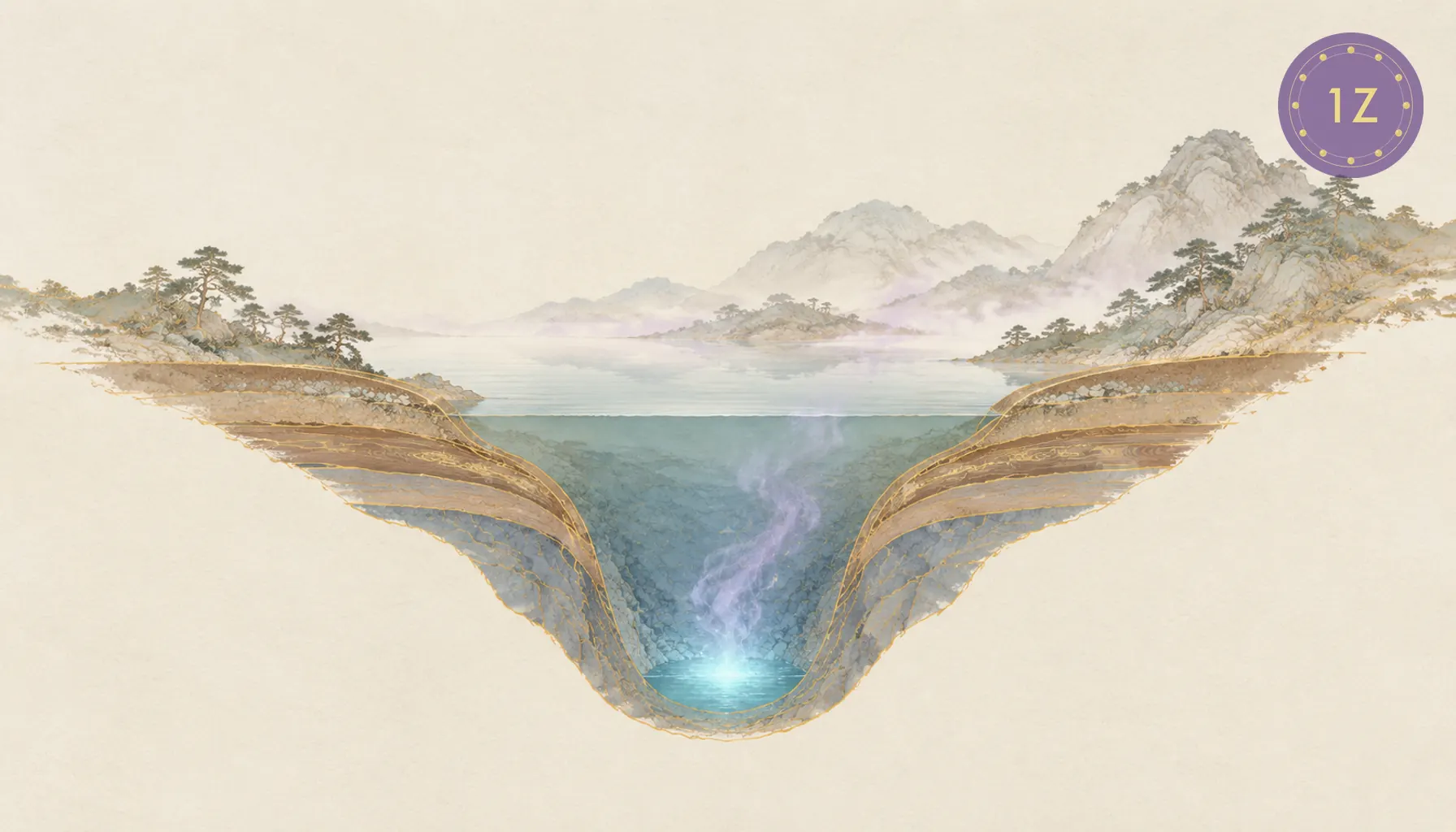
Look inside the branch and the vault structure appears: Wu (戊), Yang Earth, as main qi; Yi (乙), Yin Wood, as middle qi; Gui (癸), Yin Water, as remnant qi, returned by the lookup in strict weighted order. Weighted means the first name dominates the read, the second supports, and the third sits deepest. “Chen is Earth” is the headline, and the Water underneath is the reserve.
That reserve is why the classical tables file Chen as the water vault. Of the four storage branches (Chen, Xu, Chou, Wei), each stores exactly one element, and Chen stores Water, the storage seat of the Water trine that runs Shen, Zi, Chen (Monkey, Rat, Dragon). Earth alone holds 4 of the 12 Earthly Branches while every other element holds 2 branches, and exactly 7 branches carry 3 hidden stems, Chen among them.
Hidden stems live only inside Earthly Branches, never in the stems themselves, and the hidden stems guide walks all twelve. Storage classically means locked until a clash or combination turns the lock, and schools differ on which key opens which vault.
Five Chen Month Pillars: Which Birth Chart Gets Which
The branch is fixed; the stem comes from the year. The Five Tigers rule (五虎遁) derives the month stem from the birth year’s Heavenly Stem, the mechanism the Four Pillars overview lists as the month pillar’s second input, and since Chen is one of the six Yang branches, only Yang stems ever pair with it: Wu, Geng, Ren, Jia, Bing, the complete Yang set.
| Year-stem pair | Chen month pillar | Nayin |
|---|---|---|
| Jia or Ji years | Wu Chen (戊辰) | Forest Wood |
| Yi or Geng years | Geng Chen (庚辰) | Chaste Metal |
| Bing or Xin years | Ren Chen (壬辰) | Longflow Water |
| Ding or Ren years | Jia Chen (甲辰) | Lamp Fire |
| Wu or Gui years | Bing Chen (丙辰) | Sand Earth |
Five pillars, five nayin names, one from each element: Forest Wood, Chaste Metal, Longflow Water, Lamp Fire, and Sand Earth. The names rotate over an Earth branch that never changes. Two Chen-month births six years apart can share the branch and still answer to different nayin names.
The doubling case is real: 2000 is itself a Geng Chen year, so a Chen-month birth that year carries Geng Chen as year pillar and month pillar alike, sexagenary number 17. Its nayin, Chaste Metal, is a Metal name seated on the Earth branch that generates it, storage over storage.
Check your own birth year against the left column, and the table hands you the pillar.
How Strong a Chen Month Birth Chart Reads: Five Day Masters, Five States
Month order is the heaviest single weight in strength assessment, and the Chen month splits the five Day Masters across every classification the scale has. The deterministic lookup returns this:
| Day Master | State in the Chen month | Classification |
|---|---|---|
| Earth | 旺 (Prosperous) | Strong (STRONGEST) |
| Metal | 相 (Supported) | Strong |
| Fire | 休 (Resting) | Moderate (draining) |
| Wood | 囚 (Imprisoned) | Weak |
| Water | 死 (Dead) | Weak (WEAKEST) |
For the two ends, the tool prints its explanations verbatim: “Earth in an Earth month is 旺 (Prosperous): the month element is the same as the Day Master, peer support at full volume.” And the floor: “Water in an Earth month is 死 (Dead): Earth controls Water (the month element restrains the Day Master), the weakest configuration.”
What stands out about the Chen month is the spread: one branch yields two Strong reads, one Moderate, and two Weak. The vault’s own Earth tops the table while the Water it stores sits at the bottom, container and reserve at opposite ends.
If you are checking a specific chart, treat the table as the opening weight and let the other pillars argue.
Bonds and Frictions Around the Vault: Dragon Natives and the Self-Punishment Year
The vault does not sit alone on the wheel; three bonds define how it behaves. Chen clashes Xu (戌), the Dog’s branch, a Six Clash the lookup flags directly: under our 78-pair scoring framework, the Dragon-Dog pair scores 38. The full pair analysis unpacks a clash between two Earth branches, pressure inside the same element rather than elemental war.
The friendly bond points the other way: Chen’s secret friend is You (酉), the Rooster’s branch, a Six Harmony whose structural potential classically reads as tending toward Metal. The Dragon-Rooster pair analysis scores it 95, one of three pairs at our ceiling. In my reading, this is the vault meeting the finished good, the bond pulling toward exactly that Metal.
The friction inside is quieter: Chen sits among the four self-punishment branches (Chen with Chen, Wu with Wu, You with You, Hai with Hai), where a branch meets its own double. For Dragon natives the next Dragon year arrives in 2036 (Bing Chen), and the traditional read adds an inner-friction layer, ambition turning inward, to the usual renewal-year scrutiny, which is why I tell Dragon clients to treat that year as an audit their own branch scheduled.
Storage also explains the long arc I keep seeing in my practice: one client, an Earth Dragon born in a 1988 Wu Chen year, spent fifteen working years unrecognized before a favorable ten-year luck pillar carried the recognition through, with industry standing arriving after 40. I read that arc through the vault itself: the recognition was stored, not absent, and storage keeps a schedule rather than taking orders. The vault pays on its own calendar, and the solar-term calendar is where the schedule is written.
Is the Chen month the same as the lunar third month?
No. The Chen month is defined by solar terms: it starts when the sun reaches the Qingming position, around April 4 to 6, and ends at Lixia around May 5 or 6. The lunar third month is defined by new moons, and a lunar year runs about 354 days against the solar year’s roughly 365, so lunar months drift earlier every year and only occasionally line up with the term windows. A date inside the lunar third month can therefore fall in the Mao month, or even the Yin month, of the BaZi system. The boundary table above shows the same-day split: Ji Mao for April 4, then Geng Chen for April 6. When a source says third month, check which calendar it means before you use it.
How do I check whether an April birth landed in the Chen month?
Check the exact Qingming time for the birth year first, because the term lands on April 4, 5, or 6 depending on the year’s astronomy. Births before the term belong to the Mao month, births from the term onward belong to the Chen month, and Lixia flips the seat again around May 5 or 6. The subtle case is a birth on the term date itself: the term arrives at a specific hour, so the calendar date alone cannot settle the pillar. Run the birth through a calculator that computes the term’s exact time for that year, then trust the window, not the calendar page. If you were born in early April and your chart says Mao month, that is usually the boundary at work, not an error.
Does a Chen month make every chart strong in Earth?
No. The Chen month reads Prosperous (旺) only for Earth Day Masters, and the strongest counter-case prints verbatim: “Metal in an Earth month is 相 (Supported): Earth generates Metal (the month element generates the Day Master), so the state is Strong, never Neutral.” Water and Wood take the two Weak rows and Fire the Moderate drain, all visible in the table above. The nuance specific to this branch is wetness: the classical tables file Chen among the wet storage branches, contrasted with the dry vaults Xu and Wei, a distinction schools lean on when they discuss how stored elements release. In practice, treat the month as the opening weight of any assessment, then let the remaining pillars argue.
Sources
Solar term – Wikipedia: the 24-term structure, 12 sectional plus 12 principal terms, with approximate dates for Qingming, Guyu, and Lixia.
Four Pillars of Destiny – Wikipedia: how the month pillar is built from solar-term boundaries and the year stem.
Solar Terms – Hong Kong Observatory: the observatory’s reference for solar term timing.
Conclusion
The Chen month is the third month of the solar-term year: a Qingming-to-Lixia window whose branch stores the Water trine’s reserve, carries one of five Yang stems, and reads five ways for the five Day Masters. Run your own April dates through the BaZi calculator and see which side of Qingming your chart lands on.