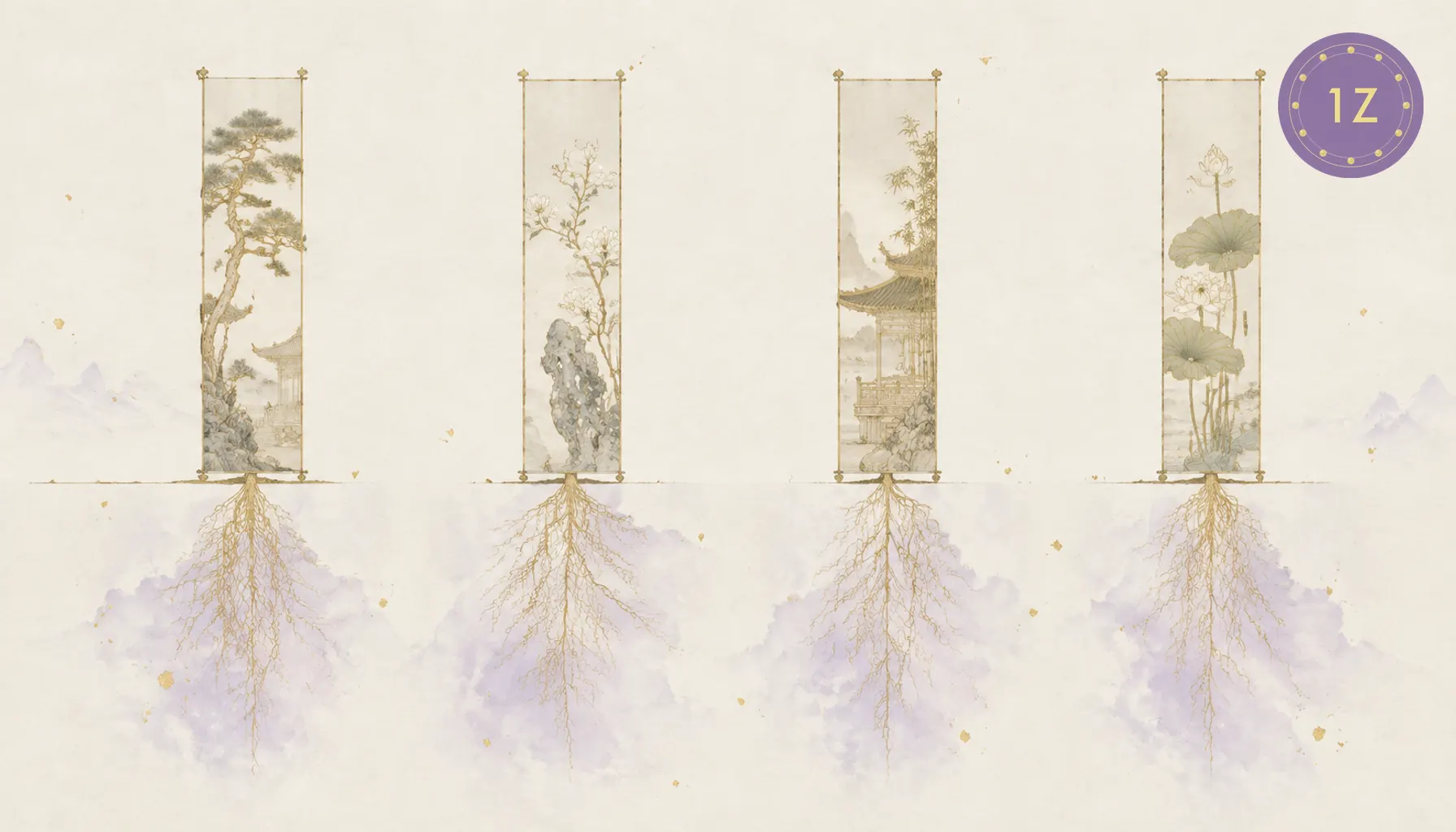

Hidden stems (藏干) are the heavenly stems stored inside each of the twelve Earthly Branches, and every branch in your birth chart carries between 1 and 3 of them in a fixed weight order. The visible stems sit above the branches like a canopy, while the hidden layer works below like a root system: unseen, but feeding everything above it. Below is the complete 12-branch table in weight order, the structural counts behind it, and a three-step method for reading the layer in your own chart.

Key Takeaways
- Each of the twelve branches stores one to three hidden stems in a fixed order: main qi (本气), middle qi (中气), residual qi (余气).
- The counts split cleanly: seven branches store three stems, two branches (Wu and Hai) store two, and three branches (Zi, Mao, You) store exactly one.
- Zi, Mao, and You are the only single-qi branches, holding pure Water, pure Wood, and pure Metal respectively.
- Hidden stems supply the Ten Gods roles that the visible layer only implies, which is why they decide where a day master stands firmly.
- Weight order matters when reading: the main qi speaks loudest, the residual qi whispers.
- To place your own hidden layer, you need the four pillars of your birth chart; our BaZi calculator assembles them for you.
What Hidden Stems Mean in a Birth Chart
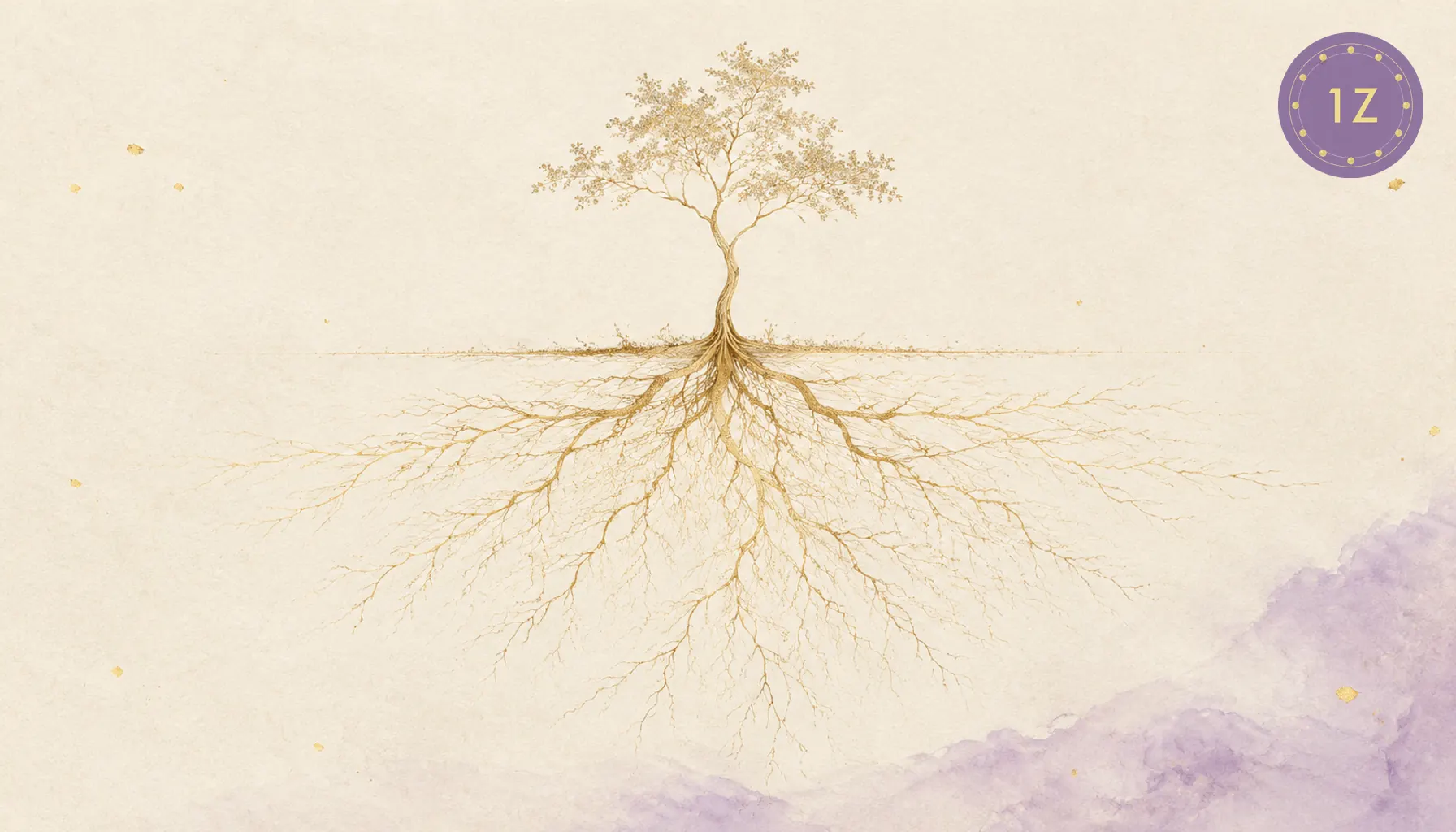
The BaZi system arranges 10 Heavenly Stems and 12 Earthly Branches into 4 pillars, one pillar each for year, month, day, and hour, with the day dividing into 12 windows of 2 hours each. The stems are the visible layer. Each branch, however, is not a solid block: the Earthly Branches conceal 1 to 3 stems inside them, and classical texts treat that concealed layer as real qi, present but not showing on the surface. The Four Pillars framework reads both layers together.
We read the visible stems as the canopy and the hidden stems as the root system, and that framing carries practical weight. Two charts can show the same stems above and behave differently below, because the branches under those stems may anchor the day master or starve it. In my experience, the hidden layer is where a chart stops being a poster of labels and starts being a plant you can actually water.
The layer also settles arguments the visible layer cannot. A chart with no Wood stem anywhere above may still carry Wood inside 5 different branches (Yin, Mao, Chen, Wei, Hai), and a day master with roots in the hidden layer reads very differently from one floating without them. That is the gap between a label sheet and a living structure.
The Complete Twelve-Branch Table, in Weight Order
The table below copies the classical mapping our tool reproduces for every chart, across all 60 stem-branch pairs of the cycle. Weight order runs main qi first, then middle qi, then residual qi, and the order is not decoration: the main qi contributes the strongest note, the residual qi the faintest.
| Branch | Animal | Hidden stems (main → middle → residual) |
|---|---|---|
| Zi | Rat | Gui (single qi) |
| Chou | Ox | Ji → Gui → Xin |
| Yin | Tiger | Jia → Bing → Wu |
| Mao | Rabbit | Yi (single qi) |
| Chen | Dragon | Wu → Yi → Gui |
| Si | Snake | Bing → Geng → Wu |
| Wu | Horse | Ding → Ji |
| Wei | Goat | Ji → Ding → Yi |
| Shen | Monkey | Geng → Ren → Wu |
| You | Rooster | Xin (single qi) |
| Xu | Dog | Wu → Xin → Ding |
| Hai | Pig | Ren → Jia |
Tabulating the storage depth gives the second useful view. Seven branches run the full three-stem depth, two branches stop at two, and three branches hold a single stem.
| Stems stored | Branch count | Branches |
|---|---|---|
| 3 (full depth) | 7 | Chou, Yin, Chen, Si, Wei, Shen, Xu |
| 2 | 2 | Wu, Hai |
| 1 (single qi) | 3 | Zi, Mao, You |
Three Pure Branches, Two Dual-Stem Branches, Seven Full Branches
The single-qi trio deserves its own paragraph because single-qi purity is rare. Only Zi, Mao, and You hold exactly 1 stem: pure Gui Water, pure Yi Wood, and pure Xin Metal respectively. Twelve seats exist and just 3 of them are pure, which is why classical readers treat these three as unmixed voices; whatever the branch promises, it delivers at full concentration.
Wu and Hai form the two-stem middle case, and their compositions differ in flavor. Wu stores Ding Fire as main qi with Ji Earth as middle qi, and the classical memory anchor describes the Horse as fire carrying a clay base. Hai stores Ren Water as main qi with Jia Wood as middle qi, and its anchor calls the Pig water carrying a forest seed. Neither branch is pure, yet each keeps a clear hierarchy: the first stem governs, the second supports.
The remaining 7 branches store 3 stems each, running the full main-middle-residual spread: Chou, Yin, Chen, Si, Wei, Shen, and Xu. Reading them is a weight exercise. Yin starts with its own Jia Wood, warms with Bing Fire, and trails Wu Earth, in that order, and a reader who flattens the three into an unordered list loses exactly the information the table exists to carry.
What the Hidden Layer Adds to a Birth Chart Reading
Under an editorial framework reviewed by Mei Lin Chen, the hidden layer earns its keep in two ways, and the first is anchoring. A day master with its own element stored as main qi inside a branch stands on ground; the same day master with no such storage floats. I have watched the hidden layer decide a chart’s outcome more than once, and what stands out about it is precisely this: it converts the strength question from guesswork into lookup, one branch at a time.
The second contribution is the Ten Gods cast. Every hidden stem plays a role relative to the day master, using the same mapping our Ten Gods table documents for visible stems, so the hidden layer supplies supporting actors the visible chart never announced. The five element guide explains why a stored element still counts toward strength, since generation and control run on elements rather than on visibility. For most beginners, these quiet roles are the surprise of the whole exercise: visible stems change with every pillar and a luck pillar resets every 10 years, while the hidden layer sits fixed inside the branches for a lifetime.
A case from our files shows both contributions at once. A 1976 Fire Dragon client, a therapist by trade, kept colliding with authority figures and wanted to know why. Her day master was Jia Wood, and the month pillar above it carried Geng Metal, the Seven Killings star pressing on Jia from above. Inside that same month branch (Yin) sat Jia, Bing, and Wu: her own Wood rooted directly beneath the pressure, with Bing Fire waiting mid-layer. One pillar earlier, the transparent year stem did louder work: the 1976 Bing Fire overhead, her Eating God, met the Geng pressure head-on in the classical Eating-God taming Seven Killings (食神制杀) shape. That combined arrangement, in my interpretation, is why the pressure never broke her; the root system held while the canopy took the weather, and her work eventually turned exactly that pressure into a profession about authority.
I tell clients the same thing whenever a chart under-delivers on its visible promises: check the roots before rewriting the canopy. The hidden layer is usually where the answer sits.
How to Read Hidden Stems in Your Birth Chart
- Assemble the four pillars. Year, month, day, hour: each pillar is one stem over one branch.
- Lay the hidden layer under each branch. Read the table above branch by branch, keeping the main, middle, residual order intact, and mark every spot where your day master’s element appears as main qi.
- Cast the Ten Gods for each hidden stem. Compare each hidden stem against your day stem and note the role it plays.
Three passes, one fixed table, zero guesswork. That is the whole skill, and it repeats identically on every chart you will ever read. If the four pillars themselves are new to you, our chart reading basics page walks the assembly first.
Two references carry the rest. The element cycle explains which relations generate and which control, and the free calculator handles the calendar arithmetic, which is the part humans get wrong by hand.
How do hidden stems combine with my day stem?
Each hidden stem combines with your day stem through the standard Ten Gods mapping, exactly as a visible stem would. Run one comparison per hidden stem: relations that generate you act as Resource, relations you generate act as Output, relations that control you act as Officer, relations you control act as Wealth, and relations of your own element act as Companion. Polarity then splits each family: a Jia Wood day master meeting Xin Metal reads as Direct Officer (opposite polarity), while the same Jia meeting Geng Metal reads as Seven Killings (same polarity). A Jia meeting Wu Earth is a Wealth relation of the same polarity, the Indirect Wealth flavor. Every hidden stem in the twelve-branch table above resolves through that same two-step check, which is why a single chart can hold a dozen named roles before any interpretation begins.
Why do some branches store 3 hidden stems while others store 1?
Branches store different numbers of hidden stems because the classical table fixes each branch’s composition rather than deriving it on the spot. You holds Xin Metal alone: a single-qi branch, one stem at full concentration. Wu holds Ding Fire as main qi and Ji Earth as middle qi, the fire-with-a-clay-base composition, and Hai holds Ren Water over Jia Wood, the water-with-a-forest-seed composition. Both dual-stem branches stop at two ranks, main qi and middle qi, with no residual layer beneath them. The remaining seven branches (Chou, Yin, Chen, Si, Wei, Shen, Xu) run the full three-stem spread from main qi down to residual qi. That gives the full census: three pure branches, two dual-stem branches, seven full branches, twelve in all. The practical consequence is concentration: a single-qi branch delivers its element undiluted, while a three-stem branch blends three voices in a fixed order of loudness.
Can a hidden stem rescue an element missing from the visible stems?
An element is not missing from a birth chart just because no visible stem carries it; the hidden layer keeps it present inside the branches. Metal with no Metal stem above still hides in 5 branches across the table: Geng inside Si and Shen, Xin inside Chou, Xu, and You, with You carrying it as pure single qi and Shen holding it as main qi. The seats differ in readiness: Geng inside Si sits at its Growth position (长生), while Xin inside Chou and Xu waits in storage tombs, classically locked until a clash or combination opens the vault. A chart can therefore root a Metal day master (Geng or Xin) through branches that show no Metal anywhere on the surface. The reverse matters too: assuming an element is strong because a stem displays it can mislead when no branch actually stores that element beneath. Reading both layers together, visible and hidden, is the whole point of the table, and it is why two charts with identical stems can behave like different plants.
Conclusion
Hidden stems turn the four pillars from a flat label sheet into a layered structure: canopy above, root system below, 12 branches holding 1 to 3 stems each in a fixed order. Our calendar engine resolves birth years 1900 to 2099 (200 years of data), so the pillar arithmetic underneath your hidden layer is exact. To see your own hidden layer, run your birth data through our free BaZi calculator and read the branches against the table above.
Sources
- Four Pillars of Destiny (Wikipedia): backs the four-pillar structure and stem-branch framework described above.
- Earthly Branches (Wikipedia): backs the twelve-branch system and their classical associations.
- Chinese astrology (Britannica): backs the classical cosmological framework the hidden-stem layer rests on.