
In BaZi, your season is the family of month branches your birth month belongs to, and that family sets the opening weight your chart carries into any reading. Four seasons cover the year through twelve branches, three per season, each branch holding one solar-term month. This guide maps all twelve, shows how one season reads five ways depending on the Day Master, and points to the 12Zodiacs tools that run the lookup for you.

Key Takeaways
- A BaZi season is the three-branch family your month branch belongs to: Yin, Mao, Chen form spring; Si, Wu, Wei form summer; Shen, You, Xu form autumn; Hai, Zi, Chou form winter.
- The month branch traditionally carries the most weight of any single seat in a strength reading.
- Five states describe how the season treats your Day Master: 旺 (Prosperous), 相 (Supported), 休 (Resting), 囚 (Imprisoned), 死 (Dead). No neutral column exists.
- One spring month yields five verdicts at once: Wood Prospering, Fire Supported, Water Resting, Metal Imprisoned, Earth Dead.
- Seasons follow solar terms, not Gregorian dates: the Tiger month opens at Li Chun, a term that lands on February 4 in most years and drifts to February 3 or 5 at the edges.
What a Season Is in a BaZi Birth Chart
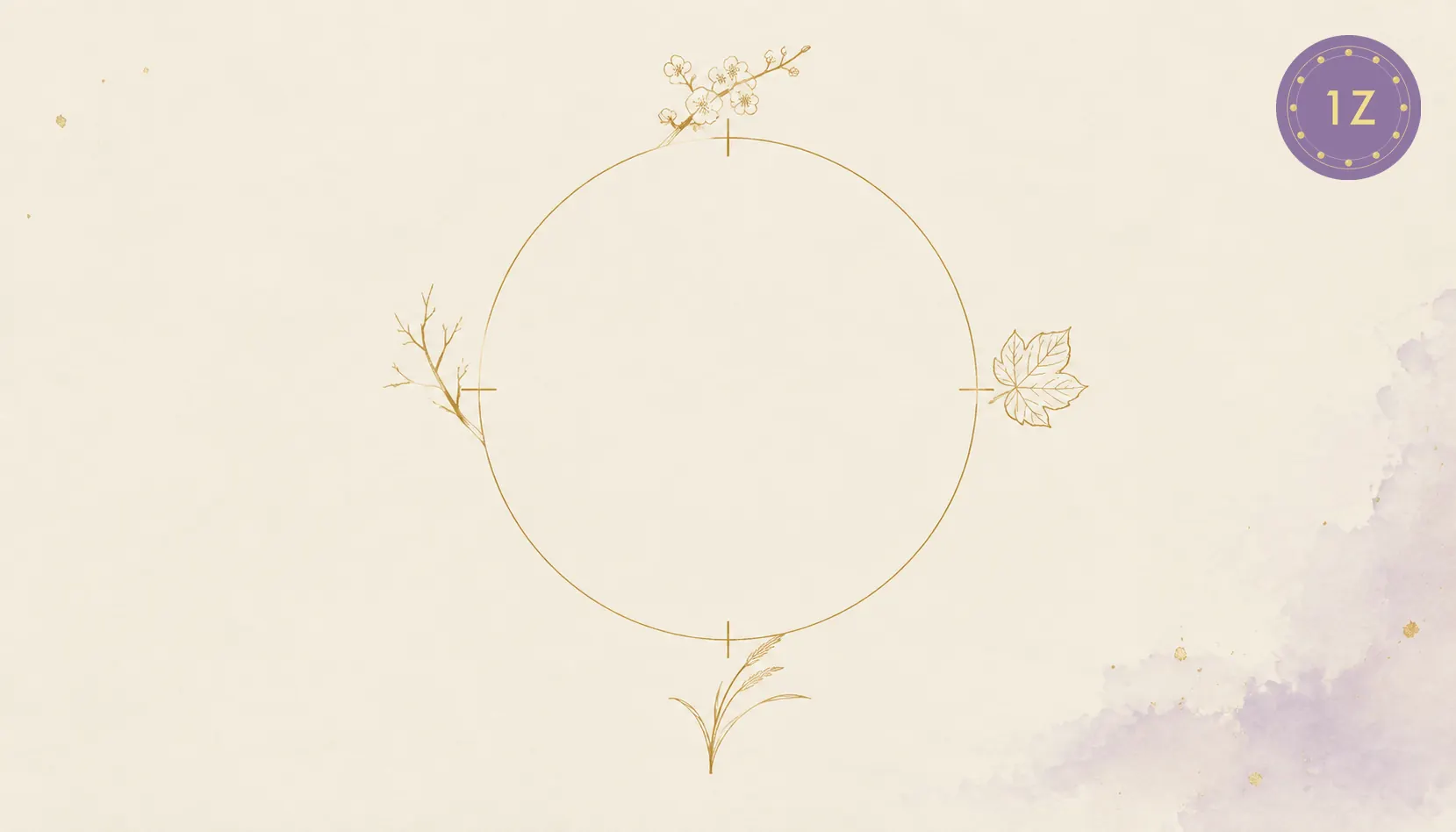
In a BaZi birth chart, the season of birth reduces to one question: which branch sits in your month pillar? The month pillar is the second of the four pillars, fixed by solar terms rather than calendar dates, and its branch (the month branch, 月支) belongs to a three-branch season family. Spring owns Yin, Mao, Chen. Summer owns Si, Wu, Wei. Autumn owns Shen, You, Xu. Winter owns Hai, Zi, Chou.
Each family runs in the classical three-beat order: an early month (孟), a middle month (仲), a late month (季). The Tiger branch Yin opens the year at Li Chun, the Start of Spring term, and each of the twelve hands over to the next at a named term. One window runs roughly 30 days, so a season spans about 90 days of real time. If you arrive from Western astrology, keep one boundary in mind. Western signs follow the sun against the star field, while BaZi seasons follow the month branch and its terms. The two overlap by temperament rather than by season. The pattern that emerges from reading charts this way is clean: name the branch first, and the season name follows from the table, never from feel or folklore.
The Twelve Month Branches of the Four Seasons
The map below is the whole system on one screen: twelve branches, four season families, one solar-term window per branch, and the classical compass seat each branch occupies. Month order counts from Li Chun, so the first month belongs to the Tiger and the twelfth to the Ox. UNESCO inscribed the twenty-four solar terms on its intangible heritage list in 2016, and this grid has been load-bearing for a very long time.
| Branch | Animal | Season seat | Month order | Solar-term window | Compass seat |
|---|---|---|---|---|---|
| Yin (寅) | Tiger | Early spring (孟春) | 1st | Li Chun to Jing Zhe | Gen, northeast |
| Mao (卯) | Rabbit | Mid spring (仲春) | 2nd | Jing Zhe to Qing Ming | Zhen, due east |
| Chen (辰) | Dragon | Late spring (季春) | 3rd | Qing Ming to Li Xia | Xun, southeast |
| Si (巳) | Snake | Early summer (孟夏) | 4th | Li Xia to Mang Zhong | Xun, southeast |
| Wu (午) | Horse | Mid summer (仲夏) | 5th | Mang Zhong to Xiao Shu | Li, due south |
| Wei (未) | Goat | Late summer (季夏) | 6th | Xiao Shu to Li Qiu | Kun, southwest |
| Shen (申) | Monkey | Early autumn (孟秋) | 7th | Li Qiu to Bai Lu | Kun, southwest |
| You (酉) | Rooster | Mid autumn (仲秋) | 8th | Bai Lu to Han Lu | Dui, due west |
| Xu (戌) | Dog | Late autumn (季秋) | 9th | Han Lu to Li Dong | Qian, northwest |
| Hai (亥) | Pig | Early winter (孟冬) | 10th | Li Dong to Da Xue | Qian, northwest |
| Zi (子) | Rat | Mid winter (仲冬) | 11th | Da Xue to Xiao Han | Kan, due north |
| Chou (丑) | Ox | Late winter (季冬) | 12th | Xiao Han to Li Chun | Gen, northeast |
Read Wei carefully: the Goat month is late summer (季夏), the sixth month of the solar-term year, and no amount of gentle-pasture imagery moves a fixed table position. Notice too where the Earth branches sit: Chen, Wei, Xu, and Chou each close a season, so those four months read as Earth months (our five elements guide walks the full set) even though their season seats say spring, summer, autumn, and winter. That wrinkle matters the moment strength enters the picture. Twelve rows, no exceptions, and the two rows people misread most are Wei and Chen.
How Your Season Reaches the Day Master
The season reaches you through one transmission line: the month branch supplies the month element, and the month element is read against your Day Master, the heavenly stem of your day pillar (our Day Master primer covers the basics). Classical practice has weighted this month-order test ahead of every other single seat since the Song-dynasty reforms associated with Xu Zi Ping, with the five-state vocabulary running through Ming-dynasty compendiums like the San Ming Tong Hui. The verdict comes in exactly five states.
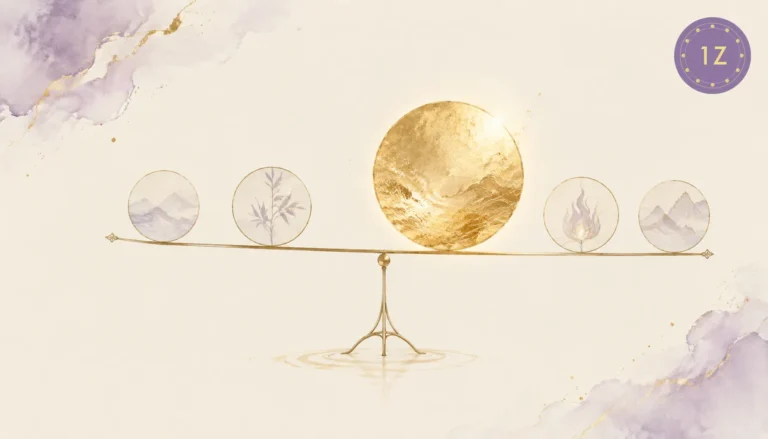
Take one spring month, Mao, the Rabbit’s branch, and walk the five Day Masters through it. Wood in a Wood month is 旺 (Prosperous): the month element is the same as the Day Master, peer support at full volume. Fire in a Wood month is 相 (Supported): Wood generates Fire (the month element generates the Day Master), so the state is Strong, never Neutral. Water in a Wood month is 休 (Resting): Water generates Wood (the Day Master’s energy pours into generating the month element), a moderate drain.
The remaining two states fill the same spring differently. Metal in a Wood month is 囚 (Imprisoned): Metal controls Wood (the Day Master restrains the month element), which costs effort. Earth in a Wood month is 死 (Dead): Wood controls Earth (the month element restrains the Day Master), the weakest configuration.
| Birth season (month element) | Wood DM | Fire DM | Earth DM | Metal DM | Water DM |
|---|---|---|---|---|---|
| Spring: Yin, Mao (Wood) | 旺 Prosperous | 相 Supported | 死 Dead | 囚 Imprisoned | 休 Resting |
| Summer: Si, Wu (Fire) | 休 Resting | 旺 Prosperous | 相 Supported | 死 Dead | 囚 Imprisoned |
| Earth months: Chen, Wei, Xu, Chou (Earth) | 囚 Imprisoned | 休 Resting | 旺 Prosperous | 相 Supported | 死 Dead |
| Autumn: Shen, You (Metal) | 死 Dead | 囚 Imprisoned | 休 Resting | 旺 Prosperous | 相 Supported |
| Winter: Hai, Zi (Water) | 相 Supported | 死 Dead | 囚 Imprisoned | 休 Resting | 旺 Prosperous |
The matrix above generalizes that spring to the whole year, and two notes keep it honest. First, no neutral column exists anywhere in it: 相 (Supported) counts as Strong, and the engine behind our strength tables prints that warning on every run (the methodology page documents the pipeline). Second, the Earth-month row sits outside the four season families on purpose. Chen closes spring and Wei closes summer, yet both read by Earth verdicts, because the branch’s own element, rather than the season label, faces the Day Master. For most Metal natives, that row is the whole point: the same spring that reads Imprisoned (囚) turns Supported (相) the moment the calendar reaches the Earth months. My case files keep confirming one pattern here: the month verdict frames the question, and the day stem answers it.
When the Season Turns: The February Boundary
BaZi months are solar-term months (节气月), cut at term boundaries rather than at the first of the Gregorian month, and never at a new moon. Each term lands on a precise hour, and the calendar recomputes that hour every year.
A real pair of dates shows how sharp the cut is. Take February 3, 2000. The BaZi year has not turned yet: the chart still belongs to the Rabbit year that began in 1999. The month pillar for that winter day is Ding Chou, the Ox branch, the twelfth month, late winter. Take February 5, 2000, two days later. The BaZi year has turned to Geng Chen. The month pillar for that spring day is Wu Yin, the Tiger branch, the first month of spring. One step across Li Chun turns three dials at once: month branch, season family, and year pillar.
Li Chun lands on February 4 in most years and drifts to February 3 or 5 at the edges. The other twenty-three solar terms slide the same way. That drift is why our calendar engine computes exact term times against Purple Mountain Observatory data instead of copying a fixed February 4 into every chart. Births within a day of a boundary get the hour-level check. So run the term, not the calendar page, whenever a birth sits near a line.
Reading a Birth Season Without Overreading It
Here is the working sequence I use when a client asks what their season means.
- Locate the month branch. Match the birth window against the table above, or let a tool that computes exact term times place the branch for you.
- Name the season family and the month element. The family gives spring, summer, autumn, or winter; the branch itself gives the month element, with the four season-closing months reading as Earth.
- Read the verdict as one weight among four. The month speaks loudest, the other pillars still get their say, and a trend-level answer is the right ceiling for one seat.
In my practice notes, a client born in 1991 makes the season layer concrete. Her year pillar reads Xin Wei, the Metal Goat, her day stem is Xin Metal, and her month branch is Wei, which seats her birth in late summer with Earth as the month’s main element. Earth generates Metal, so her Xin day stem opens the chart in the 相 (Supported) state rather than a depleted one. She arrived describing herself as an empath who drained in crowded rooms, and in our editorial lens the season read reframes that sensitivity as a well-resourced instrument instead of a defect. The practical layer we set was scheduling: crowded engagements away from the You hour (17:00-19:00), when Metal qi peaks, plus a morning meditation slot in the Yin hour (03:00-05:00).
For most clients, the season verdict lands as relief: the chart has a timetable, and the season names which chapter opens first.
Can two people born in the same BaZi season get opposite strength verdicts?
Yes, two people born in the same BaZi season can land on opposite strength verdicts, and the split runs through the Day Master. The season names the month family, but the five-state test reads the month element against each chart’s own day stem, so the same Rabbit-month spring that crowns a Wood day stem 旺 (Prosperous) hands an Earth day stem 死 (Dead). The reason sits in how the pillars cycle. The month branch is fixed by the solar-term year, while the day pillar runs its own sixty-day wheel through all sixty stem-branch pairs. Any day stem can therefore arrive in any season. Our strength matrix spells out the spring spread: in Yin and Mao alone, Wood reads 旺, Fire reads 相, Water reads 休, Metal reads 囚, and Earth reads 死. Season sets the question, the day stem writes the answer, and a full chart read weighs both against the remaining pillars.
Is a BaZi season the same as a Western zodiac season?
A BaZi season and a Western zodiac season are different instruments that happen to share a word. BaZi seasons track the month branch and its terms, twenty-four of them, each marking the sun’s passage along the ecliptic in fifteen-degree steps. Western signs divide the year into twelve roughly thirty-day spans keyed to the sun’s position against the star field. The two calendars also drift against each other. Li Chun, the Start of Spring term that opens the Tiger month, lands on February 4 in most years and drifts to February 3 or 5 at the edges. The other terms slide in the same fashion. Any overlap you feel between the two systems is temperament-level resemblance rather than shared mechanics, so we read them as parallel lenses. When a chart question gets serious, the month branch, not the sun sign, is the seat that answers it.
How do I find my BaZi season if I was born near a month boundary?
Finding your BaZi season near a month boundary starts with one rule: the term clock, rather than the Gregorian date, decides. Each of the twelve month branches switches at a named solar term, and those terms land on precise hours that shift from year to year. A birth on the boundary date itself can fall on either side, depending on the exact term time in that year. Practically, look the term up for your birth year instead of memorizing a date, and give any birth within about 24 hours of a boundary the hour-level check. Our calculator computes exact term times for this reason, calibrated against Purple Mountain Observatory data. One further wrinkle: the classical tables assume Northern Hemisphere seasonality, and schools differ on how to adapt readings for Southern Hemisphere births, so treat that edge case as a practitioner conversation rather than a lookup.
Sources
- Solar term, Wikipedia: backs the twenty-four-term structure, the fifteen-degree ecliptic spacing, and the Li Chun window of February 3-5.
- Twenty-Four Solar Terms, UNESCO Intangible Cultural Heritage: backs the 2016 inscription of the term system.
Conclusion: Your Season on One Map
The BaZi season system compresses into one screen: twelve branches, four families, five verdicts, one boundary that turns the year. Name your month branch, read its element against your day stem, and the opening weight of your chart stops being a mystery. When you want that lookup done for you, run your birth data through the 12Zodiacs BaZi calculator and read the season verdict straight off the month pillar.