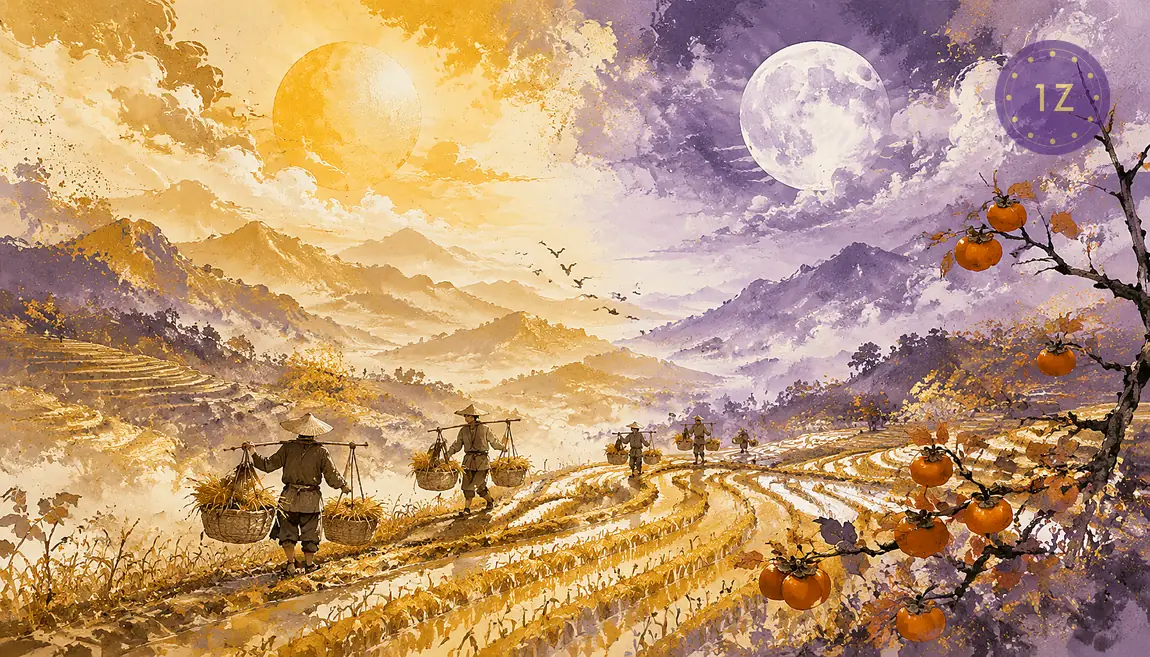

Qiufen (秋分), the Autumn Equinox, arrives in 2027 at the precise moment of 14:01 on September 23, Beijing time (UTC+8), when the sun crosses the celestial equator at 180° longitude and day and night stand equal across the globe. It is the sixteenth of the 24 solar terms, the pivot of autumn, and since 2018 the date of China’s national Harvest Festival for farmers.

Key Takeaways
- Qiufen 2026 arrived at 08:05 on September 23; Qiufen 2027 begins at 14:01 the same date, both computed to the minute at 180° celestial longitude
- Since 2018, the Qiufen date doubles as China’s Farmers’ Harvest Festival (中国农民丰收节), the country’s first national holiday dedicated to farmers
- The term marks true global balance: day and night within minutes of equal everywhere on Earth, not just in China
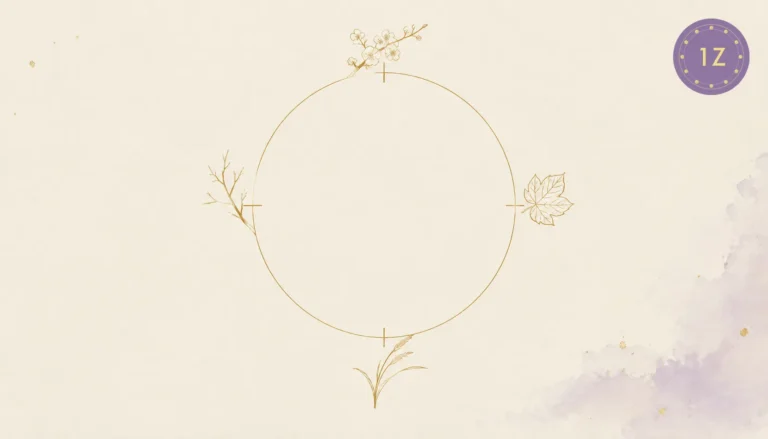
- Classical phenology records three pentads: thunder falls silent, hibernating insects close their burrows, rivers begin to shrink
- In BaZi, Qiufen sits at the midpoint of the Rooster month (酉月), peak Metal season, mirroring the spring equinox across the wheel
What Is Qiufen, the Autumn Equinox Solar Term?
Qiufen means “autumn’s division,” the day the sun crosses the equator and the hemisphere’s light and dark settle into equal shares. It is the fourth term of autumn, arriving after White Dew and before Cold Dew, and the old almanac gloss explains the name precisely: “at Qiufen, yin and yang are half and half, so day and night are equal and cold and heat are balanced” (秋分者,阴阳相半也,故昼夜均而寒暑平). The precision is worth savoring: this is the only pair of terms in the calendar, Qiufen and its spring counterpart Chunfen, whose definition is global rather than Chinese-latitude.
The date carries two modern and ancient honors. In 2018 the State Council designated the Qiufen date as the Chinese Farmers’ Harvest Festival, choosing the equinox for its symbolism of the season’s fair accounting, and the observance now brings agricultural exhibitions and harvest fairs to every province. The older tradition beneath it is the autumn sacrifice to the moon: the imperial calendar’s original moon rite sat at Qiufen, because the equinox night moon is round without fail, and the custom later drifted to the fifteenth of the eighth lunar month, where it survives as Mid-Autumn Festival. The Wikipedia Qiufen entry holds the astronomical frame, and the solar term system carries UNESCO intangible cultural heritage status.
The Exact Moment Qiufen Begins in 2026 and 2027
The equinox arrives at one minute worldwide; almanacs that print the date without the hour leave out the shared instant:
| Year | Exact Moment (UTC+8) | Sun’s Celestial Longitude |
|---|---|---|
| 2026 | September 23, 08:05 | 180° |
| 2027 | September 23, 14:01 | 180° |
Both instants come from the 12Zodiacs almanac engine on JPL DE440s ephemeris data. The 2027 moment converts to 06:01 UTC, which is 02:01 the same night in New York (EDT, UTC-4): the whole world shares the equinox date in 2027, a small coincidence of geometry worth noting. The roughly six-hour annual drift accumulates from the tropical year’s quarter-day surplus, corrected each leap February, the same arithmetic that moves every term.
In BaZi practice the minute marks a midpoint rather than a boundary, since the Rooster month opened at White Dew roughly fifteen days earlier. Its almanac weight is symmetrical and calendrical: the point from which nights outrun days for the next six months, the traditional “autumn balance” reference for diet and activity adjustments. The 12Zodiacs daily almanac marks the instant to the minute.
The Three Pentads: Silence, Sealed Doors, Shrinking Waters
The Yizhoushu phenology for Qiufen reads as spring’s ledger run in reverse:
| Pentad | Chinese | English | Phenology Type |
|---|---|---|---|
| First (days 1-5) | 雷始收声 | Thunder falls silent | Weather |
| Second (days 6-10) | 蛰虫坯户 | Hibernating insects seal their burrow doors | Animal |
| Third (days 11-15) | 水始涸 | Rivers and lakes begin to shrink | Weather |
The mirror with the spring equinox is exact and deliberate in the classical source: spring’s pentads open with thunder and stir hibernators outward, autumn’s close with thunder gone and hibernators walling themselves in. The third pentad records the dry season’s start, water levels dropping as rainfall thins, which is also the farmer’s cue for the final irrigation round before harvest. What stands out about the sequence is its bookkeeping quality, every entry an account being closed, a fitting phenology for the term whose name means division and whose modern role is auditing the harvest.
Standing Eggs, Sending Autumn Ox, and the Harvest Table
Qiufen’s customs orbit balance and the finished harvest:
| Custom | Practice | Logic |
|---|---|---|
| Standing eggs (竖蛋) | Balancing eggs upright at the equinox hour | The day of balance is said to make balance easy |
| Tangyuan in the fields (粘雀子嘴) | Placing unsweetened rice balls on field edges | “Sticking the sparrows’ beaks” so they leave the harvest alone |
| Autumn ox charts (秋牛图) | Sending printed ox-and-farming images door to door | Itinerant well-wishers trade verses for rice, opening the harvest social season |
| Harvest Festival events (丰收节) | Provincial farm fairs, produce awards, rural tourism | The 2018 national observance riding the traditional date |
| Crab and osmanthus | Eating hairy crab as osmanthus blooms | The Jiangnan autumn pairing at its seasonal peak |
The egg custom deserves the same honesty given at Lichun: gravity is no kinder on the equinox than any other day, and the success rate rises mostly because whole families try patiently at the same table. The tangyuan-in-the-fields custom is the calendar’s most literal pest negotiation, feeding the birds a toll so they spare the grain, and the autumn ox charts document a rural economy of verse-singing messengers that persisted into living memory. We recommend the crab: unlike the eggs, its timing is real, hairy crab and osmanthus peak together in the weeks around the term, and the calendar’s food timing is at its most reliable when it tracks a season rather than a sentiment.
Qiufen in Your BaZi Chart: Metal at Its Height
For BaZi practice, Qiufen is the Rooster month’s midpoint, a zhongqi in the same technical class as the two solstices: the month opened at White Dew, and the equinox marks its peak. The 2027 season month pillar runs Ji You (己酉), Earth over Metal, the strongest Metal signature of the calendar at its flood.
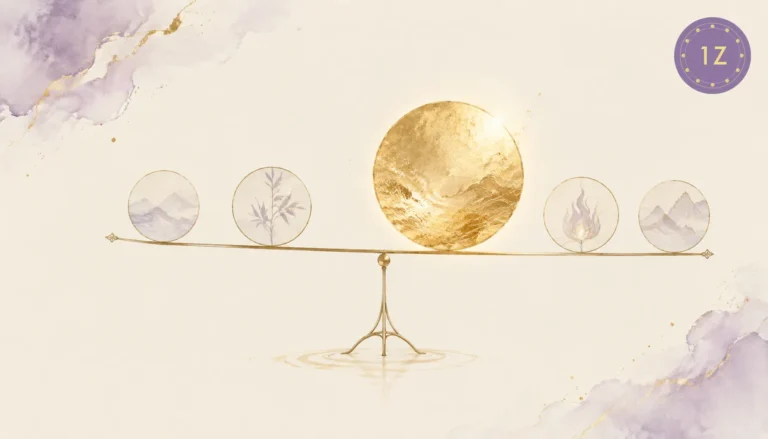
The Rooster branch belongs to the four cardinal branches (子午卯酉), the group holding a single dominant hidden stem: You carries pure Xin (辛) Yin Metal, the stem of refined metal, jewelry, precision instruments, and the harvest blade. The classical image for the season is the sickle, and the doctrinal reading follows the agriculture: Metal’s month is for cutting, finishing, and collecting, which is why traditional practice treats the post-equinox weeks as the season for closing matters rather than opening them. The spring mirror completes the doctrine: Chunfen’s Mao month of pure Yi Wood opens the year’s growth, Qiufen’s You month of pure Xin Metal closes it, the two equinox months forming the calendar’s cleanest Wood-Metal axis.
Metal Day Masters read the surrounding weeks as their strengthening season, and Wood Day Masters as the stretch requiring pacing, since Wood is pruned when Metal commands. In practice, the difference shows up most clearly in energy, not events. In Mei Lin Chen’s practice, the Qiufen fortnight is the natural annual review point: one 2nd Trine client, a Rooster-born auditor by profession, schedules her year’s client portfolio reviews in the Rooster month on the theory that her chart’s Metal precision peaks with the season, and a decade of clean books has yet to argue. The pattern generalizes further than most people expect: charts perform differently by season, and the solar calendar is the schedule. The Rooster year pages profile the branch in full, and the auspicious dates calendar applies term boundaries to planning.
What to Do Around the Equinox
Practical guidance for the term:
- Watch the temperature swing, not the average. Post-equinox days stay warm while nights drop fast; the season’s colds come from the spread, and dressing in layers is the traditional answer, with the “spring wrapping, autumn freezing” doctrine applied in moderation. We recommend the layers over the doctrine: the freezing part is for the young and sturdy.
- Eat toward moisture. Pears, lily bulb, white fungus, and honey answer the season’s dryness in the classical kitchen; the crab and persimmon that peak now are best paired with ginger tea for balance.
- Attend a Harvest Festival event if one is near. The 2018 national observance turned the date into a genuine fair season, and provincial produce awards are the calendar’s most photogenic week.
- Note the Mid-Autumn adjacency. The lunar festival drifts across September and October while Qiufen is fixed; some years the two nearly coincide, doubling the moon-viewing season, others split it a month apart.
- Check birthdays against the term minute. Equinox-week births are mid-Rooster-month rather than boundary cases, but charts stamped near White Dew two weeks earlier deserve the minute-level check.
Why do some tables call Qiufen the equal-day mark when day and night are not exactly equal?
Atmospheric refraction and the sun’s disk width make the measured day a few minutes longer than the astronomical night everywhere on Earth, so the perfectly equal day falls a few days before the equinox at mid-latitudes. What the equinox actually equalizes is the geometric day, the moment the sun’s center crosses the equator, making day and night equal by definition rather than by stopwatch. Chinese almanac language avoided the trap: the classical gloss says yin and yang are “half and half” at Qiufen, a statement about the calendar’s symmetry rather than a claim your sundial will certify, and the small gap is why serious tables publish the crossing instant while folk custom contentedly stands eggs anyway.
How does the Harvest Festival relate to the older autumn observances on the same date?
The 2018 national festival is a modern layer on a deep stack. The imperial autumn sacrifice to the moon originally keyed to the Qiufen date, because the equinox moon rises full, and the rite later migrated to the eighth lunar month’s fifteenth day, becoming Mid-Autumn Festival. Village customs around the date, tangyuan for the sparrows, autumn ox chart exchanges, harvest dinners, carried the practical calendar. The Farmers’ Harvest Festival chose the date deliberately to inherit the symbolism: the equinox’s fair accounting of light and dark reads naturally as the fair accounting of a year’s farming, and the modern fairs revived a date that had been doing harvest-ceremony duty for over two thousand years.
Can the equinox affect BaZi charts despite being born weeks from the boundary?
The equinox itself is a midpoint marker, so charts on either side of the day share the Rooster month, but its seasonal signal runs wider than its boundary. Seasonal-strength analysis weights Metal from White Dew through Cold Dew, with the equinox week as the peak reference, so a Rooster-month chart reads differently from a Dragon-month chart even with identical stems elsewhere, and the two equinox months, You and Mao, form the sharpest opposed pair in the seasonal wheel. Practitioners use the equinoxes as the year’s two balance points for exactly this reason: they divide the year into a Wood-dominant half and a Metal-dominant half, and charts tilt with the half they were born into.
Conclusion
Qiufen is the calendar’s cleanest audit: light and dark split even, the harvest weighed, the thunder retired. The 2027 equinox arrives at 14:01 on September 23 Beijing time, the Rooster month stands at its Metal peak, and the fields are being counted. To see which half of the year your chart was born into, try the 12Zodiacs BaZi Calculator, and for every term boundary through the season, follow the Tung Shing almanac.
Sources
- Qiufen, Wikipedia (term definition, dates, phenology)
- The Twenty-Four Solar Terms, UNESCO Intangible Cultural Heritage (heritage listing)
- Solar Terms, China Culture, Ministry of Culture (official English translations)
- Solar term timing data computed by the 12Zodiacs almanac engine (JPL DE440s ephemeris)