
Six break pairs (破) are a quieter relationship line the Chinese zodiac keeps beside its clash pairs: the 12 branches form three sets of four, and the classical table assigns each set two break pairs next to its two clash pairs. Break pairs rarely decide a match or a chart by themselves, yet they explain a persistent texture that compatibility lists miss, such as why Rat and Rooster can feel at odds without ever appearing on a clash chart. This article maps the geometry behind all six, separates the two pairs that double as harmonies, and sets the honest boundary: a break is a footnote to the zodiac, not a verdict.

Key Takeaways
- The 12 branches form three sets of four, and the classical table assigns each set two break pairs beside its two clash pairs, six breaks in total.
- The 6 break pairs are Rat-Rooster (子酉), Horse-Rabbit (午卯), Tiger-Pig (寅亥), Snake-Monkey (巳申), Dragon-Ox (辰丑), and Goat-Dog (未戌).
- Two breaks hide inside Six Harmonies: Tiger-Pig and Snake-Monkey are both harmony and break, and the harmony governs.
- Breaks from the four peak branches run strongest, while growth-branch and tomb-branch breaks stay light.
- Every one of the 12 branches has exactly one break partner, just as it has exactly one clash partner.
- In compatibility terms breaks are seasoning, not structure: none of the four break-only pairs carries a classical bond in our scoring.
What a Break Pair Means in the Chinese Zodiac
The twelve Earthly Branches carry more than one layer of relationship. Most learners meet the loud layer first: the Six Clashes, the six pairs that sit opposite each other and pull apart. Underneath that loud layer sits a quieter one. When the branches are grouped by position, each set of four holds two direct clash pairs, and the classical table assigns each set two further break pairs beside them. The Chinese name is 破, pronounced po, and the character means to break or to chip away.
A break pair is best described as low-grade friction, and the branch positions behind it come from the same calendar engine we build on, the one the Purple Mountain Observatory publishes. It is not the open opposition of a clash, and it is not the covert injury of a harm. It is a small wearing texture that shows up mostly in how a pair behaves over time rather than in any dramatic event. In our reading practice, a break surface shows as the repeating small thing two people or two chart factors do to each other, never as the thing that ends the story. The six clash pairs and their louder language have their own article; the break layer is the one that quietly fills in the gaps.
One caution before the tables: break pairs are easy to miss precisely because they are quiet, and the cost of missing them shows up in pairing examples. A well-known case is Rat-Rooster, which reads as entirely unconnected in a quick scan, yet carries a break from the peak set. Writing “no conflict at all” about that pair would skip a real line.
The Geometry Behind Every Break Pair
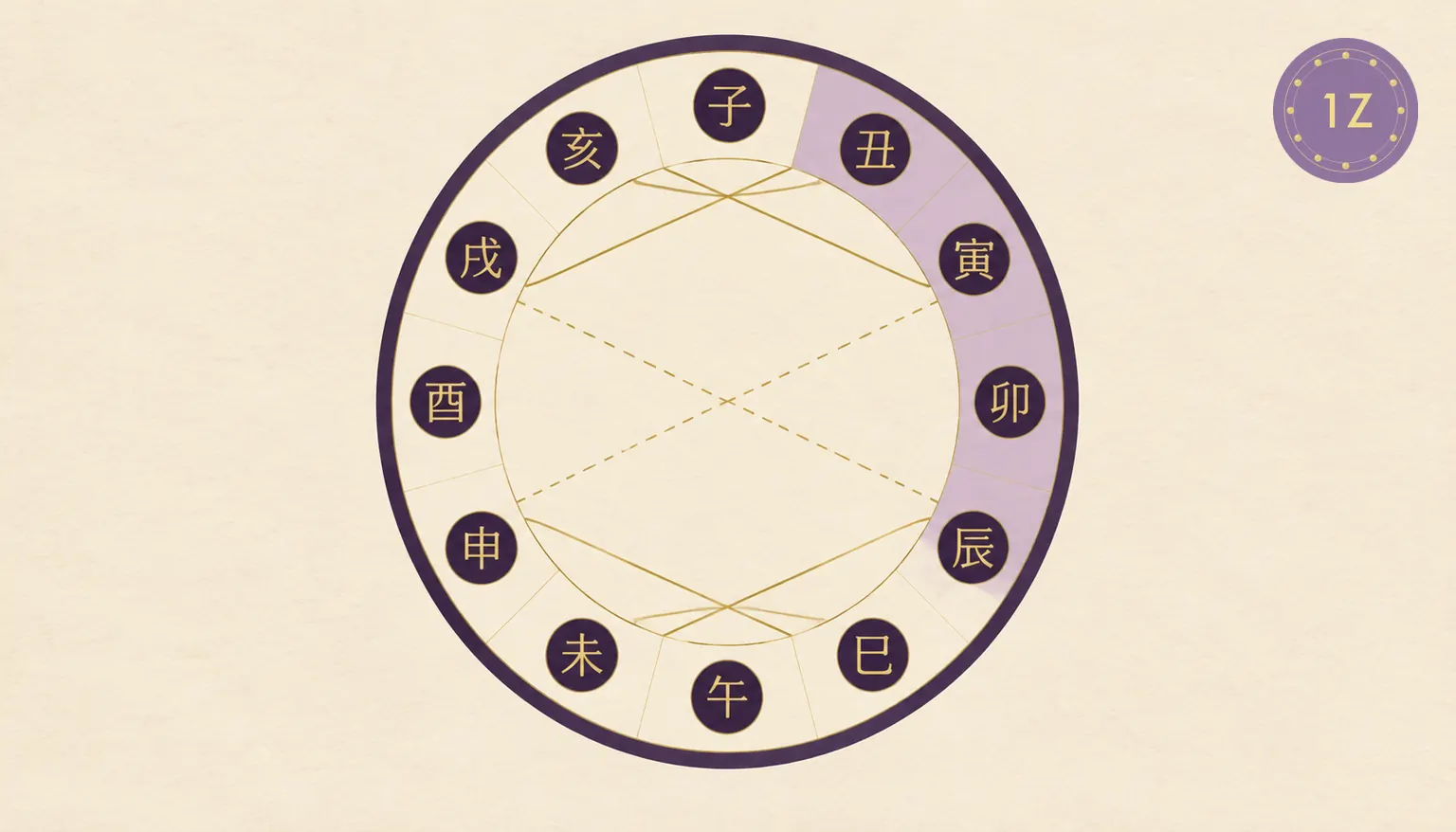
The branches sort into three sets of four by position and energy: the four peak branches (Rat 子, Horse 午, Rabbit 卯, Rooster 酉), the four growth branches (Tiger 寅, Monkey 申, Snake 巳, Pig 亥), and the four tomb branches (Dragon 辰, Dog 戌, Ox 丑, Goat 未). Within each set of four, two pairs sit diametrically opposite and clash, and the classical table assigns two further pairs to the break layer. The set’s other two pairings belong to yet other layers, such as harms and penalties, which is why one set of four can feed several relationship tables.
| Set of four | The two clashes | The two break pairs |
|---|---|---|
| Peak (子午卯酉) | Rat-Horse, Rabbit-Rooster | Rat-Rooster, Horse-Rabbit |
| Growth (寅申巳亥) | Tiger-Monkey, Snake-Pig | Tiger-Pig, Snake-Monkey |
| Tomb (辰戌丑未) | Dragon-Dog, Ox-Goat | Dragon-Ox, Goat-Dog |
The pattern is worth pausing on because the same 12 branches, one for each of the zodiac animals, divide into the same 3 sets in every chart. Learn which set a branch belongs to, remember that each set contains two direct clashes, and the two break pairs sit in the table beside them. No memorizing of scattered pairs is required, and the structure repeats for all three sets. Every branch therefore has exactly one clash partner and exactly one break partner, a symmetry that holds across all 12 branches with no exceptions.
| Branch | Its clash partner | Its break partner |
|---|---|---|
| Rat 子 | Horse 午 | Rooster 酉 |
| Horse 午 | Rat 子 | Rabbit 卯 |
| Rabbit 卯 | Rooster 酉 | Horse 午 |
| Rooster 酉 | Rabbit 卯 | Rat 子 |
| Tiger 寅 | Monkey 申 | Pig 亥 |
| Monkey 申 | Tiger 寅 | Snake 巳 |
| Snake 巳 | Pig 亥 | Monkey 申 |
| Pig 亥 | Snake 巳 | Tiger 寅 |
| Dragon 辰 | Dog 戌 | Ox 丑 |
| Ox 丑 | Goat 未 | Dragon 辰 |
| Goat 未 | Ox 丑 | Dog 戌 |
| Dog 戌 | Dragon 辰 | Goat 未 |
The Six Break Pairs in Full
With the geometry in place, the six pairs themselves carry a strength order, and the order comes from which set they belong to. Breaks inside the peak set run strongest, because four peak branches hold fully formed qi that will not yield to each other. Growth-branch and tomb-branch breaks stay light, either because the qi is still young or because it is already retiring.
| Break | Pair | Set | Strength | Note |
|---|---|---|---|---|
| 子酉 | Rat-Rooster | Peak | Strongest | The pair most often miscalled “unconnected” |
| 午卯 | Horse-Rabbit | Peak | Strongest | Same peak dynamic as Rat-Rooster |
| 寅亥 | Tiger-Pig | Growth | Light | Doubles as a Six Harmony; the harmony governs |
| 巳申 | Snake-Monkey | Growth | Light | Doubles as a Six Harmony; the harmony governs |
| 辰丑 | Dragon-Ox | Tomb | Light | Wet-earth friction, easy to overlook |
| 未戌 | Goat-Dog | Tomb | Light | Dry-earth friction, easy to overlook |
The strength order is a reading aid rather than a rule of destiny. In practice, we weight a break only when the same pair also carries nothing stronger, and we never let a break outweigh a clash, a harm, or a harmony sitting on the same two branches. Two of the pairs above are special because they carry both a harmony and a break, and they deserve their own section.
When a Break Pairs with a Six Harmony
Tiger-Pig (寅亥) and Snake-Monkey (巳申) appear on both maps at once. Both are Six Harmony pairs, the strongest relationship tier in the zodiac, and both are break pairs from the growth set. The resolution is not a contradiction: the harmony is the bond, and the break is a small grain inside the bond. Classical reading and our own scoring both put the harmony in charge, and the break stays a minor texture.
The lived example in our files is a Snake-Monkey pairing we have followed for years: an Earth Snake and an Earth Monkey, carrying the 己巳 and 戊申 year pillars, who built a long academic partnership. In our reading the relationship type is Six Harmony, and our 78-pair dataset scores the pair 94, placing it in the top tier of Six Harmony pairs. Reading the same two branches on the break map shows why even that pairing carries a repeated small friction: the break layer never stops a strong bond, and it also never quite disappears. What stands out about this case is that the friction was not conflict but a mild mutual wearing-down, the partners’ own words for a habit of picking at each other’s working style. I read that as a break signature living inside a 94-point harmony, and I would not change the harmony verdict because of it. In my own notes I keep the break under “texture” rather than “verdict”, which is how I keep the two layers from blurring.
In our experience across the dataset, the two harmony-break overlaps are the only cases where a break coexists with a classical bond. The other four breaks sit on pairs with no classical relationship at all, which is exactly why they are so easy to overlook in a compatibility scan.
How a Break Compares with Clash and Harm
Zodiac relationship layers are often confused with each other because they all describe friction. The distinction matters for how strongly you weight each line, and the three layers sit at very different volumes.
| Layer | Pairs | Geometry | Strength | Reading |
|---|---|---|---|---|
| Six Clash (六冲) | 6 | Diametric opposite | Loudest | Open opposition, the headline |
| Six Harm (六害) | 6 | Crossing hidden | Medium | Covert injury, persistent |
| Six Break (六破) | 6 | Cross pairs inside each set of four | Quietest | Low-grade wearing texture |
The three layers never compete on the same pair, which keeps the reading clean: each of the 12 branches has one clash partner, one harm partner, and one break partner, and they are three different animals. A break line matters most in two places. The first is a natal or luck-pillar reading where the break pair appears and nothing louder does, where it explains a chronic small drain. The second is a compatibility example, where calling a break-only pair “free of conflict” skips a real texture. Everywhere else, a break is a footnote that confirms the bigger lines rather than replacing them.
Why Break Pairs Matter in Compatibility Lists
Compatibility pages on the open web show why the break layer deserves a recorded place. A search for Rat and Rooster turns up articles calling them a strong pair or even a destined one, and none of those articles mention that the pair sits on a break from the peak set. The Chinese zodiac relationship grid has no slot for the breaks in most popular tables, so readers are left with either “clash” or “no conflict”, with no vocabulary for the middle.
Our own scoring of all 78 pairings classifies the four break-only pairs as neutral, meaning no classical bond attaches to Rat-Rooster, Horse-Rabbit, Dragon-Ox, or Goat-Dog. That is an honest label, and the break layer is the refinement under it: neutral does not mean featureless, and the break gives the neutral pair its specific flavor. Across our 78-pair dataset, 48 of the pairings, 62%, carry no classical branch relationship at all, and four of those 48 are the break-only pairs. Knowing the six breaks turns that large neutral zone from a blank into a map with six small landmarks.
The takeaway for anyone checking their own pairing is simple. Check the clash layer first, then the harmony and harm layers, and then glance at the break table for the two names you have not seen yet. If the pair you are reading appears there, you have found the quiet texture that most compatibility lists leave out, and if it does not, you have confirmed that the pair really is unmarked.
Is it true that Rat and Rooster are a strong match, or are the two at odds?
Rat and Rooster carry no classical bond in the standard relationship grid, so most tables mark them neutral rather than good or bad. What those tables usually omit is that the pair sits on a break from the peak set of branches, one of the two strongest breaks in the six-break list. In practice that means the pairing is workable with no dramatic clash, while a low-grade wearing texture tends to recur around schedules, standards, and whose way of doing things wins. Pairing assessments that ignore the break layer will describe the pair as blank; pairing assessments that use it will describe the specific small friction. Neither reading predicts an outcome, and our own 78-pair scoring keeps the pair neutral.
Break vs clash in the zodiac: which friction layer should I trust?
A clash is a diametric opposition between two branches that sit across from each other, and it reads as the loudest relationship layer in the zodiac. A break is a different animal: inside each set of four branches the classical table places two break pairs beside the two direct clash pairs. Clash pairs are open and dramatic, while break pairs are a low-grade wearing texture that rarely ends anything on its own. Each of the 12 branches has exactly one clash partner and exactly one break partner, and the two partners are never the same branch, which is why the layers never blur on a single pair.
Can a Six Harmony pair also carry a break without cancelling it?
Two break pairs double as Six Harmonies: Tiger-Pig (寅亥) and Snake-Monkey (巳申). Both come from the growth set of branches, and both sit on the strongest relationship tier in the zodiac at the same time as they appear on the break list. The harmony governs, because a genuine bond outranks a minor texture, and the break survives as a small grain inside the bond rather than a contradiction of it. In our files a long-running Snake-Monkey academic partnership scored 94 in our dataset showed exactly this shape: a top-tier harmony carrying a mild recurring friction that never threatened the partnership.
How should I check break pairs against my own four pillars?
Check the natal and luck pillars first, and read the pairing tables second, because the weight differs. In a BaZi chart, a break pair matters most when it appears between the natal pillars and nothing louder is present, where it reads as a chronic small drain in that part of the chart, such as the spouse palace or the career palace, and a luck-pillar decade runs 10 years before the next layer arrives. In compatibility work the break is mostly a refinement that stops you calling a neutral pair featureless. In neither case does a break override a clash, a harm, or a harmony on the same branches, and classical texts treat the break layer as subordinate. If you want to see which palace carries which branch for your own chart, our BaZi calculator lays out all four pillars and their branches for you to check.
Conclusion
Learn the three sets of four branches, remember that each set hides two clash pairs and leaves two break pairs behind, and the whole six-break map comes free of charge. Use the strength order as a reading aid, treat the two harmony-break pairs as harmonies, and keep every break as the footnote it is, present enough to explain a quiet texture, never loud enough to decide a verdict. For your own pairing or chart, run the branches through our zodiac tools and check whether any of the 6 quiet pairs appears in your own four pillars.