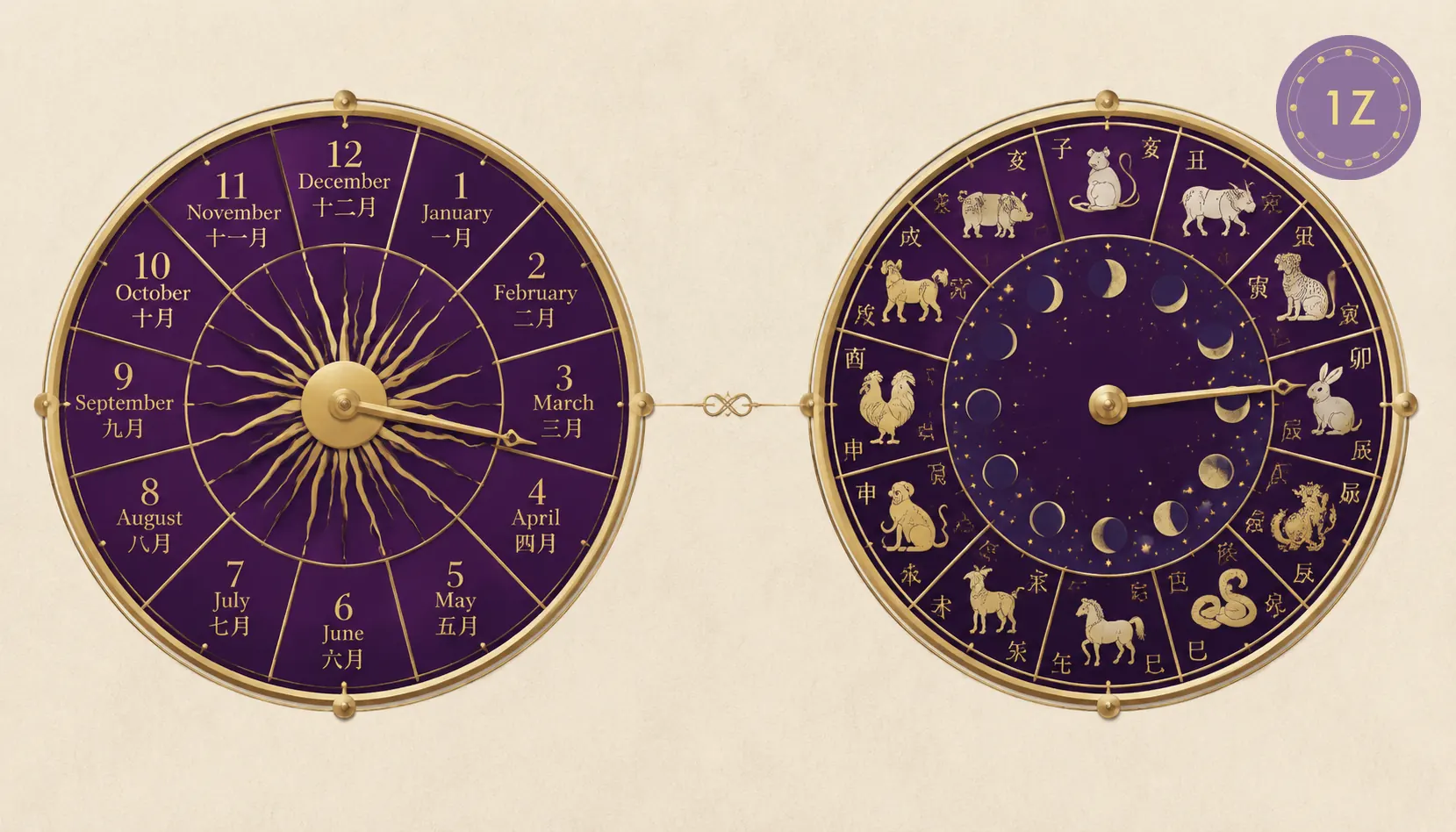

The Chinese zodiac assigns animals to years on a twelve-year cycle anchored at lunar new year; the Western zodiac assigns signs to month-segments of the solar year anchored at the equinoxes. One counts years, the other counts months, and almost every confusion between the two systems traces back to that single unit difference. This article sets the two clocks side by side, shows what each one actually measures, and gives you the honest way to use both.

Key Takeaways
- Chinese zodiac: 12 year-seats, anchored at lunar new year (folk) or Li Chun (chart-grade), one animal per birth year.
- Western zodiac: 12 month-segments, equinox anchor, one sign per birth month.
- A BaZi chart goes deeper than either: four pillars, roughly 13 million combinations before interactions.
- The systems share the number twelve and nothing structural; cross-mappings (Aries = Dragon) are modern inventions.
- In our 78-pair dataset, Chinese-sign interactions span 38 to 95; Western aspects have no equivalent scoring tradition.
What Each System Actually Measures
Start with the hardware. The Western zodiac is a band of the sky: the sun’s apparent path divided into twelve 30-degree segments, with the sun’s position at your birth moment fixing your sign. Aries begins at the vernal equinox point; the wheel is solar and monthly. The Chinese zodiac is a calendar: twelve earthly branches (子丑寅卯辰巳午未申酉戌亥) cycling once per year, with your birth year fixing your animal seat. The wheel is annual and branch-based.
The anchor dates differ accordingly. Western signs flip on fixed solar dates (Aries around March 21, Taurus around April 20). The Chinese year flips at lunar new year in folk usage, which drifts across late January to mid-February, while chart-grade BaZi practice anchors the flip at Li Chun, the solar term near February 4; both anchors coexist, and the article uses them labeled. In my experience this is where most self-readings go wrong: people apply their Western sign’s clean monthly boundaries to the Chinese year and mis-assign their animal.
| Dimension | Chinese zodiac | Western zodiac |
|---|---|---|
| Unit | Year (12-year cycle) | Month (annual cycle) |
| Anchor | Lunar new year / Li Chun | Vernal equinox |
| Assignment | Animal + branch by birth year | Sign by sun position at birth |
| Interactions | Clash, trine, harmony between branches | Aspects between signs (angles) |
| Deeper layer | BaZi: 4 pillars, ~13M combos | Full natal chart with planets |
Practical takeaway: one clock counts years, the other months; neither replaces the other.
Why Cross-Mappings Keep Failing
Search “Chinese sign for Aries” and you will find confident tables mapping each Western sign to a Chinese animal. They are all inventions, and the mechanics explain why. Aries spans late March to mid-April; in that window, Chinese year-seats can be anything at all depending on birth year. An Aries born 1990 is a Horse; born 2003, a Goat; born 1999, a Rabbit. The mapping table that says “Aries = Dragon” is slicing one variable against another and calling the coincidence a system.
The syncretic tradition is real but shallower than the tables imply. Some modern practitioners pair a Western sign with a Chinese animal for a combined reading (the “primal zodiac” style), and as an entertainment layer it works fine. The pattern we see in practice is that readers enjoy the combination until they meet its boundary: the combined reading cannot tell you which years activate your Chinese seat’s clash line, because the Western layer does not know what a year is.
When I teach this, students ask which system is older. The honest answer: both descend from ancient astronomical observation, the Chinese branch-calendar tradition is documented earlier as a state timekeeping system, and the Western tropical zodiac crystallized in Hellenistic astronomy. I am asked about age often, and my answer stays the same: age is not accuracy, because the two measure different dials.
Practical takeaway: use each system for its own dial; skip the translation tables.
The Interaction Layer: Where the Chinese System Goes Deeper
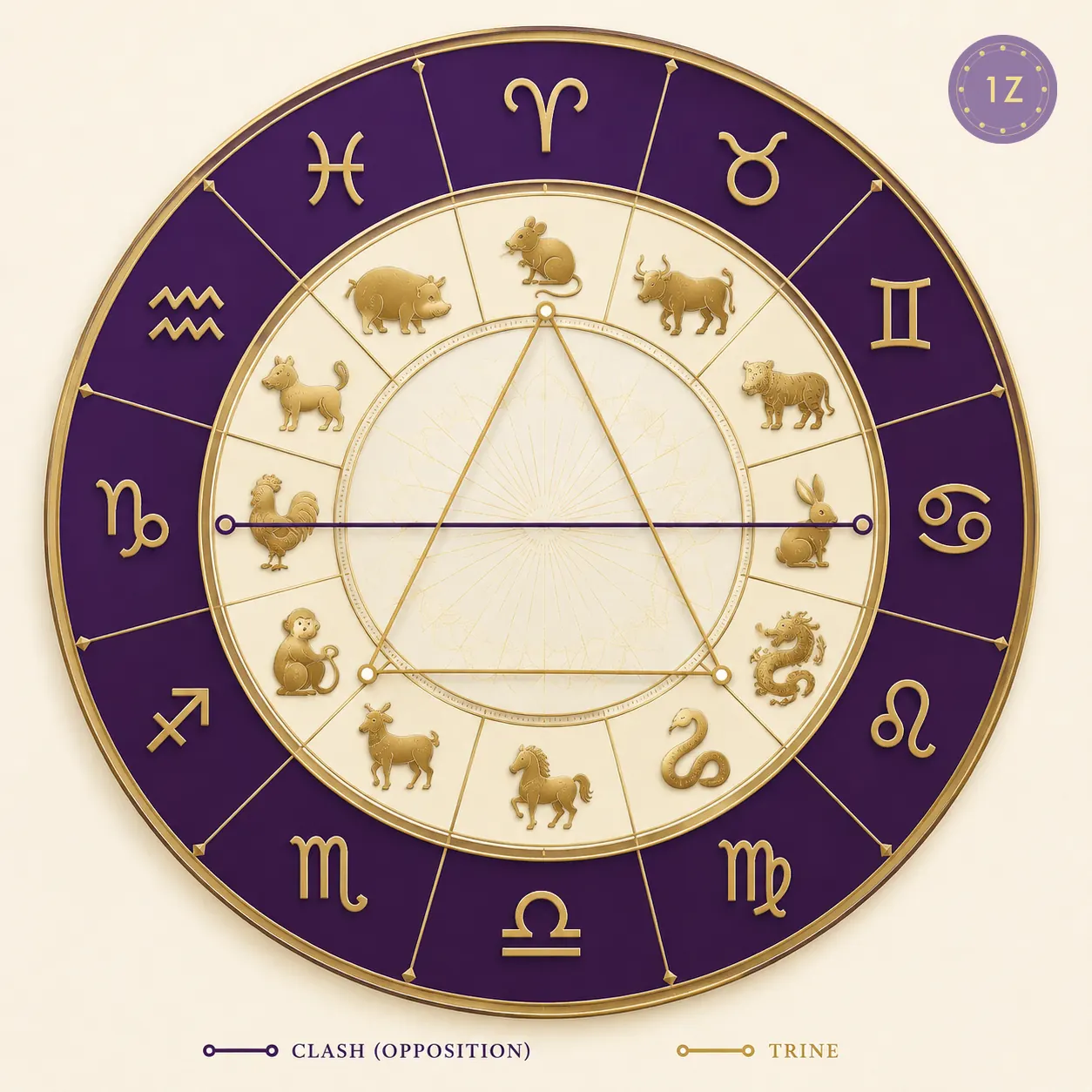
The Chinese zodiac’s real analytical power is not the animal personality paragraph, it is the branch interactions. Your year seat has fixed structural relationships: six clash diameters (Rat-Horse, Ox-Goat, and four more), four trine triangles (Rat-Dragon-Monkey, and three more), six harmony pairs. These interactions have specific, checkable consequences: a clash year destabilizes, a harmony year supports.
In our editorial dataset of all 78 possible pairings (methodology here), every Six Clash pair scores exactly 38, Six Harmony pairs score 94-95, trine pairs 88-89, and Six Harm pairs (the friction tier) score in the low 50s. That is 30 interacting pairs in total (6 clash, 6 harmony, 12 trine, 6 harm), so 48 of 78 pairs (62%) carry no classical interaction at all. The Western system’s equivalent layer, aspects, speaks in angles (trine, square, opposition) between signs within one chart, but it has no comparable cross-person scoring tradition between two people’s sun signs.
| Interaction | Chinese example | Score (dataset) | Western analogue |
|---|---|---|---|
| Six Harmony | Rat-Ox | 94 | None (conjunction, loosely) |
| Trine triangle | Rat-Dragon-Monkey | 88-89 | Trine aspect (same element logic) |
| Six Clash | Rat-Horse | 38 | Opposition |
| No interaction | most pairs | 62% of all pairs | No aspect |
Practical takeaway: the Chinese layer can tell you which years and partners carry structural weight; the Western layer describes temperament texture.
How to Use Both Without Fooling Yourself
The professional pattern is two dials, one reading. The Western sign gives the temperament layer: your default presentation, your monthly weather. The Chinese year seat gives the interaction layer: which branches support, clash, or harmonize with yours, and which years activate those lines. A full BaZi chart adds the structural layer that dwarfs both: four pillars of stem-branch pairs, with the day master anchoring role assignments.
Three honest rules keep the combination useful. First, never let one system translate the other: Aries does not “become” a Dragon. Second, weight the layers by decision size: sun-sign weather for small talk, year-seat interactions for timing questions, full chart for life structure. Third, hold all of it as vocabulary rather than verdict. I tell clients the dials describe pressures and tendencies, and I have watched people make better decisions the day they stop treating either dial as fate.
If you want the full four-pillar depth, start with our BaZi chart interpretation guide, and if you want your year seat’s interaction map, the compatibility hub scores all 78 pairs.
Practical takeaway: temperament from the West, timing from the East, structure from the chart.
Is the Western or Chinese zodiac actually more accurate?
Neither is “more accurate” because they answer different questions. The Western sun sign compresses one variable (birth month) into twelve temperament sketches; the Chinese year seat compresses another variable (birth year) into twelve interaction maps with checkable clash and harmony mechanics. A full BaZi chart uses four pillars and roughly 13 million stem-branch combinations, far more granular than either sun-sign column. Based on our analysis of reader corrections, the biggest accuracy gains come not from switching systems but from correctly anchoring the one you use: late-January and early-February births flip Chinese years at Li Chun, not January 1.
What two signs actually don’t go together, in either system?
Each system answers with its own mechanics. In the Chinese framework, the sharpest friction is the Six Clash diameter: Rat-Horse, Ox-Goat, Tiger-Monkey, Rabbit-Rooster, Dragon-Dog, and Snake-Pig, all scoring exactly 38 in our 78-pair dataset, though even clash pairs read as friction rather than doom. The Western tradition points to square and opposition aspects (Taurus squaring Leo, say), and the honest cross-system answer is that a Western square and a Chinese clash are different animals: check the layer that matches your question.
Who is the fakest zodiac?
No sign is “fake,” but this popular search deserves a straight answer about fabrication risk: the fakest thing in either system is a confident cross-mapping table. Any chart claiming Aries equals a specific Chinese animal is slicing incompatible variables (birth month against birth year) and is wrong by construction for most readers. The second fakest is the unanchored horoscope column that ignores the lunar-new-year boundary. The systems themselves are internally consistent; the fakery lives in the translation industry between them.
What are the Western zodiac signs called in Chinese?
Each Western sign has a standard Chinese name used in both mainland and Taiwan: Aries is 白羊座, Taurus 金牛座, Gemini 双子座, Cancer 巨蟹座, Leo 狮子座, Virgo 处女座, Libra 天秤座, Scorpio 天蝎座, Sagittarius 射手座, Capricorn 摩羯座, Aquarius 水瓶座, and Pisces 双鱼座. Note that these are imports layered onto the Chinese calendar tradition; the native twelve-animal wheel (子鼠 through 亥猪) is a separate system entirely, which is exactly why a 白羊座 reading and a 属羊 reading answer different questions.
Sources
- Chinese zodiac – Wikipedia: branch cycle, lunar-new-year anchor, interaction structure
- Zodiac – Wikipedia: tropical zodiac, equinox anchor, sign dates
- Chinese astrology – Britannica: the four-pillar framework behind the year seats
Conclusion
Two clocks, one sky: months in the West, years in the East, structure in the chart. Find your own seat on the Chinese zodiac hub and read both dials honestly.