
BaZi chart interpretation is the practice of reading four data layers in a fixed order: the eight characters themselves (four pillars), the element balance, the Ten Gods roles, and the branch interactions. Each layer answers one question, and skipping layers is where most misreadings begin. This article walks the four layers in order and tells you honestly where interpretation ends and full reading begins.
Key Takeaways
- Layer 1 reads the pillars: year, month, day, hour, each one stem-plus-branch.
- Layer 2 reads element counts: which of the five elements dominate and which run thin.
- Layer 3 reads Ten Gods: what each stem’s role is relative to your Day Master.
- Layer 4 reads combinations: clashes, harmonies, and punishments between branches.
- A chart interpretation tells you structure and tendencies; a full reading adds timing and channel analysis.
Layer 1: The Pillars and What Each One Represents
| Pillar | Reads for | Weight in classical method |
|---|---|---|
| Year | Generational weather, outer world | Lightest |
| Month | Season of birth, career field | Heaviest |
| Day | Self (Day Master) and spouse zone | Anchor |
| Hour | Late life, private ambition | Supporting |
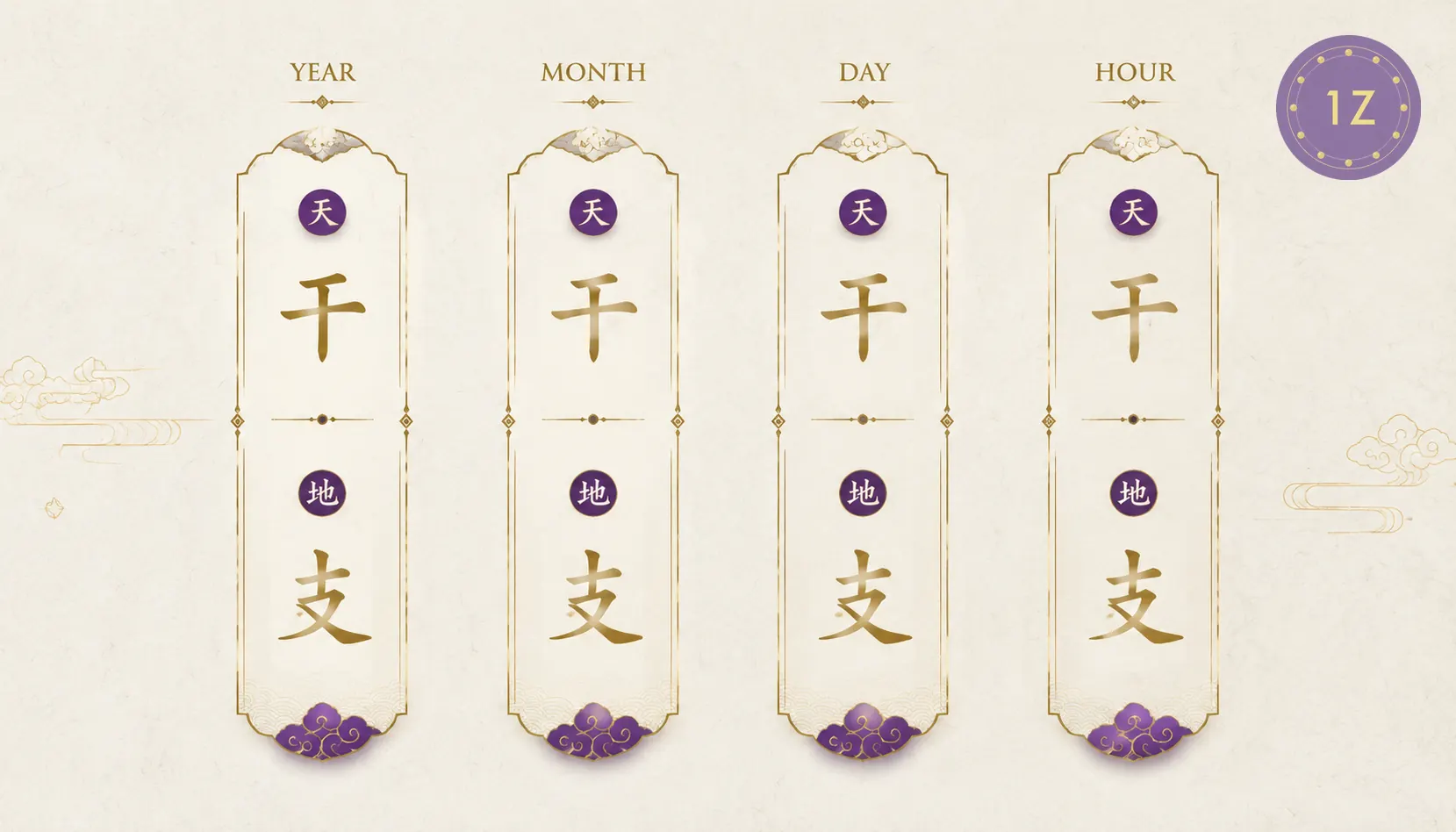
Your chart has four pillars, each a stem-branch pair. The year pillar (like Geng Shen, 庚申) marks generational weather; the month pillar marks the season you were born into and carries the most weight in classical strength analysis; the day pillar is you, its heavenly stem being the Day Master; the hour pillar marks your late-life zone and private ambitions.
The Day Master is the anchor of the whole reading. It is the stem of your day pillar, and every other stem in the chart is read relative to it. If you were born on a Jia Wood day (甲), Jia Wood is you: growth-logic, expansion, the desire to rise. When I teach beginners, the single fastest upgrade I watch land is learning to say “the chart” instead of “me” for everything that is not the Day Master. The other seven characters are your weather, not your identity.
One structural note before moving on: the pillars are fixed at birth and their calculation is mechanical. The year pillar follows the solar calendar (Li Chun boundary, not January 1), the month pillar follows solar terms, and the hour pillar converts your birth hour through the five-rats rule. The beginner’s chart walkthrough on our Chinese zodiac hub covers the full calculation if you want to build your chart first.
Practical takeaway: read pillars in order year-to-hour, but read everything relative to the Day Master.
Layer 2: Element Balance Without Superstition
Count the five elements across all eight characters, hidden stems included. The pattern we see in practice is that most charts are lopsided by design: a summer birth runs hot on Fire, a winter birth runs deep in Water, and a Metal-season birth (autumn) often carries three or four Metal characters before you notice.
The counts tell you the chart’s raw material. A Wood-heavy chart has expansion in surplus; a Water-heavy chart has depth and flow but may lack structure. What the counts do not tell you, on their own, is good or bad. That verdict requires the strength question (is the Day Master supported or overwhelmed by its season?) and the usefulness question (which element would balance the chart?). Both are channel questions, and both belong to Layer 3.
For readers who want the honest boundary early: element counting is arithmetic, and in my experience arithmetic is the safest thing a beginner can do at home. Strength and usefulness judgments are where interpretation proper begins, and where articles end and readings start.
Practical takeaway: count first, judge later, and never call an element bad without asking what the chart needs.
Layer 3: Ten Gods, the Role-Assignment Layer
Ten Gods assigns each stem a role relative to your Day Master, based on the five-element cycle plus polarity. Same element is Companion (比劫). The element you control is Wealth (财). The element that controls you is Officer (官杀). What you produce is Output (食伤). What produces you is Resource (印). Polarity splits each role into a polite and a blunt twin: Direct Officer versus Seven Killings, for example, are the negotiable and non-negotiable versions of authority pressure.
This is the layer where a chart starts talking about life themes. A chart thick with Officer stars lives inside structure and accountability. A chart led by Output stars lives by craft and expression. The blunt-versus-polite distinction matters constantly: the same controlling pressure reads as a career ladder under Direct Officer and as a battlefield commission under Seven Killings (our Seven Killings profile unpacks that star in depth).
The Layer 3 discipline is role-literalism. Every stem plays exactly one role per Day Master, and the roles interact through the same five-element cycle they came from. When you hear an interpretation that leaps from “Officer star present” to “you will be a government official,” you are hearing a shortcut, not a reading. The star describes pressure-structure; the career guess requires the full chart.
Practical takeaway: Ten Gods names the pressures; it does not name your future.
Layer 4: Combinations Between Branches
The final layer reads how the four (plus eight hidden) branches interact: Six Clash (diametrically opposed branches), Three Harmony trines, Six Harmony pairs, punishments, and harms. Each interaction modifies the pillars it touches, and the vocabulary is short:
| Interaction | Geometry | Effect on the pillars it touches |
|---|---|---|
| Six Clash | 6 diameter pairs (Zi-Wu, Mao-You…) | Instability pressure on both seats |
| Three Harmony | 4 trines (Shen-Zi-Chen…) | Elements pool into one force |
| Six Harmony | 6 mirror folds (Zi-Chou…) | Mutual softening and support |
| Punishment | 2 triangles + 1 pair | Low-grade structural friction |
A clashed branch destabilizes its pillar’s theme; a trine-bonded set of branches pools their elements into one force.
Two ground rules keep this layer honest. First, interactions are structural facts, not verdicts: a clash in the spouse palace means instability pressure on that zone, not divorce. Second, interaction strength varies with distance (adjacent pillars interact most strongly, roughly a 2-pillar reach) and with whether the interacting branches’ stems support or resist the merge. The classical literature spends most of its pages exactly here, on combination conditions, because this is where charts become unique.
Across our 78-pair compatibility dataset the lesson repeats at scale: 48 of 78 pairs (62%) carry no classical interaction at all, and the remaining 38% splits across clash, trine, and harmony bands, and neutrality, not drama, is the statistical norm. The methodology page holds the full definitions and limitations. Chart-internal combinations obey the same bell curve. Most branches in most charts simply coexist.
Practical takeaway: combinations modify; they rarely dictate.
How Accurate Is Any of This
Honest paragraph, because the question is fair. BaZi is a descriptive framework with mechanical layers (pillars, element counts, role assignments are arithmetic) and interpretive layers (strength, usefulness, combination outcomes are judgment). The mechanical layers reproduce identically for anyone who follows the rules; the interpretive layers are where practitioners differ, the same way two analysts can read the same balance sheet and weigh risks differently.
Our editorial position: use the framework for what it demonstrably provides, a structured vocabulary for self-observation, and hold the predictions lightly. I have watched clients use this framework both ways, and the ones who benefit most treat the chart as a mirror with a fixed grammar, not a verdict with a date on it. Based on our analysis of how the framework’s layers stack, the further an interpretation travels from the mechanical core, the more humility it deserves.
Practical takeaway: trust the arithmetic, weigh the judgment, keep the agency.
How do I interpret my BaZi chart step by step?
Work the four layers in order. First extract the pillars and identify your Day Master (day stem). Second, count the five elements including hidden stems. Third, assign Ten Gods roles to every stem relative to the Day Master. Fourth, map interactions between branches: clashes, trines, harmonies, punishments. Each layer constrains the next, and the order matters because element counts without role context, or roles without interaction context, produce most of the misreadings beginners encounter.
What is a good BaZi chart?
The classical answer is balance with one clear useful god: a chart whose Day Master is strong enough to use its best element, or weak enough to accept support gracefully. The honest answer is that “good” is chart-relative. A lopsided chart with one strong channel can outperform a balanced chart with none, the way a specialist out-earns a generalist in the right market. In our editorial framework, the better question is whether the chart’s strongest pressure has a working channel, and that question has an answer for every chart.
How is BaZi interpretation different from a zodiac sign reading?
Depth of data. A zodiac sign reading starts from one variable (birth year) and describes 12 archetypes. A BaZi interpretation starts from four pillars (roughly 13 million combinations before hidden stems), assigns 10 roles, and maps interactions across 12 branches. The zodiac sign is one branch of your year pillar; the chart contains it plus seven more characters. That is why sign readings feel universal and chart readings feel personal: one has twelve buckets, the other has millions.
Can BaZi interpretation predict specific events?
Not at the specificity people hope for, and I say this as a practitioner: the serious literature never claimed it did. What the framework offers is pressure-and-timing language: which themes (career, relationship, health zones) carry load, and which luck-pillar decades activate them. Practitioners translate that into probability-flavored guidance. If you were born in 1980 (Geng Shen year, 46 years before the current Fire Horse), the framework can say your Metal runs strong and your Tiger years carry clash pressure on that axis; it cannot say you will change jobs in March. Keep the grammar, release the fortune-telling.
Sources
- Four Pillars of Destiny – Wikipedia: pillar structure and reading order
- Chinese astrology – Britannica: historical framework of the four-pillar method
- Ten Gods – Wikipedia: role definitions and polarity splits
Conclusion
Interpretation is a ladder with four rungs, climbed in order. Start yours on the full chart walkthrough and let each layer finish its sentence before the next begins.