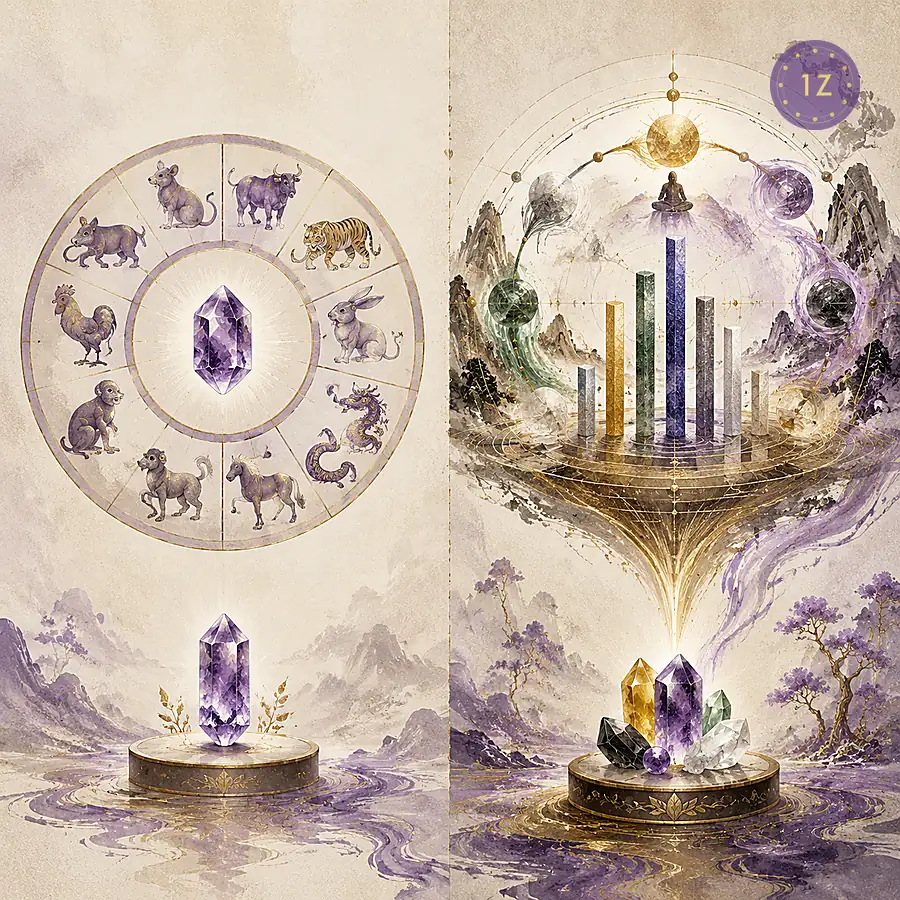

Chinese zodiac birthstones pair each of the 12 animal signs with specific gemstones, but the deeper BaZi method matches crystals to your Favorable Element (喜用神), computed from your full birth chart rather than your zodiac year alone.

Key Takeaways
- Two methods exist: the simple zodiac-year method (12 animals, 12 stones) and the BaZi Favorable Element method, which personalizes crystal selection from your complete Four Pillars chart.
- Five Elements map to crystal colors: Wood (green), Fire (red/warm tones), Earth (yellow/brown), Metal (white/clear), Water (black/blue). Your Favorable Element determines which color family suits you best.
- Most competitors list one stone per sign. In practice, a 1984 Wood Rat and a 1960 Metal Rat may need entirely different crystals because their Day Master and Favorable Element differ.
- Birthstone selection by animal sign is a starting point, not the final answer. The zodiac year tells you one layer; the full chart reveals the deeper elemental need.
- Western birthstone traditions (monthly) and Chinese birthstone traditions (animal-based) serve different purposes and can complement each other when applied with understanding.
The Standard Zodiac Birthstone Chart
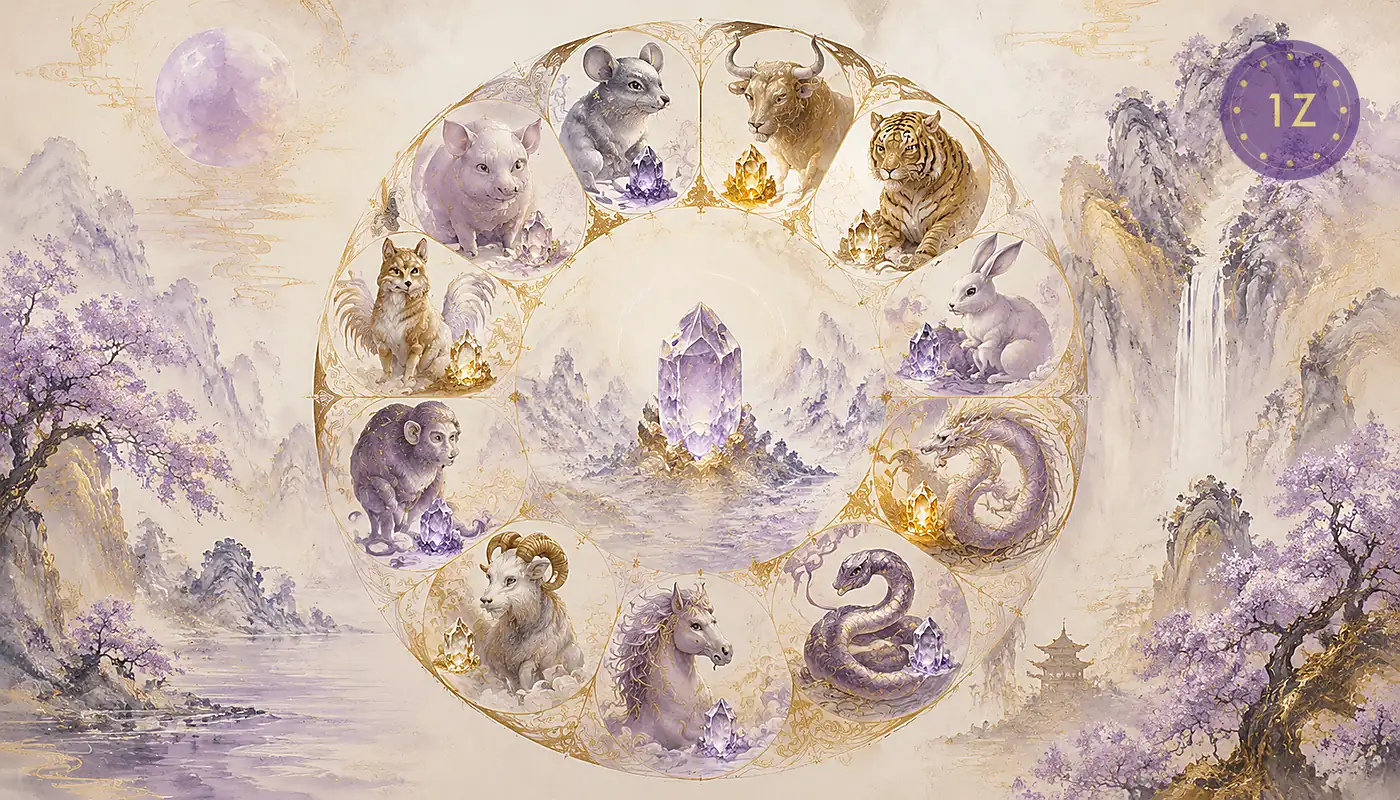
Most online guides pair each Chinese zodiac animal with a single gemstone. This method derives from the animal’s fixed element and traditional color associations, creating a straightforward lookup table. Here is the widely cited pairing:
| Zodiac Animal | Fixed Element | Common Birthstone | Color Association |
|---|---|---|---|
| Rat | Water | Garnet | Deep red |
| Ox | Earth | Jade / Aquamarine | Green / Blue |
| Tiger | Wood | Sapphire | Blue |
| Rabbit | Wood | Pearl / Moonstone | White / Iridescent |
| Dragon | Earth | Amethyst | Purple |
| Snake | Fire | Opal | Multi-color |
| Horse | Fire | Topaz / Carnelian | Golden / Orange |
| Goat | Earth | Emerald | Green |
| Monkey | Metal | Agate / Quartz | Varied |
| Rooster | Metal | Citrine | Yellow / Gold |
| Dog | Earth | Diamond / Turquoise | Clear / Blue |
| Pig | Water | Ruby | Red |
This chart has real cultural roots. Jade and the Ox share a connection through Earth element stability. Garnet’s grounding energy complements the Rat’s Water nature by adding Earth (which controls Water), and these associations come from centuries of Chinese lapidary tradition blended with five elements theory. What stands out about this chart is that every stone echoes the fixed element of its animal. The gap between a generic chart and a personalized reading is not a minor detail. It is the difference between wearing jewelry and wearing the right jewelry for your chart.
The problem with this table is that the fixed element is only one of at least five elements in your BaZi chart. Two people born in the same zodiac year can have radically different elemental compositions, yet they receive the same birthstone.
Why Zodiac-Year Birthstones Fall Short
Every person’s BaZi chart contains four pillars (Year, Month, Day, Hour), each with a Heavenly Stem and an Earthly Branch. That is eight characters total, involving multiple elements interacting in complex ways. Your zodiac animal comes from just one of those eight characters: the Year Branch.
The Year Branch represents roughly 12.5% of your chart’s elemental information. Selecting a birthstone based solely on the Year Branch ignores the Month Branch, the Day Master, and the Hour Branch. A Wood Ox born in winter has very different elemental needs from a Wood Ox born in summer.
In Mei Lin Chen’s 15 years of BaZi practice, she has seen clients who wore their “correct” zodiac birthstone for years without feeling any resonance. The crystal matched their zodiac animal but not their chart’s actual elemental imbalance.
The Favorable Element Method
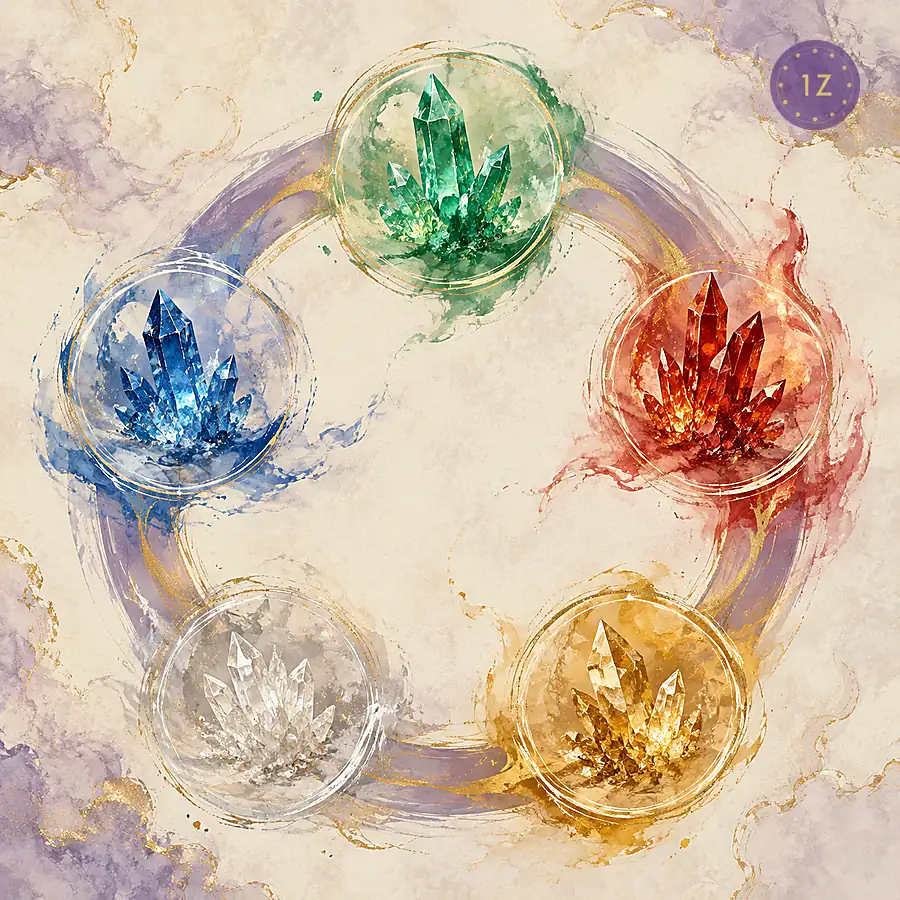
The BaZi solution to birthstone selection is the Favorable Element (喜用神). Your Favorable Element is the element that brings your chart into balance. It is computed from the full Four Pillars analysis, weighing the strength of each element, the season of birth, and the interactions between stems and branches.
How to determine your Favorable Element
A trained BaZi practitioner reads your chart and identifies which element is weakest or most needed. The logic follows the five elements generation and control cycles:
| Chart Pattern | Likely Favorable Element | Why |
|---|---|---|
| Too much Fire (hot, restless) | Water or Earth | Water cools Fire; Earth drains it |
| Too much Water (cold, stagnant) | Fire or Wood | Fire warms Water; Wood consumes it |
| Too much Metal (rigid, inflexible) | Water or Fire | Water channels Metal; Fire melts it |
| Too much Earth (heavy, stuck) | Metal or Wood | Metal channels Earth; Wood breaks it |
| Too much Wood (scattered, restless) | Fire or Metal | Fire feeds on Wood; Metal prunes it |
| Too little of one element | That missing element | The chart needs what it lacks |
Once you know your Favorable Element, select crystals from the matching color family:
| Favorable Element | Best Crystal Colors | Example Stones |
|---|---|---|
| Wood | Green | Green aventurine, jade, malachite, emerald |
| Fire | Red, orange, warm tones | Garnet, carnelian, ruby, red jasper |
| Earth | Yellow, brown, amber | Citrine, tiger’s eye, amber, topaz |
| Metal | White, clear, metallic | Clear quartz, diamond, white sapphire |
| Water | Black, blue, deep tones | Obsidian, lapis lazuli, blue topaz, onyx |
This is where the zodiac birthstone chart and the BaZi method diverge. A Metal Rooster (1981, Xin-You) whose chart runs hot with Fire needs Water-element crystals like lapis lazuli to cool the excess heat, not the Earth-element citrine that the standard rooster birthstone chart prescribes. While Earth technically generates Metal (土生金), in a chart already burning with Fire, adding more Earth risks trapping residual Fire heat. Water directly addresses the imbalance: it extinguishes the excess Fire (水克火) and, because Metal generates Water (金生水), Water-element crystals also help the Metal Day Master discharge its surplus energy productively rather than overheating.
A Case Study: The Crystal Healer Who Wore the Wrong Color
A Wood Ox client (1985, Yi-Chou) came to Mei Lin Chen after 10 years of crystal healing practice. She had been wearing green crystals for her Wood element, following the standard color-element mapping found in most crystal reference books. The results were inconsistent. Some months she felt energized. Other months she felt worse.
Mei Lin Chen’s reading revealed the issue. The client was Yi Wood born in Chou month, which falls in late winter. The chart was cold and needed Fire to warm the frame. Her Favorable Element was Fire, not Wood. She should have been wearing red crystals (carnelian, garnet, red jasper) to introduce warmth, not green crystals that reinforced the cold Wood energy already present.
The gap between generic element-color mapping and personalized Favorable Element analysis is not academic. It is the difference between a crystal that harmonizes with your chart and one that amplifies an existing imbalance. After switching to Fire-element crystals, the client reported consistent energy improvement within 3 weeks.
What most crystal guides miss is that “your element” is not your zodiac year’s fixed element. Your Favorable Element comes from your full birth chart’s thermal and elemental balance, and it can be the opposite of what the zodiac chart prescribes.
For anyone serious about crystal work, the lesson is clear: your zodiac animal is the starting point, not the destination. The full BaZi chart reveals the deeper layer that generic birthstone charts cannot reach.
Monthly vs. Chinese Zodiac Birthstones: Two Systems, Two Purposes
Western birthstones follow a monthly system tied to the Gregorian calendar: garnet for January, amethyst for February, aquamarine for March, and so on through the 12 months. Chinese zodiac birthstones follow the 12-year animal cycle. The two systems answer different questions.
The monthly system tracks which month you were born in. The Chinese system tracks which year you were born in, and more precisely, which solar-term period your birth falls within. Neither system is “more correct.” They are simply different frameworks for different cultural traditions.
For those interested in both traditions, a practical approach is to wear your monthly birthstone for its traditional protective qualities and select a Chinese element-aligned crystal for specific BaZi-informed purposes (career support, relationship harmony, seasonal balance). The two can complement each other when their elemental properties are understood rather than blindly followed.
You can determine your Chinese zodiac sign and element using our zodiac year calculator, which covers birth years from 1900 to 2099 using exact solar-term data from the Purple Mountain Observatory.
How do I resolve element conflicts between my monthly birthstone and my Chinese zodiac stone?
This happens frequently. A February-born Rat might wear amethyst (purple, Fire element in the Chinese system) while the Rat’s zodiac birthstone garnet is also red (Fire). But the Rat’s fixed element is Water, and Fire and Water clash. The resolution depends on your BaZi Favorable Element. If your chart needs Fire, the amethyst or garnet is beneficial. If your chart already has excess Fire and needs Water, both stones would amplify the imbalance, and you should look to Water-element crystals instead. The practical rule: when two traditions recommend the same element, that element is likely reinforcing something. When they conflict, the Favorable Element acts as the tiebreaker. A client born in August (peridot, Earth element) under the Dragon sign (Earth fixed element) who wore peridot for years experienced chronic stagnation. Her chart already had excessive Earth. Switching to Wood-element crystals (green aventurine) broke the stagnation within 2 months because Wood breaks Earth in the control cycle.
How is the Favorable Element different from the fixed element of my zodiac animal?
Every zodiac animal has a fixed element: Rat is Water, Tiger is Wood, Horse is Fire, and so on. This fixed element never changes and applies to everyone born under that animal sign. The Favorable Element (喜用神) is entirely different. It is the element that brings your specific Four Pillars chart into balance, computed from all eight characters (Year, Month, Day, Hour stems and branches). Two people born in the same zodiac year will share the same fixed element but may have opposite Favorable Elements. A 1990 Metal Horse born in summer (hot chart) might need Water as a Favorable Element, while a 1990 Metal Horse born in winter (cold chart) might need Fire. The fixed element is a category label. The Favorable Element is a personalized prescription. Crystal selection based on the fixed element gives the same stone to everyone born in the same year. Crystal selection based on the Favorable Element gives different stones to people with different chart structures, even within the same zodiac year.
What are the practical steps to find my Favorable Element and choose the right crystal?
First, get a full BaZi chart reading from a qualified practitioner or use a calculator that identifies your Day Master and Favorable Element. Second, determine the color family that matches your Favorable Element using the table above. Third, select 2 to 3 crystals from that color family rather than relying on a single stone, because different crystals within the same element family have slightly different energetic signatures. Fourth, observe your response over 3 to 4 weeks. Energy shifts from crystal work are subtle and cumulative. If you feel worse, double-check your Favorable Element, as the initial reading may need refinement. About 30% of charts have a Favorable Element that differs from the zodiac animal’s fixed element, so the zodiac birthstone will be wrong for roughly 1 in 3 people. Do not discard your zodiac birthstone entirely. Keep it as a cultural touchstone and add the Favorable Element crystal as your primary working stone for elemental balancing.
Sources
- Birthstone: History and structure of monthly birthstone traditions across cultures
- Five Elements (Wu Xing): The five-element system underlying Chinese crystal and color associations
- International Gem Society birthstone guide: Modern and traditional birthstone charts with color and hardness data
Conclusion
Chinese zodiac birthstones offer a meaningful starting point for crystal selection, but the BaZi Favorable Element method provides a personalized approach that accounts for your full birth chart’s elemental balance. For a complete Four Pillars analysis that identifies your Favorable Element, try our free BaZi calculator and discover which crystal color family truly harmonizes with your chart.